

News
NELEX Backs TheMap.online on Digital Jobs for Nigerians


Federal Ministry of Labour and Employment, through its department- National Electronic Labour Exchange (NELEX), has expressed support to TheMap.online, an indigenous e-Commerce platform, in its drives to create digital jobs for teeming young Nigerians.
The platform, TheMap.Online was developed using Google maps open source code by adding a lot of Nigerian local contents to make it the number one intelligent directory in the country.
Speaking on the support that may lead to partnership, Mrs Miemiye Badeje, director of NELEX, said that the Federal Government of Nigeria owned website, NELEX, has always been active for connecting jobseekers to credible employment creators in conditions of freedom, and equal opportunities.
The Director said that the Division within the Employment and Wages Department of the Federal Ministry of Labour and Employment, supports TheMap.online for job creation targeted at unemployed, under employed, youth corpers, uneducated/illiterates, students, retirees, pensioners, internally displaced persons (IDPs), traders, house wives, artisans/craftsmen, disabled/handicapped ,etc, in Nigeria and also in diaspora, “as the developers of the initiative are deploying platforms such as Google platforms, Facebook, Instagram, Twitter, LinkedIn, YouTube, Pinterest, Tumblr, IMO, Skype, Snap chat, custom mobile apps, etc, to create multiple job opportunities that can enable Nigerians to work and make money from home or any location”.
“We have always been on the vanguard for digital jobs in the country, she sees TheMap.online platform as credible, all encompassing, and falls in line with the President Muhammadu Buhari’s job for all agenda. Therefore, we endorse the platform and urge young Nigerians to embrace the opportunities inherent.
“This is a life transforming platform as people are already taking advantage which enables them to better their worth by operate various businesses online ranging from; online restaurants, online salon, online filling stations, online banking, online gymnasium, online pickup/delivery, online media houses, online shops, online farms, online customer service, online school and so much more. We are proud to work with the developers to make this a reality as they are taking Google maps a step further by not only adding those features that does not work well in Nigeria but have automated and incorporated local businesses, location icons, hotspots and created jobs out of them,” Mrs Badeje. added.
Speaking to Nigeria CommunicationsWeek on the Initiative, Mr. Anyanso MMA, the Internet Infrastructure Developer at Edu Hub Consults, and developer of TheMap.online, said that the choice of approaching NELEX was borne out of the desire to drastically reduce the number of unemployed youths in the country, generate more economic activities and facilitate cash circulation.
“You can visit any location, places or businesses in Nigeria and interact with their products and services virtually from the comfort of your home. A very good example; you can visit Computer Village, Balogun Market, Alaba International Market, Ladipo Market in Lagos, while you are relaxing in your bedroom at Abuja, FCT. Our platform enables you visit each shop in those market places, see products, negotiate price with each seller, can see products on video calls and above all you can purchase any item there and pay cash on delivery at your door step or pay cashless online.
“We have digitalized every business and every location in Nigeria ranging from, malls, properties for sale/lease, gymnasium, shops, retailing, education, marketplaces, restaurants, salons, taxi stands, hotels, car wash, auto service/mechanic workshops, vulcanizers, public toilets, filling stations, artisans/craftsmen settlement, banks, roadside stalls/kiosks, schools, laundry dry cleaning, factories/industries, you can imagine the rest, and pu them at the touch of your finger tips” he said.
Mr. Anyanso MMA said that bringing several businesses and locations online requires a lot of manpower to drive and complete value chains to keep both offline and online locations active and functioning.
“TheMap.online allows any interested Nigerian to own any kind of business online and operate it and make money from home provided they have a smart phone, or mobile devices; Android, iOS, Windows or Blackberry, telecoms network and active internet bundle,” he added.
He said that signing up on the platform starts with training sessions, after which “they install various mobile apps, web apps and portal according to their training. Recommend necessary hardware a participant/business requires to run their businesses such as; weighing scale; Android Bluetooth mobile printer; POS terminal, mobile barcode scanners; Smart phones; Mobile devices, game consoles; Motion sticks/motion cameras; Quantum health equipments, amongst others.
“From our backend we can assign them jobs/duties/tasks to be completed online or deploy them to physical locations where they can perform various tasks according to their training and make money”, he said, adding that “Job assignments to our trainees most times are determined by; availability online, transaction proximity, type of duty to perform based on customer request, et cetera.
According to Mr. Anyanso, through its Bounce Back (BB) concept attached to the digital job creation which will positively impact internally displaced persons, (IDP’s), in northern Nigeria who will be trained on how to better their lives through ecommerce, earn money with dignity and also come back to the society become relevant and fit in. Corperpreneur package for Nigerian Youth Corpers, Studenterprise for undergraduates in higher institutions, eSME for freelancers, house wives, artisans/craftsmen, entrepreneurs/business owners, those intending to start any type of business and those who do not have any idea of what to do.


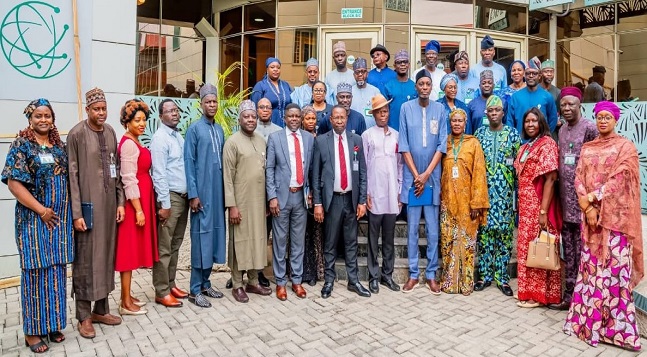
The National Information Technology Development Agency (NITDA) has reinforced its commitment to advancing Nigeria’s digital transformation agenda through strengthened collaboration with key strategic institutions, as it hosted the Director General of the National Institute for Policy and Strategic Studies (NIPSS), Professor Ayo Omotayo, alongside participants of the Senior Executive Course (SEC) 48, 2026.

The visit, which builds on an earlier strategic study tour, provided a platform for in-depth engagement on the role of digital innovation in driving sustainable economic growth, with particular focus on the Orange Economy.
Representing the Director General of NITDA, Kashifu Inuwa CCIE, the Director of Stakeholder Management and Partnerships, Dr Aristotle Onumo, highlighted the Agency’s commitment to fostering a vibrant digital ecosystem through inclusive policies, strategic partnerships, and capacity development initiatives.
“NITDA is committed to creating an enabling environment where innovation can thrive by bringing together government, private sector, academia, and creatives to drive Nigeria’s digital economy,” he stated.
Inuwa underscored the growing importance of the Orange Economy, describing it as a critical driver of innovation and economic value through intellectual property. He identified sectors such as digital content creation, film, animation, and digital art as key contributors to national development.
“The Orange Economy represents a powerful opportunity to transform our rich cultural heritage and creativity into sustainable economic growth,” he noted.
He further highlighted Nigeria’s unique advantage, particularly its youthful and creative population, while calling for stronger collaboration among stakeholders to fully harness the sector’s potential.
“With our youthful population and rich cultural assets, Nigeria is well-positioned to become a global leader in the Orange Economy if we deepen collaboration and investment across the ecosystem,” he added.
During the engagement, NITDA also presented its strategic initiatives aimed at supporting the digital and creative sectors, including digital infrastructure development, promotion of digital literacy, and implementation of policies that enable startups and innovators to scale.
Addressing challenges facing the sector, Inuwa pointed to issues such as limited access to funding, infrastructure gaps, weak intellectual property protection, and ecosystem fragmentation, while emphasising the need for coordinated action.
“Addressing challenges such as funding gaps, infrastructure deficits, and intellectual property protection is critical to unlocking the full potential of Nigeria’s creative economy,” he said.
The Agency reiterated its target of achieving 70 per cent digital literacy by 2027, noting that ongoing programmes are equipping millions of Nigerians with essential digital skills, including those in underserved and informal sectors.
In his remark, Professor Omotayo described the visit as an important opportunity to deepen understanding of how digital technologies are reshaping economic sectors, particularly the creative industry. He noted that the insights gathered would contribute significantly to policy recommendations aimed at strengthening Nigeria’s economic framework.
Participants of the SEC 48 programme engaged actively during the session, raising questions on capacity development, access to tools, and frameworks for protecting digital content. NITDA highlighted its ongoing collaborations with industry stakeholders to provide training, innovation hubs, and access to digital tools for young Nigerians.
The engagement concluded with a renewed commitment from both NITDA and NIPSS to strengthen collaboration in research, policy development, and capacity building, aimed at positioning Nigeria as a globally competitive force in the digital and creative economy.


Nigeria Revenue Service (NRS) has assumed responsibility for collecting mineral royalties from mining operators nationwide, following new tax laws effective January 1, 2026.

NRS
The shift emerged from a Thursday meeting between Solid Minerals Development Minister Dele Alake and NRS Chairman Dr. Zacch Adedeji. Their joint statement, endorsed by both, confirms NRS now administers all federally collectible revenues, including royalties.
Enacted by President Bola Tinubu on June 26, 2025, the Nigeria Tax Laws 2025 empower this transition. The Ministry of Solid Minerals Development remains a key partner, supplying pricing data, geological insights, and sector coordination.
NRS Special Adviser Dare Adekanmbi’s statement outlines collaborative steps: a nationwide sensitization program for operators on filing and payments; development of a digital royalty system; and regular joint technical sessions to address issues.
Both agencies pledge orderly, transparent implementation to boost the mining sector. Operators must comply with obligations and join upcoming programs.
The move aims to streamline revenue collection while fostering mining growth.
Microsoft has rolled out a new set of features for its Microsoft 365 Copilot platform, including tools for complex, multi-step work and deeper research tasks, as competition in workplace artificial intelligence (AI) intensifies.

The update introduces Copilot Cowork, a capability aimed at handling long-running tasks across Microsoft 365 applications.
The feature is being made available through the company’s Frontier programme, which typically gives early access to experimental tools.
Microsoft is also integrating technology linked to Claude – an AI model developed by Anthropic –into Copilot, signalling a broader shift toward using multiple AI systems within a single product rather than relying on a single model.
Jared Spataro, chief marketing officer for AI at Work at Microsoft, says the company is positioning Copilot as a system embedded directly into workplace software, rather than a standalone tool.
“Microsoft 365 Copilot is your AI for work,” he says, adding that it draws on multiple AI models and is integrated into existing workflows.
Alongside this, Microsoft has upgraded its Researcher feature, which is designed to analyse information from multiple sources and generate structured reports.
A new “Critique” function separates the drafting and review process between different AI models – one generates an initial response, while another evaluates and refines it.
The company says this approach improves output quality, with Researcher showing gains on its internal benchmark for accuracy, completeness and objectivity.
Another addition, called Model Council, allows users to compare outputs from different AI models side-by-side, highlighting differences in responses and reasoning.
The updates form part of what Microsoft calls “Wave 3” of Copilot, as it pushes to embed generative AI deeper into enterprise software. The move reflects a wider industry trend towards combining models from multiple providers, including OpenAI and Anthropic, to improve performance and reliability.

N4.65 Trillion in the Vault, but is the Real Economy Locked Out?

FG, Others Say Nigeria Wastes 38m Tonnes of Food Annually

Ecobank Assures of Seamless Easter Banking Services

Anchor Gets Nigerian, Canadian Licences as Transactions Crosses $2.5Bn

CycleFlow, IFC Launch Supply Chain Finance Platform in Nigeria

Spotify’s Loud & Clear Report Reveals Over ₦60Bn Revenue for Nigerian Artists in 2025

Madonna University Taps Tech Guru Adote for Strategic Board Role

China Threatens to Shut Nigeria’s Satellite Over $11.44m Unpaid Debt

FCCPC Bans Lagos ‘No Refund’ Policy, Vows Fines and Shutdowns for Traders

Healthcare Under Attack: Why Cybersecurity is Now Critical Care




 E-Financial3 days ago
CBN Says 33 Banks Raise Fresh N4.65 Trillion in Recapitalisation Exercise

 Telecom3 days ago
NITDA Urges Joint Action to Drive Nigeria’s Digital Innovation

 Telecom3 days ago
NCC Insists Telcos Must Compensate Subscribers for Poor Quality of Service

 E-Business3 days ago
Cybersecurity Firm Uncovers CrystalX RAT which Steals Data, Mocks its Victims

 E-Business3 days ago
Oracle Sacks 12,000 in India, Begins Shift to AI

 Telecom3 days ago
Oracle Corporation Axes 30,000 Workers in Brutal AI Shake-Up

 E-Financial3 days ago
Nigeria, Others Lose $88bn Yearly to Illicit Flows —Edun

 E-Financial2 days ago
UBA Beefs Up Mobile App Security to Stop Fraudulent Debits, Withdrawals