

E-Financial
Nigerian Stock Market Steady ahead of Presidential Elections

By Lukman Otunuga, FXTM Research Analyst,
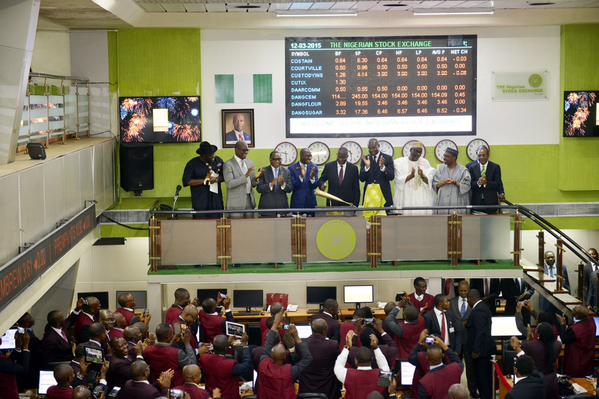
Investor optimism over government spending boosting domestic growth continues to support appetite for risk in Nigeria with the All Share Index steady around 30,748.50 as of writing. A combination of bargain hunting and growth optimism are likely to push domestic stocks higher ahead of the presidential elections next week. Confidence over the health of the nation has the potential to receive another welcome boost if next week’s GDP figures for Q4 meet or exceed market expectations. While the outcome of the presidential elections remains highly uncertain, it will certainly have a lasting impact on the Nigerian economy.
Are equity bulls running out of ammunition?
Away from Nigeria, it is shaping up to be a dull day for financial markets with equities across the world struggling for direction due to a lack of fresh catalysts.
Stocks in Asia witnessed another muted session today as many markets in the region remain closed for the Lunar New Year holiday. In Europe, shares got out of the wrong side of the bed thanks to weak earnings from French banking group BNP Paribas and disappointing data from Germany. While Wall Street has the potential to extend gains this afternoon on strong corporate earnings and cautious optimism over US-China trade talks, the medium- to longer-term outlook for equity markets tilts to the downside. Concerns over slowing global growth remains a dominant theme while the unpredictable nature of trade negotiations has certainly left investors on edge. With other geopolitical risks such as Brexit, China’s slowdown, Eurozone growth concerns and political turbulence in Washington seen stimulating risk aversion, the ingredients are in place for a stock market sell-off.

Investors who were expecting fireworks and action from US President Donald Trump’s State of the Union address were left empty handed after nothing new was brought to the table. While Trump discussed trade relations with China, border security and the budget, this was of no real interest to markets and such was reflected in the muted reaction. With Trump failing to provide fresh insight into the progress over US-China trade talks and the March deadline looming, sensitivity to trade developments is poised to heighten moving forward.
Brexit uncertainty and growing pessimism over Theresa May’s ability to secure further concessions from the EU continues to weigh on the Pound. With the European Union already stating that the Withdrawal Agreement is “not open for re-negotiations” it will be interesting to see what the prime minister achieves from her trip to Brussels. While negativity over Brexit is likely to continue punishing the Pound in the short term, the currency could receive a boost if expectations mount over the government delaying Brexit by extending Article 50. Although the Bank of England policy meeting is on Thursday, we expect the Pound to offer a muted reaction to this risk event as Brexit continues to overshadow economic fundamentals.
In the commodity markets, Gold is trading lower today thanks to an appreciating Dollar. While the precious metal is seen extending losses in the near term, bulls still remain in control in the medium to longer term. For as long as global growth fears weigh on market sentiment and expectations mount over the Fed taking a break on rate hikes this year, Gold will continue shining. Focusing on the technical picture, the precious metal has the potential to rebound towards $1,320 if $1,308 proves to be reliable support. A breakdown below $1,308 is likely to invite a decline back towards the psychological $1,300 level.


Mastercard and TeamApt Ltd., a subsidiary of Moniepoint Inc. and a provider of financial infrastructure and payment solutions, have entered a strategic collaboration to strengthen digital payment capabilities for businesses and financial institutions across Africa.

As part of this collaboration, TeamApt will operate directly on Mastercard’s global payments network as a non-bank acquirer, enhancing its ability to onboard credible and licensed entities to deliver seamless payment acceptance, transaction processing and acquiring services. This will further expand its card acceptance infrastructure, allowing more merchants to accept Mastercard payments across in-store, online and mobile channels.
The collaboration integrates TeamApt’s switching infrastructure with Mastercard’s network to facilitate secure, high-volume transactions across online and in-store channels. With Nigeria being home to more than 40 million micro, small, and medium-sized enterprises (MSMEs), and small businesses identifying digital solutions as vital to scaling, according to Mastercard’s 2026 SME Confidence Index, expanding payment acceptance remains an important opportunity for growth.
By combining TeamApt’s deep local market expertise with Mastercard’s global scale, businesses and individuals will benefit from more reliable transactions, stronger security and faster, safer and more accessible digital payment experiences.
“Expanding digital payment acceptance is one of the fastest ways to support small businesses across Africa to compete, grow, and reach more customers. By working with TeamApt, we are equipping MSMEs and informal sector businesses in Nigeria with robust, secure infrastructure to seamlessly process transactions across multiple channels. This collaboration brings more businesses into the digital economy, unlocking vital new opportunities for growth, credit access, and cross-border trade,” said Folasade Femi-Lawal, country manager, West Africa at Mastercard
“This collaboration with Mastercard represents an important step forward in our commitment to removing barriers within the payments ecosystem. For years, TeamApt has focused on building infrastructure that helps financial institutions and businesses grow with confidence. By working closely with Mastercard, we are extending those capabilities, enabling businesses to accept payments more seamlessly and giving users the freedom to transact securely both locally and internationally,” said Dennis Ajalie, Chief Executive Officer of TeamApt.
The collaboration also delivers international value, enabling Mastercard cards supported by TeamApt’s infrastructure to be used across millions of merchant locations worldwide. Customers gain the convenience of secure global payments, while merchants can more easily serve both local and international customers.
A Central Bank of Nigeria (CBN)-licensed switching and processing company, TeamApt has, for over a decade, built and operated critical financial infrastructure that powers banks, fintechs and other institutions. The company’s technology supports secure and reliable transaction processing across multiple payment channels, enabling businesses and consumers to participate more easily in the digital economy.
This collaboration further underscores the strength of Moniepoint’s ecosystem. With operations and agent coverage across all 774 local government areas in Nigeria, Moniepoint has established one of the nation’s most extensive financial services networks, positioning the group to drive meaningful scale and adoption of digital payment solutions.
Securities and Exchange Commission (SEC) has directed capital market operators to immediately freeze the assets of six individuals and three entities designated as terrorism financiers by the Nigeria Sanctions Committee.

The directive was contained in a circular signed by the SEC management on June 26, 2026, and published on the commission’s website on Wednesday.
The SEC said the Nigeria Sanctions Committee designated the individuals and entities under the Terrorism Prevention and Prohibition Act (TPPA), 2022, and subsequently added them to the Nigeria Sanctions List.
The designated individuals are Babangida Muhammed Adamu Hammajam, Abdullahi Umar Usman, Ibrahim Abubakar, Adamu Chiroma, Muktar Muhammad Adamu and Yakubu Ogirima Ibrahim.
The three entities are Nine to Nine BDC Ltd, Generation Currency BDC Ltd and Abbal Bako & Sons Bureau de Change.
The commission directed all capital market-regulated entities to immediately identify and freeze, without prior notice, all funds, assets and other economic resources belonging to the designated individuals and entities.
“Immediately, identify and freeze, without prior notice, all funds, assets, and any other economic resources in their possession, belonging to the designated individuals and entities and report same to the Secretariat of the Nigeria Sanctions Committee,” the commission said.
The SEC also directed operators to report all frozen assets and other actions taken in compliance with the sanctions, including attempted transactions involving the designated individuals and entities.
The commission further instructed capital market operators to file suspicious transaction reports with the Nigerian Financial Intelligence Unit (NFIU) for analysis.
Operators were specifically directed to report “all cases of name matching in financial transactions prior to or after receipt of this Sanctions List” as suspicious transaction reports to the NFIU.
The commission prohibited capital market operators from dealing with the designated individuals and entities and ordered them to maintain continuous monitoring of transactions involving them.
“Take Note that at all times, any unusual or suspicious transactions MUST be promptly reported to the Nigerian Financial Intelligence Unit (NFIU),” the SEC said.
The directive takes immediate effect.
The commission warned that failure to comply with the directive would constitute a violation of the Investments and Securities Act, 2025, as well as its Anti-Money Laundering and Countering the Financing of Terrorism Rules and Regulations.
“Such violation would attract appropriate regulatory sanctions, including fines, suspension of operations, or revocation of registration,” the SEC said.
The commission said Hammajam was listed on June 18 for alleged involvement in terrorism financing and support for the Islamic State West Africa Province (ISWAP).
It said Usman was designated for allegedly providing material support to a designated terrorist organisation through repeated financial transactions, while Ibrahim was listed over alleged involvement in terrorism financing and membership of ISWAP.
According to the SEC, Chiroma was allegedly involved in terrorism financing through the use of bureau de change and related corporate entities to facilitate the movement of funds linked to terrorist activities.
The commission said Adamu was listed on June 15 for allegedly providing financial support and facilitating transactions linked to the financing network of the ISWAP Okene cell.
Ogirima Ibrahim, according to the SEC, was listed on June 18 for allegedly providing material and financial support to the ISWAP Kogi cell.
The three bureau de change companies were also listed on June 15 over their alleged involvement in facilitating or channelling funds connected to the ISWAP Okene financing network.
The SEC said the directive formed part of broader measures by Nigerian and international authorities to disrupt suspected terrorism-financing networks.
On June 23, the United States announced sanctions against three individuals and six entities allegedly linked to Islamic State financing, including three bureau de change operators.
Two days later, the Central Bank of Nigeria also directed banks to freeze accounts belonging to customers linked to terrorism financing.
The latest SEC directive reinforces the regulatory focus on preventing Nigeria’s capital market and financial system from being exploited to finance terrorism and other illicit activities.


Securities and Exchange Commission (SEC) has issued an urgent directive requiring all capital market-regulated entities (CMREs) to immediately subscribe to Nigeria’s Sanctions (NigSac) Alerts system.

Effective immediately, failure to comply with this, or other AML/CFT regulations, may result in severe fines, suspension of operations, or revocation of registration.
This follows fresh designations by both local and international authorities of individuals and Bureau de Change operators for alleged direct involvement in terrorism financing and material support to the Islamic State West Africa Province (ISWAP).
The directive, according to three circulars issued by the apex capital market regulator, requires a mandatory compliance measure with threats of fines, operational suspension, or outright registration revocation for non-compliance.
The directive, pursuant to the implementation of Financial Action Task Force (FATF) statements on high-risk jurisdictions, signals an escalation in Nigeria’s anti-money laundering and counter-terrorism financing regime.
The SEC’s broader circular implementing FATF high-risk jurisdiction statements reflects Nigeria’s heightened exposure to international scrutiny. SEC, in line with directives from Central Bank of Nigeria (CBN), now requires CMREs to terminate all correspondent banking relationships with listed high-risk jurisdictions, business entities and individuals.
“In line with the provisions of the Terrorism Prevention and Prohibition Act (TPPA), 2022, the Nigeria Sanctions Committee (NSC) has designated six (6) Individuals and three (3) Entities as terrorist financiers and subsequently added them to the Nigeria Sanctions List,” SEC stated in circular to all market operators.
The circular mandated all capital market regulated entities and individuals to do the following:
“Immediately, identify and freeze, without prior notice, all funds, assets, and any other economic resources belonging to the designated persons and entities in their possession and report same to the Secretariat of the Nigeria Sanctions Committee;
“Report to the Secretariat of the Nigeria Sanctions Committee any assets frozen or actions taken in compliance with the designation, including attempted transactions;
“Immediately file a suspicious transactions report to the Nigerian Financial Intelligence Unit (NFIU) for further analysis on the financial activities;
“Report as a suspicious transactions report to the NFIU, all cases of name matching in financial transactions prior to or after receipt of this Sanctions List;
“Subsequently prohibit dealings with the designated persons and entities; and continue to check for transactions relating to the designated persons and entities and report findings to the Nigeria Sanctions Committee through [email protected]”, SEC stated.
“Take Note that at all times, any unusual or suspicious transactions shall be promptly reported to the NFIU,” SEC warned.
According to the capital market apex regulator, the circular takes immediate effect and failure to comply with the directives constitutes a violation of the Investments and Securities Act, 2025, and the SEC AML/CFT Rules and Regulations and such failure would attract appropriate regulatory sanctions, including fines, suspension of operations, or revocation of registration.
The directive implies that capital market operators should immediately audit their AML/CFT technology stacks to ensure NigSac Alerts subscription and automated flagging capability.
CMREs are required to file suspicious transactions reports with the Nigerian Financial Intelligence Unit (NFIU) for any name matching with designated individuals and entities, whether such matches occur pre- or post-transaction.
The obligation extends to reporting all funds frozen and actions taken in compliance with designations to the NSC Secretariat via [email protected].
The designations also create secondary compliance obligations: CMREs must now maintain watchlists that incorporate designations from both the NSC and US Treasury, as regulatory expectations implicitly track international sanctions coordination.
For institutional investors and fund managers, this translates to enhanced due diligence on counterparty relationships, particularly where transactions flow through informal financial infrastructure or jurisdictions flagged under FATF increased monitoring status.

Airtel Nigeria Adds Over 1,000Cell Sites in Nationwide Expansion to Surpasses 17,000

MacOS Users Report More Cyber Threats than Windows Users – Survey Reveals

Mastercard, TeamApt Collaborate to Expand Digital Payments Across Africa

Access Holdings Sets New Benchmark in Nigeria’s Finance Talent Pipeline

ESUT Workers Get N82,000 Minimum Wage as Enugu Approves Fresh Salary Increase

EFCC Busts NIS Visa Overstay Racket, Uncovers N700m in an Account

Fact-Check: Elon Musk’s “Tesla Pi Phone” is Internet Rumor

NBC Tasks Broadcasting Stations over 2028 DSO Global Deadline

NBC Scraps Annual Digital Access Fee on DSO

Glo Sponsored African Voices to Feature Netflix’s “The Polygamist” Stars




 Telecom2 days ago
ipNX Joins Calls for Innovation-Friendly Ecosystem and Stronger Local Opportunities at Regenesys AI Summit

 E-Business2 days ago
NDPC Probes UNILAG, Lotus Bank, Hackerbella over Alleged Students’ Data Misuse

 News2 days ago
PalmPay Reinforces Commitment to Youth Empowerment on International Youth Day

 E-Financial2 days ago
KudiWave Asks for Clarification over N750m Transfer from PalmPay Account

 Telecom2 days ago
NCC Reports over 5,000 Fibre Cuts in 6 Months

 Telecom2 days ago
Google Selects Six Nigerian News Creators for Emerging Voices Growth Lab

 E-Financial2 days ago
Nigerians Borrow More to Buy Homes as Mortgage Demand Climbs – CBN

 General News2 days ago
NUPRC Warns of Counterfeit, AI-Generated Appointment Letters