

E-Financial
Nigerians Save for their Future, MasterCard Survey Reveals

Results of the latest MasterCard Worldwide Survey on Consumer Purchasing Priorities – Money Management has revealed that Nigerians continue to understand the importance of saving their money, with 95% of respondents committing to increasing their savings in the following six months.
Compared to the previous year’s results, this latest finding represents an 8% increase on the 87% of respondents who had similarly committed to increasing their savings in 2011.
Now in its second year in Nigeria, the MasterCard Worldwide Survey on Consumer Purchasing Priorities – Money Management includes a series of questions that investigates respondents’ financial planning over the course of the following six months and seeks to determine levels of basic money management skills in terms of budgeting and savings.
The most recent survey was conducted between 24 April and 10 June 2012, and involved 11,376 respondents aged 18 to 64 across 25 markets spanning the Asia Pacific, Middle East and Africa regions. On the African continent, the survey was conducted in Egypt, Kenya, Morocco, Nigeria and South Africa
When respondents were questioned about their primary reason for wanting to increase their rate of saving over the subsequent six months, 84% indicated that they were wary of the impact that global economic events may have on the Nigerian market and they felt they needed to prepare for unforeseen emergency expenditure.
The survey established that a significant 95% of respondents believed that they should regularly save a portion of their monthly income. The allocation of their total salaries that they intended to save in the following six months was diverse, with 26% saving one tenth or less, half of all respondents saving between 11-30%, and 11% saving more than one third of their salaries.
“It is clear that Nigerians understand the importance of setting a portion of their monthly income aside,” said Omokehinde Ojomuyide, country manager, West Africa, MasterCard Worldwide. “In fact, it is one of the most important and necessary actions that any Nigerian can take to ensure their financial security.”
The Central Bank of Nigeria (CBN) has emphasized this with its National Financial Inclusion Strategy, through which it aims to achieve a total number of 63 million users of banks’ savings account products by 2020, from the 21 million accounts that were active last year.
Ojomuyide adds that investments, retirement planning, and buying or upgrading a property, were the most popular reasons for saving, with a large percentage of Nigerians saving for more than one purpose.
Reinforcing the positive results around savings were the facts that 94% of respondents believed it was never too early to have a financial plan and 81% agreed financial planning was not just for the rich.
However, the survey revealed that while large numbers of Nigerians understand the importance of planning and saving for their retirement years, and are setting money aside for that purpose, only 37% of respondents have calculated the total amount that they would need to retire to maintain their lifestyle when the time comes for them to stop working.
“Many people think that saving for retirement is something that can be postponed for action later in life,” says Ojomuyide. “However, one of the first steps to take towards financial independence is making adequate preparations for when a person is no longer working, whether this retirement is by choice or from ill health – and the advice of a qualified and experienced financial planner will help Nigerians take the necessary steps to provide for their future.”
The survey also indicated that Nigerians manage their money carefully and effectively. Ninety-four percent believe that they have the ability and understanding to budget their day-day finances, 78% track their spending on a weekly basis and 83% regularly monitor the progress of their investments.
“Even though the survey shows that Nigerians lag with planning for their retirement, it reveals that they understand the importance of budgeting and saving, and more importantly, they are taking steps to include these activities in their daily lives,” Ojomuyide says. “It is this awareness of personal finances, and the knowledge of how to manage money, that will help Nigerians embrace the CBN’s National Financial Inclusion Strategy and its Cashless Policy.”
“Understanding the importance of managing money beyond immediate daily needs is the first step towards owning a bank account, which then opens up the benefits of broader financial inclusion,” she says. “This in turn makes the appeal of a cashless economy even more clear, as the dangers and inconvenience of cash are eliminated, and electronic payments are increasingly embraced.
“MasterCard is working closely with Government, financial institutions and merchants to make the CBN’s goals for a financially secure Nigeria reality, by making it easy, safer and more convenient for Nigerians of all income groups to put their savings to good use,” she concluded



Kuda Microfinance Bank partnered with Lovers & Frnds for a Valentine’s edition event on Sunday, February 15, at Space Hub Lekki, Lagos, redefining celebrations around love, friendship, and social connections beyond romance.

Kuda Bank
The R&B-themed gathering drew couples, friend groups, and solo attendees with music sets from DJs like TGarbs, games, gift exchanges, and colour-coded tags—red for relationships, yellow for mingling singles, orange for non-minglers—to spark easy interactions.
Kuda activated a branded photo booth, merchandise giveaways, prize activities, and complimentary drinks for Premium loyalty tier customers, while vendors used Kuda Business POS terminals for seamless cashless payments.
Senior Brand Manager Emmanuel Femi-Adejobi said: “We partner with experiences matching our customers’ lifestyles in music and entertainment, creating spaces they genuinely connect with—we’ll keep supporting how they live and celebrate.”
By Mathew Anthony, Market Analyst at FXTM
In another positive development for Nigeria, the CBN has proceeded with 50-basis points rate cut.

FXTM Logo
With favourable fundamental forces at play, it was always a question of how much rather than if rates will be cut in February.
Although some were expecting a hefty 100-basis point cut, this was still a positive move by the CBN, mirroring the dovish strategy of other major banks on the continent.
Interest rates were slashed thanks to cooling inflationary pressures, a stronger Naira and rising FX reserves.
This move is likely to boost confidence over the economic outlook ahead of the Q4 GDP report scheduled for release later this month.
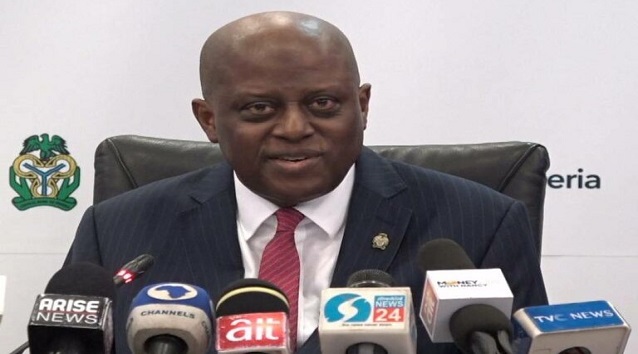
Central Bank of Nigeria (CBN) has lowered its Monetary Policy Rate (MPR) by 50 basis points to 26.50 percent from 27 percent, a unanimous decision announced by Governor Olayemi Cardoso at the end of the 304th Monetary Policy Committee (MPC) meeting in Abuja on Tuesday.

CBN
Cardoso cited 11 straight months of decelerating headline inflation—reaching 15.10 percent in January 2026 per National Bureau of Statistics—as key, driven by prior tightening lags, naira stability, food supply gains, steady petroleum prices, export earnings, remittances, and balance of payments strength.
Liquidity ratio stays at 30 percent, CRR unchanged at 45 percent for commercial banks (16 percent merchant banks) and 75 percent non-TSA public deposits; standing facilities corridor now +50/-450 basis points around MPR.
The MPC retained other parameters, welcoming Executive Order 09 redirecting oil/gas revenues to the federation account for fiscal boost, last cutting rates in September 2025 after November’s hold.

SERAP Says Phone Tapping Law Violates Human Rights, Calls for Withdrawal

MultiChoice Suspends Yearly DStv Price Hike as Canal+ Pushes Growth

Microplastics Found in 90 Percent of Prostate Cancer Samples

Lotus Bank, REA Seal N100Bn Deal to Power Rural Nigeria

DG NITDA Reaffirms FG Commitment to Responsible, Inclusive AI
Nigeria’s 9 Top FinTech Firms Valued at $10.6Bn in January 2026

CBN Upgrades Licences of Opay, Moniepoint, Kuda, Palmpay, Paga to National Status

NITDA, NBC Explore Strategic Collaboration on Digital Transformation, Media Regulation

Kaspersky Launches OT Calculator to Align Cybersecurity Investments with Business Goals

Why the Future of PR Depends on Healthier Client–Agency Partnerships




 General News3 days ago
Zinox Technologies and TD Africa Forge Strategic Partnership to Revolutionize African Tech Ecosystem

 Telecom3 days ago
Uwaje Pays Tribute to Leo Stan Ekeh @70

 Telecom2 days ago
Cyber Immunity Emerges as Shield for Nigerians Amid Rising Scams

 E-Financial2 days ago
$214Bn Missing, Institutions Silent: Is Accountability Dead in Nigeria?

 E-Business2 days ago
Interswitch Partners Abia to Digitise Public Hospitals

 General News2 days ago
NITDA, Abia Partner on Enterprise Architecture Reform

 E-Business2 days ago
WIEG 2026 Summit Shifts to April 22-23 for Maximum Impact

 News1 day ago
NITDA Urges Stronger State Partnerships as Key to Digital Economy Goals @ South-South Stakeholders Forum