

News
NiRA Expects Paradigm Shift in PP Sectors Policies on .ng Registration

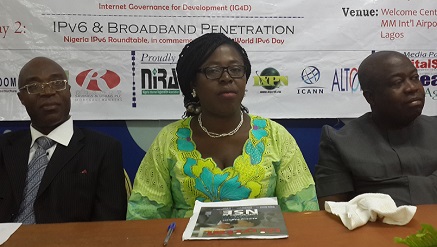
The Nigeria Internet Registration Association (NiRA), said, it views n.g domain name registration as paramount in paradigm shift in government and private sector policies and practices.
This NiRA’s expectation was contained in a presentation by Mrs Mary Uduma, president of the Assocation titled: ‘Leveraging Multistakeholder Ecosystem for .ng Growth’, delivered at the 6th Nigeria DigitalSENSE Forum.
Uduma who was represented by Akinbo Cornerstone, said added that the prerequisites for .ng scale up are multi- faceted, requiring collaboration of various sectors including Government.
Aside requiring a paradigm shift in government and private sector policies and practices, the strategy to achieve this has to be flexible and dynamic, capitalizing on proper utilization of existing and emerging opportunities.
Uduma maintained that the process needs enough scope for different actors to lead at different times and at various levels and partnership formed on the basis of transparency, accountability and mutual sharing of responsibilities, risks, and benefits.
On the sidelines of Government’s efforts, the NiRA Boss said, “The Ministry of Communication Technology is taking a giant leap with the creation of Cross-Platform that allows for an online registration portal that can be used for registration of Companies with the Corporate Affairs Commission;

“The eGovernment has gone a step further to agree and set a deadline for migration of all Government Websites to switch to .gov.ng before August 27, and under the leadership of Mrs. Omobola Johnson, MCT and NITDA has contributed immensely to .ng growth.
The private sector, she said, “Partnership formed on supporting Local Content growth has increased the uptake of the .com.ng by the likes of Google.
“The .ng Registry can boast of zero downtime due to the like of MainOne Cable highly impressive support for managing bandwidth.
“Many more MoU are in the kitty to be signed for promoting enduser orientation and awareness by service providers such as MTN, AIRTEL, to mention a few”.
Uduma, however, admitted that more has to be done for greater results on the registration.
Earlier, Mrs. Nkemdilim Nweke, executive director, Operations, DigitialSENSE Africa Media, said the Forum was created and nurtured as a think-tank platform where Nigerian internet stakeholders converge to raise and address germane issues concerning the ICT sector, particularly, computing, internet governance-related issues, towards helping to further Nigeria in the ever rapidly advancing phenomenon of global ICT.
Speaking on the theme of the Forum, ‘Internet Governance, eBiz and Open Access in Nigeria,’ she said it offers Internet Service Providers (ISPs), telecom operators, value added service providers and other stakeholders the enabling ground to articulate a stand on internet governance issues and accurately align NDSF on IG4D position into the national, regional, Africa and global agenda.
While addressing the Forum, specifically, the students in attendance, she said, “It is pertinent at this juncture, to remind all young internet users, particularly, to always be mindful of what they post on the internet because everything posted on the net is traceable to the author. Therefore, you are passionately advised to mind the stuff you post and the language with which materials are posted on the internet for global consumption.”
She said the issue has become important because the result of what one posts online for the consumption of the global village remains his/her permanent signature and model of his/her image, which will definitely rub off on the future contacts.


Southeast Asia cybercrime networks are expanding operations into Africa as crackdowns intensify in the subregion, according to a recent report from the United Nations Office on Drugs and Crime (UNODC).

The massive, unintended geographic shift triggered by intense pressure from international task forces in Myanmar and Cambodia,have seen highly sophisticated criminal networks now establishing footholds in major tech hubs across Kenya and Nigeria, transforming local technical talent into accomplices for industrial-scale digital theft as reported by https://streamlinefeed.co.ke/
This strategic migration represents a critical evolution in the $17 billion crypto scam economy.
Transnational scam syndicates are organized criminal networks that run industrial-scale online fraud using trapped or trafficked labor.
The UNODC has documented this diversification, noting that African nations are increasingly targeted as operational bases due to robust internet infrastructure and a surplus of unemployed tech workers.
In response, local authorities are engaged in a frantic game of catch-up against well-funded foreign cartels.
Recall that in 2025, UNODC, described the shift as part of a broader trend in which crime “spreads like a cancer,” into regions with weaker enforcement and limited digital safeguards.
The report pointed to the rapid proliferation of online fraud operations, including cryptocurrency scams and phishing schemes, moving from countries like Myanmar and Cambodia into new footholds in Africa—particularly Nigeria.
A recent case publicized June 12, 2025 by the WeChat public account West Africa Chinese Voice illustrates the trend: Nigeria’s Economic and Financial Crimes Commission (EFCC) arrested 177 Chinese nationals in Lagos and Abuja between December 2024 and January 2025.
The suspects were allegedly running scam centers under the guise of corporate offices, where local Nigerians were trained to carry out online investment frauds—many following the “pig-butchering” model, which builds trust with victims before luring them into fraudulent crypto investments.
Authorities seized hundreds of SIM cards, high-performance computers, and prewritten scam scripts during the raids

Ugochukwu Eze, a 47 year-old man, was on Thursday arraigned before a Federal High Court in Lagos for allegedly hacking into the server of SunTrust Bank to steal a total of N800m.

Ugochukwu also known as Amazon, was arraigned before the court by the operatives of the Department of State Security (DSS).
DSS accused Ugochukwu of fraudulently hacking into the server of SunTrust Bank to remove and divert the sum of N800 million into several accounts in other financial institutions.
M. Bajela,prosecuting counsel, DSS, in the charges filed before the court alleged that the defendant and others now at large, between 2023 and 2026, conspired among themselves and unlawfully and seriously hindered the function of Suntrust Bank Plc’s computer system server and in the process fraudulently diverted over N800 million belonging to the bank.
Ugochukwu was also accused of concealing and transferring various sums of money traced to the unlawful cyber-attacks to some account in some financial institutions.
The offences alleged to have been committed by the defendant according to the prosecutor contravened sections 5; 6(1) and 8 of Cybercrimes (Prohibition, Prevention etc) Act, 2024. And Sections 10, 20 and 18(2)(D) of the Money Laundering (Prevention and Prohibition) Act, 2022.
The defendant pleaded not guilty to the allegations.
Based on his plea of not guilty, the prosecutor asked the court for a trial date, and prayed the court to remand the defendant in the facility of the correctional services pending the time trial will commence.
However, E. Afrogha, defendant’s lawyer, told the court that she has filed her client’s bail application. adding that her client has been in the DSS custody for over a month.
But the prosecution counsel told the court that he has not been served with the bail application, not withstanding that his witnesses are available.
Based on the counsels’ submissions, Justice Friday Ogazi, presiding judge, adjourned the matter to August 24,2026 for hearing of the bail application.
The judge also ordered that the defendant be remanded in the custody of the Nigerian Correctional Services (NCS) pending the hearing of the bail application.
One of the counts against the defendant reads: “That you UGOCHUKWU EZE (AKA AMAZON) (M) (47 YEARS) sometime between 2023 and 2026 in Lagos, and other places within the jurisdiction of this honourable court, unlawfully seriously hindered the function of SunTrust Bank Plc’s computer system, and in the process fraudulently diverted over N800, 000,000.00 (Eight Hundred Million Naira) belonging to the said SunTrust Bank thereby committed an offence contrary to and punishable under Section 8 of the cybercrime (prohibition, prevention etc.) Act, 2024.”


Liquid Intelligent Technologies is using light-beam technology developed by Google spinout Taara to supply data centres and large enterprise networks in Lagos, addressing the high costs and delays of laying underground fibre in dense urban corridors.

The deployment includes nearly 12 live optical links serving banks, hotels, and utilities across commercial districts, proving optical technology can supplement traditional physical infrastructure where trenching cables is impractical.
High-capacity bandwidth is being distributed directly from points of presence at Africa Data Centres and other Lagos facilities to enterprises beyond the reach of fibre cables.
This reduces network downtime in areas where physical cable cuts take days to repair. The rollout follows a two-year deployment by Liquid to strengthen network resilience for local internet service providers.
Nigeria remains one of the largest economies on the continent, with Lagos acting as its primary commercial hub. Expanding network infrastructure across dense urban environments requires operators to blend multiple technologies.
Using focused beams of light transmitted through the air, the technology allows operators to establish links within days rather than weeks, complementing existing physical networks.
Liquid is now assessing expansion into Abuja, Ibadan, and Kano.
“For Liquid, deployment speed has been one of the most significant advantages,” said Eugene Uka, acting chief executive officer of Liquid Intelligent Technologies Nigeria.
He added: “Traditional fibre deployments are not always a possibility, especially across difficult terrains. Taara links can often be installed and activated within hours, allowing Liquid to fulfil its mission to create a digitally connected future that leaves no African behind.”
Bhavesh Mistry, regional lead for Taara in Africa, commented: “As demand for connectivity continues to grow, operators need more flexibility in how they expand and reinforce their networks.
“Fibre remains an essential part of modern communications infrastructure, and will for some time, but there are many situations where deploying fibre quickly or cost-effectively can be difficult. Wireless optical communication gives operators another tool to extend capacity, reach customers faster, and build more resilient networks without compromising performance.”
The Taara Lightbridge system delivers up to 20 gigabits per second of capacity across distances up to 20 kilometres using invisible light beams.
The platform avoids trenching, spectrum licensing, or extensive civil engineering work. Taara claims its system is active in more than 20 countries with telecommunications operators, including T-Mobile, Airtel, Digicel, Liquid, and SoftBank.

Fleeing Southeast Asia Scam Syndicates Find New Homes in Nigeria, Kenya- Report

DSS Arraigns Eze for Allegedly Hacking, Stealing N800m from SunTrust Bank

SEC Unveils Probate/Unclaimed Monies Clinic to Help Families Recover Inherited Investments

We have Multiple Layers of Protection for 281m Accounts in Nigeria – NDIC

NCC Asks Telcos to Make Budgetary Provisions for Cybersecurity

From Scarcity to Scale: What Africa Can Learn from India’s Agricultural Transformation

EFCC Busts NIS Visa Overstay Racket, Uncovers N700m in an Account

BON Establishes Six Ad Hoc Committees to Modernize Broadcasting

How EFCC Turned Recovered Loot Into School Supplies for Thousands of Nigerian Students

BVN Enrollments Hit 69.55m- NIBSS




 E-Business2 days ago
Kaspersky Reveals a New Malicious Framework Targeting Cryptocurrency Users with the Use of OkoSpyware

 E-Business2 days ago
CMS T&M Launches TMO Rides to Enable a Faster & Cashless Transport Experience for CMS – Ajah Passengers

 E-Business2 days ago
Firm to recruit over 100 professionals to boost NRS e-Invoicing compliance

 E-Business2 days ago
Nigeria Tightens Data Privacy Compliance as FG Issues Directive to MDAs

 Telecom2 days ago
FG Commences 90,000km Fibre Optic Rollout within Weeks

 Telecom2 days ago
Treepz Partners with CMS T&M to Digitize Public Transportation for Millions of Lagos Commuters

 Telecom2 days ago
Dimension Data to Channel Funds to Support Nigerian Fibre Expansion

 E-Financial1 day ago
Access Holdings Deepens Sustainable Finance Impact, Expanding Green Assets to ₦92.14 Billion