

News
NITDA Commissions Knowledge Access Centres in Daura

The National Information Technology Development Agency ( NITDA) has commissioned a Knowledge Access Venue (KAV) in Government Pilot Secondary School (GPSS), Daura, Katsina State.
Speaking at the commissioning, Mr. Peter Jack, director-general of NITDA, said two schools in Katsina State were selected for the IT centre, GPSS, Daura and Government Day Secondary School, Kusada, to integrate youths empowerment in the information technology penetration process in Nigeria.
Jack said: “I am particularly delighted to be commissioning KAV in Katsina which fits into integrating youth empowerment in the IT penetration process in Nigeria. Our youths are cardinal members of the Internet ecosystem; I implore users of this facility to continue to use the venue for learning and collaboration to harness positive values for our youth population. The benefits include acquisition of ICT Skills, research capabilities, and entrepreneurship for youths as part of the education curriculum.”
He noted that NITDA has been in total and continuous support of IT implementation in schools across the nation since its inception, saying the agency as part of the Federal Ministry of Communication has been faithful to the idles and principles of IT usage and penetration in Nigeria, adding that it is the ministry’s mandate to ensure Nigeria and Nigerians are connected.
The NITDA boss said the establishment of KAVs is very apt even as he announced that efforts towards building a veritable and resilient knowledge based economy using ICT as an enabler has resulted to ICT contributing about 9.58 per cent to the nation’s GDP.
He further said that NITDA in conjunction with the Ministry is working tirelessly to confront various challenges facing the growth of Internet ecosystem in Nigeria, some of which includes infrastructure, low e – governance index, innovation, skill acquisition, adding that the challenges will soon be history to the nation’s success in the IT sector development.
Earlier in his remarks, Aminu Bello Masari Katsina State Governor, represented by the deputy governor, Alhaji Mannitol Yakubu, said the commissioning of the IT centres will no doubt enhance teaching and learning in secondary schools through the use of information and communication technology and education empowering initiatives.
”In line with the above, Katsina State government will make sure that science, technical and vocational education is given much premium. The existing science and technical schools will continue to receive the needed attention they require in order to meet up with the current wave of globalisation in science and technology of the 21st century. Our existing 39 computer centres, which some have full internet services, will be improved and maintained to get the best results and achieve the set objectives,” he added.
The governor said the government is quite aware that the world is now globally turning into a digital age, saying it is therefore inevitable for every society to focus it’s attention towards the development of science and technology, adding that his administration will through the Ministry of Education continue to organise workshops, seminars and conferences with the aim of building the capacity of teachers to deliver for optimum results in schools.
He further said that the Computer Based Test (CBT) centres in the state will continue to be maintained and improved for use by candidates in writing their JAMB examinations in the state without any hitch.
He thanked NITDA for selecting Katsina State for the project, promising the states unflinching support and cooperation in all its programmes for the upliftment of the education sector in the state and the nation in general.
In his remarks, the permanent secretary, Ministry of Education in the state, Alhaji Sagir Ibrahim Muhammad, said the KAV will facilitate digital life style in the school as well as its immediate communities.
Alhaji Muhammad urged beneficiaries of the project to share these facilities with the surrounding communities on a commercial basis to support maintenance and ensure sustainability, adding that the project will go a long way in achieving the state’s educational objective, in line with the current global wave of digitalisation and quest for making the world a global village.
He thanked the agency for identifying the schools to benefit from the project even as he tasked the school authorities to make sure the facilities are maintained and secured, noting that they may start malfunctioning and subsequently breakdown if they are left idle without proper utilisation.


News
Galaxy Backbone Confirms Over 150,000 Active Official Government Email Accounts, Clarifies Status of GOVMAIL


Galaxy Backbone Limited (GBB), Nigeria’s foremost ICT infrastructure and shared services provider to the Federal Government, wishes to reiterate and clarify the availability, maturity, and ongoing expansion of the Federal Government’s official email infrastructure, widely known as GOVMAIL.

GOVMAIL is a secure and centralized official email platform established for use by Ministries, Departments, and Agencies (MDAs) to facilitate professional, auditable, and efficient communication across all arms of government.
The platform was launched by the Office of the Head of the Civil Service of the Federation, Mrs, Didi Esther Walson-Jack as part of a broader digital transformation agenda aimed at modernizing public service workflows and reducing reliance on paper-based correspondence and fragmented, external email services.
Recent statements by the Head of the Civil Service of the Federation, Mrs. Didi Esther Walson-Jack, underscore the strategic importance of GOVMAIL in the wider push towards a paperless civil service.
In late 2025, she announced that over 100,000 official GOVMAIL accounts had been created for civil servants across federal MDAs under an expanding paperless policy and that the transformation reflects a clear shift away from traditional paper correspondence to secure digital communication at scale. Today, that number has grown to over 150,000 Official government email accounts, current in use by government workers across MDAs.
Galaxy Backbone also affirms that these email accounts operate within a protected sovereign government domain environment hosted on secure local infrastructure, supported by enterprise-grade cybersecurity architecture.
The platform underpins centralized identity management and ensures compliance with national data protection standards, reinforcing accountability, audit-trail visibility, and overall digital governance efficiency.
In addition to GOVMAIL, Galaxy Backbone operates secure national Tier III and Tier IV Data Centres, a robust National Fibre Backbone, a Security Operations Centre (SOC), and a Network Operations Centre (NOC) that jointly power mission-critical government digital services. This infrastructure is closely aligned with the Federal Government’s digital economy strategy and its efforts to deepen digital service delivery, transparency, and efficiency across MDAs.
To accelerate adoption and ensure that every government worker who is expected to have an official email has one, GBB is working collaboratively with MDAs to close existing gaps and onboard remaining staff within the shortest possible time. These coordinated efforts reflect the shared objective of equipping public servants with the digital tools necessary for responsive, efficient, and secure inter-agency communication.
Galaxy Backbone remains committed to working with stakeholders across the different arms of government to sustain and build on this progress. The company appreciates the emphasis placed on strengthening digital governance and remains ready to provide technical clarifications and support collaborative engagements that further advance Nigeria’s digital public service ecosystem.
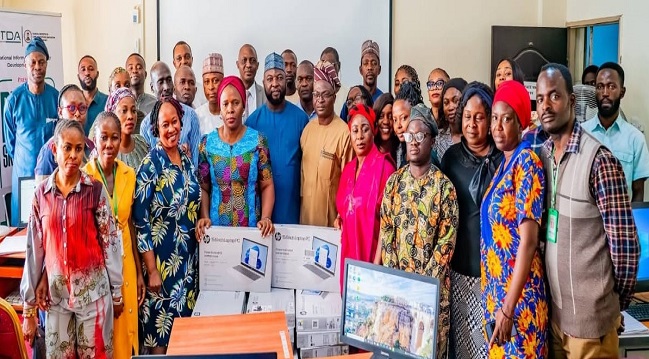
In a strategic move to modernise Nigeria’s public service, the National Information Technology Development Agency (NITDA) has concluded a specialised digital capacity-building programme for the Federal Character Commission (FCC).

The initiative, which included the donation of 35 laptops, aims to transition the Commission from manual processes to a data-driven oversight model, ensuring more transparent and equitable representation across all government MDAs.
In alignment with President Bola Ahmed Tinubu’s key priority area of reforming the economy for sustained and inclusive growth, as well as improving governance for effective service delivery, it forms part of NITDA’s Digital Literacy for All (DL4All) programme aimed at strengthening digital capacity across public sector institutions and building a workforce equipped to drive Nigeria’s digital transformation agenda.
The training, held at the Commission’s headquarters, focused on enhancing participants’ competencies in critical areas such as data analysis and data management, skills considered essential to improving institutional performance and service delivery.
Representing the Director General of NITDA, Kashifu Inuwa CCIE, the Acting Director of Digital Literacy and Capacity Building, Dr Ahmed Yusuf Tambour, explained the purpose of the intervention.
“We are here at the Federal Character Commission to carry out a training for staff of the Commission in the area of digital literacy to enhance their proficiency,” he stated.
He noted that the training was deliberately tailored to align with the Commission’s statutory responsibilities.
“We are particularly focusing on data analysis and data management, because this really aligns with the core mandate of the Commission,” he said.
The Federal Character Commission, which is responsible for monitoring and ensuring equitable representation in public service across Ministries, Departments and Agencies (MDAs), relies heavily on accurate and well-managed data to carry out its oversight functions.
By strengthening staff capacity in data handling and digital tools, NITDA aims to enhance the Commission’s ability to manage nationwide datasets efficiently and transparently.
Describing the programme as impactful and well-received by participants, Inuwa said, “So it’s been a great journey. We’ve trained 35 participants here, and the training has been very well received.”
As part of the intervention, NITDA donated 35 laptops to the Commission to facilitate continuous learning and enable staff to seamlessly integrate digital tools into their daily operations.
The gesture is expected to reinforce the sustainability of the training outcomes and improve workflow efficiency within the Commission.
Expressing optimism about the long-term benefits of the initiative, Inuwa added, “We are hoping that this will help the Commission to manage the very, very important data that they collect across all MDAs.”
The intervention reflects NITDA’s sustained commitment to deepening digital inclusion within government institutions under the Renewed Hope Agenda. By equipping public servants with practical digital skills and the necessary tools, the Agency is advancing institutional efficiency, strengthening data-driven decision-making, and supporting the Federal Government’s vision of a modern public service capable of driving inclusive national development and economic reform.

Nigeria and the European Union have inked a scientific and technology deal that grants access to about €100 billion in research and innovation funding for scientists, start-ups, and public institutions.

The agreement is a significant boost to the country’s tech environment, providing new prospects for research, innovation, and start-up growth.
The arrangement was signed in Abuja by Gautier Mignot, head of the EU delegation to Nigeria and ECOWAS, and Kingsley Udeh, Nigeria’s minister of innovation, research, and technology.
After more than two decades without a formal framework, the agreement transfers cooperation from informal to structured, large-scale collaboration.
The European Commission’s Horizon Europe programme, the world’s largest public research budget, is at the heart of the deal, which will bring together Nigerian researchers and firms to work on cross-border projects in health, agriculture, climate, food systems, and new technologies.
Udeh stated that the relationship puts Nigeria as a continental powerhouse for science and enterprise, with an emphasis on translating research into commercially viable products and assisting startups in scaling into global players.
Gautier Mignot noted that Nigerian organisations are already active in several Horizon-backed and global health research projects, but the new pact provides a legal and political framework to significantly expand participation, funding access and visibility.
To ensure delivery, both parties created a Joint Science and Technical Cooperation Committee to drive implementation and track measurable outcomes.
Beyond academia, the agreement aims to support innovators, boost university–industry collaboration, and help more Nigerian tech firms compete globally, strengthening Nigeria’s position as a leading startup hub in Africa.

Galaxy Backbone Confirms Over 150,000 Active Official Government Email Accounts, Clarifies Status of GOVMAIL

More 14m Farmers to Benefit from AfDB-backed Initiative

Dimension Data Nigeria Secures ₦20Billion Funding to Strengthen Digital Infrastructure

Newmark Webinar Explores How AI Could Transform Healthcare in Africa

Alerzo Liquidates Delivery Fleet as N4.38bn Moniepoint Loan Row Deepens

Accidental Billionaire Opts for Jail Instead of Returning Money Credited Him by Mistake

New Horizons Nigeria Breaks Ground: First to Fuse Mandarin into ICT Curriculum

Kaspersky Brings more Transparency to Threat Detection with New Hunt Hub

NDPC Commits to Balancing Data Privacy, Protection Information

OADC Lagos Reinforces Commitment to Local Data Hosting and Digital Transformation @ NDPC’s National Privacy Week Summit




 News2 days ago
NITDA Equips Federal Character Commission with Data Tools to Drive Public Sector Reform

 Telecom2 days ago
Telecom Giant MTN Injects N1.0 Trillion CAPEX into Network Expansion

 E-Financial2 days ago
History is Watching: Tinubu’s Moment to Rescue Nigeria’s Stolen Future

 E-Business2 days ago
Kaspersky Discovers New Phishing Campaign Exploiting Google Tasks Notifications to Steal Corporate Credentials
- Telecom1 day ago
MTN Nigeria Posts Record N1.70 Trillion Pre‑Tax Profit, Declares N20 Dividend for 2025

 Telecom2 days ago
Samsung Unveils Galaxy S26 Series, Powered by Smarter, Background AI

 E-Financial2 days ago
Union Bank Assures Safety of Deposits Post-Cardoso MPC Remarks
 Telecom1 day ago
Dimension Data Nigeria Secures ₦20Billion Funding to Strengthen Digital Infrastructure