

News
OLX, LASTMA Encourage Commuters to Observe 7 Safety Tips

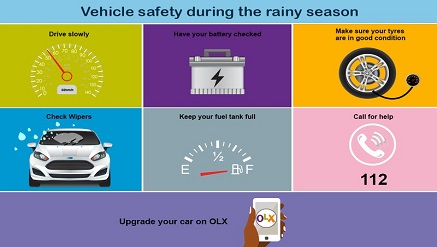
The rain has been quite heavy this season, although the farmers would be extremely grateful for the rain; those who drive or own cars are concerned about the effect the rain would have on their vehicles.
Leading online classifieds site OLX.com.ng provides a platform for Nigerians to buy and sell vehicles quickly and conveniently. In addition to facilitating trade, OLX partners with government agencies and corporate organizations that are relevant and offer value to vehicle users.
Recently, OLX worked with LASTMA to educate Nigerians on 5 very important precautions to take to ensure they are safe when driving during the rainy season.
Olawale Musa, general manager of LASTMA advised road users that the following precautions should be taken when driving during the rainy season.
Drive Slowly
Road users are advised to be patient while driving in bad weather. To avoid major accidents we advise that you limit your speed to a maximum of 60km/h or even less as the case may be.

Driving slowly also prevents the car from being damaged by hidden potholes. Road users should also use their hazard lightsto alert other road users who have poor visibility. =
Have Your Battery Checked
Getting stranded in the rain with a dead battery is not fun, and can easily be avoided. The typical lifespan of a battery is between 3-5 years.
Wet weather can stress your battery, and humidity can cause terminal corrosion and minor electrical grounds that can drain it overnight. If your battery is over three years old, it is advisable you have it checked especially during the rainy season.
A good indicator that the battery is getting weak is when it starts to sound sluggish during start up. Any mechanic can perform a simple test for battery strength. Buying a new battery is a whole lot better than getting stranded in the rain.
Make Sure Your Tyres Are In Good Condition
Do not underestimate the importance of good traction for the slippery roads. Make sure your tyres are appropriate for the raining season by consulting a tyre repairer aka vulcaniser. Ensure that all tyres including the spare are properly inflated.
Fill the Windshield Washer Fluid Reservoir and Check Wipers
Your windshield wipers will be used a lot during the rainy season. Top off the fluid and make sure you have a set of good blades.
Water deposits can clog the tiny nozzles on windshield washers over time thankfully, these can be cleaned easily with a fine needle, which can also be used to nudge and re-aim the nozzles to adjust the spray pattern.
If the washers are badly damaged, replacement washers with better spray patterns are relatively cheap and easily available.
Keep Your Fuel Tank full
A fuel tank that is nearly empty could result in condensation forming on the inside walls of the fuel tank. Fluctuating temperatures can result in water getting inside the tank. It’s never a good idea to run your tank to near-empty any time of the year because you run the risk of getting stranded.
Call For Help
If you are involved in an accident or in any form of an emergency; Lagosians can dial these toll free lines 767 or 112.
Upgrade Your Car On OLX
If you feel your car is not rainy season compliant, sell your old car on the OLX site using an OLX Champ and search for great deals on the site to buy exclusive offers on verified cars.
The OLX Group operates a network of online trading platforms in over 40 countries. It builds market leading classifieds marketplaces that empower millions of people to buy, sell and create prosperity in local communities.
With over 300 million monthly users worldwide, OLX Group makes it fast and easy to buy and sell almost anything online, such as household goods, phones, cars and houses.
Through consumer brands including Avito, dubizzle, letgo, OLX, Stradia and Storia, more than 10 million things are listed on its market-leading apps and platforms every single month.
The OLX Group is powered by a team of 4,000 people, operating from 25+ offices across five continents. The team is united behind a single mission to enhance people’s lives by facilitating win-win exchanges.


Union Bank of Nigeria has secured certification under the Payment Card Industry Data Security Standard (PCI DSS) version 4.0.1, a global standard for protecting payment card data.

The certification took effect on August 11, 2026, confirming that the bank’s systems for storing, processing and transmitting customers’ credit and debit card information meet stringent international security requirements.
PCI DSS certification is designed to reduce the risk of payment card data breaches and financial fraud while strengthening customer confidence in electronic payment systems.
The assessment covered key areas of Union Bank’s operations, including network infrastructure, card issuance, ATM and POS transactions, payment processing, reconciliation, settlement, chargebacks, dispute resolution and retail banking.
Union Bank was assessed and certified under the Service Provider category.
The certification process lasted a full year and involved quarterly assessments, with support from departmental, business and functional heads across the bank. Digital security firm Digital Encode supported the process, while the final independent audit was conducted by CyberCube, an accredited Qualified Security Assessor.
Yetunde B. Oni, Managing Director and Chief Executive Officer of Union Bank, said the certification demonstrates the bank’s commitment to protecting customer information.
“The security of our customers’ information is central to everything we do at Union Bank. This certification reaffirms that our payment systems and processes meet a rigorous global standard, and it reflects the discipline of colleagues across the Bank who work every day to keep customer data safe.”
The renewal also ensures that Union Bank maintains continuous PCI DSS certification, in line with the Central Bank of Nigeria’s requirement for banks to sustain compliance without interruption.
New data from CFA Society Nigeria is reshaping how the country’s financial sector thinks about talent development, with Access emerging as the single largest source of CFA candidates in Nigeria, distinction industry watchers say signals a deeper shift in how leading institutions are building investment expertise from within.

In its Where Nigeria’s Finance Professionals Work series, published in a national daily, CFA Society Nigeria placed Access first among employers of CFA candidates nationwide, with 82 candidates enrolled in the programme, more than double the 38 recorded at the next-placed institution and well ahead of every other bank or financial services firm on the list.
Access also ranked second among employers of CFA charterholders, with 11 professionals who have completed all three levels of the Programme and met its experience and ethics requirements.
For an industry that has long measured itself by balance sheet size and branch count, the rankings point to a different kind of competition: one over who is building the deepest bench of certified, globally credentialed talent.
CFA Society Nigeria compiled the data from its Salesforce Membership Database as at June 2026, and described the exercise as a way of recognising employers whose people “bring rigour, integrity and global best practices into the workplace every day.”
Analysts following the sector say the outcome is notable less for the ranking itself than for what it suggests about talent strategy across Africa’s financial services industry. A single institution developing more aspiring charterholders than the rest of the market combined raises the floor for professional standards nationally, not just within one balance sheet.
Every candidate who advances through the CFA Programme adds to a shared pool of ethics-trained, analytically rigorous professionals that Nigeria’s capital markets, pension funds and asset managers all eventually draw from.
Access Holdings Group Chief Executive Officer Innocent C. Ike, commenting on the rankings, framed the achievement in terms of institution-building rather than recruitment: “Every candidate on that list represents our commitment to building institutions and professionals that endure.”
The remark echoes a broader thesis increasingly voiced by market observers, that talent depth, not scale alone, is what will determine which African financial institutions earn lasting global credibility.
That distinction sits at the centre of Access’s stated ambition to become the World’s Most Respected African Financial Services Group. If the CFA numbers are any indication, the Group’s route to that goal runs less through square metres of branch network and more through the calibre of the people sitting inside it, a bet that Nigeria’s finance professionals, and the institutions that will one day hire them, are already placing alongside Access.


Nigeria Civil Aviation Authority (NCAA) has announced plans to introduce Radio Frequency Identification (RFID) baggage tracking technology across domestic and international airport terminals to tackle the growing problem of delayed, misrouted and missing luggages

Michael Achimugu, director, Public Affairs and Consumer Protection, NCAA, disclosed this at a stakeholder engagement forum in Lagos.
Achimugu said the RFID-enabled system would replace the traditional barcode-based baggage tracking framework and provide airlines and passengers with real-time visibility of checked luggage from check-in to final collection.
According to him, the technology would improve baggage traceability, reduce mishandling and strengthen accountability across the baggage-handling chain.
Unlike conventional barcode systems, RFID technology allows baggage to be automatically scanned at multiple points without requiring direct line of sight, enabling real-time tracking of luggage throughout its journey.
Achimugu said issues involving short-landed, missing, lost or damaged baggage had remained among the major complaints from air travellers, alongside flight delays.
He said the introduction of RFID technology was therefore aimed at improving baggage-handling standards and restoring passenger confidence in the aviation sector.
The NCAA said the initiative also aligns with IATA Resolution 753, which requires airlines to track baggage at key points during the passenger journey.
The authority expects the technology to provide more accurate information on the location of luggage, facilitate quicker resolution of baggage-related complaints and improve the overall passenger experience.
The NCAA said the initiative would also strengthen accountability among airlines and other stakeholders involved in baggage handling at Nigerian airports.

FG Seeks to Half Burkina Faso’s Internet Cost while Nigerians Pay more

Cyberthreat: New Malware, Turns Phones into Tools for Card Fraud- Report

SEC Clears Blockchain for Accelerated Regulatory Incubation Programme

Union Bank Secures Global Payment Data Security Certification

NLNG, NCDMB Boost Engineering Research with Innovation Centre

EFCC Busts NIS Visa Overstay Racket, Uncovers N700m in an Account

Fact-Check: Elon Musk’s “Tesla Pi Phone” is Internet Rumor

NBC Tasks Broadcasting Stations over 2028 DSO Global Deadline

Glo Sponsored African Voices to Feature Netflix’s “The Polygamist” Stars

Access Bank Debunks Shutdown Report, Vows Action against Perpetrators




 Telecom2 days ago
Airtel Nigeria Adds Over 1,000Cell Sites in Nationwide Expansion to Surpasses 17,000

 E-Financial2 days ago
Mastercard, TeamApt Collaborate to Expand Digital Payments Across Africa

 E-Business2 days ago
MacOS Users Report More Cyber Threats than Windows Users – Survey Reveals

 News2 days ago
Access Holdings Sets New Benchmark in Nigeria’s Finance Talent Pipeline

 Telecom2 days ago
Nigerian Startup Act: NITDA Calls for Stronger Inter-Agency Collaboration

 E-Financial2 days ago
SEC Orders Immediate Freeze of Assets Linked to Six Terrorism Financiers, Three Entities

 General News2 days ago
Anambra Seeks Digital Inclusion in Rural Communities

 Broadcasting2 days ago
ESUT Workers Get N82,000 Minimum Wage as Enugu Approves Fresh Salary Increase