

E-Financial
Oradian, Top Contender for African FinTech 100 Award

By peter oluka
Oradian, a Croatian-based fintech Company has emerged one of the contenders for African FinTech100 award to be unveiled later this month.
The fintech company from Zagreb, recently won the European FinTech Award for the ‘Most Innovative Banking Software’; reinforcing its acclaimed position as a leading provider with Innovative Banking Software designed, specially for microfinance institutions
Come 12 & 13 October 2017 when the winners of the African FinTech Awards will be announced at the Finance Indaba, Oradian will seek to be crowned again as the most promising and innovative African FinTech companies.
Nomination Process
More than 12000 FinTech enthusiasts voted for their favourite company and top-notch judges graded all the promising FinTechs.
The first round of the African FinTech Awards ended on the 15th of September. The public and the panel of judges decided on who are the most promising African FinTech companies.
The second and final round will be held 12 & 13 October during the African FinTech Awards & Conference. During this day the Top 3 FinTech companies within each category will have 7 minutes in front of the top-notch panel of judges to show them why their company should win an award. After the pitches the judges will have time for a Q&A.
Antonio Separovic, managing director of Oradian commented on the African FinTech 100 saying, “We judge our success by how well our customers are doing. As they succeed and grow, Oradian succeeds and grows. This nomination, being in the African FinTech Top 100, is a reflection of the outstanding works our team and our community of customers is doing everyday”.
Oradian Wins the European FinTech Award
At the awards event held in Brussels on September 27, the finalists and Europe’s most prospective tech companies from each category went head-to-head in a pitch competition, judged by fintech experts, investors and academics. Based on Oradian co-founder Julian Oehrlein’s pitch, the jury proudly named Oradian the winner of this year’s European FinTech Award.
In the weeks leading up to the awards event, Oradian rose to the top of its category as a top three finalist in Innovative Banking Software, surpassing 55 European software companies in public voting and judges’ scoring.
“This is a great chance for Oradian to show how we are using fintech and applying some of the industry’s greatest minds to make an impact in financial inclusion. Microfinance institutions around the world are using our platform to reach millions, many of whom live on less than two dollars per day,” said Oradian’s co-founder Julian Oehrlein. “We are proud because the award recognises the progress we’re making. We are enabling countless fintechs to gain traction with mass markets of microfinance clients. Through API integration, institutions can add other fintech solutions, like mobile money apps, to our platform and offer these new services to their clients,” stated Oehrlein.
The European FinTech award marks Oradian’s ninth award in three years. Additionally, Oradian’s latest acknowledgment comes from Forbes, as Julian Oehrlein is nominated for the prestigious “30 under 30” award reserved for the brightest entrepreneurs under the age of 30 using business to change the world.
With operations in five countries and 45 partnering microfinance institutions, Oradian reached a new milestone of serving one million end-clients globally in June 2017. Oradian currently employs 50 people worldwide, with majority of the staff in Zagreb, where they offer several job opportunities.
*Oradian co-founder Julian Oehrlein on stage at the European FinTech event in Brussels accepting the award for Europe’s Most Innovative Banking Software (PRNewsfoto/Oradian).



The Senate yesterday recorded two major milestones in Nigeria’s financial sector, passing a landmark Insurance Regulatory Commission Bill to replace the nearly three-decade-old National Insurance Commission (NAICOM) Act of 1997.

Also in a separate development, the Committee on Banking Insurance and other Financial Institutions, overwhelmingly cleared former Director-General of the Securities and Exchange Commission (SEC) and current Deputy Governor of the Central Bank of Nigeria (CBN), Mr. Lamido Yuguda, for appointment as Chairman of the Board of the Asset Management Corporation of Nigeria (AMCON).
The insurance reform legislation, described by lawmakers as one of the most comprehensive overhauls of Nigeria’s insurance regulatory framework in decades, seeks to modernise regulation, strengthen consumer protection, enhance financial stability and align the nation’s insurance industry with global best practices.
The bill, passed during plenary presided over by the President of the Senate, Senator Godswill Akpabio, followed the adoption of the report of the Senate Committee on Banking, Insurance and Other Financial Institutions chaired by Senator Mukhail Adetokunbo Abiru (APC, Lagos East).
The legislation repeals the National Insurance Commission Act, 1997 and establishes a new Insurance Regulatory Commission with broader supervisory and enforcement powers designed to respond more effectively to the changing dynamics of the insurance industry.

Presenting the committee’s report, Abiru told senators that the existing legal framework had become grossly inadequate for regulating a rapidly evolving insurance sector.
He said: “The current National Insurance Commission Act 1997 is outdated and does not adequately address the emerging economic growth, needs and development of the insurance business.”
According to him, although NAICOM had made significant contributions to regulating insurance companies, brokers and loss adjusters while protecting policyholders and enforcing industry standards, its enabling law had failed to keep pace with international developments.
Abiru explained: “Despite its significant contributions, the enabling law has become obsolete, failing to align with current realities and global best practices, and unable to keep pace with the evolving nature of the insurance industry, exposing numerous gaps in the law, necessitating urgent amendments.”
He disclosed that the proposed law guarantees the independence of the Insurance Regulatory Commission while substantially expanding its powers to supervise operators and safeguard the stability of the financial system.
According to him, the commission would have authority to issue regulations, standards, guidelines and directives, collaborate with domestic and international regulatory institutions, exchange supervisory information and intervene promptly in troubled insurance companies before their problems escalate.
He stressed that the strengthened intervention powers would remove bureaucratic bottlenecks that had previously delayed regulatory actions against distressed insurance firms.
Abiru said the legislation also introduces stricter corporate governance requirements by prescribing higher qualifications for members of the commission’s governing board.
He explained that only individuals with proven competence in insurance, finance, law, risk management and corporate governance would qualify for appointment, thereby ensuring more professional oversight of the industry.
The committee chairman further revealed that the bill significantly strengthens enforcement mechanisms by imposing stiffer sanctions on erring operators.
According to him, the law provides for heavier financial penalties, suspension of operating licences, additional liabilities for defaulting operators and disqualification of persons responsible for the collapse or regulatory failure of insurance institutions from occupying positions within the industry.
Abiru also noted that the legislation broadens the commission’s mandate beyond regulation to include the effective administration, supervision, control, integrity and overall development of insurance business in Nigeria.
He said the proposed change of name from the National Insurance Commission to the Insurance Regulatory Commission would eliminate longstanding confusion about the agency’s role and better reflect its statutory responsibility as the country’s insurance regulator.
Giving insight into the legislative process, Abiru disclosed that the committee subjected the bill to rigorous scrutiny, including a public hearing held on November 12, 2025.
He said more than 50 memoranda and several oral submissions were received from critical stakeholders, including the Federal Ministry of Finance, CBN, Nigeria Deposit Insurance Corporation, SEC, Federal Mortgage Bank of Nigeria, Nigerian Insurers Association, Nigerian Council of Registered Insurance Brokers and the Chartered Insurance Institute of Nigeria. Africans& Diaspora
According to him, the overwhelming consensus among stakeholders was that urgent reforms had become inevitable.
Abiru said: “The inputs made on the proposed bill will go a long way in providing a comprehensive legal framework for the regulation and supervision of all manner of insurance businesses in Nigeria to ensure that the industry is able to successfully compete on a global level and improve international competitiveness of Nigeria’s insurance industry.”
After considering the bill clause-by-clause in the Committee of the Whole, the Senate unanimously passed it for third reading.
Akpabio commended Abiru and members of the committee for championing what he described as a far-reaching reform capable of transforming Nigeria’s insurance industry.
He assured the committee that the National Assembly would continue to enact laws that would strengthen the country’s financial services sector, improve transparency and promote international competitiveness.
The bill will now proceed to the House of Representatives for concurrence before being transmitted to President Bola Tinubu for presidential assent.
After the plenary on Tuesday, the Senate Committee on Banking, Insurance and Other Financial Institutions overwhelmingly cleared Yuguda as Chairman of the Board of AMCON after granting him the rare privilege of a “take a bow and go” screening.
The committee dispensed with the conventional screening process on the grounds that Yuguda had previously appeared before the Senate for confirmation into several strategic public offices and had consistently demonstrated exceptional competence.
Presenting the nomination, the Special Adviser to the President on National Assembly Matters (Senate), Senator Basheer Lado, reminded lawmakers that Yuguda had undergone rigorous screening in the past.
He explained that the latest appearance was simply to comply with the provisions of Section 10(1)(a) of the AMCON Establishment Act, 2019, as amended. Abiru described Yuguda as one of the most trusted public officials appointed by President Tinubu.
He told committee members: “As all of us may recall, the appointee, Mr. Lamido Yuguda, whose résumé is before every member, has appeared before this committee on previous occasions.”
He added: “More recently, he also appeared before us for screening as Deputy Governor of the Central Bank of Nigeria.”
In a light-hearted remark that drew laughter from members, Abiru observed: “If you ask me, I think he is probably the luckiest person in this administration, having been appointed by the same president on three different occasions for three different responsibilities.
“I am sure you will agree with me that he is more than qualified for the role he is about to assume.”
Former Senate Chief Whip, Senator Orji Uzor Kalu, immediately moved the motion for Yuguda to “take a bow and go”.
Kalu said: “President Tinubu has, on three occasions, appointed the same man to important national assignments. I therefore move that Mr. Lamido Yuguda be allowed to take a bow and go.”
The motion was seconded by the committee’s Acting Vice-Chairman, Senator Mohammed Sani Musa, who described the nominee as eminently qualified.
Musa said: “Looking at the résumé of the nominee and considering that Mr. President has repeatedly found him worthy of appointment to critical national offices, there is no doubt that he is eminently qualified.” ExecutiveBranch
The committee unanimously adopted the motion through a voice vote, after which Abiru formally declared Yuguda cleared.
The committee, however, quickly shifted attention to AMCON’s future, with Musa calling for a comprehensive briefing on the corporation’s performance as it approaches its statutory wind-up date in 2030.
He reminded the management that AMCON was established to resolve non-performing loans, distressed banks and systemic financial risks, stressing that lawmakers needed a comprehensive assessment of its achievements and pending obligations.
Musa said: “It has a statutory lifespan and is expected to wind up around 2030. Looking at that timeline, there is a need for this committee to receive an up-to-date report on the status of AMCON.
“We need to know where the corporation stands today, what it has achieved since inception and what outstanding responsibilities remain before its expected sunset.”
Responding, Abiru assured the committee that the requested briefing would be provided.
He said: “I am sure the leadership of AMCON understands the point you have raised, and it is well noted.
“I have no doubt that, in the not-too-distant future, the committee will receive a comprehensive response on the issues you have highlighted.” The recommendation confirming Yuguda’s appointment is expected to be presented before the Senate in plenary for final approval.
E-Financial
CBN Retains Interest Rate at 26.5% as Cardoso Cites Global Uncertainty Despite Inflation Drop
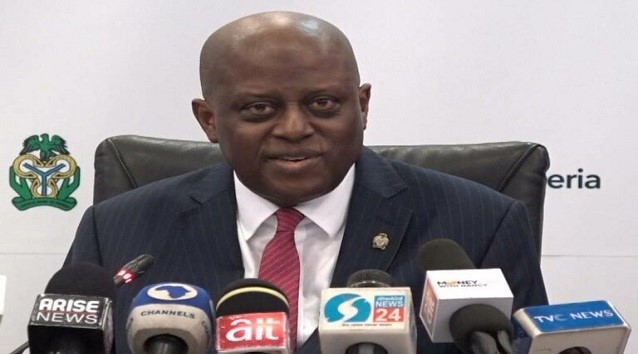
Central Bank of Nigeria (CBN) has retained the Monetary Policy Rate (MPR), the nation’s benchmark interest rate, at 26.5 per cent, citing heightened global uncertainties despite signs of resilience in the domestic economy.

The CBN Governor, Mr Olayemi Cardoso, announced the decision on Tuesday after the conclusion of the 306th meeting of the Monetary Policy Committee (MPC) held in Abuja from July 20 to July 21.
Cardoso said the committee resolved to maintain the current monetary policy stance after reviewing domestic and international economic developments.
“The Committee decided to retain the Monetary Policy Rate at 26.5 per cent,” he said.
The governor said renewed geopolitical tensions, particularly in the Middle East, continued to pose risks to global energy prices and inflation, necessitating a cautious approach.
He said the committee also retained the Standing Facilities Corridor at +50/-450 basis points around the MPR.
The Cash Reserve Ratio (CRR) was also left unchanged at 45 per cent for Deposit Money Banks, 16 per cent for merchant banks and 75 per cent for non-Treasury Single Account public sector deposits.
According to Cardoso, the MPC’s decision followed an assessment of the balance of risks confronting the economy.
“Although headline inflation moderated marginally in June 2026, global uncertainties have intensified, largely due to renewed hostilities in the Middle East,” he said.
He added that despite the challenging global environment, Nigeria’s economy had remained resilient, supported by ongoing structural reforms.
The governor noted that the committee would continue to monitor economic developments and adjust policy measures when necessary to maintain price stability.
The latest decision represents the second time in 2026 that the MPC has maintained the benchmark interest rate at 26.5 per cent.
The announcement came shortly after the National Bureau of Statistics (NBS) reported that Nigeria’s headline inflation rate eased slightly to 15.91 per cent in June 2026 from 15.93 per cent recorded in May.


National Insurance Commission (NAICOM) has declared that it has no plans to extend the 31 July 2026, deadline for the ongoing insurance industry recapitalisation exercise, asserting that the date is firmly rooted in the new Insurance Act.

Speaking at the investiture of Mr Akinjide Oluwarotimi-Orimolade as the 53rd president of the Chartered Insurance Institute of Nigeria (CIIN) in Lagos, Olusegun Omosehin, commissioner for Insurance, emphasised that the exercise remained central to building a resilient market.
With less than two weeks left before the window closes, the regulator commended operators making steady progress but stressed that the timeline must be treated with absolute urgency.
Omosehin said, “A stronger capital base must translate into stronger service delivery, prompt claims settlement, improved consumer protection, and a market that Nigerians can trust.
“The industry’s future will be determined by the quality of leadership, depth of competence, and discipline in serving the public interest.”
The ongoing exercise follows the historic signing of the Nigeria Insurance Industry Reform Act by President Bola Tinubu, which effectively repealed the outdated 2003 Insurance Act. Under the new framework, the sector is transitioning from a static baseline model to a dynamic risk-based capital structure. This regulatory shift aims to fortify operators against systemic economic shocks and better position the industry to contribute significantly to the Federal Government’s target of a $1tn economy.
Consequently, the exercise requires a massive capital lift across the board, pushing life underwriters from N2bn to N10bn, non-life operators from N3bn to N15bn, and reinsurers from N10bn to N35bn.
The push comes amid strong legislative alignment, with the National Assembly pledging its full backing to ensure these reforms translate into deeper market penetration.
Also speaking at the event, Ahmadu Jaha, chairman of the House of Representatives Committee on Insurance and Actuarial Matters, reaffirmed the parliament’s dedication to providing the necessary legal frameworks to drive sector growth.
Jaha said, “As Chairman of the House Committee on Insurance and Actuarial Matters, I wish to reaffirm the unwavering commitment of the House of Representatives to supporting legislative initiatives that will strengthen the insurance industry, improve regulatory effectiveness, enhance consumer protection and promote wider insurance penetration across Nigeria.
“The National Assembly recognises the critical role of the insurance industry in mobilising long-term capital, financing infrastructure development, protecting businesses and households against unforeseen risks, promoting financial stability and driving sustainable economic growth.”
Responding to the charge, the newly inaugurated Orimolade, president, CIIN, stated that his administration would aggressively protect the public interest by advancing the core mandates of the institute.
Orimolade promised “to build on the programmes of my predecessors while evolving new ideas that can further increase insurance education, awareness and acceptance across the country.”

NPC Opens Nationwide Digital Birth, Death Registration Platform

FG Launches C.L.I.C.K.D., Consumer Credit Scheme for Tech Devices

Airtel Nigeria Expands Retail Footprint to Strengthen Customer Access Nationwide

Ovaloop Technologies Unveils Digital Tools to Formalize SMEs Operations Across Africa

Kaspersky Survey Highlights the Need for Smartphone Security

NRC, Ponzi Scheme Collapses Resulting Loss of Billions of Naira

NASENI Moves to Digitize CCB’s 5m Assets Declaration and Operations

Lebara Nigeria Launches Lebara Play, Africa’s First Telecom-Owned Micro-Drama Platform

CANAL+ Partners Samsung to Pre-Load DStv Stream on New Samsung TVs In Nigeria, Other African Countries

Tokenization, Blockchain Technology will Transform Financial Institutions – IMF




 News2 days ago
Adebutu, PDP Chieftain Accuses Nigerian Governors of Embezzling LG Allocations

 E-Financial2 days ago
Access Holdings Sells 7.44% Stake in Ghana Unit

 E-Financial2 days ago
NDIC Urges Youths to Shun Ponzi Schemes, Embrace Savings

 News2 days ago
NIMASA Unveils Accelerator Scheme to Drive Innovation, Sustainable Growth

 E-Business2 days ago
SERAP to Sue NASS over Bill Empowering NDPC to Regulate Social Media

 E-Financial2 days ago
NRS Issues July 31 Deadline for e-Invoicing Compliance

 News2 days ago
ICPC Secures Final Forfeiture of N941m Linked to IPPIS Fraud

 News2 days ago
eBusinessLife Advocates Greater Support for Girls in ICT as Students Showcase AI Innovations