

General News
Path to Purchase: The Power of Children in Determining Household Buying Decisions

By: Solafunmi Oyeneye, Senior Channels Manager, & Giuliana Dias, Senior Director, Research & Insight, VIACOMCBS Networks Africa (VCNA),
The collaborative process of purchase decisions within homes can no longer be denied. Long gone are the days when there was a top-down hierarchy in households, and the decision making was the sole preserve of parents. These days, especially in homes with millennial parent’s aged 25 to 35, children are more actively involved and have more influence on decisions made in households.
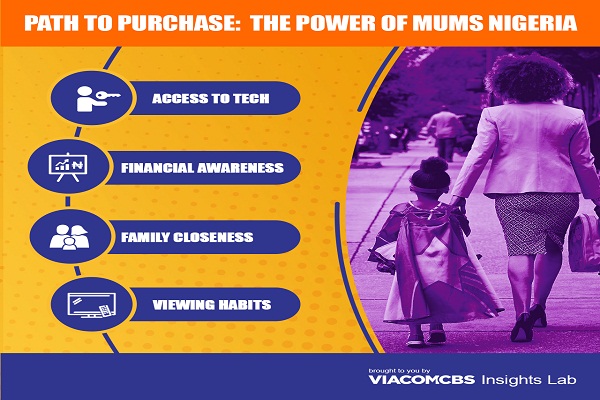
The research revealed four key drivers behind the shift to a more inclusive, collaborative decision making in households.

Giuliana Dias, Senior Director, Research & Insight, VIACOMCBS Networks Africa
Unprecedented Tech Access – In recent times, with nearly 12 devices per household, kids have unprecedented access to information and parents are no longer the gatekeepers of information in the home. In fact, parents are more likely to leverage their children’s knowledge in making more informed purchase decisions for the family; as children are likely to be more aware of brands and are able to filter that information into whether or not they want to purchase products from these brands.
Millennial Upbringing – This second key driver is attributed to the shift to a more inclusive, collaborative decision making within the home. Majority of millennials attended daycare, participated in playgroups, played organized sports, making them more accustomed to collaboration and teamwork. They infuse this into their style of parenting in their willingness to see their children as teammates in the success of the family. Young parents have reimagined the roles of kids in the family; as a result, decisions are made as a family, with kids playing a significant role in the outcome.
Financial Awareness – Millennial parents have also made it a priority to teach their kids about financial awareness, informing them on the financial situation of the family. Children are no longer shielded from the economic realities of their family. Research conducted by ViacomCBS on families with children aged 6 – 14 revealed that over 60% of the kids were aware of household budgets, and about 45% were aware of how much things cost.
With this knowledge, kids can balance the information they have of brands with the economic realities of their family in order to manage their expectations. With a collaborative effort of parents and kids, decisions can be made more easily acceptable by every member of the household.
Family Closeness – This last driver identified in the study indicates 78% of Nigerian parents saying they want to be best friends with their kids. Families are closer than ever, kids are no longer looking up to just athletes and celebrities, they’re also beginning to look up to their parents. Parents are able to better connect with their children, by having more conversations that are open and sharing more amongst themselves.
Sharing ranges from health, financial and even household purchase decisions. Family sharing has become automatic and unconscious. Do children however have opinions on all categories of purchase? Out of 25 categories tested in Nigeria, most kids are involved in at least 14 out of these 25 categories. Their greatest influence being over entertainment, food and groceries, restaurants, electronics, vacation and telecommunication. This means that in households with kids, they play a significant role in the final purchasing decisions that concern any of these six categories.
The path to purchase in households has become a collaborative process of negotiations between parents and children, who are influenced more by emotional than rational factors.

Solafunmi Oyeneye, Senior Channels Manager, VIACOMCBS Networks Africa
Parents are influenced by how happy a purchase makes their kids, while kids are influenced by how happy they will be with a product. Both parents and kids consider if a product will enable the family to spend more time together. Parents are also likely to spend 60% more when their kids are involved in decision making within the household.
Understanding these paths to purchase will enable brands to engage and provide for different members of the family. Therefore, brands in creating their messages must reach both parents and kids, as they both play critical roles in purchase decisions. Within the TV environment we know that the best place to find parents and kids simultaneously is children’s television.
Interestingly, for every one child watching any Nickelodeon channel, there are at least four females aged 25 and above watching at the same time. With over 245,000 kids (aged 7-14) on the Nickelodeon channels monthly, the majority of viewers per month are mums 25+ which are over a million viewers monthly.
Though parents (Mums) usually make the final purchase decisions within households, the role that children play in these decisions cannot be denied. These influential members of the home should be treated as important by brands in determining and communicating their message to target families.


Socio-Economic Rights and Accountability Project (SERAP) has filed a lawsuit against the Code of Conduct Bureau (CCB) over its failure to investigate an alleged abuse of office in the National Assembly regarding the amendments to the Electoral Act and tax reform laws.

“Public officers hold their offices in trust for the people and must not deploy official power for personal or sectional advantage,” SERAP said in a statement on Sunday.
In the suit marked FHC/ABJ/CS/634/2026, SERAP is seeking an order of mandamus to compel the CCB to immediately probe lawmakers and executive officials involved in the processes.
SERAP specifically wants the CCB to investigate claims that critical provisions on electronic transmission of election results were secretly removed from the Electoral Act Amendment Bill, as well as alleged discrepancies between the tax reform bills passed by the National Assembly and the versions signed into law.
The group is also asking the CCB to refer any public officers found guilty of violating the Code of Conduct to the Code of Conduct Tribunal for prosecution.
No date has been fixed for the hearing.
The statement reads, “We’re also seeking an order of mandamus to direct and compel @CCBNigeria to probe the allegations that certain lawmakers and officers of the executive branch unlawfully altered some aspects of the tax reform bills, which resulted in differences between the tax laws passed by lawmakers and the gazetted copy available to the public.”
SERAP emphasised that granting the reliefs sought would help address critical concerns relating to conflict of interest, abuse of office, non-disclosure of interests, and reinforce adherence to due process.
The group added that, “It would serve to curb the erosion of the Code of Conduct for Public Officers in the exercise of legislative powers.”
“Where lawmaking is shaped by abuse of office and conflict of interest, it ceases to be a legitimate exercise of constitutional and fiduciary responsibility and becomes a legal and ethical infraction prohibited under the Code of Conduct for Public Officers,” the statement concluded.
President Bola Tinubu has approved a N3.3 trillion payment plan aimed at settling long-standing debts in Nigeria’s power sector, in a move expected to improve electricity supply and restore investor confidence.

The development was disclosed in a statement issued on Sunday by Bayo Onanuga, special adviser to the President on Information and Strategy.
According to the statement, the approval followed a final review of legacy debts accumulated under the Presidential Power Sector Financial Reforms Programme over 10 years, spanning February 2015 to March 2025.
“Following verification, ₦3.3 trillion has been agreed as a full and final settlement, ensuring a fair and transparent resolution,” the statement partly read.
The government noted that implementation of the repayment plan has already commenced, with 15 power generation companies signing settlement agreements valued at ₦2.3 trillion.
It added that the Federal Government had so far raised ₦501 billion to fund the initiative, out of which ₦223 billion had already been disbursed, while further payments are ongoing.
Explaining the significance of the programme, Olu Arowolo-Verheijen, special adviser on Energy to the President, said the initiative goes beyond debt clearance.
“This programme is not just about settling legacy debts. It is about restoring confidence across the power sector, ensuring gas suppliers are paid, power plants can keep running, and the system begins to work more reliably,” she said.
She added that the plan formed part of the sector reforms, including improved metering and the introduction of service-based tariffs.
“It is part of a broader set of reforms already underway, including better metering and service-based tariffs that link what you pay to the quality of electricity you receive.
“The government is also prioritising power supply to businesses, industries, and small enterprises because reliable electricity is critical to creating jobs, supporting livelihoods, and growing the economy.
“The goal is simple: more reliable power for homes, stronger support for businesses, and a system that works better for all Nigerians,” she added.
The presidency stated that the settlement of the debts was expected to enhance liquidity across the power value chain, leading to more stable electricity generation and improved service delivery.
President Tinubu also commended stakeholders for their roles in resolving the long-standing issues and confirmed that the next phase of the programme, known as Series II, will commence within the current quarter.
Nigeria’s fragile power supply has been marked by frequent grid collapses, low generation levels, and persistent outages affecting homes and businesses.
A 2024 report by Africa Trade Barometer disclosed that Nigeria loses an estimated $26 billion yearly to power failures.
It said businesses spend about $22 billion annually on off-grid fuel to offset the impact of power shortages. This further pushes operational costs.
“Economic losses arising from Nigeria’s electricity shortages are estimated to be USD 26 billion annually, without accounting for spending on fuel for off-grid generators, which is estimated to be a further USD 22 billion,” the report by Standard Bank said.
“In Nigeria, surveyed businesses must contend with a national grid that frequently collapses as it fails to meet a daily peak demand which is nearly four times its generation capacity,” it added.
General News
Union Bank Looted: How Former Directors Gambled with Billions and Nearly Destroyed a National Bank
The former directors and owners of Union Bank did not just fail, they engineered a financial disaster. They manipulated reports, hid massive losses, diverted foreign loans and treated depositors’ money like a private wallet.

Union Bank
Investigators uncovered billions of dollars in misconduct. These directors buried over ₦250 billion in losses, piled a $300 million foreign loan onto the bank without protection and then forced Union Bank to carry the burden. They even used the bank’s own funds to buy its shares, an outrageous betrayal of trust.
It didn’t stop there. Over $100 million was pulled out improperly, leaving the bank exposed and struggling. Loans meant for customers were secretly diverted into shady transactions. False reports were sent to lenders. The system was deliberately deceived.
This was not incompetence. It was exploitation.
By 2025, their actions had created nearly ₦400 billion in losses and over ₦147 billion in unpaid charges. The bank was on the edge.
The Central Bank of Nigeria (CBN) stepped in just in time. Without that intervention, Union Bank could have collapsed, dragging others down with it.
Now, the bank is stabilising. But let’s be clear: this recovery is happening in spite of those former directors, not because of them.
They didn’t build value. They destroyed it.
And Nigerians deserve to never forget who was responsible.

Offset Communications Slams N50m Suit against Qore Technologies for Alleged Copyright Infringement

Compensation for Poor Service Quality is Automatic- NCC

SERAP Sues CCB over Electoral Act, New Tax law

Tinubu Approves N3.3 Trillion Payment Plan to Boost Power Supply

FG to Strengthen Cybersecurity Coordination as NDPC Probes Alleged Data Breach

Spotify’s Loud & Clear Report Reveals Over ₦60Bn Revenue for Nigerian Artists in 2025

Madonna University Taps Tech Guru Adote for Strategic Board Role

China Threatens to Shut Nigeria’s Satellite Over $11.44m Unpaid Debt

Healthcare Under Attack: Why Cybersecurity is Now Critical Care

Why JustMarkets Is a Strong Choice for Gold Trading




 General News3 days ago
FG, Others Say Nigeria Wastes 38m Tonnes of Food Annually

 E-Financial3 days ago
CBN, Banks, Fintechs Launch PSPC to Boost Nigeria’s Payment System

 News3 days ago
NITDA Strengthens Collaboration with NIPSS to Drive Digital Innovation, Orange Economy Growth

 E-Financial2 days ago
N4.65 Trillion in the Vault, but is the Real Economy Locked Out?

 General News2 days ago
Union Bank Looted: How Former Directors Gambled with Billions and Nearly Destroyed a National Bank

 E-Financial3 days ago
CycleFlow, IFC Launch Supply Chain Finance Platform in Nigeria

 E-Financial3 days ago
Anchor Gets Nigerian, Canadian Licences as Transactions Crosses $2.5Bn

 News3 days ago
NRS Takes Over Mineral Royalties Collection Under New Tax Laws