

News
Payment for National e-ID Card Begins in 2022 – NIMC

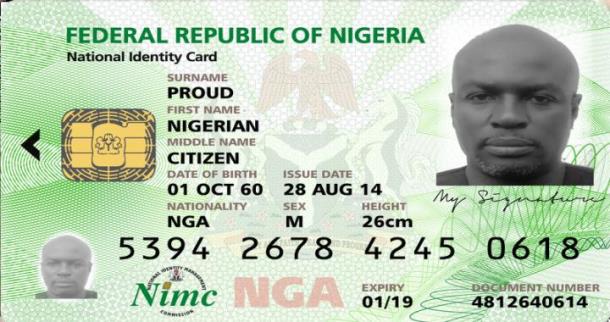
The National Identity Management Commission (NIMC), says payment for issuance of National Identity Card would begin in 2022.
Mr Aliyu Aziz, NIMC Director General, said this at the lunch time reform seminar on National Digital Identity Ecosystem Strategic Road Map for enrollment of Nigerians and legal residents into National Identity Database (NIDB) in Abuja on Thursday.
The event was organised by the Bureau of Public Service Reforms (BPSR) in collaboration with NIMC.
Aziz urged Nigerians to make use of the opportunity to get registered and have an identity.
He said the National e-ID Card can only be issued to Nigerians registered into the national identity system and legal residents who have attained the age of 16 years and above, unlike the National Identification Number (NIN) which is assignable to Nigerians only.
The NIMC boss said the e-ID card can be used for identification, payment and other applications in Nigeria.
According to him, the e-ID card will integrate existing identity database into government institutions and enable everyone to also receive a multipurpose ID card.
“As a government, we recognise the huge importance of moving towards a digital government therefore, we must embrace and harness the potentials inherent in digital identity to build and develop our country.
“Nations all over the world and in particular, developed countries have utilised identity as foundation to transforming governance and enhancing service delivery in the areas of healthcare, agriculture, voting, transportation, financial inclusion, access to basic service and welfare programmes,” he said.
Aziz assured Nigerians that no one would be denied government services on account of not having the National Identity Number (NIN).
“The mandatory enrollment or collection of data by government agencies or licensed agents, along with private sector organisations to be licensed by NIMC under the digital identity ecosystem means fast-tracking of the enrollment process in the national identity system.
“We have a mandate to register all Nigerians and legal residents or at least over 95 per cent of the population within the next three years. It does not necessarily mean that NIMC must have offices or enrollment centres in all nooks and crannies of the country, especially given the current economic situation and realities in our country.
“Instead, in its wisdom the Federal Government approved the new digital identity ecosystem which ensures and mandates all government agencies earlier mentioned and private sector organisations to be licensed by NIMC, to collect citizens’ data using guidelines issued by NIMC through secured approved channels of communication and send such data to NIMC to generate NIN,” he said.
Aziz enjoined Nigerians to take advantage of the NIMC sites to track their e-ID cards from any gadget especially smart phones, tablets, laptops or computers.
“Push the proceed button, fill in your first name and last name as well as your National Identification Number and click on the check now button. Wait for seconds while it is loading and the status of your NIMC card will appear on the display,” he said.
The NIMC boss said Nigerians can now use the USSD for NIN retrieval, adding that the USSD service would enable them to retrieve their NIN conveniently by using any type of mobile phone as it is also available on all mobile networks in the country.
“Dial *346# from the options displayed, select NIN retrieval, by typing in 1, if you are using the same phone number you enrolled with for your NIN.
“Or select NIN Search, by typing in 2, to retrieve your NIN by inputting some of your registered details (if you are not using the same phone number you enrolled with follow the steps displayed on your screen and provide the required inputs.
“Note that using this service attracts a N20 fee only deducted from your phone credit balance,” he said.
Earlier in his open remarks, the Acting Director-General, BPSR Mr Dasuki Arabi said the world is currently facing political, economic, social and technological challenges.
Arabi, who was represented by BPSR Director of Communications, Mr Inyang S Inyang, said the challenges have spurred government institutions to undergo various reforms to cope, address and manage change for improved performance on quality service delivery to citizens.
“Nigeria, like any other country of the world has undertaken various public sector reforms especially since the beginning of democratic rule in 1999.
“Part of the public service reform is to move the public service delivery standards to world class, by refocusing public institutions on the citizens and transforming the public service into a value based and well performing institutions,” he said.



A Federal High Court, Lagos has declared Mrs. Ebele Okpala, a female banker with Keystone Bank, wanted over alleged N35 million fraud.

Apart from declaring the banker who is said to be outside the country wanted, Justice deinde Dipeolu, trial judge in the matter, also directed the Department of State Security (DSS), Nigerian Immigration Service (NIS), and Nigeria Customs Service (NCS), to arrest her upon arriving the country.
Justice Dipeolu made the above order while granting a motion ex-parte marked FHC/L/530C/2024, filed and moved by M. Bello, on behalf of the Nigeria Police.
In the motion, Ebele Okpala and one Perpetual Onyeto, also a banker were listed as first and second defendants/respondents in the suit, while DSS, NIS and NCS were listed as cited parties/respondents.
In urging the court to make the above orders, Bello, informed the court that the application was pursuant to several sections of the Administration of Criminal Justice Act (ACJA) 2015, and under the court’s inherent jurisdiction. Adding that the application was supported by an affidavit deposed to by Inspector Tope Akerele of the Force Criminal Investigation Department (FCID), Special Fraud Unit (SFU), Ikoyi, Lagos.
In granting the application, Justice Dipeolu held, “After considering the application and the supporting affidavit, the request had merit and granted all the reliefs sought by the prosecution.
“That an order is hereby made that the 1st defendant/despondent be declared wanted and placed on the wanted list of the Nigeria Police Special Fraud Unit, 13, Milverton Road, Ikoyi, Lagos until she is arrested.
“That an order is hereby made compelling cited parties/respondents to assist in apprehending 1st defendant/Respondent once he enters into the country.
“That an order is hereby made permitting the Publication of the name of the 1st defendant/despondent in the National Daily Newspapers and Social Media handles by the Nigeria Police Special Fraud Unity Ikoyi, Lagos for the purpose of fulfilling the requirement of the Order 1 above.”
Recall that both the wanted banker and the second defendant/respondent were previously arraigned before the court by the operatives of the police Special Fraud Unit, PSFU.
Specifically, the two bankers were arraigned before the court sometimes in September 2024, on alleged conspiracy, theft, money laundering, fraudulent lift of lien placed on bank’s customer’s account and obtaining the sum of N35 million by false presence.

The United Kingdom has announced expanded collaboration with Nigeria to accelerate the country’s digital economy through a package of initiatives delivered under the UK’s Digital Access Programme.

At the heart of this partnership is the State-level Policy, Regulatory and Institutional Reforms Enabling Digital Transformation (SPRIRET) initiative which was announced during the June visit of the UK Minister for Africa and International Development, Baroness Chapman MP.
The SPRIRET Project is designed to support reforms across five states: Abia, Edo, Ekiti, Enugu and Niger, and to reduce regulatory barriers and unlock greater investment and innovation in broadband, digital services, and emerging technologies. The UK will look to support more states in future iterations of the project.
SPRIRET will work with Initiative for Digital Inclusion to strengthen state-level policies, governance systems, digital infrastructure and human capacity to improve service delivery, increase transparency, and expand citizen access and participation in the digital economy.
The project is designed as a scalable model for nationwide replication, enabling states to generate new economic opportunities and support inclusive digital transformation at scale.
British Deputy High Commissioner, Mr. Jonny Baxter said: “The UK is proud to partner with Nigeria to drive an inclusive and innovative digital economy. Through initiatives like SPRIRET, we are supporting practical reforms that will unlock investment, strengthen institutions, and expand digital access, creating opportunities for businesses and citizens alike. This partnership reflects our shared ambition to harness technology for sustainable growth.”
Prof. Chidiebere Onyia, Secretary to the State Government, Enugu State said: “We wish to express our sincere appreciation to the British Deputy High Commission and the Foreign, Commonwealth and Development Office (FCDO) for the sustained interest in Enugu State’s development agenda and for the initiative in co-designing the SPRIRET project in response to the State’s priorities.
“We are satisfied that the SPRIRET project addresses a critical gap at the level of policy, regulatory, and institutional reform – areas that are foundational to giving lasting direction and effectiveness to all current and future digital investments in the State. We look forward to a productive and impactful partnership that will significantly advance Enugu State’s vision of an inclusive digital economy.”
Alongside SPRIRET, the UK is supporting targeted interventions to strengthen Nigeria’s wider digital ecosystem. A Technical Assistance Facility will enhance the performance of the Universal Service Provision Fund, improving its systems, institutional capacity and delivery to ensure more inclusive and sustainable digital access outcomes.
In parallel, the Safeguarding Trust, Digital Rights, Inclusion and Data Ethics (STRIDE Nigeria) Project will promote responsible data governance by raising awareness of rights under the Nigeria Data Protection Act, strengthening institutional compliance, and building a pipeline of skilled professionals.
Through a nationwide “Own Your Data” campaign and targeted fellowships, the initiative will equip citizens and businesses with the knowledge and tools to participate safely and confidently in the digital economy.
Together, these initiatives demonstrate the UK’s continued commitment to supporting Nigeria in building a more inclusive, secure and dynamic digital economy – unlocking growth, strengthening institutions, and empowering citizens.

Nigerian Army has warned that terrorist and criminal groups were increasingly exploiting cyberspace to recruit members, raise funds, coordinate attacks and spread propaganda, describing the trend as a growing threat to Nigeria’s national security.

Lt.-Gen. Waidi Shaibu, chief of Army Staff (COAS), raised the alarm on Tuesday at the 2026 Nigerian Army Cyber Warfare School Seminar in Abuja.
Represented by Maj.-Gen. Jeremiah Manjang, deputy chief of Special Services and Programmes, the Army Chief said cyberspace has evolved into a strategic battlefield where both state and non-state actors operate with unprecedented speed, making security threats more complex and difficult to counter.
He noted that hostile actors no longer require physical presence to disrupt critical infrastructure, compromise sensitive information, manipulate public opinion or undermine national security through anonymous cyber attacks.
According to him, terrorism, insurgency, banditry, kidnapping, separatist agitations, organised crime, misinformation and disinformation are increasingly being enabled, coordinated and amplified through digital platforms and cyber networks.
“The reality is that terrorist and criminal groups now exploit cyberspace for recruitment, propaganda, fundraising, intelligence gathering, attack coordination and concealment of illicit financial transactions. This demands a proactive and coordinated national response,” he said.
Shaibu said the changing nature of security threats had compelled the Nigerian Army to strengthen its cyber capabilities to effectively address complex, asymmetric and technology-driven challenges.
He called for stronger cyber intelligence capabilities driven by artificial intelligence (AI), machine learning and advanced data analytics to improve early warning systems, threat detection and predictive security analysis.
The COAS also advocated deeper collaboration among government institutions, the military, law enforcement agencies, academia and the private sector, stressing that cybersecurity can no longer be handled by a single institution.
He emphasised the need for sustained investment in indigenous cyber capabilities, research, technological innovation and human capacity development to protect Nigeria’s digital sovereignty and enhance national resilience against emerging threats.
Shaibu further stated that integrating cyber capabilities into conventional military operations would strengthen surveillance, intelligence gathering, geospatial analysis, command-and-control systems, situational awareness and overall operational effectiveness.
Earlier, Brig.-Gen. Jacob Bawa, commandant of the Nigerian Army Cyber Warfare School, said the seminar was organised to deepen cybersecurity awareness, strengthen cyber resilience and promote collaboration among security stakeholders.
Bawa noted that Nigeria’s increasing reliance on digital technologies has exposed critical infrastructure, including telecommunications, power systems, financial institutions and government databases, to cybercriminals, terrorists and hostile state actors.
He said the Cyber Warfare School was established as a centre of excellence for cyber warfare training, education and research.
According to him, participants at the seminar would examine cyber resilience, threat intelligence, incident response, cyber warfare and emerging technologies with a view to developing practical recommendations for strengthening Nigeria’s cybersecurity architecture.
Also speaking, Abdulhakeem Ajijola, cybersecurity expert, warned that national security now depends significantly on the protection of digital systems, noting that artificial intelligence is transforming military operations, command structures and the protection of critical infrastructure.
Ajijola urged Nigeria to develop sovereign cyber capabilities, warning that excessive dependence on foreign-controlled software, platforms and artificial intelligence systems could undermine national resilience, operational continuity and independent decision-making during periods of crisis.
He stressed that while technology should be deployed to strengthen national sovereignty, responsibility for operational decisions must remain with human commanders.

Court Declares Keystone Bank Staff Wanted over Alleged N35m Fraud

IMF Raises Concerns over N8.83 Trillion Unreported Spending in Nigeria’s Budgets

NOTAP to Commercialise University Research, Expands Patent Drive

FG Unveils Digital Postcode System for MDAs

BoI, NBCC Sign MoU to Deepen Bilateral Trade, Industrial Growth and Investment

Mobile Internet Gender Gap Widest in Africa – GSMA

London Strengthens Global Investment Ties with Africa @ First Ever London-Africa Business Summit

FG Targets Alleged N3tn Capital Flight, Opens Airtime Credit Market to Nigerian Fintechs

Japan, UNESCO Boost Digital Learning in 15 CoEs with Donation of ICT Equipment

Nigeria Launches FreeTV Nationwide




 News2 days ago
Verve Strengthens Global Acceptance Across Leading Digital Platforms

 News2 days ago
Army Says Terrorists Now Recruiting, Raising Funds Online

 Telecom2 days ago
Lebara Nigeria Becomes Member of GSMA Network

 E-Business2 days ago
Kaspersky Warns of The Gentlemen Ransomware Group Expanding Operations with New Malware

 Telecom2 days ago
Airtel Nigeria Deepens Focus on Data Usage Transparency @ Customer Forum

 Telecom2 days ago
Vitel Wireless Warns Public, Says it Not Running any Investment Scheme

 E-Financial2 days ago
Bank of Industry Appoints Kuramo Capital as Manager of Dice Fund of Funds

 General News2 days ago
FG to Abolish JSS-SSS Separation Policy after 20m Pupils Drop Out