

General News
Philips Renovates, Deploys Mobile Ultrasound at OriIyanrin Healthcare Centre

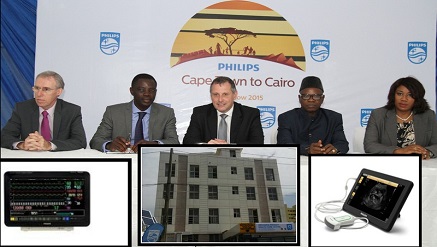
On the occasion of Philips’ sixth consecutive Cape Town to Cairo roadshow, Philips in collaboration with OriIyanrin Primary Healthcare (PH) Center popular known as the “Healthcare Centre”) unveiled an extensive overhaul and refurbishment of the mother and child care facilities at the Healthcare Centre.
Essentially, Philips upgraded the facilities in the labour, paediatric and new born baby wards, designing them to support the well-being and recovery of expectant mothers and their new born babies.
It is anticipated that over time, as a result of this pioneering project, many lives will also be saved.
The Healthcare Center, located in Iru/Victoria Island, LCDA, Lagos, has a very high patient in-flow with an average of 300-400 outpatients per month, as well as 30-40 follow up appointments per week.
The Healthcare Center records an average of twenty (20) births per month. The labour, pediatric and new born units in the Healthcare Center prior to the refurbishment were in need of an upgrade.
The Healthcare Center is the largest amongst three primary healthcare centers in the district- Oniru Primary Health Centre and TakwaBay Island Primary Health Centre being the other two; all of which have minimal manpower.
Therefore the upgrading of the Healthcare benefit all three centers, and enable them to provide more efficient patient care.
Calming Environment for Mothers and Babies
The project, undertaken by Philips has resulted in a complete overhaul and renovation of existing mother and child care facilities.
Philips began by painting and decorating the wards in order to create a serene and calming environment; Philips has also installed new toilets, tables, chairs, beds and cabinets.
In addition, all the light fittings have been retrofitted with the latest Philips LED lighting solutions; LED lighting enables rest and recovery, as it’s not as harsh as conventional fluorescent lighting, it requires minimal maintenance and also helps to reduce energy consumption.
Earlier, due to frequent power outages as well as poor and sporadic lighting, doctors found it very challenging to deliver babies at night time, this problem is now eliminated.
This new innovative solar LED lighting provides safe and uninterrupted illumination, while saving costs.
Philips has also invested in landscaping and beautifying the roundabout and streets surrounding the Healthcare Centre; all elements to provide a clean and attractive area, as well as easy access to the Healthcare Center.
Installing lifesaving Innovations
To further improve the maternal health and child care facilities, Philips has also provided the Healthcare Centerwith a range of its innovative solutions, many of which have been developed specifically with African conditions in mind.
Innovative Ultra-Mobile Ultrasound
Noticing the lack of basic ultrasound in the labour ward, Philips has equipped the Healthcare Center with its innovative ultra-mobile ultrasound system VISIQ; the size of a tablet, the VISIQ is the first ultra-mobile system from Philips.
VISIQ’s unique combination of mobility, ease of use and image quality, will enable clinicians in the Healthcare Centre to carry out comprehensive obstetric and abdominal scans themselves rather than referring patients to larger ultrasound centers or hospitals. This enables fast diagnosis and treatment.
Approximately ten times smaller than a traditional ultrasound machine and with reduced energy consumption, VISIQ can be used for screening, triage and fetal well-being scans, all of which helps to address the critical issue of maternal and infant care in Nigeria.
Monitoring with Assurance
In addition, Philips has also installed its Efficia Patient Monitor in the Healthcare Center.
Designed to be both portable and intuitive, and using time-tested physiological measurement algorithms the Efficia monitor will empower staff at the Healthcare Centre with actionable, care-specific information required to make patient management decisions and provide fast and efficient patient care.
Furthermore, to ensure proper usage of the technology, Philips is conducting an extensive training workshop at the Healthcare Center for midwives, maternity nurses, obstetricians and ultrasound practitioners; the objective is to provide hands-on application training, as well as a clinical refresher course on where to look and what to look for, and how to use this information to guide diagnoses and treatment decisions.
For new mothers and soon-to-be mothers in the Healthcare Center, Philips will be hosting demonstrations by experts on the importance of breast feeding and learning the correct techniques to enable comfort and ease for both infant and mother.
Breastfeeding is fundamental to reducing infant mortality. It can protect against common childhood infections such as neonatal sepsis.
According to the WHO (World Health Organization), exclusive breastfeeding for a baby’s first six months and partial breastfeeding into a child’s second year, reduces a child’s chances of succumbing to several preventable illnesses including diarrhoea and acute respiratory tract infections.
Maternity Screening Camp to Enable Early Detection of Complications
As per previous years, Philips is setting up a maternity screening camp during the Nigerian phase of the Cape Town to Cairo roadshow.
The screening camp at the Healthcare Center will give expectant mothers in the local community the opportunity to avail themselves of a free ultrasound screening. For the majority of the women in the area this will be their first time to have a scan during their pregnancy.
A pre-natal screening ensures that any complications can be detected in advance of labour; if any of the women require further medical attention they will be taken care of immediately at the Healthcare Center.
Speaking on these development, at the inauguration of the refurbished facilities, Robin Armstrong, general manager, Philips Healthcare, West Africa said, “It gives me great pleasure to unveil the renovation of the mother and child care facilitates at the Healthcare Center. This project will hopefully ease the burden for the healthcare workers in the district, and in time save many lives as well. Most expectant women visiting this facility can now have access to care which will help to keep both them and their babies healthy.”
Armstrong added that, “Since the beginning of the Philips Cape Town to Cairo roadshow we have continually sought to champion the UN Millennium Development Goals 4 and 5 (MDGs), related to reducing child mortality and improving maternal health.
“Our commitment to Mother and Child Care in Africa is unwavering – as the Sustainable Development Goals (SDGs) supersede the MDGs our focus will remain the same, and we will continue to advance healthcare in Africa, providing solutions, innovations and collaborations that bring meaningful change.”
On his part, Dr Wale Akeredolu, medical officer health, Public Health and Primary Health Centre Department, Iru /Victoria Island LCDA commented on the refurbishment thus, “The impact this project will have on our district cannot be overstated. Community Healthcare Centers are generally under resourced and sparsely equipped with technology. Our Healthcare Center is no different in this regard, and in particular our mother and child care facilities have been under enormous pressure in recent years. We are delighted to have collaborated with Philips, as this project will breathe new life into our Healthcare Center and enable us to improve care for our patients.”
Fourth Stop on the Sixth Cape Town to Cairo Roadshow
The announcement of the OriIyanrin Primary Healthcare Center formed part of Philips’ annual pan-African Cape Town to Cairo roadshow that kicked off on 11th May 2015, in Cape Town.
Nigeria is the fourth stop on a journey covering 12,000 km across 11 cities and 8 countries over a period of 4 to 5 months.
The roadshow has gained significant momentum over the past five years, allowing Philips to get to the heart of some of the key issues facing Africa – including Mother and Child Care, the rise of non-communicable diseases, energy efficient LED and solar lighting solutions, as well as shining a spotlight on the need for clinical education and training.
Last year when the roadshow stopped off in Nigeria, Philips unveiled a stunning LED lighting makeover of the well-renowned Nigerian National Arts Theater in Lagos, one of the most iconic buildings in the city.
Royal Philips is a diversified health and well-being company, focused on improving people’s lives through meaningful innovation in the areas of Healthcare, Consumer Lifestyle and Lighting.
Headquartered in the Netherlands, Philips posted 2014 sales of EUR 21.4 billion and employs approximately 108,000 employees with sales and services in more than 100 countries.
The company is a leader in cardiac care, acute care and home healthcare, energy efficient lighting solutions and new lighting applications, as well as male shaving and grooming and oral healthcare.


General News
Union Bank Looted: How Former Directors Gambled with Billions and Nearly Destroyed a National Bank


The former directors and owners of Union Bank did not just fail, they engineered a financial disaster. They manipulated reports, hid massive losses, diverted foreign loans and treated depositors’ money like a private wallet.

Union Bank
Investigators uncovered billions of dollars in misconduct. These directors buried over ₦250 billion in losses, piled a $300 million foreign loan onto the bank without protection and then forced Union Bank to carry the burden. They even used the bank’s own funds to buy its shares, an outrageous betrayal of trust.
It didn’t stop there. Over $100 million was pulled out improperly, leaving the bank exposed and struggling. Loans meant for customers were secretly diverted into shady transactions. False reports were sent to lenders. The system was deliberately deceived.
This was not incompetence. It was exploitation.
By 2025, their actions had created nearly ₦400 billion in losses and over ₦147 billion in unpaid charges. The bank was on the edge.
The Central Bank of Nigeria (CBN) stepped in just in time. Without that intervention, Union Bank could have collapsed, dragging others down with it.
Now, the bank is stabilising. But let’s be clear: this recovery is happening in spite of those former directors, not because of them.
They didn’t build value. They destroyed it.
And Nigerians deserve to never forget who was responsible.


Federal government, The European Union (EU), and the United Nations Industrial Development Organisation (UNIDO) have called for urgent and coordinated action to curb food waste and promote sustainable consumption and production practices.

They warned that when food is wasted, the water, energy, and labour invested in its production are also lost, accelerating climate change and undermining global efforts to build a zero-waste, circular economy.
Speaking in Abuja at the commemoration of this year’s International Zero Waste Day, themed “Food Waste Reduction: Minimisation and Valorisation,” Zissimos Vergos, deputy Ambassador of the EU Delegation to Nigeria and ECOWAS, disclosed that Nigeria wastes approximately 38 million tonnes of food annually, more than any other country in Africa.
He further noted that globally, in 2022 alone, nearly one billion tonnes of food—almost one-fifth of all food available to consumers—was wasted.
“This is not just a loss of food; it is a squandering of precious resources, a missed opportunity to combat hunger, and a direct threat to our planet’s health,” he said.
Vergos stressed that food loss and waste are major drivers of environmental degradation, contributing up to 10 per cent of global greenhouse gas emissions—nearly five times the emissions of the entire aviation sector—and accounting for as much as 40 per cent of global methane emissions.
Highlighting Nigeria’s ongoing efforts, he said: “The Nigeria Circular Economy Roadmap, the establishment of the Interministerial Circular Economy Committee, the push to develop a National Plastic Waste Management Regulation, these are not small gestures. These are structural shifts.
“They signal that Nigeria is not waiting for someone else to solve its problem; it is building the system to solve it from within. Now, today’s theme: food waste reduction, minimisation and valorisation, is the right conversation at the right moment.”
Vergos also shared three key lessons from the EU’s experience to support Nigeria’s efforts. First, he urged investment in rural infrastructure, including roads, storage, and cold chains, to address post-harvest losses beyond the farm gate. Second, he emphasised the need to promote agro-processing by converting fresh produce into value-added products such as tomato paste and cassava flour, while linking smallholder farmers to processors and markets.
Third, he called for embedding zero-waste principles, recycling, and resource efficiency into school curricula from the primary level to foster a culture of sustainability among future generations.
Reaffirming the EU’s commitment, he stated, “The EU stands ready to be your partner in that work, through funding, through technical cooperation, and through genuine solidarity.”
In his keynote address, Balarabe Abbas Lawal, minister of Environment, reiterated the Federal Government’s commitment to environmental protection and sustainable practices aimed at safeguarding the health and well-being of Nigerians.
“Food waste remains a significant challenge that affects not only our environment but also our economy and society. Every discarded meal represents wasted resources such as water, energy, labour, and capital, while Nigerians continue to face food insecurity.
Addressing food waste is therefore central to sustainable development and ensuring a healthier future for all,” he said.
He added: “The Federal Ministry of Environment, in this year’s national appropriation, has developed projects on food waste elimination in major markets around Nigeria. And this is to show you that the Federal Ministry of Environment is tackling the issues of food waste at its core, especially post-harvest losses.”
Stressing the broader impact, he noted that addressing food waste aligns with the Ministry’s core objectives. “Reducing food waste will not only help to lower pollution and greenhouse gases, but also conserve valuable resources and promote more efficient and responsible consumption patterns across households, businesses, and institutions,” he added.
Also speaking, Amb. Philbert Johnson, Director and Representative of UNIDO’s Sub-Regional Office in Nigeria, emphasised that food must not be wasted, especially in a country grappling with food insecurity and malnutrition.
“Food is far more than a commodity: it is a foundation of wealth, a driver of health, and a pillar of security. It sustains our homes, supports industries, and underpins the stability of our societies.
“When food systems function efficiently, they generate income, enhance resilience, and improve well-being. When food systems fail, when food is lost or wasted, the consequences ripple across our economies, our environment, and our communities.”
He reaffirmed UNIDO’s commitment to supporting Nigeria in building resilient, inclusive, and sustainable agro-industrial systems.

President Bola Ahmed Tinubu has directed the immediate installation of 5,000 CCTV cameras across identified flashpoints in Plateau State as part of urgent measures to address the worsening security situation in the state.

The President gave the directive during an emergency visit to Plateau on Thursday, where he held a brief stakeholders’ meeting at the Yakubu Gowon Airport following the recent killings in Angwan Rukuba, Jos, where at least 28 persons were killed by unidentified gunmen.
Tinubu also approved the formation of a delegation of key stakeholders to engage in further deliberations on lasting solutions to the security challenges in the state.
He condoled with families of the victims and directed that support be provided to cushion their losses.
President Bola Tinubu while expressing deep sympathy to families of victims said the installation of surveillance cameras was part of a deliberate move towards addressing the kind of attacks that befell residence of the recent attack in the State.
In his remarks, Governor Caleb Mutfwang appreciated the President’s visit and show of concern, but expressed worry over the recent wave of attacks in the state, describing the situation as disturbing and requiring urgent attention.
The meeting had in attendance, former Governors, serving and former National and State Assembly members, traditional rulers, government appointees as well as relatives of those killed in the Angwan Rukuba attack.

Union Bank Looted: How Former Directors Gambled with Billions and Nearly Destroyed a National Bank

N4.65 Trillion in the Vault, but is the Real Economy Locked Out?

FG, Others Say Nigeria Wastes 38m Tonnes of Food Annually

Ecobank Assures of Seamless Easter Banking Services

Anchor Gets Nigerian, Canadian Licences as Transactions Crosses $2.5Bn

Spotify’s Loud & Clear Report Reveals Over ₦60Bn Revenue for Nigerian Artists in 2025

Madonna University Taps Tech Guru Adote for Strategic Board Role

China Threatens to Shut Nigeria’s Satellite Over $11.44m Unpaid Debt

FCCPC Bans Lagos ‘No Refund’ Policy, Vows Fines and Shutdowns for Traders

Healthcare Under Attack: Why Cybersecurity is Now Critical Care




 E-Financial3 days ago
CBN Says 33 Banks Raise Fresh N4.65 Trillion in Recapitalisation Exercise

 Telecom3 days ago
NITDA Urges Joint Action to Drive Nigeria’s Digital Innovation

 E-Business3 days ago
Cybersecurity Firm Uncovers CrystalX RAT which Steals Data, Mocks its Victims

 Telecom3 days ago
NCC Insists Telcos Must Compensate Subscribers for Poor Quality of Service

 Telecom3 days ago
Oracle Corporation Axes 30,000 Workers in Brutal AI Shake-Up

 E-Business3 days ago
Oracle Sacks 12,000 in India, Begins Shift to AI

 E-Financial3 days ago
Nigeria, Others Lose $88bn Yearly to Illicit Flows —Edun

 E-Financial2 days ago
UBA Beefs Up Mobile App Security to Stop Fraudulent Debits, Withdrawals