

E-Financial
Polaris Bank Champions Accelerating Action at International Women’s Day Seminar


Polaris Bank has reaffirmed its commitment to gender equality and women’s empowerment through its International Women’s Day (IWD) Seminar, themed: “Accelerating Action: Breaking Barriers & Creating Equal Opportunities”.

The event provided a platform for thought leaders, professionals, and advocates to emphasize the urgent need to accelerate action towards gender equality by breaking barriers and creating equal opportunities for women across all sectors.
Speaking at the event, Polaris Bank’s Executive Director, Mrs. Abimbola Ozomah conveyed greetings from the Managing Director/CEO, Management, and Staff of the Bank, highlighting the importance of the day. “International Women’s Day is a moment to recognize the remarkable achievements, contributions, and struggles of women throughout history and across all sectors of society. However, it is also a call to action. This year’s theme, ‘Accelerate Action,’ urges us to take swift and decisive steps toward achieving gender equality by breaking down systemic barriers and biases that hinder women’s progress.”
Reinforcing Polaris Bank’s commitment to gender inclusivity, Mrs. Ozomah, stated, “At Polaris Bank, we believe that real progress happens when organizations go beyond conversation and actively implement policies that support women’s growth.
“Empowering women and ensuring their inclusion in every sphere of society, is at the core of our values. This seminar is part of our broader mission to create an inclusive and equitable society for all.”
The seminar featured an insightful conversation with industry experts who shared practical strategies for overcoming systemic barriers, fostering leadership opportunities, and enhancing financial inclusion for women.
In her experience sharing session, Ayaba M. Ayo-Joseph, a Non-Executive Director with Polaris Bank, advocated that women should be supportive of each other, stating, “We as women should help each other and not bring each other down. These efforts should not be restricted to just International Women’s Day or a day just in March. This should be practiced all the time.
She also shared 8 Ways to Accelerate Action for women’s empowerment.
Economic independence for women, stepping out into leadership roles as we need more women in leadership positions, advocating for gender-friendly workspaces, being a mentor to uplift others, practicing self-care, creating safe spaces for women, collaborating with other women to build strength in unity, and being digitally savvy to leverage technology for growth.
She concluded her session with a powerful reminder to womenfolk saying: “The change we wish to see starts with us. Let’s keep pushing the boundaries and support each other as we go.”
Mrs. Subulade Giwa-Amu, a Non-Executive Director, Polaris Bank, stated the role of character and purpose in achieving success, saying, “Success is built on character, resilience, and purpose. Challenges will arise, but integrity is the key to overcoming them.”
She also highlighted the importance of financial independence and self-investment, adding, “Financial independence starts with vision and focus. Work-life balance is essential, but prioritization is crucial at different stages of life.”
She further advised women to continuously invest in themselves, saying, “Invest in yourself, continuous learning and personal growth are non-negotiable for success.” Speaking on women’s empowerment, she urged collaboration over competition: “There is room for everyone at the top. Women must support and uplift each other, rather than compete unnecessarily.”
Tolulope Makinwa-Adeniyi, Executive Director, Muazu Africa, reiterated the power of relationships and personal development: “Relationships are invaluable. Express admiration, nurture connections, and build a network that will open doors for you.” She also encouraged personal growth, saying, “Do the hard things, growth comes from embracing challenges, stepping out of comfort zones, and pushing beyond limitations.”
She further stressed the importance of Mastery, stating, “Mastery is power. Stay ahead by continuously upgrading your skills, embracing new technologies, and refining your expertise”. Calling for a mindset shift, especially amongst the school girls from the five selected schools in Lagos state present at the event. She remarked, “The ‘Cinderella Complex’ must end—women don’t need to be saved; they need to take charge of their own destinies.”
Ndidi Ukaonu, director of Parthian Partners, called for action over conversation: “It’s time to move beyond discussions about gender equality and start implementing real change.”
She encouraged individuals to define their impact and take ownership of their success, challenging them to ask, “What am I known for? What legacy am I building? How am I contributing to change?”
She also reinforced the need for confidence and taking initiative, saying, “Stop waiting for permission to be great—own your power and walk in it.” Closing with a rallying call, she urged participants to, “Accelerate action, break barriers, and create opportunities. The world is waiting for you to step up. The time is now”.
Polaris Bank remains steadfast in its mission to drive change, ensuring that women are not only heard but also empowered to lead.


Central Bank of Nigeria (CBN) has been named Central Bank of the Year 2026 by an awards committee in London.

The award recognises the bank’s major reforms that helped stabilise Nigeria’s economy and improve investor confidence.
The award is part of the 13th annual Central Banking Awards. It highlights how the CBN helped turn around Nigeria’s economy, which was close to crisis in 2023.
At that time, Nigeria faced serious problems such as high inflation, a weak currency, low foreign reserves, and about $7 billion in unpaid foreign exchange obligations.
There was also a big gap between official and black-market exchange rates.
After Olayemi Cardoso was appointed governor in October 2023 by Bola Ahmed Tinubu, the CBN introduced strong reforms. These reforms focused on proper monetary policies, transparency, and market-based systems.
One major change was in the foreign exchange system.
The CBN removed multiple exchange rates and introduced a “willing-buyer, willing-seller” system. This made the market more transparent and reduced manipulation.
The bank also cleared old foreign exchange debts owed to sectors like aviation and manufacturing.
This helped restore trust in the economy. By late 2025, the gap between official and black-market exchange rates dropped to less than 2%.
Nigeria’s foreign reserves also improved, rising to $46.7 billion by November 2025 the highest level in almost seven years.
This was due to better foreign exchange inflows, stronger exports, and renewed investor confidence.
The International Monetary Fund praised these reforms, saying they improved the foreign exchange market and made pricing more reliable.
Inflation, which peaked at 34.8% in December 2024, dropped to 15.1% by January 2026. The CBN achieved this by raising interest rates and carefully managing the economy.
The bank also improved its internal operations. It stopped some programmes that were increasing money supply and causing inflation.
It strengthened its systems, improved compliance, and introduced digital tools, including artificial intelligence.
In the banking sector, the CBN introduced new rules requiring banks to increase their capital. This is expected to make the financial system stronger.
Nigeria also improved its fight against financial crimes. In 2025, the country was removed from a global watchlist for money laundering after improving its monitoring systems.
These reforms boosted Nigeria’s global image. Credit rating agencies upgraded the country’s outlook, and investor interest increased. Nigeria’s 2025 Eurobond attracted more than five times the expected subscriptions.
Although progress has been made, the CBN says challenges still remain, such as maintaining low inflation and completing banking reforms.
Overall, the award shows that Nigeria is regaining its position in the global financial system, thanks to strong policies and reforms by the CBN.

Providus Bank Limited has dispelled media reports over its compliance with regulatory capital requirements, confirming that it has successfully met and exceeded the recapitalisation threshold set by the Central Bank of Nigeria (CBN).

In a statement, the bank clarified that under the CBN’s recapitalisation framework, regional commercial banks are mandated to maintain a minimum capital base of N50 billion, stating unequivocally that it achieved this benchmark as far back as January 2025 and has since strengthened its financial standing.
According to the bank, its current paid-up capital stands at N65 billion, significantly above the regulatory minimum, underscoring its resilience and commitment to sound financial management.
The bank noted that this strong capital position places it in good stead to support its growth strategy and continue delivering value to customers and stakeholders.
Providus Bank emphasied that any suggestion implying non-compliance with the CBN’s recapitalisation requirement was inaccurate and does not reflect its current regulatory status.
The bank reiterated its dedication to maintaining robust governance standards and aligning with all prudential guidelines set by the apex regulator.
It explained: Providus Bank Limited notes recent media reports regarding the recapitalisation status of certain banks and considers it important to provide factual clarification as it relates to the Bank. Under the CBN recapitalisation framework, regional commercial banks are required to maintain a minimum capital base of N50 billion.
“Providus Bank confirms that it had met its capital requirement since January 2025 and currently has a capital base of N65 billiom which is in excess of its capital requirement.
Accordingly, any suggestion that Providus Bank has not met the applicable recapitalisation threshold is not consistent with its current regulatory standing.”
The Olayemi Cardoso-led Central Bank of Nigeria (CBN) had, on March 28, 2024, announced a two-year bank recapitalisation exercise which commenced on April 1, 2024.
The 24-month timeline for compliance ends on March 31, 2026. The upward capital revision is expected to ensure that Nigerian banks have the capacity to take on bigger risks and stay afloat amid both domestic and external shocks.
Specifically, the recapitalisation exercise requires a minimum capital of N500 billion, N200 billion, and N50 billion for commercial banks with international, national, and regional licences, respectively.
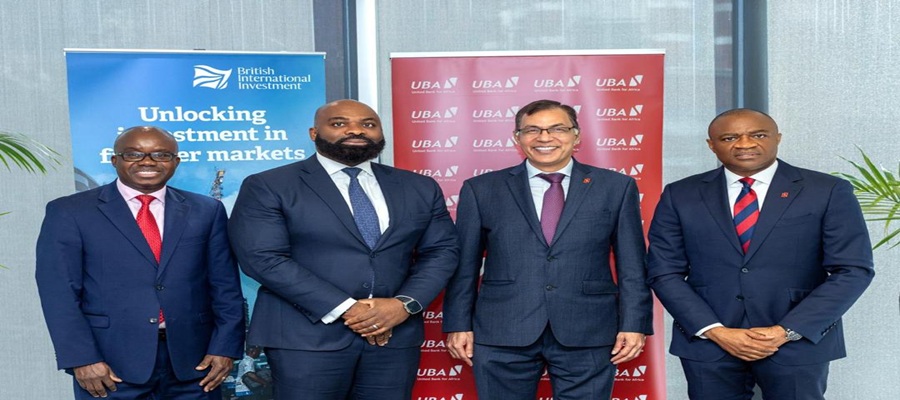
United Bank for Africa (UK) Limited (“UBA UK”) and British International Investment plc (“BII”), the UK’s development finance institution and impact investor, today announced that they have signed a letter of intent to develop trade finance collaboration opportunities. The proposed initiative aims to expand access to trade and working capital facilities for businesses operating across Africa.

L-r: West Africa Director and Head of Office Africa Coverage, BII West Africa, Benson Adenuga; Managing Director and Head of Africa, BII, Chris Chijiutomi; Lok Mishra, Chief Executive Officer, UBA UK, Loknath Mishra; Group Managing Director, United Bank for Africa (Plc) during the signing of letter of intent to develop trade finance collaboration opportunities.
Access to trade finance remains one of the most significant structural constraints on African trade. Businesses – particularly small and medium-sized enterprises – are frequently unable to secure letters of credit, guarantees, and supply chain finance on commercially viable terms, limiting their capacity to export and import competitively. This trade finance gap is estimated by the African Development Bank to be over USD 80 billion annually.
To help close this gap, UBA UK, the London subsidiary of UBA Group, Africa’s Global Bank, will leverage its deep relationships across the Group’s 20-country African network to originate and structure trade finance transactions. While BII, with a mandate to support productive, sustainable, and inclusive growth across Africa, can support transactions that might otherwise fall outside conventional commercial appetite.
Lok Mishra, Chief Executive Officer, UBA UK, said: “The signing of this letter with BII represents a landmark moment for UBA UK and for the UBA Group’s global ambitions. As the Group’s hub for Trade Operations, UBA UK is uniquely positioned to connect African businesses with the international financial system.
“Working alongside BII, we can extend that capability further — mobilising capital where it matters most and helping to close the trade finance gap that holds back so much African potential.”
Chris Chijiuitomi, Managing Director and Head of Africa, said: “British International Investment is committed to catalysing private sector growth across Africa, and trade finance is a critical enabler of that growth.
“We welcome the opportunity to collaborate with UBA Group, whose pan-African network and deep institutional relationships can help advance our ambition to expand access to trade and working capital finance, particularly in frontier markets.”
The announcement builds on growing momentum around intra-African trade facilitated by the African Continental Free Trade Area (AfCFTA), which entered into force in 2021 and represents one of the world’s most ignificant trade integration initiatives.
Both institutions have identified the operationalisation of AfCFTA as a priority catalyst for a trade finance facility, with UBA UK’s network across major AfCFTA economies offering a basis for supporting businesses navigating the emerging continental market.
This also complements the UK Government’s broader engagement with African economic development, including commitments made at the UK-Africa Investment Summit, and reinforces the City of London’s role as a leading international finance centre for Africa-focused capital mobilisation.
Future cooperation remains subject to further assessment, due diligence and the completion of internal approvals by both parties.

Tech Firms Sack over 45,000 so Far in 2026

CBN Wins Central Bank of the Year Title @13th Global Awards

Jury Finds Elon Musk Liable for Misleading Twitter Investors

FG Taps Quest Merchant Bank for Advisory on 90,000km Fibre Project

TEF-Backed Entrepreneurs Generate $4.2Bn, Create 1.5m Jobs across Africa

Kaspersky Discovers New Phishing Campaign Exploiting Google Tasks Notifications to Steal Corporate Credentials

esentry 2025 Report Shows Healthcare, Financial Services and Telecoms as Staging Grounds for Increased Cyberattacks in Africa

AfDB, UNDP Launch $10Bn AI Initiative for Africa

MultiChoice Suspends Yearly DStv Price Hike as Canal+ Pushes Growth

MTN Nigeria Posts Record N1.70 Trillion Pre‑Tax Profit, Declares N20 Dividend for 2025




 News2 days ago
African Tech Start-ups to Receive $46m of Speedinvest Africa Fund

 Telecom2 days ago
Court Bans Kenyan Telcos from Recycling SIM Cards

 E-Financial2 days ago
Providus Bank Fully Meets CBN Capital Requirement, Sets Record Straight

 E-Financial2 days ago
UBA UK, BII Sign Letter of Intent to Slash Africa’s $80Bn Trade Finance Gap

 Telecom2 days ago
Binance Earn: Simple Way to Earn Rewards on Idle Crypto Holdings

 News2 days ago
UK, Nigeria Unveil Three-Year Plan to Combat Immigration Crime

 News2 days ago
U.S. Charges Three in $2.5 Billion Plot to Smuggle Nvidia AI Chips to China

 General News2 days ago
Court Jails ‘Colonel’, ‘Major’ of Global Money-Laundering Ring