

News
Poor Data Hinders Nigeria’s Growth- Tinubu


President Bola Ahmed Tinubu has hinted at plans by his administration to address what he termed historical inadequacies of policy making hitherto thwarted by a lack of comprehensive data in Nigeria.

Bola Ahmed Tinubu
He regretted the lack of comprehensive data, saying it had been “a technological affliction” that has hindered the growth trajectory of Nigeria and the entire Africa, impeding the ability to make informed governance decisions.
President Tinubu disclosed this during the 2023 Comptroller-General of Customs Annual Conference at Lagos Continental Hotel, Victoria Island, Lagos, saying because data is the guiding light in the ever-evolving landscape of the modern world, Nigeria can no longer afford to function in the dark.
The President who was represented at the conference by Vice President Kashim Shettima, noted that the grand vision of his administration is to deploy data to make sound government decisions.
Shettima in a statement by Stanley Nwocha, his spokesman, described Tinubu as an “accounting virtuoso” with an unparalleled understanding of data and its significance to piloting the affairs of the country, noting that it is due to his knowledge of data as the invaluable gold of the 21st century that the President strategically appointed “tech-savvy Nigerians” into critical government positions in order to ensure strategic planning.
He stated: “Even before we were given this mandate, we knew that every facet of our lives is woven with data. We must not only commit to deploying data to make decisions within the government but also address the historical inadequacies of Nigerian policymaking, often impeded by a lack of comprehensive data. Our current governance landscape demands a transformative intervention, and the solution is what has brought us together today.
“There’s no doubt that the chiming of this clock of modernity is inviting us to take action. It’s inviting us to adopt evidence-based processes and innovative strategies to align policies with the objectives of this administration, to streamline decision-making, and to resolve conflict arising from misinformation and inconsistent policies within the government.”
President Tinubu also underscored the need for the integration of complex data to interpret the patterns of transactions and interactions in international trade, just as he disclosed plans by his administration to turn Nigeria into a hub of export and import activities.
Observing that the benefits of comprehensive data go beyond determining revenue generation, he said, “Data provides the sharpest lens for us to connect the dots, even in establishing the security of our borders. We can easily determine the traffic of people and goods around a specific border and share indisputable information with other nations with just a punch on our computers.
“I assure you that we remain resolute in our belief that Nigeria is unequivocally on track not only to accumulate terabytes of factual surveys but also to establish a robust public service system that upholds data integrity at its core.
“Our ambition extends beyond accumulation; it extends to transformation. We aspire to position Nigeria as the preferred destination for all stakeholders involved in export and import activities overseen by the Customs.”
Expressing delight with efforts by the Nigerian Customs Service to accumulate large amount of data to shape a public service system that upholds data integrity at its core, the President noted that the first step is to invest in the training and capacity-building of “Customs officers to stand shoulder to shoulder, terabyte by terabyte, with the best minds in the world.”
Declaring the conference open, he expressed hope that discussions at the annual event would “set the trajectory for a new era in the Nigeria Customs Service”.
Earlier, BA Adeniyi, Customs CG, while welcoming participants at the event, said the significance of technology in global Customs operation cannot be overemphasised and hence the Nigeria Customs’ adaptation to global requisitions.
He expressed optimism that the Theme of this year’s conference would provide guiding standards and principles in helping the Nigerian government open the frontiers, as it is requisite that the Customs streamline and integrate its services in its bid for global service delivery.
In his goodwill message, Dr Kunio Mikuriya, director general of the World Customs Organisation (WCO), praised the Nigerian Customs for upscaling global service delivery in maritime service delivery.
He said he was optimistic that given the dedication and commitment of the Nigeria Custom in adopting technology as a major leeway in global trade, it was just a matter of time before Nigeria became the reference point in Africa’s Customs revolution.
Also speaking, Babajide Sanwo-Olu, Lagos State Governor, promised that Lagos would continue to adapt to innovations and changing times in global trade.
He promised to ensure seamless infrastructure and a conducive environment to enable the Nigeria Customs Services to not only match global standards and yearnings but to also make the organisation the best in the world.
He praised Customs for adopting technology, stressing that thinking out of the box remains critical to Nigeria’s sustainability and growth, hence the belief that CGC’s theme for 2023 is not only commendable but indeed poignant in Nigeria’s quest for world growth and development.
On his part, the Ooni of Ife, HRH, Oba Adeye Enitan Ogunwusi, praised the commitment of the leadership of the Nigeria Customs to aiding the Tinubu administration in achieving its set eight-point agenda.
He advocated a special economic status for Lagos State, given its contributions to the nation’s economy in terms of revenue generation and developmental impact.
Also in attendance were Chairman, Senate Committee on Customs, Sen. Isa Jibrin; Chairman, House Committee on Customs, Hon. Leke Abejide; Secretary, World Customs Service, Dr. Kunio Mikuriya, and Deputy Governor of Gombe State, Manasseh Daniel Jatau.
Others are His Royal Highness, Oba of Ilaro, Oba Olugbenle Olu; former Minister of Information Alhaji Lai Mohammed, and former Comptrollers of the Nigeria Customs Service, among others.



National Agency for Food and Drug Administration and Control (NAFDAC) has alerted Nigerians on counterfeit and unregistered Cerelac Mixed Fruits and Wheat products being sold in Lagos.

NAFDAC said Nestle Nigeria, the genuine Marketing Authorisation Holder of the product, received a complaint of suspected counterfeit purportedly manufactured by Nestlé Spain, bearing Batch Code 308002910.
It said that Nestle Nigeria reported that the complainant described that the counterfeit product emitted an odour suggestive of possible contact with fuel.
NAFDAC said that preliminary review of the product by Nestle Nigeria indicated that it had expired, in spite of the container displaying an expiry date of 10-2026, which suggested that the date coding had been tampered with (revalidated).
Nestle Cerelac Mixed Fruits and Wheat is a nutritious infant cereal, designed to be a delicious first food for infants.
NAFDAC said that its post-marketing surveillance’s directorate officers in Lagos conducted a surveillance visit to Maxland Shopping Centre, 193 Ago Palace, Okota, where the product was purchased by the complainant.
It added that the suspected counterfeit and unregistered Cerelac were found on sale at the premises and subsequently mopped up, while Nestle assisted in identifying the distinguishing features between registered and unregistered product.
According to the regulatory agency, Nestle revealed that the unregistered product used a hyphen (-) to separate the day from the year, while the registered product used a slash (/) to separate the day from the year.
“It is important to note that Nestle Nigeria is not aware of the channels through which the products are supplied into the country.
“Healthcare professionals and consumers are advised to report any suspicion of the sale of substandard and falsified regulated products to the nearest NAFDAC office, call 0800-162-3322, or send an email to [email protected],” NAFDAC said.
The agency warned that counterfeit formula often lacked essential nutrients, vitamins and minerals, leading to stunted growth or developmental issues.
It said that such formula might also contain contaminants that might lead to severe health consequences to infants or even death.
NAFDAC reiterated its commitment to safeguarding public health adding that it would continue surveillance activities to ensure the quality, safety, and efficacy of all NAFDAC-regulated products circulating in Nigeria.
It said that all zonal directors of the agency and state coordinators had been directed to carry out surveillance and mop up the revalidated product, if found within the zones and states.
The agency urged distributors, retailers, healthcare professionals, and caregivers to exercise caution and vigilance within the supply chain, to avoid the distribution, sale, and use of fake products.

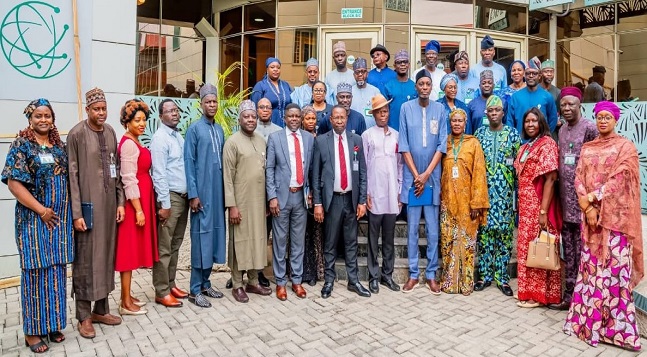
The National Information Technology Development Agency (NITDA) has reinforced its commitment to advancing Nigeria’s digital transformation agenda through strengthened collaboration with key strategic institutions, as it hosted the Director General of the National Institute for Policy and Strategic Studies (NIPSS), Professor Ayo Omotayo, alongside participants of the Senior Executive Course (SEC) 48, 2026.

The visit, which builds on an earlier strategic study tour, provided a platform for in-depth engagement on the role of digital innovation in driving sustainable economic growth, with particular focus on the Orange Economy.
Representing the Director General of NITDA, Kashifu Inuwa CCIE, the Director of Stakeholder Management and Partnerships, Dr Aristotle Onumo, highlighted the Agency’s commitment to fostering a vibrant digital ecosystem through inclusive policies, strategic partnerships, and capacity development initiatives.
“NITDA is committed to creating an enabling environment where innovation can thrive by bringing together government, private sector, academia, and creatives to drive Nigeria’s digital economy,” he stated.
Inuwa underscored the growing importance of the Orange Economy, describing it as a critical driver of innovation and economic value through intellectual property. He identified sectors such as digital content creation, film, animation, and digital art as key contributors to national development.
“The Orange Economy represents a powerful opportunity to transform our rich cultural heritage and creativity into sustainable economic growth,” he noted.
He further highlighted Nigeria’s unique advantage, particularly its youthful and creative population, while calling for stronger collaboration among stakeholders to fully harness the sector’s potential.
“With our youthful population and rich cultural assets, Nigeria is well-positioned to become a global leader in the Orange Economy if we deepen collaboration and investment across the ecosystem,” he added.
During the engagement, NITDA also presented its strategic initiatives aimed at supporting the digital and creative sectors, including digital infrastructure development, promotion of digital literacy, and implementation of policies that enable startups and innovators to scale.
Addressing challenges facing the sector, Inuwa pointed to issues such as limited access to funding, infrastructure gaps, weak intellectual property protection, and ecosystem fragmentation, while emphasising the need for coordinated action.
“Addressing challenges such as funding gaps, infrastructure deficits, and intellectual property protection is critical to unlocking the full potential of Nigeria’s creative economy,” he said.
The Agency reiterated its target of achieving 70 per cent digital literacy by 2027, noting that ongoing programmes are equipping millions of Nigerians with essential digital skills, including those in underserved and informal sectors.
In his remark, Professor Omotayo described the visit as an important opportunity to deepen understanding of how digital technologies are reshaping economic sectors, particularly the creative industry. He noted that the insights gathered would contribute significantly to policy recommendations aimed at strengthening Nigeria’s economic framework.
Participants of the SEC 48 programme engaged actively during the session, raising questions on capacity development, access to tools, and frameworks for protecting digital content. NITDA highlighted its ongoing collaborations with industry stakeholders to provide training, innovation hubs, and access to digital tools for young Nigerians.
The engagement concluded with a renewed commitment from both NITDA and NIPSS to strengthen collaboration in research, policy development, and capacity building, aimed at positioning Nigeria as a globally competitive force in the digital and creative economy.

Nigeria Revenue Service (NRS) has assumed responsibility for collecting mineral royalties from mining operators nationwide, following new tax laws effective January 1, 2026.

NRS
The shift emerged from a Thursday meeting between Solid Minerals Development Minister Dele Alake and NRS Chairman Dr. Zacch Adedeji. Their joint statement, endorsed by both, confirms NRS now administers all federally collectible revenues, including royalties.
Enacted by President Bola Tinubu on June 26, 2025, the Nigeria Tax Laws 2025 empower this transition. The Ministry of Solid Minerals Development remains a key partner, supplying pricing data, geological insights, and sector coordination.
NRS Special Adviser Dare Adekanmbi’s statement outlines collaborative steps: a nationwide sensitization program for operators on filing and payments; development of a digital royalty system; and regular joint technical sessions to address issues.
Both agencies pledge orderly, transparent implementation to boost the mining sector. Operators must comply with obligations and join upcoming programs.
The move aims to streamline revenue collection while fostering mining growth.

Offset Communications Slams N50m Suit against Qore Technologies for Alleged Copyright Infringement

Compensation for Poor Service Quality is Automatic- NCC

SERAP Sues CCB over Electoral Act, New Tax law

Tinubu Approves N3.3 Trillion Payment Plan to Boost Power Supply

FG to Strengthen Cybersecurity Coordination as NDPC Probes Alleged Data Breach

Spotify’s Loud & Clear Report Reveals Over ₦60Bn Revenue for Nigerian Artists in 2025

Madonna University Taps Tech Guru Adote for Strategic Board Role

China Threatens to Shut Nigeria’s Satellite Over $11.44m Unpaid Debt

Healthcare Under Attack: Why Cybersecurity is Now Critical Care

Why JustMarkets Is a Strong Choice for Gold Trading




 General News3 days ago
FG, Others Say Nigeria Wastes 38m Tonnes of Food Annually

 E-Financial3 days ago
CBN, Banks, Fintechs Launch PSPC to Boost Nigeria’s Payment System

 News3 days ago
NITDA Strengthens Collaboration with NIPSS to Drive Digital Innovation, Orange Economy Growth

 E-Financial3 days ago
CycleFlow, IFC Launch Supply Chain Finance Platform in Nigeria

 E-Financial3 days ago
Anchor Gets Nigerian, Canadian Licences as Transactions Crosses $2.5Bn

 E-Financial3 days ago
Ecobank Assures of Seamless Easter Banking Services

 News3 days ago
NRS Takes Over Mineral Royalties Collection Under New Tax Laws

 E-Financial2 days ago
N4.65 Trillion in the Vault, but is the Real Economy Locked Out?