

E-Financial
Reasons Naira May Hit N500 to $1 Before Year End- Otunuga


Lukman Otunuga, a research analyst at FXTM a keen follower of macroeconomic events, with a strong professional and academic background in finance, has once again predicted that certain external and internal factors may push the Nigeria’s currency vulnerability to dollar exchange rates even before the end of the year.
Well versed in the various factors affecting the currency and commodity markets, Otunuga, who was speaking Nigeria CommunicationsWeek recently in Lagos, said that depreciate in international oil price is principal among factors affecting the naira due to the mono-economic nature of the country.
He provides in-depth analysis on the global currency and commodity markets and isoften quoted by leading international media outlets such as: MarketWatch, CNBC, NASDAQ, Reuters, AFP, The Guardian and Yahoo.
Prior to joining FXTM, Otunuga spent two years as a research analyst with international currency broker FXCM, where he focused on technical and fundamental analysis of the global currency, commodity and stock markets.
Otunuga was also responsible for leading educational seminars for international and local high net worth individuals, and has published a series of educational articles on forex trading with City A.M.
Otunuga holds a BSc (hons) degree in Economics from the University of Essex, UK and an MSc in Finance from London School of Business and Finance, where he studied corporate finance, mergers & acquisitions and the role of international financial institutions.
Enjoy the chat:
When you heard, National Bureau of Statistics report that Nigeria’s economy has slide to recession, what first came to your mind?
“When I heard that the National Bureau of Statistics report that Nigeria’s economy has slip to recession, what first came to my mind was for extended period that oil price was down punished major oil-export dependent nations with Nigeria been a no exception.
“If we consider the fact that about 95% of export revenues and 70% of government revenue in Nigeria come from oil revenue, then you can understand why the nation has been under pressure. So, what has happened to Nigeria is both external and internal.
“Looking at the external factors, Nigeria is heavily oil export dependent. At the same time, even though dollar is not the legal tender in Nigeria, it has strong grip on the economy. Therefore, when you consider the global oil market and the dollar issues, they combined to put Nigeria under pressure.
With Nigeria’s mid-term policies, how quick can we come from the present recession?
“Well, we have to look at this from the short term and long term. Just last week, the even the Central Bank of Nigeria (CBN) decided to maintain the interest rate at 14%, despite the Finance Minister was saying that higher interest rates can actually act as barrier to the growth in future. Now, the CBN, on the short term is looking at price stability. In the month of August, inflation has climbed to 17.6%.
“So, I think the CBN is trying to see how the economy will fare in the Months of September and October before taking action. So, referring to the question, I think, on the short term, what the CBN can do is stay on the fence and watch how the Nigerian economy performs.
“On the long term, we have to fix our minds that a step has been taking towards diversification to agriculture and building of infrastructure. If these things are put in place, Nigeria could be back within the next two to three years.
You predicted that if CBN continued its policy direction with regards dollar restrictions, Naira will suffer in the market. That prediction has come to pass, Now, what in your view should CBN do differently?
“Yes, I remember that prediction. When I made that prediction I said that if the CBN was to delay de-peg of the Naira it will become deplorable over the natural forces of the demand and supply where equilibrium forces.
“That is what has happened. If you look at the Naira the official rate today naira is trading around N360 to $1 while the black market is around N420. So, I think even now, the Naira could be open to further losses, due to stronger dollar and weaker oil prices.
“There are still talks at the CBN which is why there is still gap between the official price and the black market. On what CBN should be doing, we have to keep in mind that the Naira is still affected by external factors- oil price. This entails that Naira could still be open to some losses in 2016.
Can you estimate how long (months, years) it will take Nigeria’s economy to flourish again BEYOND oil; that is, owing to Government’s decision to focus on Agriculture, technology?
“The way to diversification is best for Nigeria, but will take a very long time. Remember, Nigeria is made up over 160 million populations with youth the population quite high. One aspect of the diversification is agriculture, which is a better option to reducing food importation and export the surplus.
“When you look at agriculture, manufacturing, technology and building of infrastructure will help Nigeria live beyond oil exportation. For instance, in the West they produce oil and refine it instead of exporting crude only to import as oil later. So, this is something that can take years to achieve; I think four year minimum.
What Should CBN do with regards managing Bureau De Change (who are principal managers of dollar-naira exchange rates outside the banks)?
“I think the CBN could attempt that funds in this area be transferred through the CBN channels which will be used to manage the dollar-naira exchange.
The Federal Government of Nigeria has declared it intends to submit 2017 budget proposal to NASS as soon as possible, which sector, in your view, should have the lion’s share with regards to economic recovery?
“It goes back to what we have been saying. I feel the share should go to agriculture. No doubt, this is the time for Nigeria to diversify; and it takes time and money to get agriculture to a stable state. And when you have surplus, you export to boost your nation’s self reliance and foreign reserves.
“Another area of investment should be on infrastructure. We know that Nigeria’s infrastructure is weak and it takes a nation with strong infrastructure to easily galvanise all sectors for economic growth, especially manufacturing.
“Tourism could also be a huge industry to help in diversifying the economy. Let the government invest on roads to boost transportation of those agricultural produce and power. Power will enable SMEs heave sign of relief too and spring up surprises in technological advancements.
What is you prediction with regards how much Naira will exchange to Dollar by year end? What informed your view?
“For now, the main driver between the naira-dollar exchange rates as at today the dollar is domineering. The dollar may continue to strengthen against the Naira, because the U.S is working to strengthen its currency too. If this continues by year end naira may exchange for N500 to a dollar at the black market and N400 official rate.
In the face of the economic recession in the country, what is FXTM doing to help Nigerians (traders) on financial mastery/management?
“Good financial management is extremely important and this comes down to a person’s ability to successfully balance opportunities and risk with regard to their investments. When talking about forex trading, this means having in place a robust risk management strategy and acquiring an in-depth knowledge of the markets so that you can react accordingly to changing market conditions.
“These skills can be learnt and improved, which is why at FXTM we’ve really invested in trader education to ensure that Nigerians can achieve the most from their trading experience. We’ve recently held a number of highly successful educational events in Abuja, including a seminar on ‘The Ultimate Trading Formula’ and a 3-day afternoon trading workshop, and we’ll be holding similar events in Lagos in November. In addition, our local office also offers regular free educational training sessions.
Each week we hold a range of programs including: Basic, Applied and Advanced level financial market trading courses, a MetaTrader 4 Class and an investment seminar on how to trade with the FXTM Invest Program.
“FXTM was one of the first brokers to introduce the updated MetaTrader5 platform that offers hedging and we are seeing a lot of interest in that, so we will look to develop classes on that in the near future as well.


Providus Bank Limited has dispelled media reports over its compliance with regulatory capital requirements, confirming that it has successfully met and exceeded the recapitalisation threshold set by the Central Bank of Nigeria (CBN).

In a statement, the bank clarified that under the CBN’s recapitalisation framework, regional commercial banks are mandated to maintain a minimum capital base of N50 billion, stating unequivocally that it achieved this benchmark as far back as January 2025 and has since strengthened its financial standing.
According to the bank, its current paid-up capital stands at N65 billion, significantly above the regulatory minimum, underscoring its resilience and commitment to sound financial management.
The bank noted that this strong capital position places it in good stead to support its growth strategy and continue delivering value to customers and stakeholders.
Providus Bank emphasied that any suggestion implying non-compliance with the CBN’s recapitalisation requirement was inaccurate and does not reflect its current regulatory status.
The bank reiterated its dedication to maintaining robust governance standards and aligning with all prudential guidelines set by the apex regulator.
It explained: Providus Bank Limited notes recent media reports regarding the recapitalisation status of certain banks and considers it important to provide factual clarification as it relates to the Bank. Under the CBN recapitalisation framework, regional commercial banks are required to maintain a minimum capital base of N50 billion.
“Providus Bank confirms that it had met its capital requirement since January 2025 and currently has a capital base of N65 billiom which is in excess of its capital requirement.
Accordingly, any suggestion that Providus Bank has not met the applicable recapitalisation threshold is not consistent with its current regulatory standing.”
The Olayemi Cardoso-led Central Bank of Nigeria (CBN) had, on March 28, 2024, announced a two-year bank recapitalisation exercise which commenced on April 1, 2024.
The 24-month timeline for compliance ends on March 31, 2026. The upward capital revision is expected to ensure that Nigerian banks have the capacity to take on bigger risks and stay afloat amid both domestic and external shocks.
Specifically, the recapitalisation exercise requires a minimum capital of N500 billion, N200 billion, and N50 billion for commercial banks with international, national, and regional licences, respectively.

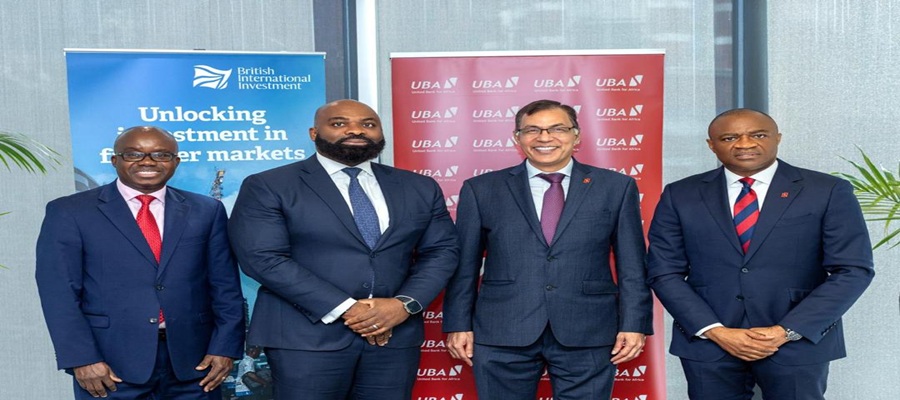
United Bank for Africa (UK) Limited (“UBA UK”) and British International Investment plc (“BII”), the UK’s development finance institution and impact investor, today announced that they have signed a letter of intent to develop trade finance collaboration opportunities. The proposed initiative aims to expand access to trade and working capital facilities for businesses operating across Africa.

L-r: West Africa Director and Head of Office Africa Coverage, BII West Africa, Benson Adenuga; Managing Director and Head of Africa, BII, Chris Chijiutomi; Lok Mishra, Chief Executive Officer, UBA UK, Loknath Mishra; Group Managing Director, United Bank for Africa (Plc) during the signing of letter of intent to develop trade finance collaboration opportunities.
Access to trade finance remains one of the most significant structural constraints on African trade. Businesses – particularly small and medium-sized enterprises – are frequently unable to secure letters of credit, guarantees, and supply chain finance on commercially viable terms, limiting their capacity to export and import competitively. This trade finance gap is estimated by the African Development Bank to be over USD 80 billion annually.
To help close this gap, UBA UK, the London subsidiary of UBA Group, Africa’s Global Bank, will leverage its deep relationships across the Group’s 20-country African network to originate and structure trade finance transactions. While BII, with a mandate to support productive, sustainable, and inclusive growth across Africa, can support transactions that might otherwise fall outside conventional commercial appetite.
Lok Mishra, Chief Executive Officer, UBA UK, said: “The signing of this letter with BII represents a landmark moment for UBA UK and for the UBA Group’s global ambitions. As the Group’s hub for Trade Operations, UBA UK is uniquely positioned to connect African businesses with the international financial system.
“Working alongside BII, we can extend that capability further — mobilising capital where it matters most and helping to close the trade finance gap that holds back so much African potential.”
Chris Chijiuitomi, Managing Director and Head of Africa, said: “British International Investment is committed to catalysing private sector growth across Africa, and trade finance is a critical enabler of that growth.
“We welcome the opportunity to collaborate with UBA Group, whose pan-African network and deep institutional relationships can help advance our ambition to expand access to trade and working capital finance, particularly in frontier markets.”
The announcement builds on growing momentum around intra-African trade facilitated by the African Continental Free Trade Area (AfCFTA), which entered into force in 2021 and represents one of the world’s most ignificant trade integration initiatives.
Both institutions have identified the operationalisation of AfCFTA as a priority catalyst for a trade finance facility, with UBA UK’s network across major AfCFTA economies offering a basis for supporting businesses navigating the emerging continental market.
This also complements the UK Government’s broader engagement with African economic development, including commitments made at the UK-Africa Investment Summit, and reinforces the City of London’s role as a leading international finance centre for Africa-focused capital mobilisation.
Future cooperation remains subject to further assessment, due diligence and the completion of internal approvals by both parties.


Central Bank of Nigeria (CBN) has introduced stricter rules guiding the use and management of the Bank Verification Number (BVN) as part of efforts to reduce fraudulent transactions within the financial system.The revised framework, which takes effect from May 1, includes tighter controls on BVN enrolment, data access and customer information updates.

The apex bank said the measures are aimed at strengthening identity management, improving fraud monitoring and safeguarding the integrity of banking transactions.
Under the new guidelines, BVN enrolment is now restricted to individuals aged 18 and above, while customers will only be allowed to change the phone number linked to their BVN once.
The restriction is designed to curb identity manipulation often exploited by fraudsters through repeated updates of personal information.
The CBN also directed financial institutions to maintain a temporary watchlist for BVNs linked to suspicious transactions.
Affected BVNs may be flagged for up to 24 hours, during which customers are expected to verify or clarify flagged transactions before further action is taken.
In addition, access to BVN data has been tightened, with the apex bank retaining exclusive control over the database while granting access only to licensed financial institutions under defined conditions.
The move, according to the CBN, is expected to enhance data security and support a more resilient financial system as BVN enrolment continues to grow.

Court Jails ‘Colonel’, ‘Major’ of Global Money-Laundering Ring

Court Bans Kenyan Telcos from Recycling SIM Cards

Providus Bank Fully Meets CBN Capital Requirement, Sets Record Straight

African Tech Start-ups to Receive $46m of Speedinvest Africa Fund

U.S. Charges Three in $2.5 Billion Plot to Smuggle Nvidia AI Chips to China

Kaspersky Discovers New Phishing Campaign Exploiting Google Tasks Notifications to Steal Corporate Credentials

esentry 2025 Report Shows Healthcare, Financial Services and Telecoms as Staging Grounds for Increased Cyberattacks in Africa

AfDB, UNDP Launch $10Bn AI Initiative for Africa

Mutual Benefits Assurance Settles ₦5.9bn Claims in January 2026

MultiChoice Suspends Yearly DStv Price Hike as Canal+ Pushes Growth




 E-Financial2 days ago
Kuda MFB Increases Kuda for Her Business Grants to ₦10 Million

 Telecom2 days ago
Vitel Wireless Lures Subscribers with “Data that Never Expires” Campaign

 News2 days ago
NSIA Sign MoU with UK’s Asset Green Ltd to Develop $496M Integrated Dairy Livestock Production Platform in Nigeria

 News2 days ago
BoI, MTN Foundation Launch N1Bn Fund for Women Entrepreneurs

 General News2 days ago
One SA Bank Equals Nigeria’s Entire Banking Sector – Why Recapitalisation Is Critical for Global Competitiveness

 Broadcasting2 days ago
Nigeria tops global rankings for USDT, USDC ownership

 E-Financial1 day ago
CBN Introduces Stricter BVN Rules to Curb Fraudulent Transactions

 General News2 days ago
Luno Launches First Crypto Prediction Market in Nigeria