

News
Samsung, Rele Gallery Collaborate on Ground-Breaking Food Art Exhibition & Online Contest


Samsung Electronics West Africa and contemporary art space, Rele Gallery have collaborated to present an unprecedented culinary art and photography exhibition as well as online competition, with the theme ‘What’s Cooking?’
The exhibition featured the works of two prominent photographers, Kelechi Amadi-Obi and Ade Asiko Okelarin, who drew inspiration from Nigerian cuisine created by three leading chefs, Tiyan Alile, Ozoz Sokoh (Kitchen Butterfly) and Dunni Obata (Dooney’s Kitchen).
The Samsung Galaxy S7 edge Smartphone was used to capture the photographs showcased at the exhibition.
The exhibition was preceded by an online culinary art contest which attracted over 300 entries from across the country and produced three winners who were announced at a private viewing event to mark the beginning of the four-week exhibition at the gallery in Lagos.
The Food Art competition engaged talented Nigerians from all over the country trying their hands at culinary artistry by creating an original work of art using real food in line with the exhibition theme.
Entries were uploaded by participants on www.techmeetsart.ng, who also stated what inspired their food art. All entries were judged by a reputable panel of chefs and photographers based on published guidelines.
Mr. Paul Lee, managing director, Samsung Electronics West Africa, speaking at the event which took place at Rele Gallery, Onikan, Lagos, said that ‘‘Technology and art have had an unfamiliar relationship over the years with many people wondering what the nature of this relationship is. Art and technology derive strength and inspiration from one another. Hosting a competition among chefs is logical as cooking is also a form of art. With this novelty, Samsung is rebooting the relationship between art and technology by being a part of exhibitions and initiatives that will foster new collaborations across both disciplines and industries.’’
Also speaking on the online contest, Mr. Emmanuoil Revmatas, Director, Information Technology and Mobility, Samsung Electronics West Africa, expressed satisfaction with the quality of entries received, while reiterating Samsung’s mission in making life better and more exciting.
‘‘There are a number of necessities that are imperative in life, and two of them include food and technology. The collaboration between Samsung and Rele Gallery has produced the #TechMeetsArtNG initiative, a platform where technology helps to enhance art on different levels. This year’s theme, ‘What’s Cooking’ is all about fusing technology and art as well as food.
The special culinary delights were brought into focus with the use of Samsung Galaxy S7 edge Smartphone by renowned photographers such as Kelechi Amadi-Obi and Ade Okelarin (Asiko) to capture Nigerian art food created by all three distinguished chefs,’’ Revmatas explained.
“Rele Gallery is committed to changing the way we consume; navigate the world around us, through art. As we’ve come to discover food is much more than something we eat, through this project we highlight that there is an art to cooking and presenting it.
‘For the first time ever, Nigerian cuisine gets to be documented as an art piece, to inspire experimentation and exploration of the possibilities.
The Galaxy S7 Edge features a 5.5-inch super AMOLED display screen allowing for clearer videos and images with a resolution of 2560 x 1440 (Quad HD). The Galaxy S7 series brings pictures to life like never before on a Smartphone with a simple hand gesture.
Thanks to the dual pixel technology, the auto-focus on the Samsung Galaxy S7 series is quicker, thereby producing sharper and brighter images – even in dimly-lit settings.
The overall winner of the competition, Ms. Haneefah Adam, a medical scientist and lifestyle blogger whose work depicted the portrait of the African woman with ingredients of the South East Nigerian delicacy, was rewarded with Samsung’s flagship Galaxy S7 Edge smartphone, and had the winning picture displayed at the Rele Gallery.
Second and third runners-up were also rewarded with a Samsung Galaxy Tab A and Galaxy Tab E respectively. The exhibition is open to the public from Sunday, May 15, 2016 until June 10, 2016.



African technology start-ups will receive a $46 million (€40 million) commitment from EIB Global, the development arm of the European Investment Bank (EIB).

The funds will be deployed through the first Africa-focused investment vehicle from European venture capital (VC) firm Speedinvest.
The Speedinvest Africa Fund, which has a total target size of €200 million, targets companies across innovation hubs in Egypt, Morocco, Nigeria, Kenya, and South Africa.
It also invests in high-potential markets, including Ghana, Côte d’Ivoire, Cameroon, the Democratic Republic of Congo, Tunisia, Tanzania, and Uganda.
The investment strengthens EU–Africa ties, supports digital transformation, and promotes inclusive economic growth, says the EIB.
The strategy is designed to improve digital and financial inclusion while enabling start-ups to scale across borders by strengthening linkages between African and European ecosystems. Technology has the power to turn good ideas into real impact, says Karl Nehammer, vice-president of the EIB.
By backing this vehicle, it is enabling African innovators to scale, access new markets, and build sustainable businesses, says Nehammer.
The fund focuses on technology-enabled and mobile-based services across payments, healthcare, mobility, and education.
This aligns with the EU’s Global Gateway priorities and is expected to deliver social benefits, including job creation for youth and expanded access to digital banking for underserved communities.
At least 30% of the vehicle’s capital will support companies advancing gender equality, including those with women as founders, employees, or consumers.
With EIB Global support, the firm is deepening its long-term commitment to backing founders across Africa while strengthening enduring bridges between Africa and Europe, says Oliver Holle, CEO and managing partner of Speedinvest.
Speedinvest has previously backed African growth-stage companies, including mobility fintech Moove and digital bank FairMoney.
By combining a local presence with a European network of operators, sector expertise, and follow-on capital, the firm aims to help founders scale regionally and internationally, says Holle.
The fund will be managed by partners Deepali Nangia and Rana Abdel Latif, with a new African office planned to support its local operations.

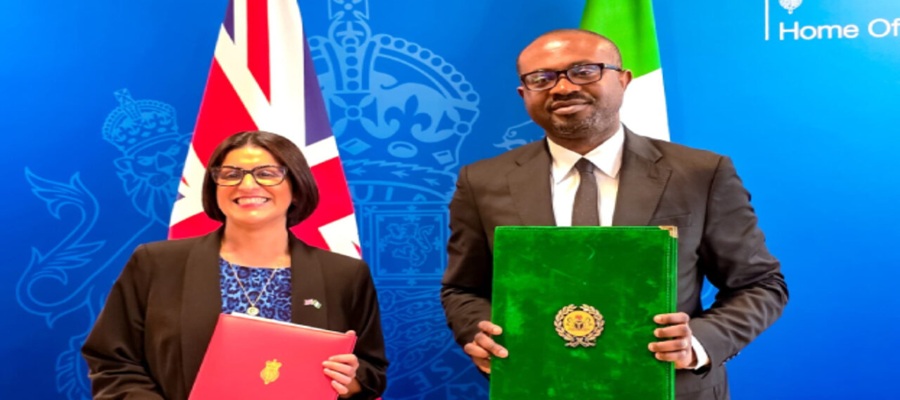
United Kingdom and Nigeria have agreed on a three-year strategic plan to tackle organised immigration crime and strengthen border security cooperation.

The initiative was announced in a joint statement by the UK Home Office following the state visit of Bola Ahmed Tinubu to the UK.
The agreement was signed by UK Home Secretary Shabana Mahmood and Nigeria’s Minister of Interior, Olubunmi Tunji-Ojo.
According to the statement, the framework focuses on combating visa fraud, improving border management systems, and enhancing legal cooperation between both countries.
Under the plan, Nigeria is expected to review its legal framework to impose stricter penalties on immigration-related offences, particularly those involving forged or fraudulent travel documents.
Both countries also pledged to strengthen laws and enforcement mechanisms governing visa processing and travel documentation.
A key component of the agreement is the expansion of the UK–Nigeria Organised Immigration Crime Unit, with new memoranda of understanding centred on intelligence sharing and joint operations.
The UK government will further support Nigerian border agencies through training programmes and capacity-building initiatives.
The partnership also places emphasis on the protection of vulnerable migrants, particularly women and children, while enhancing research, document verification systems, and migration monitoring processes through the UK–Nigeria Migration, Justice and Home Affairs Dialogue.
Both governments described the agreement as a reflection of their shared commitment to tackling transnational crime and improving migration management through closer collaboration.
The deal forms part of broader engagements during Tinubu’s visit, which focused on strengthening bilateral relations across security, migration, and economic development.
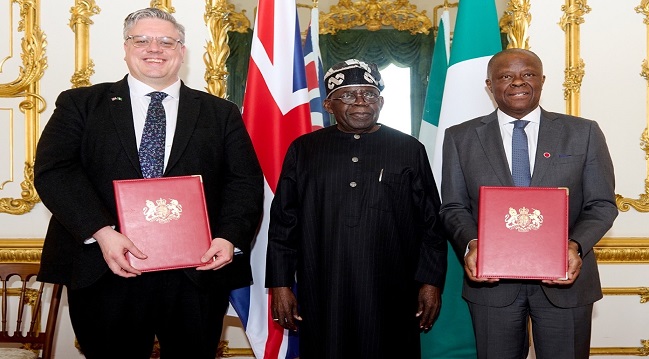
Thousands of skilled UK and Nigerian jobs will be supported and hundreds of millions invested into the economy as a historic financing deal was signed yesterday between the UK and Nigeria.

The £746 million sum will be used to support the refurbishment of two of Nigeria’s major national maritime infrastructure facilities located in Lagos, the Lagos Port Complex (Apapa Quays) and the TinCan Island Port Complex. It will be delivered through UKEF’s Buyer Credit Facility, coordinated and arranged by Citibank, N.A London Branch (“Citi”). Island Port Complex.
The agreement between UK Export Finance, the UK government’s export credit agency (UKEF), the Nigerian Ports Authority (NPA) and the Federal Ministry of Finance, will deliver significant benefits for British businesses, with at least £236 million of supplier contracts directed to British companies.
British Steel will supply 120,000 tonnes of steel billets to construction companies Hitech Nigeria and ITB Nigeria for the ports deal, amounting to a £70 million contract that represents British Steel’s largest export order backed by UKEF. It follows from the Government’s newly announced Steel Strategy which seeks to revitalise the steel sector.
Peter Kyle, Buisness and Trade Secretary said: “Hot on the heels of our landmark Steel Strategy, this is a major win for British Steel made possible by UK Export Finance which is testament to the quality of UK-made steel and the booming UK-Nigeria relationship.
“Through our new Strategy we’re backing British steelmakers for long-term success at home and abroad, and this contract will reinforce British Steel’s world-class expertise while supporting jobs and growth in Scunthorpe.”
Dr. Adegboyega Oyetola, Nigerian Minister of Marine and Blue Economy said: “The modernisation and upgrading of Nigeria’s ports represents a major step forward for the country and aligns closely with the Federal Government’s commitment to unlocking the full potential of the marine and blue economy.
“Through strategic partnerships such as this with the United Kingdom, we are laying the foundation for a new era of efficiency, transparency and competitiveness in Nigeria’s port system.
“Modern infrastructure, supported by digitalised and automated processes, will transform the way our ports operate and strengthen Nigeria’s position as a leading maritime hub in West and Central Africa.
“Nigeria’s port operations will be transformative. Turnaround times for vessels and cargo dwell times within the ports are projected to fall sharply as automated processes replace paperwork-heavy procedures and as expanded capacity removes longstanding bottlenecks.
“The modernised infrastructure will enable faster clearance of imports and exports, reduce demurrage and logistics costs for businesses, significantly improve the predictability and transparency of cargo movement and generate more revenue for national development.”
Alongside the NPA deal announcement, the UK and Nigeria will sign a Memorandum of Understanding (MOU) establishing a framework for potential future collaboration.
The MOU sets out Nigeria’s priority project pipeline, seeking UKEF finance and support, with the UK set to benefit directly through substantial supply chain participation. The signing signals a clear commitment from both governments to deepen their long-term partnership on trade, infrastructure and sustainable growth.
Hitech Nigeria and ITB Nigeria have been at the forefront of some of Nigeria’s most transformative infrastructure projects and advanced engineering.
The Steel Strategy highlights one of many initiatives that the Government is already doing including those on energy prices, skills, procurement and financing support of projects such as the Scrap Metal Taskforce and the new Trade Defence Measures.
Allan Bell , British Steel CEO said: “This is a record-breaking contract for British Steel and a major boost to our 4,000 employees and many more people in our supply chains.
“After government intervention last April, everyone at British Steel has worked hard to stabilise the company. This deal represents us moving from stabilisation to building long-term sustainability for the business.
“As one of the largest ever orders for billet in the history of this company, it marks a tremendous vote of confidence in British Steel and UK manufacturing. And as the biggest order we have ever secured with UK Export Finance, it demonstrates how we are working with the UK Government to meet the global demand for our products.
“We thank the government for its support and look forward to working with Hitech Construction Africa Ltd on this transformative project.”
Richard Hodder, Global Head of Export & Agency Financing at Citi said: “Citi has been present in Nigeria for over 40 years and is delighted to support NPA and the Federal Government of Nigeria in the financing of this critical infrastructure project which will deliver significant economic benefits to the Nigerian economy over the coming years. As the Coordinator of the transaction, we are pleased to have worked in close partnership with the team at UKEF to deliver one of the largest Export Credit Agency supported Buyer Credit Facilities ever seen in West Africa.”
Today’s milestones represent UKEF’s growing presence in the region. Since 2018, UKEF support for West and Central Africa has grown by over £3 billion, reflecting the region’s appetite for diversified trade partnerships and the UK’s commitment to being a trusted partner for long-term investment.
Tim Reid, CEO at UK Export Finance said: “This deal represents a milestone for UK-Nigeria trade relations and demonstrates the full capacity of UK Export Finance to unlock transformational opportunities for British businesses, while supporting sustainable economic growth in key markets.
“With over £200 million feeding back to British companies, including one of the largest steel billet contracts in British Steel’s history and our new Memorandum of Understanding, UKEF are laying the foundations for a deeper, long-term relationship with Nigeria, that will open doors for British exporters across the entire region.”
Together, these announcements signal to international markets that Nigeria is open for trade and investment, demonstrating credible government-to-government delivery and building wider investor confidence around Nigeria’s trade infrastructure and growth agenda.

Court Jails ‘Colonel’, ‘Major’ of Global Money-Laundering Ring

Court Bans Kenyan Telcos from Recycling SIM Cards

Providus Bank Fully Meets CBN Capital Requirement, Sets Record Straight

African Tech Start-ups to Receive $46m of Speedinvest Africa Fund

Binance Earn: Simple Way to Earn Rewards on Idle Crypto Holdings

Kaspersky Discovers New Phishing Campaign Exploiting Google Tasks Notifications to Steal Corporate Credentials

esentry 2025 Report Shows Healthcare, Financial Services and Telecoms as Staging Grounds for Increased Cyberattacks in Africa

AfDB, UNDP Launch $10Bn AI Initiative for Africa

Mutual Benefits Assurance Settles ₦5.9bn Claims in January 2026

MultiChoice Suspends Yearly DStv Price Hike as Canal+ Pushes Growth




 E-Financial2 days ago
Kuda MFB Increases Kuda for Her Business Grants to ₦10 Million

 Telecom2 days ago
Vitel Wireless Lures Subscribers with “Data that Never Expires” Campaign

 News2 days ago
NSIA Sign MoU with UK’s Asset Green Ltd to Develop $496M Integrated Dairy Livestock Production Platform in Nigeria

 News2 days ago
BoI, MTN Foundation Launch N1Bn Fund for Women Entrepreneurs

 General News2 days ago
One SA Bank Equals Nigeria’s Entire Banking Sector – Why Recapitalisation Is Critical for Global Competitiveness

 Broadcasting2 days ago
Nigeria tops global rankings for USDT, USDC ownership

 General News2 days ago
Luno Launches First Crypto Prediction Market in Nigeria

 E-Financial1 day ago
CBN Introduces Stricter BVN Rules to Curb Fraudulent Transactions