

News
Schmidt Futures, Rhodes Trust Open Applications for Brilliant Nigerian Teens to Join Global Rise Community


Schmidt Futures, in partnership with the Rhodes Trust, announced that young people ages 15 to 17 (as of July 1st, 2023) can apply for the 2023 Rise Global Challenge with the launch of the ‘Rise To’ campaign.

The flagship program of Schmidt Futures and the anchor of a broader $1 billion philanthropic commitment from Eric and Wendy Schmidt, Rise finds brilliant people who need opportunity and supports them for life as they work to serve others. Rise will build a lifelong community of students, teachers, and institutions across sectors who aim to serve others.
The program, which identifies young people between the ages of 15 and 17 from around the world, is designed to encourage a lifetime of service and learning by providing support that could include scholarships, career services, and funding opportunities to help these leaders serve others for decades to come.
Since its inception, Rise has welcomed over 150,000 people from over 170 countries to its community and selected 200 Winners from 69 countries of origin who have showcased their brilliance – from making education more accessible to mitigating global warming and developing tools to better detect cancer.
Schmidt Futures recognizes that talent is created equally, but opportunity is not, which is why the Rise program partners with 30+ global organizations, including NBA Africa, the African Leadership Academy, HALI Network, and BUILD Nigeria, to scour the globe to find brilliant young people who are passionate about building a better world.

Over the last two years, a total of 11 Nigerian students have been selected as Rise Global Winners. Their projects include
- Starting an international NGO to educate the public and solve pressing social issues including gender equality and gender laws in Nigeria;
- Developing a program that offers teacher training programs, a student-centered curriculum as well as internship opportunities for students to receive quality computer science education in public and private schools;
- Building robotics to automate tasks; and
- Increasing access to STEM opportunities for Nigerian girls, among others.
“BUILD Nigeria is thrilled to continue growing our partnership with Rise in Nigeria as we work together to find and support the next generation of young problem-solvers looking to build a better world,” said Tolulope Olasewere, Co-Founder of Build Nigeria.
To celebrate the opening of applications, the ‘Rise To’ creative campaign invites brilliant young minds to continue to turn opportunities into action as they ‘Rise To’ face the world’s most pressing issues. Produced by Ogilvy, the campaign seeks to inspire and foster a global community of 15- to 17-year-olds invested in creating a better future.
Rise has partnered with multi-platinum singer-songwriter Bishop Briggs, known for her viral track “River,” on a series of beautifully shot films and audio ads featuring 2021 Rise Global Winners. The ads will come to life across social media as well as on Spotify and are set to the tune of Brigg’s new single “superhuman.”
The song, which was released today, is inspired by this new generation of young people and recognizes the superhumans that lie dormant in each of us.
“As a new parent, when I wrote “superhuman,” I was inspired by this brilliant up-and-coming generation,” said Bishop Briggs. “The Rise Global Winners’ dedication to building a better world truly exemplifies what the song is about — knowing you have the strength to continue on no matter what comes your way.”
Over the next two weeks, ‘Rise To’ will feature an integrated digital campaign showcasing the diverse brilliance of Rise Global Winners and inviting more to join the community. The activation will involve celebrating two years and 200 Global Winners across two iconic locations — Times Square in New York and the Burj Khalifa in Dubai.
Winners featured in the ‘Rise To’ campaign include:
- Rushank Goyal (India), who advocates against food adulteration in his community by conducting discussion sessions.
- Leah Mtindya (Zambia), who spreads awareness among teenagers about sexual and reproductive health, trans healthcare, and domestic abuse.
- Saoirse Exton (Ireland), who rewrote Irish mythology from a feminist perspective, foregrounding the strong characters that traditional narratives tended to suppress.
- Artash Nath (Canada), who created a way to measure the effectiveness of COVID-19 lockdowns using seismic vibrations to track human movement.
- Jennifer Uche (United States), who launched a podcast that highlights the importance of youth advocacy and the power of young people to change the world.
Rise Global Winners will receive individualized and flexible support to achieve their goals as they work to serve others. The program is designed to encourage a lifetime of service to develop innovative solutions to solve society’s hard problems.
That’s why Rise provides all applicants, regardless of Winner status, with access to its global network, free online courses, and curated opportunities from partners. To stay up-to-date on the benefits available for Rise applicants each year, please read the Official Rise Challenge Rules by visiting https://www.risefortheworld.org/rules.
“Eric and I have been impressed by the optimism, initiative and curiosity of the young people in the growing Rise community,” said Wendy Schmidt, co-founder of Schmidt Futures and president of the Schmidt Family Foundation. “We are excited to continue expanding this network with the 2023 cohort and can’t wait to see what these talented teens can accomplish when they work together in service for others.”
“We look for hidden brilliance, in whatever form it takes, wherever it is in the world,” said Eric Braverman, CEO of Schmidt Futures. “There are so many extraordinary people who could do so much more to make the world better if they only could find opportunity — and each other. We hope to make the longest bet we can imagine on exceptional talent with perseverance, integrity, and care for others.”
“We know that amazing things happen when talented people from different backgrounds are brought together and given opportunities to study, collaborate, and innovate,” said Elizabeth Kiss, CEO of the Rhodes Trust. “Rise is an extraordinary opportunity for people from every corner of the world to embark on a lifelong journey of service and impact. Wherever you are, we encourage you to apply. You only know what you can achieve when you try.”
All Rise Global Winners receive the following benefits upon selection:
- Residential Summit: A fully-funded, three-week residential summit with other members of the Rise Global Winner cohort.
- Global Winner Network: Access to the Rise Global Winners network to connect on common interests, make service commitments, launch enterprises, and collaborate.
- Counseling and Career Support: Advice and support for applying to university and selecting a career
- Programming: Access to specialized programs, courses, and other opportunities through Rise partners.
- Higher Education Scholarships: A four-year, post-secondary scholarship at any accredited university, including tuition and a living stipend, based on need and where not already covered by financial aid.
- Technology: A technology package, such as a laptop or tablet, to be determined annually.
In addition, all Rise Global Winners can apply for the following benefits:
- Partner Network: Matching to programs, secondary school scholarships, internships, and other benefits from partners who are part of the Rise network.
- Funding Opportunities: Apply for funding to experiment with innovative ideas to address major problems in local communities or around the world—ranging from seed money to start a social enterprise to a grant for a non-profit.
- Education Support: Apply for scholarship funds for a graduate degree.
How to Apply?
The online applications are open on the Rise website and are available until January 25, 2023, at 16:59 GMT. For applicants without access to mobile technology, Rise works with its partners on the ground to offer alternative pathways through paper applications.
Rise provides applicants with multiple opportunities during the application process to showcase their potential through videos, projects, and group interviews. The application allows applicants to select projects most suited to their interests, abilities, and time availability.
The Rise 2023 Challenge has three stages:
- Submission: Applicants introduce themselves through videos, create an individual project that demonstrates their talents and benefits their communities, and peer review other applicants’ projects, among other activities.
- Interview: Rise then selects up to 500 Finalists to advance to “Finalist Days,” where they demonstrate their motivations, problem-solving abilities, and teamwork skills in an innovative interview format.
- Global Winner Selection: From the Finalists, Rise selects 100 Global Winners to receive a lifetime of benefits as they work to serve others.


Africa Prudential Plc has reaffirmed its commitment to sustainable growth and digital transformation after posting another strong half-year financial performance, driven by robust growth in its core registrar business, technology-driven solutions and increased activity in Nigeria’s capital market.

Speaking during the company’s H1 2026 Investor Call on Tuesday, the management outlined plans to deepen revenue diversification and accelerate innovation as part of efforts to reduce reliance on interest income and strengthen long-term profitability.
The company reported gross earnings of ₦4.28 billion for the first half of 2026, representing a 27 per cent increase from ₦3.34 billion recorded in the corresponding period of 2025.
Profit before tax rose by 22 per cent to ₦2.41 billion, while profit after tax climbed 18 per cent to ₦1.59 billion.
Net operating income also increased by 27 per cent to ₦4.21 billion, while total assets grew by 13 per cent to ₦46.53 billion. Shareholders’ funds similarly rose by 13 per cent to ₦12.52 billion.
According to the company, the impressive performance was driven by sustained growth in its registrar business, increased corporate actions across the Nigerian capital market, stronger treasury earnings supported by the prevailing interest rate environment and rising adoption of its technology-enabled products and services.African Mineral Wealth
Managing Director and Chief Executive Officer, Dr. Catherine Nwosu, said Africa Prudential is steadily evolving from a traditional share registrar into a diversified technology and business solutions provider serving the broader capital market ecosystem.
Addressing concerns from investors about the sustainability of earnings if interest rates decline, Nwosu said the company was deliberately expanding its non-interest income sources.
“Interest rates influence our treasury income positively, but that is why we are deliberately diversifying our revenue streams. Our strategy is to grow recurring fee-based business lines such as our digital solutions, Know Your Customer (KYC) services, AGM technology, probate services and the SabiVest mobile app. Over time, this will reduce our reliance on interest income and create a more balanced and resilient earnings mix,” she said.
She noted that increasing activity in the Nigerian capital market presents fresh opportunities for technology-driven solutions.
“With capital market activity nearly doubling over the past year, demand for seamless digital investor experiences, improved market efficiency and stronger compliance standards continues to grow. We are investing in technology-enabled solutions that position us to capitalise on these opportunities while delivering sustainable value to our shareholders,” she added.
Looking ahead, the company identified five strategic priorities for the second half of 2026, including driving sustainable growth through its core registrar business and new revenue streams, accelerating technology-led product innovation, strengthening brand leadership, investing in talent development and reinforcing corporate governance.
The investor call attracted institutional investors, shareholders, analysts, regulators and other capital market stakeholders, reflecting strong interest in Africa Prudential’s earnings outlook, revenue diversification strategy and long-term growth plans.
News
IHS Nigeria Donates Business-Support Equipment to Empower People with Disabilities in Abuja Community
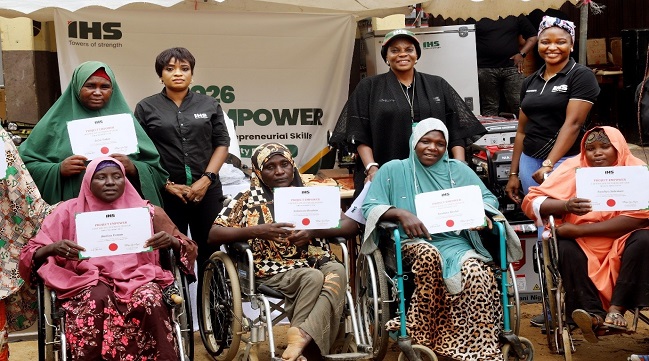
Communications infrastructure company, IHS Nigeria, has donated business support equipment to empower people with disabilities within the Karonmajiji community in the Federal Capital Territory, Abuja. This is part of the company’s commitment to drive inclusive community development and sustainable livelihood support under its Project Empower initiative.

The equipment was distributed to beneficiaries during a ceremony held in the community on Monday, July 27. The initiative was conceived following a community needs assessment and is designed to empower active traders by providing them with business tools rather than cash grants, thereby strengthening their businesses and ensuring long-term economic impact and accountability.
Speaking at the event, Director, Sustainability, IHS Nigeria, Titilope Oguntuga, described the initiative as a reflection of the company’s commitment to advancing inclusive development by equipping persons with disabilities with the tools and opportunities needed to build resilient livelihoods.
She explained that rather than providing short-term financial assistance, IHS Nigeria adopted an asset-based approach by donating 50 pieces of business support equipment, including sewing machines, freezers, generators and hairdressing kits, to the selected beneficiaries.
According to her, the intervention is designed to create lasting value by supporting entrepreneurship, promoting self-reliance and strengthening household incomes, while contributing to the achievement of the United Nations Sustainable Development Goals, particularly SDG 1 (No Poverty), SDG 8 (Decent Work and Economic Growth) and SDG 10 (Reduced Inequalities).
In his opening remarks, the Chief of the Karonmajiji Disabled Community, Alhaji Sulaiman Muhammed Katsina, represented by the Secretary of the Community, Alhaji Mohammed Dantani commended IHS Nigeria for its commitment to empowering persons with disabilities through practical and sustainable interventions.
He described the initiative as a demonstration of genuine partnership with the community and expressed appreciation for the company’s continued engagement with the Association, noting that the donation of the equipment was a significant investment in improving the livelihoods of persons with disabilities and would create meaningful economic opportunities for the beneficiaries and their families.
The event brought together traditional rulers, government representatives, leaders and members of the Karonmajiji Disabled Community Association, implementing partners, including Field of Skills and Dreams Vocational Technical and Entrepreneurship (FSD VTE) Training Institute and other community stakeholders, reaffirming a shared commitment to promoting inclusion and sustainable community development.
Project Empower reinforces IHS Nigeria’s commitment to advancing sustainable development through strategic partnerships that promote economic inclusion, strengthen community resilience and create opportunities for underserved communities.
The Chartered Institute of Bankers (CIBN) and the Association of Corporate Communication and Marketing Professionals in Banks (ACAMB) have enjoined banks to further deepen and prioritize financial inclusion, women’s empowerment and sustained growth through strategic mandates and frameworks, aimed at closing the financial gap and empowering more small, and medium enterprise (MSME) owners.

Both organisations made this call during a courtesy visit to the newly invested 24th President and Chairman of Council of the Chartered Institute of Bankers of Nigeria (CIBN), Dr. Dele Alabi, Ph.D, FCIB, as part of plans to congratulate him on his investiture as well as seek a stronger alliance between both bodies.
The visit followed Alabi’s investiture where he unveiled his “IMPACT” Vision, themed “Consolidating Our Local Impact, Enhancing Our Global Relevance.”
The vision rests on six pillars: Inclusion across geographic, gender, and generational lines; Membership growth and quality; Professionalism and ethics; Accountability; Competencies and skills development; Technology, automation, and innovation. Other areas of shared interest, include women empowerment, financial inclusion and literacy, as well as MSME clinics, all of which are top on his agenda.
Alabi explained that under him, the institute will be prioritising financial inclusion and women empowerment, because of its realisation that women are often the primary financial managers and caregivers in families. Access to savings, micro-credit, and insurance acts as a safety net during crisis and allows them to significantly improve living conditions.
He added that CIBN would be happy to drive joint knowledge sharing and exchange sessions with CBN and ACAMB across various platforms. “Educating the public through public awareness programmes, with ACAMB as the rallying point, is central to what we do,” he noted.
ACAMB President, Jide Sipe, who led the delegation, spoke in unison with the CIBN president, as he noted that, closing the inbalances in financial access help economies grow faster, reduces inequality, and encourages greater civic participation by all.

EFCC Arraigns 4 over Alleged $5.3m Fraud Scheme

CBN Orders N19Bn Refunds to Customers as Complaints Rise

Access Bank Debunks Shutdown Report, Vows Action against Perpetrators

Oye, AERE Raises Alarm as 8m MSMEs Collapse in 18 Months

Kaspersky Uncovers Cyber Threats Defining the First Half of 2026 in Nigeria, Others

NRC, Ponzi Scheme Collapses Resulting Loss of Billions of Naira

EFCC Busts NIS Visa Overstay Racket, Uncovers N700m in an Account

From Scarcity to Scale: What Africa Can Learn from India’s Agricultural Transformation

Tokenization, Blockchain Technology will Transform Financial Institutions – IMF

BON Establishes Six Ad Hoc Committees to Modernize Broadcasting




 Telecom3 days ago
Fact-Check: Elon Musk’s “Tesla Pi Phone” is Internet Rumor

 E-Financial3 days ago
Malpass, Ex World Bank Chief Raises Alarm over Nigeria’s Secretive Debt Structures

 Telecom3 days ago
How and Why Apps Deplete Data – ALTON

 News3 days ago
CIBN, ACAMB Push for Financial Inclusion, Women Empowerment

 E-Financial3 days ago
S&P Global Acquires Agusto & Co. to Strengthen Credit Ratings Across Africa

 Telecom3 days ago
Galaxy Backbone Soft Launches Government Service Portal to Simplify Access to Public Services

 E-Business3 days ago
NDPC Directs DCPMIs to Register with Agency or Face Legal Consequences

 Broadcasting3 days ago
Africa Prudential Posts N1.59bn Profit in H1 2026, Reaffirms Digital Growth Strategy