

E-Financial
SEC, Others Cautioned On Cost Saving Measures, AGM Reports Dispatches


Due to the diverse shareholding of public companies, a well regulated environment is paramount for efficient operation and adequate protection of investors’ funds, however, the Securities & Exchange Commission (SEC), the apex regulator for the capital market (CM), the Bulkpost Ventures (BPV) of the Nigerian Postal Service (NIPOST), the courier operators and ultimately, the shareholders, are expected to play the game according to the industry’s rule, to avoid losses.
The lingering issue resonated at the Bulkpost Venture Customers’ Forum/Dinner Night held in Lagos recently, where the regulator, the operators and the shareholders sat to discuss on the topic, “Cost Saving Measures And The Capital Market Rules: The Role Of Securities And Exchange Commission In The Dispatch Of Annual Reports And Notices To AGM To All Shareholders”.
However, shareholders and courier operators are of the view that whatever measures reeled out must contain provisions for the protection of the minority or the shareholders in the industry, while upholding their fundamental rights.
Essentially, stakeholders have over the years used the Forum to throw up, brainstorm on and address critical issues that touch the basics of capital market, while professionals have discussed issues ranging from mail-handling, mail-security, addressing system, crime and its prevention, conversion of warrants, safe delivery of capital market mails, among others.
This year’s forum was no difference as arguments swung from left to right, with SEC seeking for safety from literal ‘missiles’ emanating from shareholders, courier companies and even NIPOST.
The Issues:
Setting the ball rolling, Mallam Mori Baba, postmaster general of the Federation (PMG), said the Service chose to take up its responsibility primarily in the best interest of the Capital Market and the shareholders in general.
Mori Baba represented by Dr. Simon Emeje, senior assistant postmaster general and head of Courier Regulatory Department (CRD), said that the topic for the day was a true reflection of the concern of the Venture as a key player, about the happenings in the CM, and their effects on the general well-being of all the industry and shareholders.
He said, “This is more-so as we, corporate entities and/or individuals, are all in one way or the other affected by this measure either as regulators, operators and/or shareholders. Consequently, some fundamental questions the theme for this year’s programme has thrown up and hopefully would be addressed by the chief regulator of the capital market should include but not limited to should cost saving measure result in breaking established statute rules with impunity? In whose interest is the cost saving measure if shareholders are denied access to information concerning their companies?”
The PMGF also sought to know, “Is provision not made for the printing and dispatch of the reports and notices in the company’s account? What happens to such fund afterwards? Is this cost saving measure not an infringement on the fundamental rights of the shareholders? What is the effect on the shareholders, especially the capital market mail delivery chain? Why has the regulator no punished erring companies as a deterrent?”
He also said that, “SEC should in the interest of fair play, justice and equity address the mind boggling issues once and for all”.
Dispatch Of Annual Reports & Benefits: SEC’s Role
Ms Arunma Oteh, director general of SEC (Nigeria) DG represented by Mrs Molokwu Uche head, SEC, Lagos Zonal Office, admitted that given the diverse shareholding of public companies, a well regulated environment is required for efficient operation and adequate protection of investors funds.
She added that “Governments worldwide set up various regulatory bodies to enhance performance”.
In Nigeria, SEC is the apex regulator for the capital market, Corporate Affairs Commission, Financial Reporting Council, Nigerian Stock Exchange (NSE) a Self regulatory body amongst others.
She said that, the responsibility for evolving specific cost savings strategies for optimal performance, however, lies with individual corporate organisations.
Taking solace on SEC and CAC Rules as regard dispatch of reports and benefits, Molokwu, invoked ISA No.29 of 2007 where SEC was charged to focus “on adequate disclosure from market participants to enable informed decision making while Corporate Affairs Commission (CAC) as empowered by Companies & Allied Matters Act (CAMA)2004 has responsibility for ensuring adequate framework for corporate organizations in Nigeria (incorporation and winding up as well as provisions with respect to meetings, procedures, financial statements, shares etc.)
“CAMA 217 Notice of meetings – twenty one days from the date on which the notice was sent out. CAMA 220 Service of notice: A notice may be given by the company to any member either personally or by sending it by post to him or to his registered address.
Challenges And Global Trends On Cost Saving
The keynote speaker said that, “SEC rules support cost saving measures by allowing electronic dispatch of documents to shareholders. The rules are not static but are subject to amendment as issues deserving consideration are brought up. Inputs from stakeholders are solicited and deliberated upon before finalization”.
Other challenges she mentioned are, reoccurring problems with mail distribution system; sharp practices of some courier companies still with many undelivered mails; compact disks’ now in use for companies annual reports; website for Information sharing – a growing trend.
She added that SEC’s key responsibility is shareholders’/investors’ protection hence empowered by ISA it has the responsibility of releasing rules that are fair, objective and in the interest of investors in particular .
“The Commission is poised to provide an enabling environment for an efficient capital market in Nigeria. All hands however must be on deck for the actualization of a growing market where efficient performance through adequate cost saving measures is the watch word”.
In spite these explanations, Mr Bayo Adeleke, general secretary, Independent Shareholder Association of Nigeria (ISAN), said SEC’s regulatory framework has been skewed against the shareholders, especially those with fewer units of shares in companies.
He wondered why SEC thinks digitalization of annual reports is the ultimate hence majority of the shareholders cannot be able to afford the gadgets that will aid them in digesting the minutes, like laptops, or tablets.
To him, the agenda is for the rich among them; hence connectivity is still a big issue with regards website postage of annual reports.
To save cost, Adeleke suggested that nobody is allowed to buy less than 100, 000 unites of shares during the public offers; this is to curtail the printing of over 500 pages of annual report for individuals with as low as seven unites of shares.
Reacting on the debates, particularly on late delivery of mails, Dr, Mike Umo, general manager, Bulkpost Venture (BPV) and the host, said, “What they are saying is not correct. The problem is that the concerned authorities are not sticking to the 21 days as spelt out in the law. We want revenue, so whenever they bring the mails, especially the annual reports, we will collect and deliver them. The fact remains that we do no keep any mail more than 24 hours.
“Most times, we even employ people from outside. They will always want to hide under Bulkpost, when they cannot give reasons for not delivering”.
On the shortage of annual reports, he said, “It is an obvious situation that companies do not print annual report to go round the shareholders. What SEC representative said that any infraction should be reported and addressed; the thing is an obvious situation, whether CD or hardcopy, it is the same story. As the GM of Bulkpost, I have no right to go and report to SEC, rather the shareholders.
Nodding in agreement, Mr. Okey Ubah, managing director and chief executive officer of Ebony Express Limited, said that, the cost saving measures been brandished by the SEC can only be applicable when issues concerning the profitability of stakeholders in the sector are taken into cognizance.
He cited the ban on commercial motorcycles in States like Lagos, Port Harcourt, among others, as inimical to their operations.
He asked, “Why is that certain policies and laws been put in place by the Government and the Agencies do not look into the cases of certain stakeholders or practitioners in the industry. With the ban on commercial motorcycles and heightened by operations of overzealous security agencies; that aside, SEC should know that before adopting any cost saving measure, it should not be skewed against practitioners like courier companies. Remember, we are talking about job cut, because when companies cannot see jobs to deliver they will resort to downsizing”.
According to Ubah, for the issues to be addressed, they should be more engaging platforms where representatives of the regulator, the operators and the shareholders can discuss on way forward.
Since Bulkpost Venture debuted in year 2000 as a marketing outfit of NIPOST, it has continuously organized the Forum, meeting its social obligations to the teeming customers.
BPV uses the opportunity to reward individuals and organizations and bring up issues that are germane for academic discussion.



Providus Bank Limited has dispelled media reports over its compliance with regulatory capital requirements, confirming that it has successfully met and exceeded the recapitalisation threshold set by the Central Bank of Nigeria (CBN).

In a statement, the bank clarified that under the CBN’s recapitalisation framework, regional commercial banks are mandated to maintain a minimum capital base of N50 billion, stating unequivocally that it achieved this benchmark as far back as January 2025 and has since strengthened its financial standing.
According to the bank, its current paid-up capital stands at N65 billion, significantly above the regulatory minimum, underscoring its resilience and commitment to sound financial management.
The bank noted that this strong capital position places it in good stead to support its growth strategy and continue delivering value to customers and stakeholders.
Providus Bank emphasied that any suggestion implying non-compliance with the CBN’s recapitalisation requirement was inaccurate and does not reflect its current regulatory status.
The bank reiterated its dedication to maintaining robust governance standards and aligning with all prudential guidelines set by the apex regulator.
It explained: Providus Bank Limited notes recent media reports regarding the recapitalisation status of certain banks and considers it important to provide factual clarification as it relates to the Bank. Under the CBN recapitalisation framework, regional commercial banks are required to maintain a minimum capital base of N50 billion.
“Providus Bank confirms that it had met its capital requirement since January 2025 and currently has a capital base of N65 billiom which is in excess of its capital requirement.
Accordingly, any suggestion that Providus Bank has not met the applicable recapitalisation threshold is not consistent with its current regulatory standing.”
The Olayemi Cardoso-led Central Bank of Nigeria (CBN) had, on March 28, 2024, announced a two-year bank recapitalisation exercise which commenced on April 1, 2024.
The 24-month timeline for compliance ends on March 31, 2026. The upward capital revision is expected to ensure that Nigerian banks have the capacity to take on bigger risks and stay afloat amid both domestic and external shocks.
Specifically, the recapitalisation exercise requires a minimum capital of N500 billion, N200 billion, and N50 billion for commercial banks with international, national, and regional licences, respectively.

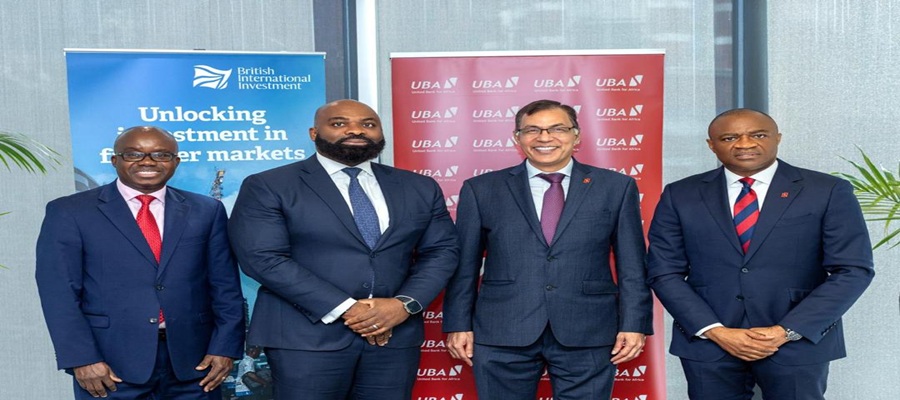
United Bank for Africa (UK) Limited (“UBA UK”) and British International Investment plc (“BII”), the UK’s development finance institution and impact investor, today announced that they have signed a letter of intent to develop trade finance collaboration opportunities. The proposed initiative aims to expand access to trade and working capital facilities for businesses operating across Africa.

L-r: West Africa Director and Head of Office Africa Coverage, BII West Africa, Benson Adenuga; Managing Director and Head of Africa, BII, Chris Chijiutomi; Lok Mishra, Chief Executive Officer, UBA UK, Loknath Mishra; Group Managing Director, United Bank for Africa (Plc) during the signing of letter of intent to develop trade finance collaboration opportunities.
Access to trade finance remains one of the most significant structural constraints on African trade. Businesses – particularly small and medium-sized enterprises – are frequently unable to secure letters of credit, guarantees, and supply chain finance on commercially viable terms, limiting their capacity to export and import competitively. This trade finance gap is estimated by the African Development Bank to be over USD 80 billion annually.
To help close this gap, UBA UK, the London subsidiary of UBA Group, Africa’s Global Bank, will leverage its deep relationships across the Group’s 20-country African network to originate and structure trade finance transactions. While BII, with a mandate to support productive, sustainable, and inclusive growth across Africa, can support transactions that might otherwise fall outside conventional commercial appetite.
Lok Mishra, Chief Executive Officer, UBA UK, said: “The signing of this letter with BII represents a landmark moment for UBA UK and for the UBA Group’s global ambitions. As the Group’s hub for Trade Operations, UBA UK is uniquely positioned to connect African businesses with the international financial system.
“Working alongside BII, we can extend that capability further — mobilising capital where it matters most and helping to close the trade finance gap that holds back so much African potential.”
Chris Chijiuitomi, Managing Director and Head of Africa, said: “British International Investment is committed to catalysing private sector growth across Africa, and trade finance is a critical enabler of that growth.
“We welcome the opportunity to collaborate with UBA Group, whose pan-African network and deep institutional relationships can help advance our ambition to expand access to trade and working capital finance, particularly in frontier markets.”
The announcement builds on growing momentum around intra-African trade facilitated by the African Continental Free Trade Area (AfCFTA), which entered into force in 2021 and represents one of the world’s most ignificant trade integration initiatives.
Both institutions have identified the operationalisation of AfCFTA as a priority catalyst for a trade finance facility, with UBA UK’s network across major AfCFTA economies offering a basis for supporting businesses navigating the emerging continental market.
This also complements the UK Government’s broader engagement with African economic development, including commitments made at the UK-Africa Investment Summit, and reinforces the City of London’s role as a leading international finance centre for Africa-focused capital mobilisation.
Future cooperation remains subject to further assessment, due diligence and the completion of internal approvals by both parties.


Central Bank of Nigeria (CBN) has introduced stricter rules guiding the use and management of the Bank Verification Number (BVN) as part of efforts to reduce fraudulent transactions within the financial system.The revised framework, which takes effect from May 1, includes tighter controls on BVN enrolment, data access and customer information updates.

The apex bank said the measures are aimed at strengthening identity management, improving fraud monitoring and safeguarding the integrity of banking transactions.
Under the new guidelines, BVN enrolment is now restricted to individuals aged 18 and above, while customers will only be allowed to change the phone number linked to their BVN once.
The restriction is designed to curb identity manipulation often exploited by fraudsters through repeated updates of personal information.
The CBN also directed financial institutions to maintain a temporary watchlist for BVNs linked to suspicious transactions.
Affected BVNs may be flagged for up to 24 hours, during which customers are expected to verify or clarify flagged transactions before further action is taken.
In addition, access to BVN data has been tightened, with the apex bank retaining exclusive control over the database while granting access only to licensed financial institutions under defined conditions.
The move, according to the CBN, is expected to enhance data security and support a more resilient financial system as BVN enrolment continues to grow.

Court Jails ‘Colonel’, ‘Major’ of Global Money-Laundering Ring

Court Bans Kenyan Telcos from Recycling SIM Cards

Providus Bank Fully Meets CBN Capital Requirement, Sets Record Straight

African Tech Start-ups to Receive $46m of Speedinvest Africa Fund

U.S. Charges Three in $2.5 Billion Plot to Smuggle Nvidia AI Chips to China

Kaspersky Discovers New Phishing Campaign Exploiting Google Tasks Notifications to Steal Corporate Credentials

esentry 2025 Report Shows Healthcare, Financial Services and Telecoms as Staging Grounds for Increased Cyberattacks in Africa

AfDB, UNDP Launch $10Bn AI Initiative for Africa

Mutual Benefits Assurance Settles ₦5.9bn Claims in January 2026

MultiChoice Suspends Yearly DStv Price Hike as Canal+ Pushes Growth




 E-Financial3 days ago
Kuda MFB Increases Kuda for Her Business Grants to ₦10 Million

 Telecom3 days ago
Vitel Wireless Lures Subscribers with “Data that Never Expires” Campaign

 News3 days ago
NSIA Sign MoU with UK’s Asset Green Ltd to Develop $496M Integrated Dairy Livestock Production Platform in Nigeria

 News3 days ago
BoI, MTN Foundation Launch N1Bn Fund for Women Entrepreneurs

 General News3 days ago
One SA Bank Equals Nigeria’s Entire Banking Sector – Why Recapitalisation Is Critical for Global Competitiveness

 E-Financial2 days ago
CBN Introduces Stricter BVN Rules to Curb Fraudulent Transactions

 Broadcasting3 days ago
Nigeria tops global rankings for USDT, USDC ownership

 E-Financial2 days ago
Binance is Missing from Ghana’s Crypto Sandbox