

E-Business
Sidmach Identifies Reasons Banking Data Are Not All Residing in the Cloud

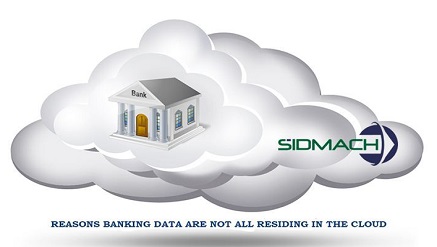
Have you ever wondered how banks get to keep massive amount of money, treasures, document for different individuals without a flinch of mix up? How they get to be all that reliable with keeping and tallying your information with your treasures?
In its blog post, Sidmach Technologies Nigeria Limited identified why banking data are not really residing in the cloud.
Well, gone are the days when people rely on the piggy bank in their granma’s room, people have resolved to using banks. It comes with benefits, so who wouldn’t like life to be a better place. The world is evolving, the population is growing yet the banking sector keeps thriving in spite of the large commodities to handle.
Technology Has Made Life Easy
The introduction of the cloud computing system without a doubt is a major milestone transformation in this technology era.
Faced with the uproar challenge of costly hardware and software technology, more banks have delved into this ideology and kept lasting smiles on the faces of their customers. The security obtained from the cloud service is top notch.
Matchless to Nothing from The Past
The advantages of these cloud services range from; Improved work efficiency; Business continuity; Cooked food (i.e reduced costs of software acquisition); Business process improvement; Used-based billing; Sharing compatibilities, etc.
Learn What the Cloud Is All About In Simple Terms
The cloud solution is a manmade invention and it is not 100% immune to hacking. Banks are very much aware of this flaw and they wouldn’t take that chance of losing data in any way. Banks have traditionally kept absolute charge and control over their information technology in the past and they would not cease from doing that.
They have been in total support of large in-house teams before the emergence of cloud solutions and if they are going to incorporate this solution at all, into their fast-paced business, they are very much aware that it is much safer to use the private cloud than the public cloud.
Apart from the better security gotten from the private cloud. It is much safer than we think. In the midst, of all these safety, ‘banks are expected to enter the cloud computing arena cautiously with no single cloud services delivery model being a silver bullet for best meeting their demanding business needs’.
The restrictions of the cloud service cannot be overlooked as no one wants to be a loser in a game. These restrictions can be traced to: Access; Confidence in providers; Uncertainties in cloud service integration with existing infrastructure; Support; Movement of banks from one cloud service provider to another, hacking, unwholly security reliability, etc., Hacking, unwholly security reliability, etc., Unwholly security reliability
These and many more are the fears of the banking industries so they have resolved to backing up their information technology and business as a whole with having their own inbuilt privately own data centres.


Kaspersky has introduced an update to its Automated Security Awareness Platform, adding full support for PDF and SCORM (Sharable Content Object Reference Model) – the industry-standard protocol for deploying and managing e-learning content.

The enhancement enables organisations to build fully customised cybersecurity training programmes that reflect their infrastructure, risk profile, and internal policies, while continuing to benefit from Kaspersky’s expert-driven security content and phishing simulations.
According to the Kaspersky report titled “Redefining the Human Factor in Cybersecurity”, employees responding to phishing attacks was one of the main causes of cyber incidents in companies worldwide, accounting for 21% of cases among other reasons.
At the same time, additional Kaspersky research reveals that social engineering attacks are predicted to increase more than any other type in the nearest future, with 87% of respondents believing that social engineering attacks will become even more effective due to the use of AI tools.
The new Kaspersky Automated Security Awareness Platform (Kaspersky ASAP) update directly addresses several persistent challenges such as reducing the number of human-related incidents, cutting time spent on managing training programmes, decreasing regulatory and compliance risks, and minimising potential legal or reputational damage stemming from cybersecurity breaches.
With the new SCORM support, the platform becomes even more flexible: companies can now upload, track, and manage their own SCORM-based learning materials directly within the system. In addition, companies can accelerate their programmes by using easier-to-create PDF-formats.
This allows organisations to tailor training to their specific technology stacks and emerging threats targeting their industry or region. Businesses that have already invested in third-party SCORM courses or internal learning development can now seamlessly reuse their existing modules, protecting their prior investments while strengthening their cybersecurity posture.
The combination of Kaspersky’s embedded content built on real cases uncovered by the company’s world-class experts with customers’ PDF materials or SCORM modules enables a true best-of-breed approach to human risk management.
Organisations can supplement Kaspersky’s up-to-date cyberattack scenarios with internal policies, unique workflows, and industry-specific lessons, ensuring training resonates with employees and reflects real operational challenges.
“Human behaviour remains one of the most unpredictable elements in cybersecurity and also one of the easiest for attackers to exploit. By adding SCORM support to Kaspersky Automated Security Awareness Platform, we’re giving organisations the flexibility to build training programmes that truly match their internal realities.
“Combined with Kaspersky’s expert-driven content and real-world attack data, this update empowers companies to create more adaptive, relevant, and impactful awareness programmes than ever before,” comments Svetlana Kalashnikova, Security Awareness expert at Kaspersky.

Nigeria Data Protection Commission (NDPC) has joined sixty (60) other Data Protection Authorities (DPAs) in endorsing the “Joint Statement on Al-Generated Imagery and the Protection of Privacy.”

NDPC
The Joint Statement was coordinated by the International Enforcement Cooperation Working Group (IEWG) of the Global Privacy Assembly.
This underscores the growing concerns regarding the privacy risks posed by Artificial Intelligence tools capable of generating realistic images and videos of identifiable individuals.
The Joint Statement highlights concerns over the misuse of Al-powered tools to create non-consensual imagery, defamatory content, and other harmful materials, particularly affecting children and vulnerable groups.
It calls on organisations to implement strong safeguards, ensure transparency, provide effective content removal mechanisms, and comply fully with applicable data protection laws.
The current effort forms part of a continuum of steps being taken by Nigeria to ensure the responsible use of Al. It will be recalled that the Honourable Minister of Communications, Innovation and Digital Economy, Dr ‘Bosun Tijani, led the initiative for the development of the National Al Strategy.
The NDPC also issued the General Application and Implementation Directive (GAID), which, amongst others, mandates privacy by design and privacy by default in the development and deployment of Al tools.
The National Commissioner/CEO of the NDPC, Dr Vincent Olatunji, has directed that the Nigeria Data Protection Act (NDP Act) Compliance Audit Returns (CAR) by data controllers and processors of major importance will serve as a yardstick for monitoring and evaluating responsible use of Al for data processing in Nigeria.
E-Business
Jumia Tech Week 2026 Begins with Tech Deals on Smartphones, Electronics, and Everyday Technology

Jumia Nigeria has announced the launch of Jumia Tech Week 2026, a two-week campaign offering customers access to discounted technology products across key categories, including smartphones, computing, home entertainment, and wearable devices.

Starting from March 2 to March 15, Jumia Nigeria’s Tech Week 2026 is themed ‘Tech Products for Less’ – a deliberate commitment by the e-commerce giant to drive down the cost of technology products for Nigerian consumers. The campaign offers significant price reductions across key product categories, enabling more Nigerians to access the devices they need at prices that reflect the company’s dedication to affordability and consumer value.
Jumia Tech Week will feature deals across a wide range of product categories, including mobile phones, computer systems and accessories, televisions and audio equipment, gaming products, home appliances, portable power solutions, health technology,, and wearable devices.
Customers will also have access to curated recommendations, including top smartphone deals, must-have accessories, gaming essentials, and home technology upgrades.
According to Temidayo Ojo, CEO of Jumia Nigeria, the campaign reflects Jumia’s broader commitment to making everyday technology more accessible to Nigerians.
“Technology has become an essential part of everyday life, and access to the right devices enables more people to participate fully in the digital economy,” said Ojo. “At Jumia, we remain focused on expanding access and improving the shopping experience as we continue to build Nigeria’s everyday retail destination.”
The campaign will include a range of customer engagement initiatives such as flash sales, brand days, anchor deals and interactive activities designed to enhance the online shopping experience.
Special highlight periods, described as Explosion Days, will take place on March 6 and March 13, featuring limited-time offers across selected technology categories. Customers will also be able to participate in interactive activities, including product-based games, treasure hunts,, and live shopping sessions during the campaign period.
The campaign will feature participation from leading brands including Oraimo, Silver Crest, Samsung, Ecoflow, Nivea and Aeon, offering customers a wide selection of technology, household and lifestyle products. Early access promotions already begun during the teaser period from February 16 to March 1, allowing customers to preview selected deals ahead of the official launch.
Jumia Tech Week forms part of the company’s broader strategy to expand e-commerce adoption by improving access to essential products and enhancing the customer experience across its platform. As Nigeria’s e-commerce market continues to grow, Jumia remains focused on strengthening its product assortment, logistics capabilities, and digital experience to serve customers better nationwide.
Customers can participate in the campaign by using the Jumia mobile app or visiting the Jumia website and following the conversation online using #JumiaTechWeek.

GCR Affirms Afreximbank’s International Scale Ratings of A, A2

SmartCash Launches ‘No Be Cho Cho Cho’ Campaign to Boost Digital Banking in Nigeria

MTN Nigeria Non-Executive Director Mazen Mroue Quits to Focus on Group Role

Google Adds Yorùbá, Hausa to AI Search, Boosting Access for Millions of Nigerians

MultiChoice Shuts Down Showmax After 11 Years Amid Streaming Wars

Dr. Cairo Ojougboh Foundation Bolsters Nigeria’s Education Drive with ₦2.7m Student Support

Kaspersky Brings more Transparency to Threat Detection with New Hunt Hub

NDPC Commits to Balancing Data Privacy, Protection Information

PwC Reveals AI Scaling Gap Slows Africa’s Digital Transformation

Firm Reviews the Evolution of Phishing Threats in 2025




 E-Financial3 days ago
NRS Targets N40trillion in Tax, Royalty Revenue in 2026

 General News3 days ago
Purple Woman 3.0 Is Back, to Empower Women in Tech this IWD 2026

 E-Financial3 days ago
SEC Revokes Registration of Kensington Agro Trading Limited

 News3 days ago
EFCC Arraigns Two FSDH Bank Officials Over $307k, €50k Fraud
 E-Business3 days ago
NDPC, 60 DPAs Collaborate on Enforcing Privacy Rights in the Use of Al

 Telecom3 days ago
Konga Launches ‘Berekete Sales’ with Up to 50% Discounts Across Major Categories

 E-Financial2 days ago
Nigeria’s VAT Jumps 34%, CIT Soars 48% to ₦14trn in 9M’25 – NBS

 General News3 days ago
NCDC Raises Alarm over Lassa Fever Ravaging 18 States in Nigeria