

Telecom
Sierra Leone’s Telecoms Regulator Visits NCC for Benchmarking

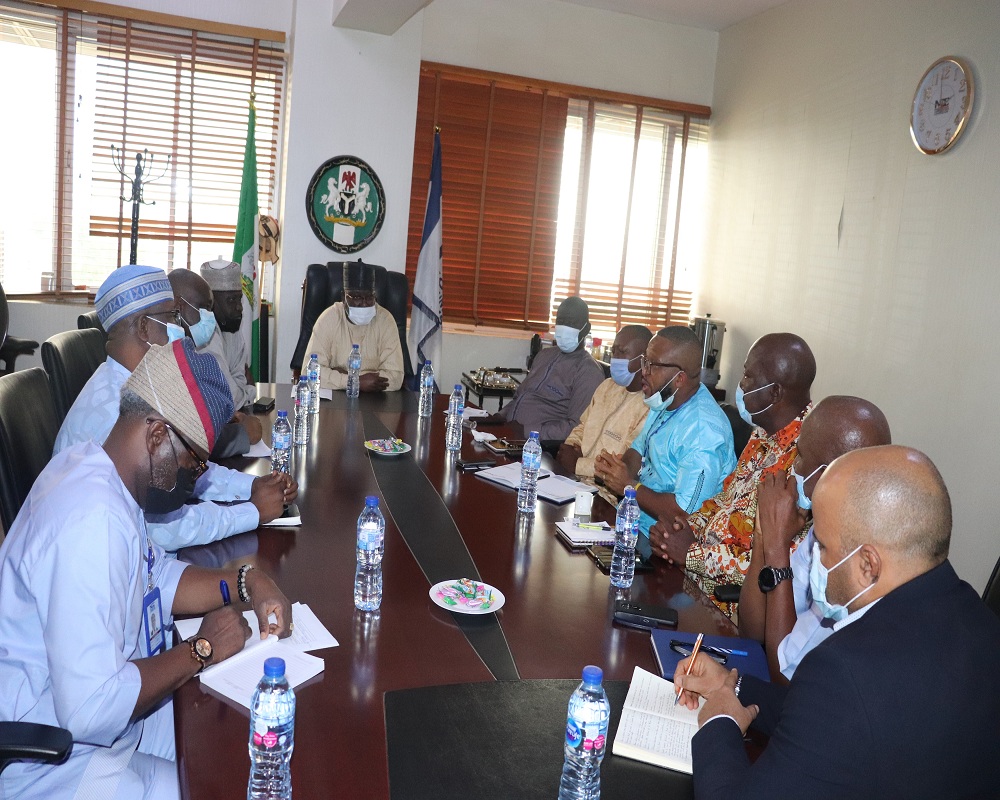
Nigeria’s global ranking as a model in telecom regulation, and her status as a leading light of operational efficiency, solidarity and collaborative partnering in sub-regional and Continental telecommunication sphere, received a boost recently when a delegation from the National Telecommunications Commission (NATCOM) of Sierra Leone, paid a visit to the Nigerian Communications Commission (NCC) for benchmarking of NCC’s regulatory policies, programmes and activities.

Cross section of NCC Staff with Sierra Leonean delegation during the visit on Thursday
Dr. Ikechukwu Adinde, Director, Public Affairs, NCC, in a statement on released on Thursday, said that the Sierra Leonean delegation, led by Amara Brewah, NATCOM’s Deputy Director-General, was received at NCC’s head office by Engr. Ubale Maska, NCC’s Exectutive Commissioner Technical Services (ECTS), on behalf of the Executive Vice Chairman (EVC) of NCC, Prof. Umar Danbatta.
Brewah expressed gratitude to NCC for the reception despite the short notice given, and stated that NCC’s gesture resounded the value it accords the relationship that exists between the two organisations.
He thanked the Management of NCC for the opportunity offered his team and described their interaction with many departments of the NCC as very engaging, quite rewarding and very contextual, considering that the two countries operated under similar circumstances and have had to contend with similar operational issues.
Brewah regretted that the short notification was due to an equally engaging sessions he and his team had at a recent forum of the West African Telecommunications Regulators Assembly (WATRA).
Maska, who warmly received the visitors, informed them that the EVC was scheduled to carry out an important international assignment before the planned visit of the Sierra Leonean counterpart was received by the Commission.

He told the visitors that, otherwise, the EVC would have loved to personally receive them because the NCC attaches great importance to visitations and exchanges by its counterparts, especially in the sub-region and on the Continent.
The ECTS said that the value NCC bestows on sub-regional and continental collaboration and partnership explained EVC’s gracious approval of the request and directive to him to receive the Sierra Leonean delegation despite the short notice.
Maska said the NCC Management was pleased by the fact that the NATCOM delegation found the visit and the engagement with many departments of NCC quite rewarding.
He said the Nigerian Communications Commission is quite appreciative of the trust and confidence reposed in it and in Nigeria by institutions like NATCOM, and the NCC looks forward unreservedly “to also learn how Sierra Leone handled some of its challenges in telecom regulation and other matters of similar interest, because we are also seek ways of improving our operations.”
Engr. Bako Wakil, the Director of Technical Standards and Network Integrity (DTSNI) at NCC, also expressed joy at seeing the Sierra Leonean delegation.
He thanked them for the visit and expressed NCC’s willingness to share more information with the visitors, especially on Quality of Service (Qos) matters, one of the central issues on which NCC never rested its oars in ensuring continuous improvement.
The NCC Management team that received the visitors include Reuben Muoka, Head Special Duties, whose Department co-ordinated the reception for the NATCOM team, Hafiz Shehu, Chief of Staff to the EVC, and Dr. Omoniyi Ibietan, Head Online Media, who represented the Director Public Affairs, Dr. Ikechukwu Adinde.
Other members of the delegation from Sierra Leone were: Hon. Brima Mansaray, Member of the Information and Communications Committee of the Parliament of Sierra Leone; Paul Squire Esq., Member of NATCOM Board of Commissioners; Abdul Bah, Director Information Technology at NATCOM; Harding Tommy, Director Policy and Government Relations; and Shaka Sasha, Manager, Fraud Management Systems. The delegation had engaging interactions with many arms of NCC including, the Departments of Digital Economy, Licensing and Authorization, Legal and Regulatory Services, TSNI, and Policy, Competition and Economic Analysis.



Wireless Application Service Providers Association of Nigeria (WASPAN) has asked the Court of Appeal to suspend the enforcement of the Federal Competition and Consumer Protection Commission’s (FCCPC) Digital, Electronic, Online or Non-Traditional Consumer Lending Regulations, 2025 (DEON Regulations).

WASPAN warned that the implementation before the determination of its appeal could expose telecom value-added service providers to sanctions and disrupt their operations.
Millions of subscribers across the country rely on borrowed airtime to communicate.
Seun Sofoluwe, an Abeokuta, Ogun State resident, said another interruption would have severe consequences for many Nigerians who depend on airtime and data lending services for their daily communication needs.
“A lot of people depend on the services, and it will be very bad for them, especially those who are so reliant on it that they do debt-to-debt servicing,” he said.
Debt-to-debt servicing refers to the practice of repaying an outstanding airtime loan immediately to qualify for another advance, underscoring the extent to which some subscribers depend on the facility to remain connected.
Sofoluwe’s concerns echo the experience of Lagos-based employee Farouk Rabiu, who recounted the hardship caused by the six-month suspension of airtime lending services before they were restored.
“I was devastated because, after exhausting my data, I was hoping to borrow credit to access my bank account. Instead, it was a major disappointment,” Rabiu had said after the services resumed.
Adding another dimension to the debate, Gbenga Adebayo, chairman of the Association of Licensed Telecommunications Operators of Nigeria (ALTON), said the earlier disruption showed that airtime credit had evolved far beyond a conventional telecommunications offering.
“What this episode demonstrated is that airtime credit is not a financial product in the way regulators initially characterised it. It is economic infrastructure that approximately 40 million people use regularly, with the vast majority of them at the base of the economy,” Adebayo said.
WASPAN, which represents licensed value-added service providers, has asked the Court of Appeal to restrain the FCCPC from enforcing the DEON Regulations pending the hearing of its appeal against the July 20 judgment of the Federal High Court in Lagos.
The association argued that immediate enforcement would expose operators to sanctions, create regulatory uncertainty and disrupt telecom-enabled services, including airtime credit and data advances, used daily by millions of Nigerians.
The FCCPC, however, has defended the resumption of enforcement, insisting the regulations are intended to sanitise the digital lending industry, curb predatory debt recovery practices, protect consumer data and eliminate illegal digital lenders.
The Court of Appeal is expected to determine whether enforcement of the regulations should remain suspended while it considers WASPAN’s appeal, a decision that could shape the future of telecom-based digital lending services and determine whether subscribers continue to enjoy uninterrupted access to airtime and data credit.

Nigerian Communications Commission (NCC) and the Rural Electrification Agency (REA) have entered into a partnership to deploy renewable energy solutions for telecommunications infrastructure in rural and underserved communities, a move expected to reduce operators’ energy costs and improve network availability.

Abraham Oshadami, executive commissioner for Technical Services at the NCC, disclosed this during the signing of a memorandum of understanding (MoU) in Abuja.
According to Oshadami, the NCC-REA Stakeholder Forum and MoU signing ceremony will enable telecom base stations located near mini-grids to access cleaner and more affordable electricity, reducing their reliance on diesel-powered generators.
He said the agreement came at a time when telecom operators are facing rising operational costs due to increased spending on diesel to power network sites amid unreliable electricity supply from the national grid.
The partnership reflects the growing relationship between the power and telecommunications sectors, as both rely on each other to deliver essential services.
Oshadami explained that while telecom infrastructure requires a steady power supply to remain operational, digital connectivity also supports electricity services such as smart metering, electronic payments and remote customer management.
According to him, the collaboration is aimed at improving access to reliable electricity and telecommunications services, particularly in remote communities where inadequate power supply has slowed digital inclusion.
He said both agencies had identified telecom base stations located within one to two kilometres of existing mini-grids, allowing the implementation of the initiative to begin immediately.
“Where mini-grids exist, we are able to identify nearby base stations and connect them to those power sources,” Oshadami said.
He added that future mini-grid projects would be planned with telecommunications infrastructure in mind, ensuring that electricity investments also support the expansion of digital services.
Telecom
Ex-Pan African Towers CEO Alleges DPI, Verod Using Court Suit to Pressure Him in $30m Buyout Dispute

A fresh twist has emerged in the legal disputes surrounding the acquisition of Pan African Towers (PAT), with the company’s former Chief Executive Officer, Azeez Amida, alleging that a lawsuit filed against him is retaliatory and intended to pressure him over an ongoing $30 million management buyout dispute.

Pan African Towers
The allegation is contained in Amida’s Statement of Defence and Witness Statement filed before the Federal High Court in Lagos in response to claims instituted by Pan African Towers.
According to the court filings, Amida argued that the latest suit should be viewed within the context of several pending disputes involving the company’s shareholders, including Development Partners International (DPI), Verod Capital Growth Fund III LP and African Development Partners International LLP.
The defence stated that Amida had already commenced separate legal proceedings against the investors over the management buyout transaction, seeking damages exceeding $30 million, while also pursuing claims against Pan African Towers arising from a Mutual Separation Agreement executed after his departure from the company.
He alleged that instead of filing substantive responses to those actions, Pan African Towers initiated fresh proceedings at the Federal High Court over expenditure approvals and procurement decisions made during his tenure as chief executive.
Amida maintained that the action was retaliatory and intended to exert pressure on him in relation to the earlier disputes.
The defence further explained that he had deliberately distanced himself from final expenditure approvals during his time as CEO because of disagreements over procurement practices and governance issues involving the board and shareholders.
According to the filings, following the appointment of a new Chief Financial Officer (CFO), financial approval responsibilities were structured to ensure the CFO retained final approval authority, while the CEO’s role was limited to endorsing requests that had already undergone departmental reviews.
The defence argued that many of the transactions now being challenged were processed through that governance framework, with approvals passing through the Finance and Human Resources departments before payment.
It added that the CFO, who remains with the company and has since been promoted, exercised the final approval authority over the disputed expenditures.
Amida also contended that the transactions cited in the lawsuit were not unilateral decisions but formed part of the company’s established governance and approval procedures involving multiple departments, executive management and, where necessary, the board.
According to the defence, documentary evidence, including internal emails, approval workflows and payment records, would be presented during the trial to support those claims.
The filings further stated that hospitality expenses, investor engagement costs and related business expenditures challenged in the suit were incurred in the ordinary course of business, known to directors and shareholders, reimbursed through established procedures and reflected in the company’s audited financial statements.
Amida also argued that the allegations only surfaced after his exit from the company despite extensive internal reviews conducted before both parties executed a Mutual Separation Agreement in November 2024.
He maintained that the agreement required any allegations of misappropriation unrelated to released assets to be investigated, supported by credible evidence and communicated to him within six months, with an opportunity to respond before legal proceedings could commence.
In a separate application, Amida challenged the jurisdiction of the Federal High Court, arguing that the dispute arose from his employment relationship and the Mutual Separation Agreement, matters he said fall within the exclusive jurisdiction of the National Industrial Court.
He also argued that a related case remains pending before the National Industrial Court and that the Federal High Court proceedings amount to an abuse of court process.
The defence indicated that it would rely on a range of documentary evidence during the trial, including audited financial statements, board communications, internal approval emails, banking records, employment documents, shareholder communications and the Mutual Separation Agreement.
The Federal High Court is yet to rule on the substantive claims or the preliminary jurisdictional objections.
While Pan African Towers’ allegations remain before the court, Amida has denied any wrongdoing and maintained that the action forms part of a broader pattern of litigation connected to the acquisition of the company.
The court is expected to determine the merits of the claims after hearing both parties.

See Verified 20 Countries Nigerian Passport Holders Can Travel Visa-Free

NPC Opens 131 Births, Deaths Registration Centres in Anambra

Lagos Chamber Opposes 21 Percent Pension Contribution, Warns of Job Losses

Subscribers, Telcos Warn FCCPC over Airtime Lending Enforcement

NCC, REA Partner to Cut Telecom Costs with Renewable Energy

NRC, Ponzi Scheme Collapses Resulting Loss of Billions of Naira

EFCC Busts NIS Visa Overstay Racket, Uncovers N700m in an Account

Tokenization, Blockchain Technology will Transform Financial Institutions – IMF

From Scarcity to Scale: What Africa Can Learn from India’s Agricultural Transformation

Spotify partners Afro Nation Portugal to expand African music experience




 Telecom2 days ago
GSMA Supports Abuja Declaration on Meaningful Connectivity for Africa, Joins Partners to Launch ATLAS Umoja

 Telecom2 days ago
Airtel Secures Another 10-year Spectrum Renewal in Nigeria

 Telecom2 days ago
MTN Nigeria Warns Customers Against Fake ‘One Month Free Data’ Promotion

 News2 days ago
Nigeria, Israel Strengthen Research, Technology Collaboration

 E-Business2 days ago
HURIWA, CLO Protests Bill Asking Social Media Firms’ to Open Shops Nigeria

 Broadcasting2 days ago
Glo Sponsored African Voices to Feature Netflix’s “The Polygamist” Stars

 E-Financial2 days ago
Moniepoint as a Key Driver in Expanding Financial Access for Businesses in Nigeria

 General News2 days ago
Anambra Govt Bans Graduation Ceremonies in Anambra Schools