

General News
Sirika Unfolds Vision for Nigerian Aviation

Senator Hadi Sirika, minister of State, Aviation has unfolded the vision and strategies of the President Mohammad Buhari administration for achieving a quantum leap forward for the Nigerian Aviation industry. First, he made it clear that Aviation” is pivotal to the growth of key economic sectors, certainly not limited to travel and tourism. Agriculture production and distribution, rural development, trade and commerce, manufacturing, oil and other non-oil sectors.”
In what could be termed a comprehensive mission, Sirika had quite some surprises and a handful of seemingly simple solutions to longstanding problems and issues. One surprise: Government plans to concession four major airports to the private sector.
The Minister believes that by bringing in the private sector, the country can achieve better infrastructural development and improve the efficiency of service delivery at these airports. The airports in question are the international airports in Lagos, Abuja, Port Harcourt and Kano.
And it’s also the month of May, 2016, which makes it one year since this administration came on board, it was an opportunity for stock taking.
Sirika said that some of the challenges facing the country’s airports were that of obsolete equipment and dilapidated infrastructure; obsolete equipment and inadequate capacity. These challenges, according to him, are expected to be addressed by the newly initiated concession programme, the much awaited completion of five new, world class, ultra-modern airport terminals in Lagos, Abuja, Kano, Enugu and Port Harcourt later this year.
On the focus, the Minister said that “ the present administration is focussing on issues that will rapidly develop the aviation industry within the shortest possible time.” These issues, include aviation safety and security, infrastructural development, the establishment of a national carrier, lack of a world class aircraft maintenance, repair and overhaul,(MRO) facility in the country.
Others are: How to quickly develop our air cargo capacity in order to participate actively in multi-billion dollars global agro-allied export trade.
The restructuring of the country’s aviation agencies and the setting up of an aerospace University in the country.
In his usually forthright manner, Sirika states the administration’s position on all of these tough issues, perhaps, leaving no one in doubt about the policy direction of the Buhari administration as regards the aviation industry.
On safety and security at our airports, the minister was of the view that government’s response should include the development of a new security strategy framework in partnership with international security organisations, the determined implementation of a certification programme for all our airports and a comprehensive security threat and vulnerability assessment of our airports. The Minister of state recently inaugurated a technical committee with the mandate to look into security at the country’s airports.
On the vexed issue of a national carrier, Sirika was emphatic that the administration will establish a national carrier because of the benefits that the country would derive from it, especially from the various Bilateral and Multilateral air services agreements signed by the government with other countries, worldwide.
It would also help stem current capital flight due to foreign airlines exploiting the current absence of a Nigerian national carrier.
He said however, that the carrier will be floated on the stock exchange and listed whereby Nigerians can buy its shares and own it. Furthermore, to realise this laudable goal, he said that government would engage the services of a transaction adviser “to develop an appropriate business model and framework to establish a national carrier using a public/private partnership concept.” When in place, the national carrier would be expected to form alliances and joint ventures with other carriers, in order to increase its reach and routes, Sirika said.
There is also the issue of national prestige and national pride when talking about a national carrier, as some smaller African countries such as Ethiopia proudly fly their countries colours on their national carriers, many of which have become successful ventures, the Minister said.
On the appalling lack of a world class aircraft maintenance, repair and overhaul, (MRO)l facility in West and Central Africa, the Aviation helmsman challenges Nigerian investors to key into the bountiful opportunity.
He said that the current administration was determined to create an enabling environment that would provide an impetus to willing investors.
He hoped that such investors could go beyond only MRO but actually initiate the local manufacturing of light aircraft spare parts in the country, which would help save foreign exchange and create more jobs for Nigerians in-country.
The issue of air cargo facilities ties with the country’s hopes of generating more foreign exchange from agricultural produce and other non-oil exports.
As the Minister noted the country is current losing a lot in potential income from export of perishable agricultural produce including fresh flowers and vegetable as a result of the absence of adequate air cargo facilities.
Apart from generating forex, it has far reaching socio- economic impact as it will improve farmers’ income significantly and help stem rural to urban migration. Government is therefore working hard to meet this challenge, with several of the required facilities under construction in strategic areas round the country, Sirika noted.
The country’s target is to get 40 per cent of the market for agro-allied and perishable agric produce export coming from Africa to global markets, he said.
A thoroughbred and experienced air pilot himself, the minister noted, howbeit sadly, that many well trained professional aviators, especially pilots are unemployed. Whereas, on the other hand, their foreign counterparts are having a field day in the country working for foreign airlines operating in the country.
Not mincing words, the minister said that government would henceforth vigorously enforce expatriate quotas for staffing of foreign airlines operating in the country, so that foreigners do not continue to take jobs meant for Nigerians. And review the policy on validation of foreign licenses (no aviator left behind policy.)
The Minister said that it is a policy of the All Progressives Congress, APC administration to set up an Aviation Development Bank, which he said, will offer Nigerian aviation entrepreneurs long term, low interest loans in single digits to help finance their airline businesses. This, accordingly, will boost the growth of the industry and help create stability.
Other salient industry issues which the Minister addressed are that of the supply and pricing of Aviation Jet A-one fuel, sourcing of foreign exchange by airlines for their operations and aircraft leasing. On Jet A-1, Sirika said government has made arrangements to start local production of the fuel which is currently 100 per cent imported.
Discussions are also in top gear with the Central Bank of Nigeria, CBN to ease forex supply shortfall to airlines, especially foreign airlines because they operate and pay for several services in foreign exchange whereas, tickets are sold in naira locally, putting airlines at a disadvantage.
Sirika said that the administration will continue with the current policy of granting duty waivers on imported aircraft and spare parts, so as to support the industry. Further, government is well aware of financing difficulties faced by Nigerian airlines in the leasing of aircraft. They have limited access to capital even then at high interest rates of about 27 per cent currently. They are also faced with inadequate numbers of aircraft, while they have high debt profiles. The Minister said that the government intends to set up an aircraft leasing company to assist these Nigerian airlines, to have better access to leased aircraft for their operations.
Then, it was time to highlight some achievements of the Ministry of Transportation in the area of aviation, since last May(2015).
The Minister noted with pride that Nigeria passed the recent ICAO security audit of the country’s airports with flying colours at a score of 96 per cent.
The aviation industry similarly passed the ICAO Universal Safety Oversight Audit of the country, reflecting the enormous hardwork and expertise of Nigerian aviation authorities.
The Buhari administration has been able to provide bomb containment vessels at the Malam Aminu Kano International Airport Kano and at the Port Harcourt International Airport. The administration has also installed solar-powered field lighting systems at 10 airports round the country including Port Harcourt , Sokoto, Akure and Enugu. In addition, Air traffic control tower operations at the Malam Aminu Kano Airport have been automated, allowing for more efficient services.
The Minister of State rounded off by promising that the Nigerian aviation industry would soon have a master plan in place, which he said will be integrated into the National Integrated Infrastructure Masterplan, NIIMP. He said that the development of Nigerian aviation is “a joint responsibility of the public and private sectors.”
Above all, Sirika is confident that the Nigerian aviation industry” can become profitable, self-sustaining and beneficial to all stakeholders,” with our concerted efforts and cooperation.
• Yakubu Dati, spokesman of the Federal Airports Authority of Nigeria, wrote from Lagos
—



Senate on Tuesday approved the fresh $6 billion loan request forwarded to the lawmakers by President Bola Tinubu.

Lawmakers approved the fresh loan on the same date the request letter was read by Godswill Akpabio, senate president.
The Senate approved the loans following the presentation and consideration of the report by Senator Aliyu Wamakko, chairman, Senate Committee on Local and Foreign Debts.
President Tinubu had written to the Senate seeking approval to borrow a total of $6 billion to finance key government projects and address budgetary gaps.
The requests were contained in two separate letters addressed to Godswill Akpabio, president of the Senate, and read during Tuesday’s plenary.
In the first letter, the President requested approval to obtain a $5 billion loan from Abu Dhabi Bank.
According to the President, the facility will be used to cover the nation’s budget deficit and support debt financing, among other fiscal obligations.
The request forms part of the Federal Government’s efforts to stabilise public finances and sustain ongoing government programmes.
In a separate communication, Tinubu also sought approval to secure a $1 billion UK Export Finance loan facility from London Citi Bank.
The loan is intended for the rehabilitation of key port infrastructure, including the Lagos Port Complex and Tin Can Island Port.
The President said the project aims to address critical infrastructure deficiencies in the country’s maritime sector
According to him, the rehabilitation will help improve efficiency, enhance safety standards, and support Nigeria’s efforts to diversify its economy beyond oil.
He added that the initiative would also strengthen Nigeria’s position as a regional trade hub.
Both requests have now been considered and approved by the Upper Legislative Chamber.
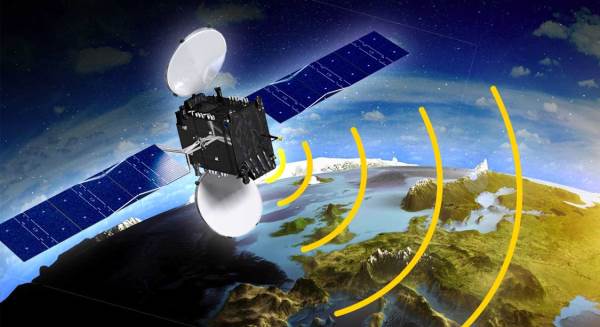
Federal government has fixed 2028 and 2029 for the launch of two communication satellites, NIGCOMSAT-2A and NIGCOMSAT-2B, as part of efforts to strengthen security and expand digital connectivity.

The government will be committing over $22 billion on the ambitious space-led growth agenda focused on new satellite launches, increased industry revenue and expanded broadband access in underserved communities.
At the opening of the 2026 Nigerian Satellite Week in Abuja, Dr Bosun Tijani, minister of Communications, Innovation and Digital Economy, confirmed the government’s approval for the acquisition of two new satellites—NigComSat 2A and 2B, describing the move as a “defining commitment” to national development, digital sovereignty and economic competitiveness.
Also, Mrs Jane Nkechi Egerton-Idehen, managing director of Nigerian Communications Satellite Limited (NigComSat), noted that the projects have moved beyond procurement to the execution stage.
She said the satellites are designed to enhance intelligence gathering, surveillance, and connectivity across Nigeria and neighbouring countries, particularly in support of security operations.
“For 2A and 2B, we have started the process. We have closed the tender and are now back into the financing and implementation stage. 2A is built to come up in 2028, and 2B for 2029.
“When they are up and running, they are expected to provide security within the borders and neighbouring countries. They will support the security agencies because data collection and intelligence in real time is important. Satellites like communication satellites allow that, irrespective of where they are,” she said.
On his part, Tijani, said the satellite programme forms part of a broader government strategy to deepen digital infrastructure nationwide.
According to him, the initiative complements ongoing investments in fibre-optic expansion and telecommunications infrastructure, while extending connectivity beyond Nigeria’s borders.
“The President’s approval of NIGCOMSAT-2A and 2B demonstrates a clear commitment to building the future. These satellites will enhance security, connect remote communities, and extend our fibre-optic network into neighbouring countries.
“Some of these neighbouring countries pay up to ten times more for internet capacity than Lagos. Extending our fibre network will not only improve connectivity but also enhance border security and regional collaboration.
“Satellite technology affects everything, from how a child in a rural community accesses the internet to how farmers make critical decisions and how businesses operate across distance,” he said.
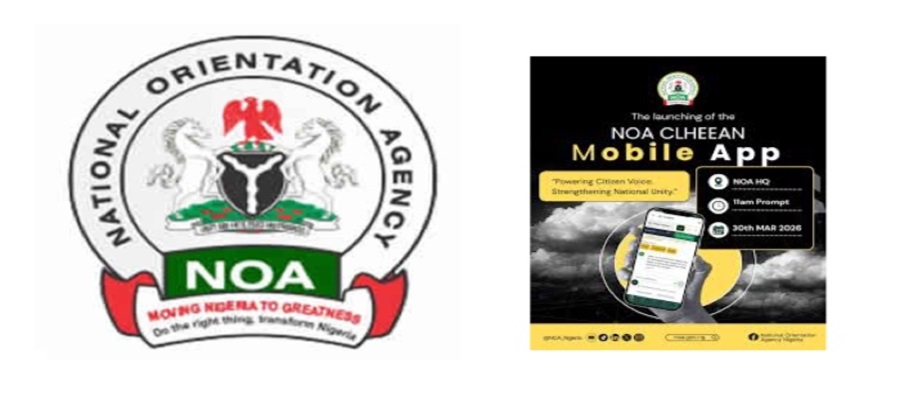
Federal government has announced the launch of CLHEEAN, an artificial intelligence-powered mobile application designed to improve interactions between citizens and public institutions.

It is also a civic education and community engagement app.
Developed under the National Orientation Agency (NOA), the platform functions as a virtual assistant accessible via mobile devices.
It allows users to access information on public policies, ask questions, and interact directly with government services.
The app includes features such as instant messaging, voice recognition, and multilingual support, including several local languages, to reach a wider audience.
With CLHEEAN, users can also submit feedback, report concerns, and take part in discussions on public policies. The approach is intended to strengthen citizen participation and improve communication between the government and the public.
Lanre Issa-Onilu, director general of the NOA, said the initiative addresses a long-standing gap between citizens seeking to be heard and systems that do not always respond effectively, adding that the platform marks a step toward closing that gap.
The launch comes as Nigeria continues to face challenges in citizen engagement and the dissemination of public information.
By leveraging artificial intelligence, authorities aim to make public services more accessible while improving transparency and responsiveness.
The initiative also reflects a broader trend across Africa, where governments are increasingly exploring the use of AI to modernize public services and strengthen ties with citizens.

How Recycled SIM Card Linked to N50m Kidnapping Nearly Landed me in Jail – Businesswoman

Senate Gives Tinubu Nod to Borrow Fresh $6Bn

FG Earmarks $2Bn to Launch 2 Satellites in 2028, 2029

CBN Directs Banks, Fintechs to Complete Cybersecurity Audit Tool

FG Launches CLHEEAN to Streamline Access to Government Services

Spotify’s Loud & Clear Report Reveals Over ₦60Bn Revenue for Nigerian Artists in 2025

Madonna University Taps Tech Guru Adote for Strategic Board Role

China Threatens to Shut Nigeria’s Satellite Over $11.44m Unpaid Debt

Jumia Tech Week 2026 Begins with Tech Deals on Smartphones, Electronics, and Everyday Technology

FCCPC Bans Lagos ‘No Refund’ Policy, Vows Fines and Shutdowns for Traders




 E-Financial3 days ago
CBN bars large‑ticket loan defaulters from banking services in tough new crackdown

 General News3 days ago
ARN Rejects Medical Bill over Attempt to ‘Scrap’ Profession

 Telecom3 days ago
NIGCOMSAT Supports Startups Growth with the Launch of Accelerator 3.0

 News3 days ago
Meningitis Kills a Quarter Million People a Year -Study

 Telecom3 days ago
FG Unveils Digital Economy Research Fund Scheme

 News3 days ago
Stakeholder says AI is Crucial to Nigerian Data Centres Amid Persistent Grid Collapse

 E-Financial2 days ago
NGX REGCO Fines 5 Firms N291m for Market Manipulation

 News2 days ago
Dangote Refinery Debunks Speculations on IPO