

Telecom
Smile Secures $365m Financing Towards 4G Expansion in Africa

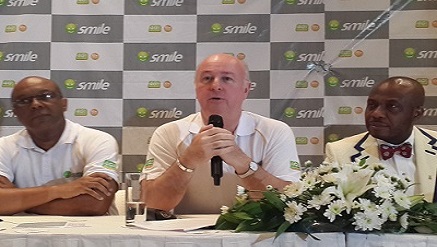
Smile Telecoms Holdings Ltd, which owns and operates mobile wireless 4G LTE broadband networks in the 800MHz band in Nigeria, Tanzania and Uganda, today announced plans to use US$365 million funding (made up of debt and equity financing) raised to expand its 4G LTE network coverage.
In a statement the company said the funding will be used to offer clear voice services and, by the end of 2015, establish national coverage comparable to the largest 3G network in each of its current countries of operation.
The funding is comprised of US$50 million of equity, raised from the Public Investment Corporation on behalf of Government Employees Pension Fund (“PIC”), and a US$315 million multi-tranche, multi-jurisdictional debt facility led by African Export-Import Bank with participation from the Development Bank of Southern Africa, Diamond Bank PLC, Ecobank Nigeria, the PIC, the Industrial Development Corporation of South Africa Limited and Standard Chartered Bank.
Smile’s shareholders now comprise Al Nahla Group, a Saudi Arabia-based company, which is the majority shareholder; Renven Investment Holdings, a pan-African investment vehicle, in which Nigerian investors, including the Obijackson Group, are the majority; Verene, representing Smile senior management and social entrepreneurs from South Africa; Telecom Investments, a Saudi Arabian-based investment company; Capitalworks, an active alternative management company, specialising in investment in the African mid-market”; the PIC; and Smile employees.
Under the terms, the funding will be used to accelerate national network roll-out, including equipment and services provided by Alcatel Lucent and Ericsson, a full MPLS (Multiprotocol Label Switching) network, a London Point of Presence and expanded international backhaul services, and to fund operational expenditure and working capital.
Irene Charnley, chief executive officer of Smile, explained that the regulatory environment in each of its countries of operation is clear, specifically in terms of license application and spectrum allocation.
“If you consider Nigeria, its regulatory environment is clear and transparent. There is no ambiguity.”
Charnley added that in South Africa the process takes much longer and the company is waiting on the regulator to provide direction on issues like spectrum. Once the company has launched its broadband network in the DRC in Q1 2016, it will focus on the South African market.
In its statement the company says there is persuasive evidence linking broadband to job creation. It quotes the Brookings Institution as stating that “for every one percentage point increase in broadband penetration, employment is projected to increase by 0.2 to 0.3 percent per year.”
“Furthermore, according to the Broadband Strategies Handbook by The World Bank, “a 10 percent increase in the penetration rate of broadband in developing countries is associated with a 1.4 percent increase in GDP per capita.”
Charnley said the process to secure the funding took three years and has been secured for a period of between seven and nine years. She reiterated that it is one of the largest capital raises ever for a telecommunications operator in Africa and brings the total funding committed to the company, since its founding in 2007, to approximately US$600 million.
Darisami International Consultancy Ltd acted as financial advisor to Smile.


Nigerian Communications Commission (NCC) has said that compensation of subscribers for poor service quality, such as persistent network outages or failed calls is automatic.

This initiative aims to ensure fairness by mandating that operators provide automatic compensation, such as airtime credits, for failing to meet regulatory Quality of Service Key Performance Indicators (KPIs).
According to the NCC, operators are required and mandated to identify affected subscribers and provide compensation directly.
In a framework for compensation of consumers published on its website, NCC said that it has directed Mobile Network Operators (MNOs) to compensate subscribers affected by prolonged or repeated poor quality of service experience within specific Local Government Areas where operators fail to meet regulatory Quality of Service Key Performance Indicators (KPIs).
The NCC also stated that the directive does not replace existing consumer protection mechanisms.
The NCC, said the directive adds a direct compensation mechanism for affected subscribers and aligns with measures set in existing legislations such as the Consumer Code of Practice Regulations 2024 and the Quality of Service Regulations 2024.
This directive applies to only Mobile Network Operators licensed and operating in Nigeria that have failed to meet their Key Performance Indicators on Quality of Service. For Internet Service Providers (ISPs) operating in Nigeria, a compensation framework is already in place.
To be eligible to receive compensation
. You experienced poor network service in an affected Local Government Area; and
- You made at least one outgoing revenue generating event (billed call, SMS, or data session) during the relevant period.
The compensation covers service failures affecting voice, data, or SMS services.
Operators are required and mandated by existing regulations to monitor their network performance across locations and service disruptions against Quality of Service KPIs.
This enables them to identify affected subscribers without the need for individual complaints.
Only service failures that fall below the defined thresholds set by the Quality of Service Regulations issued by the NCC will qualify for compensation.
Short, isolated interruptions and immediately remedied interruptions may not qualify
Compensation will be provided in the form of airtime credits.
This airtime credit will not have utilisation restrictions, and subscribers will be able to use it for voice calls, USSD sessions, data subscriptions, etc on the operators’ network.

Federal Government has announced plans to deepen collaboration with private sector players and other stakeholders in a bid to strengthen Nigeria’s cybersecurity architecture and response systems.

NDPC
Minister of Communications, Innovation and Digital Economy, Bosun Tijani, disclosed this in a recent press statement, noting that the government is considering the establishment of a Cybersecurity Coordination Council.
According to the minister, the proposed council is aimed at enhancing national cyber resilience and ensuring a more coordinated response to emerging cyber threats across public and private institutions.
Tijani emphasised that cybersecurity must be treated as a collective responsibility involving government, industry, and civil society.
“Cybersecurity is a shared national responsibility. Protecting Nigeria’s digital economy requires strong partnerships, trusted collaboration, and collective vigilance across government, industry, and civil society,” he said.
He added that through sustained collaboration, Nigeria would strengthen its capacity to detect cyber threats early, respond effectively, and build a resilient and trusted digital ecosystem.
The minister also called for increased stakeholder participation in shaping a sustainable, partnership-driven cybersecurity framework capable of deterring cybercriminal activities and safeguarding citizens, businesses, and critical digital infrastructure.
Meanwhile, the Nigeria Data Protection Commission (NDPC) has commenced an investigation into an alleged data breach involving Remita Payment Services Ltd., Sterling Bank, and other entities.
In a statement signed by its Head of Legal, Enforcement and Regulations, Babatunde Bamigboye, the commission said notices of investigation were issued to relevant parties on April 1, 2026.
The NDPC noted that affected organisations and individuals are currently providing information to aid its inquiry into the incident.
“The aim of the investigation is to ensure that data subjects are protected with appropriate technical and organisational measures,” the statement read.
It added that the probe would examine the types of personal data involved, the scope and nature of the alleged breach, potential risks to data subjects, and mitigation steps taken where breaches are confirmed.
The commission further disclosed that its National Commissioner and Chief Executive Officer, Vincent Olatunji, has directed a broader review of organisations operating digital payment systems.
According to the NDPC, entities found to be non-compliant with provisions of the Nigeria Data Protection Act, 2023, particularly regarding technical and organisational safeguards, would be scrutinised as part of efforts to maintain the integrity of the nation’s data protection ecosystem.

Sunil Mittal led Bharti Airtel has crossed the 650-million customer mark globally, fortifying its position as the world’s second-largest telecom operator by mobile subscriber base, as per a regulatory filing by the telecom operator.

“According to GSMA Intelligence, Bharti Airtel is ranked second globally by mobile customer base, with operations spread across India and Africa,” the filing said.
Commenting on this milestone, Gopal Vittal, executive vice chairman, Bharti Airtel, said: “Achieving the milestone of 650 million customers to be the second largest operator globally is a great responsibility for us to serve our customers better every day,”
He added that the telco strives to raise the bar on innovation, reliability, and experience so that every customer interaction is an opportunity to earn trust and deliver value connection.
Currently, Airtel India serves around 368 million mobile customers, meanwhile over 179 million users have been plugged into its subsidiary Airtel Africa spread across 14 countries.
Its mobile money platform, Airtel Money reached more than 52 million customers.
Additionally, the telco serves around 13 million homes with high-speed internet services and over 15 million through its Digital TV offering.
With operations spanning 15 countries and network coverage reaching over two billion people, analysts say that the latest milestone is a testimony to the natural curve of evolving from a telecom operator into a broader digital services provider.

Offset Communications Slams N50m Suit against Qore Technologies for Alleged Copyright Infringement

Compensation for Poor Service Quality is Automatic- NCC

SERAP Sues CCB over Electoral Act, New Tax law

Tinubu Approves N3.3 Trillion Payment Plan to Boost Power Supply

NDPC Investigates Remita, Others over Alleged Data Breaches

Spotify’s Loud & Clear Report Reveals Over ₦60Bn Revenue for Nigerian Artists in 2025

Madonna University Taps Tech Guru Adote for Strategic Board Role

China Threatens to Shut Nigeria’s Satellite Over $11.44m Unpaid Debt

Healthcare Under Attack: Why Cybersecurity is Now Critical Care

Why JustMarkets Is a Strong Choice for Gold Trading




 News2 days ago
NITDA Strengthens Collaboration with NIPSS to Drive Digital Innovation, Orange Economy Growth

 General News2 days ago
FG, Others Say Nigeria Wastes 38m Tonnes of Food Annually

 E-Financial2 days ago
CBN, Banks, Fintechs Launch PSPC to Boost Nigeria’s Payment System

 E-Financial2 days ago
CycleFlow, IFC Launch Supply Chain Finance Platform in Nigeria

 E-Financial2 days ago
Anchor Gets Nigerian, Canadian Licences as Transactions Crosses $2.5Bn

 E-Financial2 days ago
Ecobank Assures of Seamless Easter Banking Services

 News2 days ago
NRS Takes Over Mineral Royalties Collection Under New Tax Laws

 E-Financial2 days ago
N4.65 Trillion in the Vault, but is the Real Economy Locked Out?