

/home/kenneth/web/nigeriacommunicationsweek.com.ng/public_html/wp-content/themes/zox-news/parts/post-single.php on line 153
">
Warning: Undefined array key 0 in /home/kenneth/web/nigeriacommunicationsweek.com.ng/public_html/wp-content/themes/zox-news/parts/post-single.php on line 153
Warning: Attempt to read property "cat_name" on null in /home/kenneth/web/nigeriacommunicationsweek.com.ng/public_html/wp-content/themes/zox-news/parts/post-single.php on line 153
Souche Parcel Services Blames Airliners for Delay on Parcels

Peter Chukwu , assistant head of operations , Souche Parcel Services Limited has blamed airliners at the nation’s airport for the delay in some of the courier companies not meeting up with their transit time as most often Chukwu said airliners sometimes deceive courier companies that their consignments have left when actually the flight that is supposed to carry the consignment didn’t the nation’s airport as a result of bad whether or owing to technical hitches on the plane .
Chukwu said such deceptive information has always put courier companies on collision course with their customers who are anxious to know where their parcels are especially with the innovation in Information Technology which avails them the opportunity to trace and track their consignments as soon as they pay for such delivery .
Chukwu informed that there is a lot of pressure from the courier industry coming from clients and outstation staff of some of the courier companies. He said outstations staff because they are not within the purview of control are most of the times are not sincere in their service to their various organizations and this he said has undermined return on investment by their employers. Chukwu believes that courier operations rely on capable staff who are able to deliver the goods. He said that whether a staff have experience in courier or not that there is need for intense training in courier companies for the staff to understand the dynamics in a particular courier company.
He said courier business is all about patience that after consignments have been delivered to customers that most of the times it takes up to 60 days before payment is made even if the courier company sourced for loan to be able to execute the lob.
Souche Parcel Services, according to Chukwu recently added three branches to its network. The company now covers Akwa Ibom, Yola , Zaria and plans of massive rollout in more cities in the nearest future.


Warning: Undefined array key 0 in /home/kenneth/web/nigeriacommunicationsweek.com.ng/public_html/wp-content/themes/zox-news/parts/post-single.php on line 493
Warning: Attempt to read property "cat_ID" on null in /home/kenneth/web/nigeriacommunicationsweek.com.ng/public_html/wp-content/themes/zox-news/parts/post-single.php on line 493


Central Bank of Nigeria (CBN) is implementing stricter Bank Verification Number (BVN) regulations, including limiting phone number changes to only once in a lifetime.

This will take effect from May 1.
Also, mobile apps will be restricted to one device, a 24-hour temporary watch-list for suspicious transactions will be enforced, and enrollment is restricted to individuals aged 18 and above.
Other key changes are:
One Device Policy: Mobile banking apps will be restricted to one device, with automatic logout when accessing another device.
Fraud Watchlist: BVNs linked to suspicious activity will be placed on a 24-hour, temporary, or permanent blacklist, temporarily freezing accounts.
Age Restriction: Enrollment for BVN is now restricted to individuals aged 18 and above.
Data Correction: Changes to BVN profile details (Name, DOB) are also heavily restricted, allowing only one-time corrections to data.

Prof. Joash Amupitan, chairman, Independent National Electoral Commission (INEC), has urged broadcast organisations in Nigeria to exercise greater responsibility in the dissemination of information as the country prepares for the 2027 general elections.

Amupitan made the call on Wednesday, while addressing participants at the 81st General Assembly of the Broadcasting Organisations of Nigeria (BON), where he highlighted the growing influence of the media in shaping electoral processes.
He noted that the information environment has become increasingly significant in modern elections, warning that the spread of false or misleading information through broadcast channels could undermine public confidence in the electoral system.
According to the INEC chairman, media organisations must ensure strict compliance with the provisions of the Electoral Act 2026, particularly those relating to political broadcasting. Politics
He explained that the law requires equitable access to broadcast platforms for all registered political parties, stressing that fairness in media coverage is essential to maintaining a level playing field during elections.
“With 22 registered political parties, fairness in airtime allocation and coverage is a legal obligation,” Amupitan said.
The INEC chairman also cautioned broadcasters against airing content that contains abusive, inflammatory, or divisive language capable of inciting ethnic, religious, or sectional tensions.
Such broadcasts, he said, could threaten national unity and disrupt the electoral process if not properly managed.
Amupitan further reminded media organisations about the 24-hour cooling-off period mandated by law before election day, during which all political campaigns and advertisements must cease.
He explained that the measure is intended to provide voters with time to reflect on their choices without being influenced by last-minute campaign messaging.
While acknowledging the constitutional guarantee of freedom of expression, Amupitan emphasised that the right must be exercised within the limits of the law.
He noted that the airwaves are a public resource and must therefore be used responsibly to ensure fairness, balance, and equal access for all political actors.
The INEC chairman also pointed to the collaborative roles of INEC and the National Broadcasting Commission (NBC) in regulating political broadcasting, although he acknowledged that certain challenges persist.
These challenges, he said, include regulatory overlaps, gaps in enforcement, and the increasing convergence of traditional broadcast media with digital platforms, which has made monitoring political communication more complex.
Amupitan also expressed concern over perceived incumbency advantages in state-owned broadcast stations and the growing commercialisation of political airtime, warning that these practices could disadvantage smaller political parties. Politics
To address these concerns, he called for stronger collaboration between regulatory agencies, clearer guidelines on equal access to media platforms, and improved systems for fact-checking and verification.
He also advocated increased transparency in political advertising, including the disclosure of sponsorship and pricing structures.
Amupitan urged broadcasters to prioritise accuracy and professionalism in their operations, encouraging them to verify information before dissemination and play an active role in combating fake news.
He also called on the media to contribute to voter education and civic mobilisation, noting that public participation is vital to strengthening Nigeria’s democratic process.
Reaffirming the commission’s commitment to transparency, the INEC chairman advised media organisations to rely on official INEC communication channels for verified electoral information.
He added that the credibility of the 2027 general elections would depend not only on electoral logistics and technology but also on the integrity of the country’s information environment.
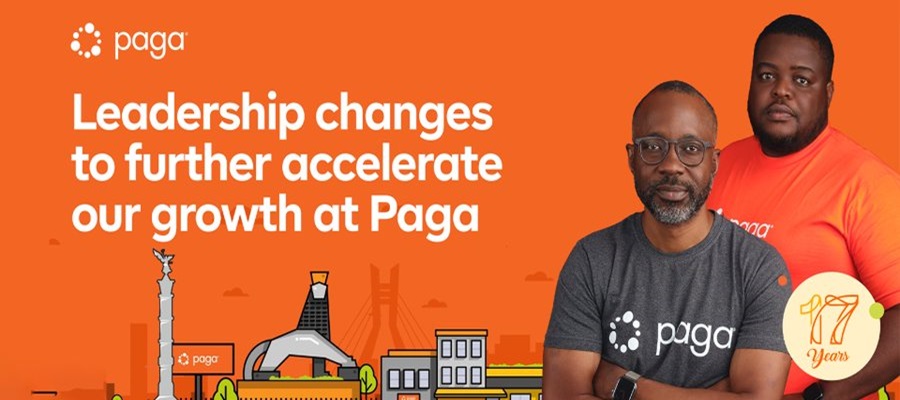
Paga Group has announced a major leadership restructuring, marking 17 years of operation and signalling a strategic shift toward deeper financial infrastructure development, emerging technologies, and expansion across Africa.

Tayo Oviosu, founder (front) and Ope Oyinloye, Group COO and CEO of Paga Nigeria
With the restructuring, Tayo Oviosu, founder, is now the Group CEO, while Ope Oyinloye has been appointed Group COO and CEO of Paga Nigeria, in an acting capacity, pending regulatory approval from the Central Bank of Nigeria (CBN).
Oviosu will also serve as executive chairman of the Group Board and non-executive chairman of Paga Nigeria.
He will be leading Paga Labs, driving geographic expansion, and overseeing fundraising efforts.
The fintech company said the changes represent a transition from its foundational phase into a new growth chapter, known as ‘Act 2’, focused on connecting Africans to global financial systems, scaling innovation, and entering new markets.
To support this transition, the company announced key leadership changes. advertisement
Jay Alabraba, co-founder, has been appointed group director of Special Projects, where he will initially lead the company’s expansion into lending and support new market entry initiatives.
Speaking on the transition, Oviosu said the company’s mission remains unchanged but its approach continues to evolve.
“Act 1 proved that we could build a profitable, high-growth infrastructure business that the world’s leading companies trust. Act 2 is about taking that infrastructure to its full potential—connecting Africans to global financial rails, moving into new markets, and leading the next wave of financial technology,” he said.
Oyinloye added that his focus will be on sustaining operational excellence while scaling the company’s next phase of growth.
With the new structure in place, Paga is positioning itself to play a more significant role in shaping the future of financial services across Africa, particularly as digital payments, blockchain technologies, and AI-driven solutions gain traction across the continent.
Paga has since evolved into a full-stack financial services infrastructure provider. Its offerings now span enterprise solutions through Paga Engine, consumer services via the Paga app, and merchant tools under Doroki.
The company’s first phase delivered significant growth. Between 2021 and 2025, total transaction value processed increased 17-fold to $11 billion across 169 million transactions in 2025 alone, with more than $1.5 billion processed monthly.
Net revenues grew five times within the same period, underscoring the scalability of its model.
Paga also expanded its enterprise footprint, with over 265 clients which include global firms such as PayPal, Meta, Amazon, LemFi, Tencent, Pesa, and Verto building on its infrastructure.
The company was further recognised by the Financial Times and Statista as one of Africa’s fastest-growing companies for three consecutive years from 2023 to 2025.
As part of its new strategic direction, Paga outlined three priorities which are strengthening its financial infrastructure to connect local and global payment systems; advancing emerging technologies such as stablecoins, cryptocurrency, and artificial intelligence through its innovation arm, Paga Labs; and expanding into new African markets.

See Key Changes in BVN Rule from May 1 by CBN

INEC Warns Broadcasters against Misinformation ahead of 2027 Polls

Paga Group Rejigs Leadership as Oviosu, Founder Becomes Group CEO

Reputation: The Real Currency Powering Fintechs

Jumia Expands Nationwide Footprint, Deepens Reach Across Underserved Nigerian Cities

Spotify’s Loud & Clear Report Reveals Over ₦60Bn Revenue for Nigerian Artists in 2025

China Threatens to Shut Nigeria’s Satellite Over $11.44m Unpaid Debt

Why JustMarkets Is a Strong Choice for Gold Trading

Kuda MFB Increases Kuda for Her Business Grants to ₦10 Million

Canal+ to Cut Jobs as Part Sweeping Restructuring




 E-Business3 days ago
Nigeria Cyberattacks: Stronger Collaboration as a Panacea

 Telecom3 days ago
Airtel Becomes World’s Second Largest Telco as Global Customer Base Surpasses 650 Million

 General News3 days ago
NIBSS Says 28 Percent of Nigerians have Registered for BVN

 Telecom2 days ago
From Import Dependency to Local Capacity: Nigeria’s Tech Manufacturing Journey

 E-Business3 days ago
CBN Slams Custodian Investment with N419m Fines over Rule Breaches

 General News3 days ago
NITDA DG Urges Stronger Collaboration to Drive Nigeria’s Digital Economy

 General News3 days ago
Ogun Set for Direct London Flights as Gateway Airport Gains Momentum

 E-Financial2 days ago
How Unethical Deals Triggered CBN Takeover of Union Bank -Forensic Report