

E-Financial
Sterling Bank, Pan-Atlantic University Partner to Certify Non-Oil Export Academy Graduates


Sterling Bank Limited has signed a Memorandum of Understanding (MoU) with Enterprise Development Centre (EDC) of Pan-Atlantic University (PAU) to certify graduates of its Non-Oil Export Academy.

L-R: Kola Oluyemi, Group Head, Sterling Academy; Dr. Nneka Okekearu, Director, Enterprise Development Centre (EDC), Pan Atlantic University (PAU); Abubakar Suleiman, MD/CEO, Sterling Bank; Dr. Nnenna Ugwu, Head, Alumni Engagement and Support Services, EDC at PAU; and Akporee Idenedo, Divisional Head, Commercial Banking, Sterling Bank at the recent MoU signing to certify graduates of Sterling Bank’s Non-Oil Export Academy.
This strategic partnership underscores the Bank’s commitment to diversifying Nigeria’s economy by supporting non-oil export growth.
This landmark agreement follows the recent launch of the Sterling Bank Non-Oil Export Academy, designed to position Nigerian exporters for global competitiveness.
The launch was preceded by a series of nationwide training programs in Lagos, Ondo, and Kano states, culminating in a grand finale themed “Excel in Non-Oil Export.”
The initiative aims to equip exporters with practical tools to thrive in international markets, thereby reducing Nigeria’s reliance on oil revenues.
Speaking at the signing ceremony in Lagos, Sterling Bank’s Managing Director and CEO, Mr. Abubakar Suleiman, affirmed that the Bank is intentional about creating an ecosystem where non-oil exporters are well-informed and equipped to advance national interests.
“We are not just training people to understand how to export; we want to train them to be competitive exporters of non-oil products,” Suleiman said.
“Our goal is to build a community of knowledgeable, certified, and confident exporters who can collaborate to solve challenges beyond their immediate capacity. Our North Star is to reach a point where hundreds of people have completed this programme and are ready to compete on a global scale.”
Dr. Nneka Okekearu, Director of the Enterprise Development Centre (EDC), expressed enthusiasm for the collaboration. “Having spent the last twenty-three years deepening the competencies of entrepreneurs, we thoroughly understand what is needed and are excited to be part of this initiative,” she noted.
Dr. Okekearu emphasized that the export market has been neglected for too long. “With the right structure, standards, and mindset in place, entrepreneurs passing through this programme will help create not only a better Nigeria but more sustainable communities,” she added, noting that she looks forward to the case studies that will emerge from the programme’s participants.
Beyond sectoral outcomes, the initiative reinforces Sterling Bank’s commitment to support the development of human capital that positively shapes and impacts the wider economy. The Academy will run four cohorts within the year, commencing in 2026.
With this partnership, Sterling Bank and the Enterprise Development Centre are laying the foundation for a new generation of globally competitive Nigerian exporters, professionals equipped not only with knowledge, but with the certification, confidence, and networks needed to scale.
As both institutions align their expertise to strengthen non-oil export capacity, this collaboration signals a bold step toward a more resilient, inclusive, and diversified economy.
The Non-Oil Export Academy therefore serves as a catalyst for national transformation, empowering businesses and communities to unlock Nigeria’s full potential on the world stage.


Fidelity Bank Plc is basking in endless and stakeholders are happy.

Dr. Nneka Onyeali-Ikpe, managing director and chief executive officer, Fidelity Bank Plc
With nearly 10 million customers, Fidelity Bank is demonstrating excellent market traction.
This a crucial evidence for investors that the bank is solution driven.
For instance, at the capital market, the bank was the toast of investors as its market value surged amid bargain hunting on the Nigerian Exchange, with investors gaining more than 11 percent after few days of tradings last week only.
Fidelity Bank’s share price increased to N22.30 at the close of the market last Friday, as 11.227 million units valued at N251.523 million.
Investors are simply reacting positively to strong earnings, technology-driven growth, and strategic expansions.
Fidelity Bank, emerged a more robust financial institution after the Central Bank of Nigeria (CBN) and the Securities and Exchange Commission (SEC) ordered massive banking recapitalization exercise.
Dr. Nneka Onyeali-Ikpe, managing director and chief executive officer, Fidelity Bank Plc, is being credited for driving these exceptional shareholder value, operational performance, and sustainable growth.
Despite the immense responsibility and intense pressure, especially during turbulent times, Onyeali-Ikpe, has been strutting her stuff by strategic vision and exemplary leadership.
Onyeali-Ikpe has built Fidelity Bank as beacon in the banking industry underpinning the bank with trust, innovative technology, strategic growth, and strong leadership as well as reputation.
She has broken every glass ceilings delivering milestones and solid imprints in the annals of banking.
The bank only recently completed CBN-verified share allotment, hitting N532 billion capital.
This heavy chest now guarantees the bank long-term stability, and enabling it operate with speed.
Since appointment on January 1, 2021, Onyeali-Ikpe, has-anchored the bank on bespoke digital, financial, and technology-driven tools designed to enhance customer experience.
By integrating AI, automation, and advanced data analytics, Fidelity Bank is today delivering solution banking.
Under Onyeali-Ikpe’s leadership, the bank has significantly improved brand equity.
Fidelity Bank also announced the completion of the acquisition of a 100 per cent stake in Union Bank UK, under the CEO.
A recent Brand Finance report ranked Fidelity Bank as the fastest-growing Nigerian brand, with its brand value more than tripling.
Onyeali-Ikpe was also named among the 2024 Most Influential Global Top 100 Export and International Trade Leaders, recognizing her contribution to expanding Nigeria’s trade and export financing capabilities.
Under her, Fidelity Bank has received multiple awards, including Export Finance Bank of the Year (2023 BAFI Awards), Best Payment Solution Provider Nigeria 2023, and Best SME Bank Nigeria 2022 (Global Banking and Finance Awards).
The bank was also recognized by Euromoney for Best Bank for SMEs (2023) and Best Domestic Private Bank in Nigeria (2023).
Onyeali-Ikpe will be leaving as head of the bank this year but her record of placing the institution upward trajectory will be indelible.
She may be leaving “big shoes to fill” because of her high-energy, infectious positivity which made her successful in everything she does.
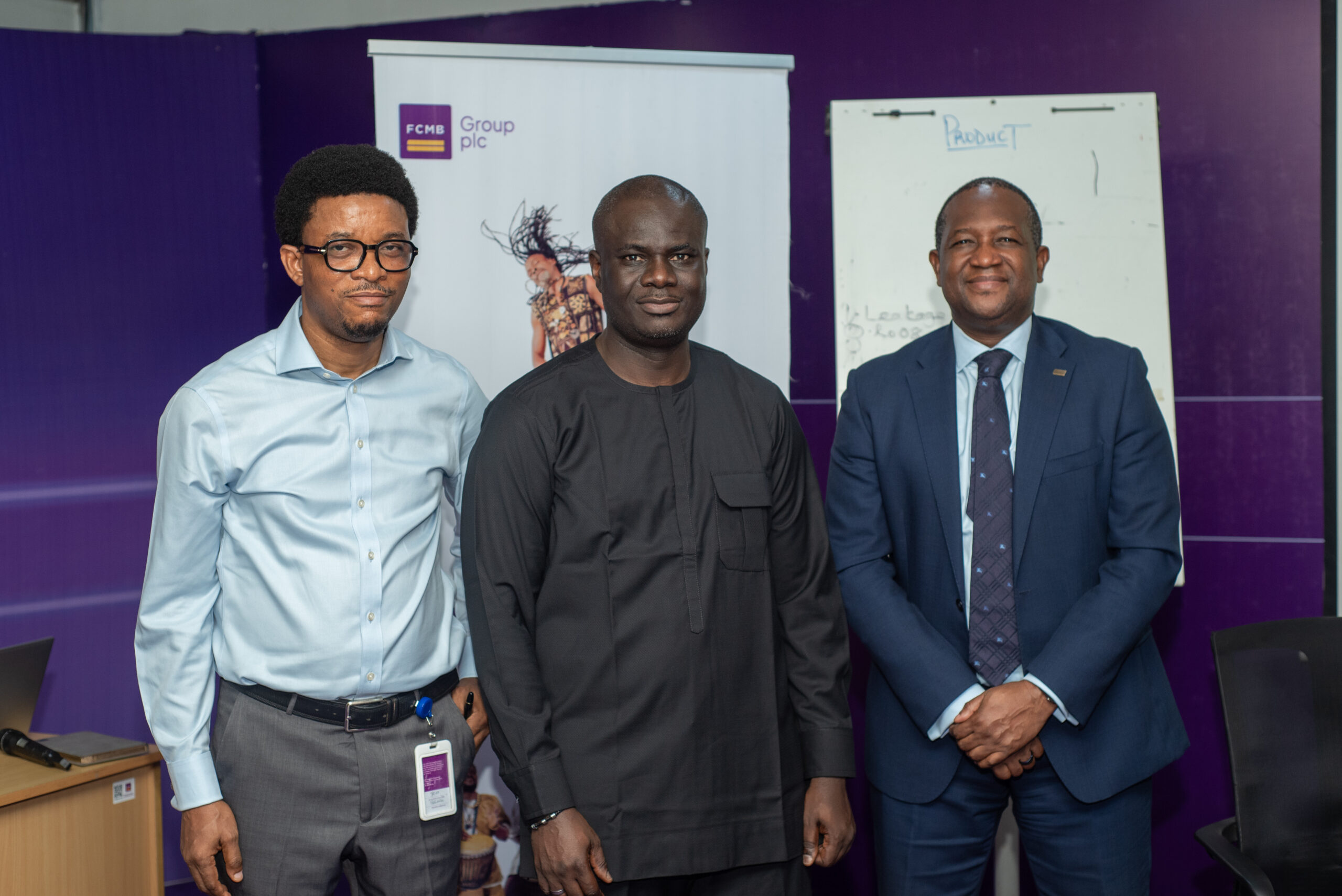
First City Monument Bank (FCMB), in partnership with BHM, hosted the pilot edition of The Monetised Content Masterclass, bringing together reporters, content creators and editors to address growing pressure on the sustainability of newsrooms and media platforms.

L-R: Adeola Adejokun, Head, Communications, First City Monument Bank; Chris Ihidero, Award-winning Director and Producer; and Diran Olojo, Divisional Head, Corporate Affairs, First City Monument Bank, during the Monetised Content: A Media Masterclass Presented by FCMB and BHM, in Victoria Island. Lagos on Monday, April 20, 2206.
The session comes at a time when traditional advertising revenues are declining for news publishers, even as Nigeria’s entertainment and digital media market continues to grow and is projected to reach $4.9 billion by 2026.
Against this backdrop, the masterclass focused on practical ways for media organisations, independent content creators, and digital platform owners to diversify income, build financial resilience, and sustain editorial independence and integrity.
Participants explored revenue opportunities beyond traditional advertising, including brand partnerships, digital content monetisation, and audience-led models. The one-day session featured panel discussions, Q&A sessions, and peer exchanges designed to translate industry trends into practical action.
Speaking at the event, Divisional Head, Corporate Affairs, FCMB Group, Diran Olojo, said: “Traditional models are under pressure, and attention is more fragmented than ever. The focus now is on building structured, sustainable platforms that can deliver both impact and long-term value.”
Also speaking, CEO and Founder of BHM, Ayeni Adekunle, said: “The economics of media have changed. For journalism to remain independent, it must also become financially resilient. That shift requires new thinking and deliberate action.”
The session was moderated by Fatu Ogwuche, Founder and CEO of Big Tech This Week, and featured speakers including investigative journalist Fisayo Soyombo, storyteller and producer Chris Ihidero, executive and storytelling expert Jennifer Mairo, and digital media entrepreneur Peter Oluka.
The initiative reflects a shared commitment by FCMB and BHM to support the long-term sustainability of the Nigerian media ecosystem through capacity building and industry collaboration.
Chartered Risk Management Institute of Nigeria (CRMI) has backed recent regulatory measures by the Central Bank of Nigeria (CBN) aimed at strengthening the security of the country’s digital financial ecosystem, while urging stricter compliance across the banking industry.

Kevin Ugwuoke, president and chairman of Council, in a statement, described the new framework as a timely and proactive response to rising risks such as fraud, identity theft, and unauthorised access within the instant payment system.
He noted that key safeguards introduced by the apex bank including a N20,000 transaction limit on newly activated mobile banking applications within the first 24 hours, mandatory device binding, and real-time enterprise fraud monitoring are designed to reduce vulnerabilities associated with account takeovers, especially during the early stages of account activation.
“By limiting transaction exposure during the high-risk activation window, the framework significantly reduces the opportunity for fraudsters to exploit newly onboarded or compromised accounts,” Ugwuoke said.
The institute, however, stressed that the success of the measures would depend largely on effective implementation.
It called on banks, fintech firms and payment service providers to strengthen cybersecurity infrastructure, invest in fraud analytics and prioritise staff training as well as customer awareness.
CRMI also welcomed the introduction of the Nigerian Overnight Financing Rate (NOFR), describing it as a major step toward standardising overnight funding rates, deepening financial markets and improving monetary policy transmission in line with global best practices.
The endorsement comes as the CBN unveiled a draft revised Guide to Charges for Banks and Other Financial Institutions, 2026, signalling a broader shift toward transparency, consumer protection and efficiency in the financial system.
The revised guide introduces caps on key banking charges and mandates stricter disclosure requirements.
Under the framework, interbank transfers between N5,000 and N50,000 are capped at N10, while transactions above N50,000 attract a maximum of N50, with transfers below N5,000 remaining free.
The apex bank also standardised ATM withdrawal charges, pegging fees at N100 per N20,000 for on-site withdrawals from other banks’ machines, while off-site transactions may attract an additional surcharge of up to N500, subject to disclosure at the point of use.
In a bid to protect borrowers, the regulator directed that all lending rates be presented as Annual Percentage Rates (APR), ensuring full disclosure of interest and associated fees.

Telcos Defend N6.98 USSD Charge despite Failed Transactions

Fidelity Bank “Basking in Approval” under Onyeali-Ikpe, CEO

FRSC, BSG Renew Pact to Tackle Drink-Driving

GSMA, Pleias Seek to Close African Language Gap in AI

Firm Reveals a 37% Increase in Malicious Packages Compromising Software Supply Chains

FG to Gift Nigerians over 100 Free TV Channels from May 15

Microsoft Revamps Copilot in Workplace AI Push

UBA Beefs Up Mobile App Security to Stop Fraudulent Debits, Withdrawals

What Adekunle Gold’s Support Means for ‘The Gathering on 100

NRS Takes Over Mineral Royalties Collection Under New Tax Laws




 News3 days ago
Buhari, SSG’s Signatures Forged to Defraud Nigeria of $6.2m in CBN – EFCC

 General News3 days ago
Reliable Payment Rails Key to Financial Inclusion – TeamApt

 News3 days ago
CSCS Targets Market Leadership Through Technology, Diversified Revenue

 General News3 days ago
MTN Powers the Ultimate Youth Link-Up with the Launch of Live It 100 Youth Campaign

 E-Business3 days ago
Angst as FG Drops $32.8m Fine on Meta for Data Breach

 General News3 days ago
EFCC Declares Tejuosho, City Boys Movement’s Women Leader Wanted over “419”

 General News3 days ago
Afreximbank to Fund 3 New Refineries in Nigeria

 Telecom2 days ago
ALTON Urges Urgent Resolution of Regulatory Dispute over Airtime Loans