

Telecom
Tecno: Mobile Giant Behind Africa’s Growing Smartphone Adoption

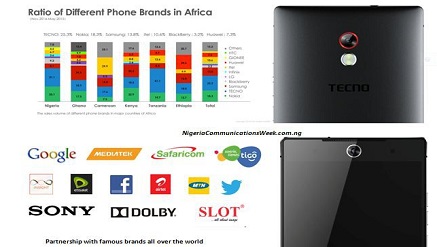
In various mobile markets around the world, different mobile brands dominate different regions. So while Apple’s iPhone is the undisputed champion in America for instance, this is not particularly the case in every other big market.
In South America, Blu owns the biggest market share, while Samsung and Micromax are the most dominant mobile brands in India. The world’s most populous country, China, has Huawei, Oppo and Vivo holding sway respectively in a market that has about the stiffest competition globally.
But, how about in Africa? Data from recent research shows that Tecno Mobile has crawled its way up to dominate the African mobile space, doing remarkably well in its ten years of existence to emerge as the local king in Africa’s mobile industry.
Meet Tecno Mobile
Tecno Mobile needs no introduction, definitely not in Africa. Tecno Mobile is a Chinese mobile phone manufacturer.
The company was started in July 2006 in Hong Kong with its first research and development centre in Shanghai, China. The dynamic mobile multinational has definitely done well for itself in the African market.
In 2006, Tecno entered the African mobile market sphere and its 10 years stay, has covered more than 35 countries while dominating major markets such as Nigeria, Tanzania, Kenya, Cameroon, Ghana and so on.
However, after the African mobile market dominance, Tecno aimed at expanding this feat to other parts of the world and it succeeded.
Today, Tecno has extended its web to more than 48 countries around the world, across the Middle East, South East Asia and South America – this has made Tecno one of the mobile brands to reckon with, not just in Africa but also around the world.
Partnership with Famous Brands All Over the World
As a company that thinks outside the box, Tecno strategically partnered with some top-ranking brands such as, Google, Facebook, Twitter, Instagram, MTN, Tigo, Airtel, Etisalat, Sony, Jumia, slot, Android, Mediatek etc. to continue keeping up with its maxim of giving its esteemed customers the best.
Why Has Tecno Been So Successful in Africa?
Understanding the market is key to a brand’s success and Tecno brand has understood the need for African consumers.
Year on year, the Asian multinational rolled out smartphone products targeted at different market segments and pegged at the right price.
“Quality is never compromised on Tecno products because at the core to the brand’s philosophy is innovation that is geared to keep product quality at par with global best as more mobile consumers embrace the brand, the company said recently while unveiling its global presence”.
In November 2007, Tecno released Africa’s first dual SIM phone the T780 to address the then problem of people carrying around several mobile phones due to poor Telecoms network infrastructure in the continent at the time.
Apart from the dual SIM cards, Tecno’s smartphones are reliable and the average life span of every Tecno product could last for over three years.
With this exploit, in 2010, Tecno was ranked among the top three brands in Africa also, according to a survey carried out in 2011, six out of every ten African use a TECNO dual SIM phone, this further increased Tecno’s market share to more than 27% within its dominant markets.
Smartphone Tailored for Every Need
Understanding that several mobile users have specific needs that regular smartphones cannot totally satisfy, Tecno has three mobile series that are tailored to satisfy a special need. They are:
BOOM series (music lovers): Tecno Boom smartphone series liaises with Boom Maxx to provide rich, crispy sound and allows users feel the perfect mega bass.
The Boom player on the TECNO Boom smartphone comes with a free digital content (Music & Video) application that allows music lovers to access a huge catalogue of music and videos from their favorite African and International artistes.
The Boom player is preinstalled with over 300,000 songs from over 4,000 signed artistes across Africa.
CAMON series (Photo lovers): Tecno Camon series provides the excellent capture experience. A lot of mobile users face the problem of capturing very high definition pictures in low light environment. Since the release of the Tecno CAMON Series, from the 5MP on the Camon C5, 8MP on the Camon C8 to the dual 13MP on the Camon C9, that limitation has been surpassed as Tecno had up to 500 professional engineers working for more than 285 days’ to produce the most suitable low-light camera on the Camon.
Phantom series (high-level business consumers): The Tecno phantom series, which is one of the best-reviewed annual flagships from the stable of Tecno, always drops with unconventional upgrades on mobile specifications.
The Tecno Phantom brands have proven in five years of its official rollout, that the product line is as competitive and appealing as any other top smartphone brand in the African market. And much to the Tecno brand’s delight, consumers are taking a liking for TECNO Phantom products.
In 2014, Tecno Phantom Z was rated the best smartphone in the Ghanaian mobile space; marking the second year in a roll for a Phantom to cart away the same award in Ghana. Last year’s phantom edition, the TECNO Phantom 6, was launched in September and is said to be the slimmest smartphone with dual rear lens camera.
Tecno: A brand with the best after-sales service for Africa
For the satisfaction of consumers, there is a special after-sales service center for every TECNO consumer. In the Nigerian market, there are 95 after-sales service centers in more than 60 cities in the country with over 400 local employees, that have been put on standby to attend to any after sale complaint whatsoever.
Tecno consumers who have an issue with their phone after just 3 days of purchase stand a chance of having their phone replaced and if the damage is not serious then, their device would be repaired within 12 hours.
The Community-Centered Business Takes Responsibility For Society
As a brand that believes in giving back, TECNO does all it can to take care of its host communities. It takes its various CSR projects very seriously and imbibes the CSR culture in its business module across its markets.
Through their various life-touching projects, Tecno has empowered several people. Some of such project is the Light Up Ikeja initiative; a CSR project executed in the first quarter of 2016 where Tecno installed Eighty plus (80+) solar-powered streetlights in the Ikeja electronic market (Popularly called Computer village) and its environs to help with the security challenges faced in the area. Other Corporate Social Responsibility projects executed by Tecno include: scholarships for pupils in public primary schools in Nigeria (Lagos), support of the Michael Essien Foundation in Ghana, amongst others.
Tecno Light Up Ikeja Project
It’s still a tough road ahead for Tecno, as no brand can survive the future by depending on its past or current accomplishments. By celebrating a decade of insightful leadership, giant strides and deserved successes, Tecno Mobile reiterates its commitment to its promise – “African mobile consumers deserve to Experience More”, and by offering consumer friendly devices and services through ever evolving innovation and technology, the multinational brand aims to consolidate on its gains and spread its tentacles all over the world.
As they would say, “it’s never enough to say, ensure you also show it”.



MTN Group, the continent’s telecom behemoth, has plunged into advanced negotiations to acquire the outstanding 75 percent stake in IHS Towers for a staggering $2.76 billion, a seismic move that would hand Africa’s largest mobile operator full reins over one of the world’s premier independent tower companies and redefine infrastructure control across emerging markets.

MTN
The proposed transaction, pegged to IHS’s latest New York Stock Exchange closing price where it trades alongside a Frankfurt listing, builds on MTN’s existing 25 percent holding forged in a landmark 2014 deal that saw the operator offload most tower assets to IHS in exchange for cash and long-term leases.
Sources close to the talks confirm discussions remain fluid with no binding agreement yet inked, and both sides caution that negotiations could shift or stall entirely—MTN has signalled readiness to pivot to alternative value-unlocking strategies for its stake if a full buyout eludes grasp.
Strategically, the power play catapults MTN toward vertical integration in a sector where operators increasingly crave direct grip on passive infrastructure to slash lease bills, streamline upgrades, and rocket-roll 4G/5G amid Africa’s insatiable data deluge.
IHS Towers, MTN’s anchor tenant across swathes of Africa with tens of thousands of masts from Nigeria’s 13,500 tenancies—renewed amid naira-dollar tussles—to South Africa and beyond the Middle East into Latin America, represents a golden infrastructure war chest primed for the operator’s 20-nation blitz.
The saga traces to 2014’s seismic sale that freed MTN capital for spectrum wars while birthing enduring lease pacts, now ripe for reversal as governance dust-ups over shareholder nominations and agendas underscore the buyout’s boardroom chess.
Market tremors rippled through IHS shares post-leak, underscoring the $2.76 billion tag’s gravity as MTN eyes cost efficiencies, network agility, and expansion muscle in oil-volatile economies where tower mastery spells survival.
Should the ink dry, MTN vaults to ownership of a colossus fuelling digital bridges from Lagos megacities to rural frontiers, slashing third-party dependence while supercharging investments in fibre-deep data dreams and 5G horizons.
Analysts buzz that the mega-deal heralds telecom consolidation waves, with operators reclaiming tower turf to fortify against rivals and unlock synergies in a landscape where infrastructure crowns kings.
Neither MTN nor IHS commented officially by press time, but the high-stakes huddle spotlights Africa’s telecom arena hurtling toward an era where owning the poles decides who dominates the digital skies.

Nigerian Communications Commission (NCC) and the Nigeria Security and Civil Defence Corps (NSCDC) have issued a forceful warning to road construction companies, government contractors and civil engineering firms across the country, declaring that the era of unchecked fibre-optic cable damage during excavation works is over, with perpetrators now facing criminal prosecution.

NCC, NSCDC
The two agencies, in a joint statement, highlighted the alarming surge in avoidable fibre cuts caused by negligence, poor planning or outright disregard for infrastructure protection protocols, stressing that such incidents severely disrupt Nigeria’s digital backbone and will attract the full weight of the law moving forward.
They described fibre optic cables as indispensable national assets that fuel the nation’s burgeoning digital economy, ensuring uninterrupted communication services, powering emergency response systems, linking businesses for commerce and trade, and enabling seamless government operations at all levels.
Any destruction of these cables, whether through careless excavation, lack of coordination with telecom operators or deliberate sabotage, directly endangers national security, undermines economic stability and compromises public safety, the organisations warned, painting a grim picture of the cascading effects of even brief network outages on hospitals, financial institutions and security agencies nationwide.
Under the Designation and Protection of Critical National Information Infrastructure (CNII) Order 2024, telecommunication fibre infrastructure has been officially classified as Critical National Information Infrastructure, making any damage from unauthorised digging, construction activities or failure to collaborate with relevant authorities a clear-cut criminal offence punishable under existing statutes.
Individuals, private construction companies and even government contractors found culpable will face immediate prosecution and stiff sanctions as stipulated in the Cybercrimes (Prohibition, Prevention, etc.) Act 2015, with the agencies vowing zero tolerance for what they termed economic sabotage disguised as construction mishaps.
“Future damage to fibre optic infrastructure caused by excavation, road construction or any civil engineering activity conducted without due consultation or collaboration with network operators and relevant regulators will attract strict legal consequences,” the NCC and NSCDC declared categorically, underscoring their resolve to safeguard this vital ecosystem through heightened enforcement.
To forestall further incidents, the agencies implored federal, state and local government bodies, road construction firms, utility service providers and private property developers to adopt proactive measures including thorough pre-construction verification of underground fibre routes using approved mapping tools, early collaboration with the NCC, telecom operators and NSCDC both before and during project execution, strict adherence to national guidelines on excavation procedures and right-of-way management, and prompt reporting of any accidental damage to facilitate swift repairs and minimise downtime.
They emphasised that these steps represent the bare minimum for compliance in an era where digital connectivity is non-negotiable for Nigeria’s progress.
Members of the public have also been enlisted in this protection drive, with calls to report suspected sabotage, vandalism or unintended damage to fibre optic installations at the nearest NSCDC office, via email to [email protected] or [email protected], or by dialling the toll-free line 622 for immediate action.
This collaborative approach, the agencies believe, will not only deter would-be offenders but also foster a culture of accountability among all stakeholders handling earth-moving equipment or infrastructure projects in a country racing towards full digital transformation.

Google has flung open applications for its landmark 10th cohort of the Startups Accelerator Africa, doubling down on nearly a decade of continent-wide tech propulsion by targeting Series A pioneers wielding AI and machine learning for scientific and societal moonshots.

The 12-week “AI First” hybrid bootcamp, kicking off April 2026, equips Africa-based or Africa-centric innovators with Google’s AI arsenal, expert mentorship, technical firepower, and investor matchmaking to catapult health and deep-tech ventures into orbit—deadline March 18 at g.co/acceleratorafrica.
“Africa’s tech landscape is seeing a vibrant shift toward deep-tech innovation,” proclaimed Folarin Aiyegbusi, Head of Startup Ecosystem, Africa. “For Class 10, we are focusing on the potential of AI to drive health and societal benefits, providing the infrastructure and expertise to turn these startups into the research labs of the continent.”
Since 2018, the accelerator has turbocharged 180+ startups across 17 nations, unlocking $350 million in funding and 3,700 direct jobs, cementing Google’s role as Africa’s AI innovation forge amid a deluge of homegrown problem-solvers.
Equity-free and hybrid-powered, Class 10 promises Google’s product credits, strategic war rooms, and global networks to forge the next wave of African AI trailblazers reshaping everything from disease detection to climate resilience.

Firm Reviews the Evolution of Phishing Threats in 2025

EdTech Platform Unveils over 5,000 Self-Paced Courses for Skills, Knowledge, and Literacy

Incentives alone won’t win over Africa’s next billion fintech users — Kuda MFB MD

MTN Guns for $2.76bn IHS Towers Buyout in African Telecom Power Grab

NCC, NSCDC Warn Construction Firms Against Damaging Fibre Optic Cables

19 Nigerian Banks Meet CBN Recapitalization Targets Ahead of March Deadline

Youth Talent Takes Center Stage as T2 Ignites High-Octane Rap Battles @ Carnival Calabar

Aig-Imoukhuede Foundation Wrapped Up 2025 with Real Change in Governance, Health, Media Across Africa

Nigerian Terra Industries Secures $11.8m for Expansion

US invests $115m in counter-drone tech for World Cup security




 News2 days ago
New Study Reveals How Moniepoint Powers Nigeria’s Downstream Oil Sector with Same-Day Settlements and Working Capital Boost

 E-Business3 days ago
OADC Lagos Reinforces Commitment to Local Data Hosting and Digital Transformation @ NDPC’s National Privacy Week Summit

 Telecom3 days ago
MTN Powers 6,000 Young SMEs with Digital Skills in Economic Backbone Boost

 News3 days ago
FG Mandates Shared Funding for N1.98trn Electricity Subsidy

 News3 days ago
Spain Bars Under-16s from Social Media in Digital Safety Crackdown

 Telecom3 days ago
Onafriq, PAPSS Launch Wallet-Based Payments Pilot from Nigeria to Ghana

 E-Financial3 days ago
FG Signs MoU with ICAN, CIBN, Others to Train 10m Nigerians in Financial Literacy

 General News3 days ago
Corporate Comms in the Age of Crypto: Why Nigeria’s Digital Finance Future Depends on Trust