

News
Telecom Body Introduces New Global Guidelines to Protect Kids Online


The International Telecommunication Union (ITU) has launched its 2020 guidelines on Child Online Protection (COP), aimed at ensuring a safe and empowering online environment for children and young people.

The ITU says while the Internet and related digital technologies opened new ways for children to communicate, learn and play, they also exposed them to a range of content, contact and harmful conduct online.
The guidelines come as the world grapples with COVID-19, which has seen technology being placed at the centre of managing the spread of the virus, further exposing children and young people online.
According to the ITU, the new guidelines were designed from the ground up to reflect the significant shifts in the digital landscape in which children find themselves, such as the Internet of things, connected toys, online gaming, robotics, machine learning and artificial intelligence.
The guidelines consist of four parts tailored to key audiences: children, parents and educators, industry and policymakers.
The guidelines for children are available in a child-friendly format and consist of a story book for children under nine, a workbook for children aged nine to 11, and a social media campaign and microsite for children and young people aged 12 to 18.
“These resources help children learn how to manage risks online, while at the same time empowering them to exercise their rights online and engage in opportunities the Internet presents to them,” says the ITU.
The guidelines for parents and educators serve as a practical tool to help them effectively support children and young people’s interaction online, to sensitise families to the potential risks and threats, and help cultivate a healthy and empowering online environment at home and in the classroom.
The guidelines for industry aim at supporting industry players in the development of their internal COP policies, such as integrating child rights considerations into all appropriate corporate policies and management processes.
The ITU adds the guidelines help in “developing standard processes to handle child sexual abuse material; creating a safer and age-appropriate online environment; educating children, carers and educators about children’s safety and the responsible use of information and communication technologies; and promoting digital technology as a mode for increasing civic engagement”.
Policymakers are also included in the guidelines, as the ITU says they serve as a solid foundation on which to develop inclusive, multi-stakeholder national strategies, through open consultations and dialogues with children, to develop better-targeted measures and more efficient actions.
“ITU and its partners sought to create a highly usable, flexible and adaptable framework firmly based on international standards and shared goals, particularly the convention on the Rights of the Child and the United Nations Sustainable Development Goals.”
Commenting on the COP, ITU secretary-general Houlin Zhao says: “The question of how to ensure children’s online safety in the age of COVID-19 is now more pressing than ever before. ITU’s new guidelines on Child Online Protection are a very timely tool to safeguard the well-being, integrity and safety of our children, our most precious gift.”
Doreen Bogdan-Martin, director of the ITU telecommunication development bureau, says: “The new COP guidelines are designed to serve as a blueprint that can be adapted and used by different countries and stakeholders in a way that is consistent with national and local customs and laws.
“They can be considered as an initial step in engaging all relevant stakeholders – governments, the private sector, parents and teachers’ associations, and children themselves – in discussions around targeted measures and actions to create a safer online environment.”


News
Galaxy Backbone Confirms Over 150,000 Active Official Government Email Accounts, Clarifies Status of GOVMAIL

Galaxy Backbone Limited (GBB), Nigeria’s foremost ICT infrastructure and shared services provider to the Federal Government, wishes to reiterate and clarify the availability, maturity, and ongoing expansion of the Federal Government’s official email infrastructure, widely known as GOVMAIL.

GOVMAIL is a secure and centralized official email platform established for use by Ministries, Departments, and Agencies (MDAs) to facilitate professional, auditable, and efficient communication across all arms of government.
The platform was launched by the Office of the Head of the Civil Service of the Federation, Mrs, Didi Esther Walson-Jack as part of a broader digital transformation agenda aimed at modernizing public service workflows and reducing reliance on paper-based correspondence and fragmented, external email services.
Recent statements by the Head of the Civil Service of the Federation, Mrs. Didi Esther Walson-Jack, underscore the strategic importance of GOVMAIL in the wider push towards a paperless civil service.
In late 2025, she announced that over 100,000 official GOVMAIL accounts had been created for civil servants across federal MDAs under an expanding paperless policy and that the transformation reflects a clear shift away from traditional paper correspondence to secure digital communication at scale. Today, that number has grown to over 150,000 Official government email accounts, current in use by government workers across MDAs.
Galaxy Backbone also affirms that these email accounts operate within a protected sovereign government domain environment hosted on secure local infrastructure, supported by enterprise-grade cybersecurity architecture.
The platform underpins centralized identity management and ensures compliance with national data protection standards, reinforcing accountability, audit-trail visibility, and overall digital governance efficiency.
In addition to GOVMAIL, Galaxy Backbone operates secure national Tier III and Tier IV Data Centres, a robust National Fibre Backbone, a Security Operations Centre (SOC), and a Network Operations Centre (NOC) that jointly power mission-critical government digital services. This infrastructure is closely aligned with the Federal Government’s digital economy strategy and its efforts to deepen digital service delivery, transparency, and efficiency across MDAs.
To accelerate adoption and ensure that every government worker who is expected to have an official email has one, GBB is working collaboratively with MDAs to close existing gaps and onboard remaining staff within the shortest possible time. These coordinated efforts reflect the shared objective of equipping public servants with the digital tools necessary for responsive, efficient, and secure inter-agency communication.
Galaxy Backbone remains committed to working with stakeholders across the different arms of government to sustain and build on this progress. The company appreciates the emphasis placed on strengthening digital governance and remains ready to provide technical clarifications and support collaborative engagements that further advance Nigeria’s digital public service ecosystem.
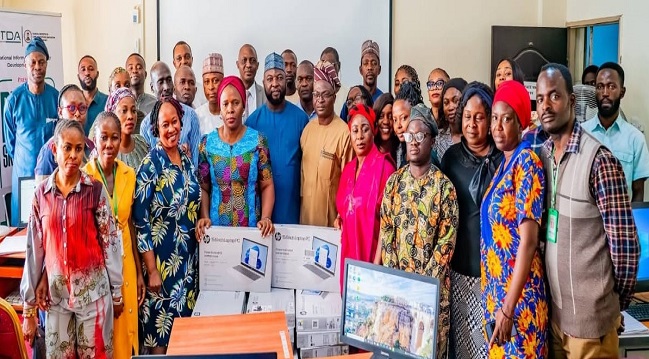
In a strategic move to modernise Nigeria’s public service, the National Information Technology Development Agency (NITDA) has concluded a specialised digital capacity-building programme for the Federal Character Commission (FCC).

The initiative, which included the donation of 35 laptops, aims to transition the Commission from manual processes to a data-driven oversight model, ensuring more transparent and equitable representation across all government MDAs.
In alignment with President Bola Ahmed Tinubu’s key priority area of reforming the economy for sustained and inclusive growth, as well as improving governance for effective service delivery, it forms part of NITDA’s Digital Literacy for All (DL4All) programme aimed at strengthening digital capacity across public sector institutions and building a workforce equipped to drive Nigeria’s digital transformation agenda.
The training, held at the Commission’s headquarters, focused on enhancing participants’ competencies in critical areas such as data analysis and data management, skills considered essential to improving institutional performance and service delivery.
Representing the Director General of NITDA, Kashifu Inuwa CCIE, the Acting Director of Digital Literacy and Capacity Building, Dr Ahmed Yusuf Tambour, explained the purpose of the intervention.
“We are here at the Federal Character Commission to carry out a training for staff of the Commission in the area of digital literacy to enhance their proficiency,” he stated.
He noted that the training was deliberately tailored to align with the Commission’s statutory responsibilities.
“We are particularly focusing on data analysis and data management, because this really aligns with the core mandate of the Commission,” he said.
The Federal Character Commission, which is responsible for monitoring and ensuring equitable representation in public service across Ministries, Departments and Agencies (MDAs), relies heavily on accurate and well-managed data to carry out its oversight functions.
By strengthening staff capacity in data handling and digital tools, NITDA aims to enhance the Commission’s ability to manage nationwide datasets efficiently and transparently.
Describing the programme as impactful and well-received by participants, Inuwa said, “So it’s been a great journey. We’ve trained 35 participants here, and the training has been very well received.”
As part of the intervention, NITDA donated 35 laptops to the Commission to facilitate continuous learning and enable staff to seamlessly integrate digital tools into their daily operations.
The gesture is expected to reinforce the sustainability of the training outcomes and improve workflow efficiency within the Commission.
Expressing optimism about the long-term benefits of the initiative, Inuwa added, “We are hoping that this will help the Commission to manage the very, very important data that they collect across all MDAs.”
The intervention reflects NITDA’s sustained commitment to deepening digital inclusion within government institutions under the Renewed Hope Agenda. By equipping public servants with practical digital skills and the necessary tools, the Agency is advancing institutional efficiency, strengthening data-driven decision-making, and supporting the Federal Government’s vision of a modern public service capable of driving inclusive national development and economic reform.

Nigeria and the European Union have inked a scientific and technology deal that grants access to about €100 billion in research and innovation funding for scientists, start-ups, and public institutions.

The agreement is a significant boost to the country’s tech environment, providing new prospects for research, innovation, and start-up growth.
The arrangement was signed in Abuja by Gautier Mignot, head of the EU delegation to Nigeria and ECOWAS, and Kingsley Udeh, Nigeria’s minister of innovation, research, and technology.
After more than two decades without a formal framework, the agreement transfers cooperation from informal to structured, large-scale collaboration.
The European Commission’s Horizon Europe programme, the world’s largest public research budget, is at the heart of the deal, which will bring together Nigerian researchers and firms to work on cross-border projects in health, agriculture, climate, food systems, and new technologies.
Udeh stated that the relationship puts Nigeria as a continental powerhouse for science and enterprise, with an emphasis on translating research into commercially viable products and assisting startups in scaling into global players.
Gautier Mignot noted that Nigerian organisations are already active in several Horizon-backed and global health research projects, but the new pact provides a legal and political framework to significantly expand participation, funding access and visibility.
To ensure delivery, both parties created a Joint Science and Technical Cooperation Committee to drive implementation and track measurable outcomes.
Beyond academia, the agreement aims to support innovators, boost university–industry collaboration, and help more Nigerian tech firms compete globally, strengthening Nigeria’s position as a leading startup hub in Africa.

Galaxy Backbone Confirms Over 150,000 Active Official Government Email Accounts, Clarifies Status of GOVMAIL

More 14m Farmers to Benefit from AfDB-backed Initiative

Dimension Data Nigeria Secures ₦20Billion Funding to Strengthen Digital Infrastructure

Newmark Webinar Explores How AI Could Transform Healthcare in Africa

Alerzo Liquidates Delivery Fleet as N4.38bn Moniepoint Loan Row Deepens

Kaspersky Launches OT Calculator to Align Cybersecurity Investments with Business Goals

Accidental Billionaire Opts for Jail Instead of Returning Money Credited Him by Mistake

New Horizons Nigeria Breaks Ground: First to Fuse Mandarin into ICT Curriculum

Kaspersky Brings more Transparency to Threat Detection with New Hunt Hub

NDPC Commits to Balancing Data Privacy, Protection Information




 News2 days ago
NITDA Equips Federal Character Commission with Data Tools to Drive Public Sector Reform

 Telecom2 days ago
Telecom Giant MTN Injects N1.0 Trillion CAPEX into Network Expansion

 E-Financial2 days ago
History is Watching: Tinubu’s Moment to Rescue Nigeria’s Stolen Future

 E-Business2 days ago
Kaspersky Discovers New Phishing Campaign Exploiting Google Tasks Notifications to Steal Corporate Credentials

 E-Financial2 days ago
Union Bank Assures Safety of Deposits Post-Cardoso MPC Remarks

 Telecom2 days ago
Samsung Unveils Galaxy S26 Series, Powered by Smarter, Background AI
- Telecom1 day ago
MTN Nigeria Posts Record N1.70 Trillion Pre‑Tax Profit, Declares N20 Dividend for 2025
 Telecom1 day ago
Dimension Data Nigeria Secures ₦20Billion Funding to Strengthen Digital Infrastructure