

Broadcasting
Telling Stories in the Era of the New TV

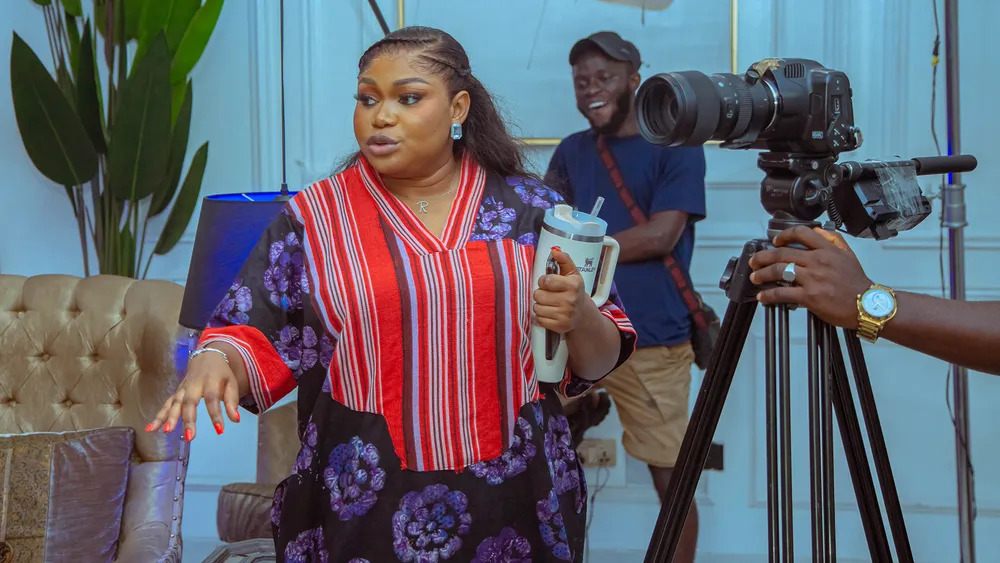
By Ruth Kadiri
When people ask me what the secret is to making films, my answer is simple: the trick is always in the story. But of course, it is never only that simple. A good script is a given, as are strong casts and the right team behind the camera. Those are the foundations. Yet over time, I have come to realize that filmmaking today requires us to think beyond the script and the set. We must also think about the screen, the audience, and the journey of the story once it leaves our hands.

As a filmmaker, I am often asked what I have learned along the way; what I would tell someone starting out, or even those who have been working as long as I have. Attending the YouTube TV/Film Day in Lagos gave me another opportunity to reflect on how the industry is shifting and what keeps me grounded. These are some of the lessons I now carry with me.
1. The trick is always in the story
No matter the format, length, or platform, it begins with the story. A viewer will forgive budget limitations, new talent, or even unfamiliar settings if the story connects. But if the story is weak, no amount of production polish will keep people watching. As filmmakers, our first task is to craft stories that reflect real lives and emotions. A character’s triumph, a family’s struggle, a moment of laughter. These are what audiences hold on to long after the credits roll.

2. Never compromise on quality
Quality is not about big budgets alone. It is about respect for the audience. In a world where viewers can choose from thousands of films and series with a click, they will not wait for a story to “get better later.” That means sound, lighting, editing, and acting must all meet a standard that keeps them engaged from the start. Even when working with limited resources, I push myself and my team to raise the bar.
3. Beyond the production, think about the screen
In the past, when we spoke about “the screen,” we meant cinema or television. Those were the spaces where stories lived, and where audiences gathered. Today, that definition has changed. The screen could be the phone in someone’s hand on a bus, a laptop late at night, or a connected TV in the living room. For many Nigerians — especially younger audiences — YouTube has become that new television. It is where they discover new films, revisit old favorites, and share what they love with others.
As a filmmaker, this shift has changed the way I create. I no longer think of my work as tied to one channel of distribution. Instead, I ask: how will this story feel on a mobile phone? How will it hold attention on a larger screen at home? YouTube is central to answering those questions, because it gives me the freedom to design for different screens while keeping the same story intact.
4. The audience is global, even if the story is local
One of the greatest gifts of this digital era is the ability for Nigerian stories to reach audiences in places I may never visit. Over 70 percent of watch time on Nigerian YouTube channels comes from outside the country. That means a story set in Benin City or Kaduna can resonate in London, New York, or Johannesburg. The key is to stay authentic. Our culture, our humor, our languages are not limitations. They are the very things that make our films compelling to the world. Subtitles and translations help, but at the core it is authenticity that travels.
5. Language is power
Nollywood is rich with languages and dialects, and I believe in using them boldly. Audiences everywhere are increasingly open to watching subtitled films. Korean dramas, Spanish thrillers, Indian romances — they all prove that language is no longer a barrier. For us, this is an invitation to lean into our diversity. By telling stories in Yoruba, Igbo, Hausa, or Pidgin, we are not limiting ourselves. We are showcasing the depth of Nigerian culture. And when paired with platforms like YouTube that make subtitling and translation simple, we can connect with people who do not speak our languages but still understand our emotions.
6. Power belongs to the storyteller again
Perhaps the most inspiring change for me is how much control filmmakers now have. We no longer have to wait for gatekeepers to decide which stories will be told or which audiences will see them. With digital platforms like YouTube, we can release directly to our viewers, build communities around our work, and grow our craft in real time. It is not easy. It requires consistency, strategy, and resilience; but it is empowering. For me, that is what keeps me creating.



Africa Prudential Plc has reaffirmed its commitment to digital transformation, revenue diversification and sustainable growth after reporting a strong financial performance for the first half of 2026.

Dr Catherine Nwosu
The company made this known during its H1 2026 Investor Call, which brought together institutional investors, shareholders, investment analysts, regulators and other stakeholders to review its financial performance and strategic outlook.
Dr Catherine Nwosu, managing director and Chief Executive Officer of Africa Prudential, said the company’s performance reflected the resilience of its business model and the effectiveness of its long-term growth strategy despite prevailing macroeconomic challenges.
According to the company’s financial results, gross earnings rose by 27 per cent year-on-year to N4.28 billion, from N3.34 billion recorded in the corresponding period of 2025.
Profit before tax increased by 22 per cent to N2.41 billion, while profit after tax grew by 18 per cent to N1.59 billion.
The company also reported a 27 per cent rise in net operating income to N4.21 billion, while total assets increased by 13 per cent to N46.53 billion.
Shareholders’ funds equally rose by 13 per cent to N12.52 billion, reflecting continued financial strength.
Management attributed the performance to sustained growth in its core registrar business, increased corporate action activities in the Nigerian capital market, improved treasury earnings and rising adoption of its technology-driven solutions.
The company said it was steadily transforming from a traditional share registrar into a broader technology and business solutions provider serving Nigeria’s capital market ecosystem.
During the interactive session, investors sought clarification on the sustainability of earnings, particularly as interest rates are expected to moderate.
Responding, Nwosu said the company was deliberately expanding its recurring fee-based revenue streams to reduce dependence on treasury income.
“Interest rates influence our treasury income positively, but that is why we are deliberately diversifying our revenue streams.
“Our strategy is to grow recurring fee-based business lines such as our digital solutions, Know Your Customer (KYC) services, Annual General Meeting (AGM) technology, probate services and the SabiVest mobile app.
“Over time, this will reduce our reliance on interest income and create a more balanced and resilient earnings mix,” she said.
Nwosu noted that increasing capital market activities had created stronger demand for seamless digital investor experiences, improved operational efficiency and enhanced compliance solutions.
She said the company would continue investing in technology-enabled products capable of delivering long-term value to shareholders while strengthening its competitive position.
According to her, Africa Prudential has identified five strategic priorities for the second half of 2026.
The priorities include driving sustainable growth across its core registrar and emerging business lines, accelerating technology-led product innovation, strengthening brand leadership, investing in talent development and deepening corporate governance.
She said the investor engagement demonstrated the company’s commitment to transparency, accountability and regular engagement with shareholders and the investment community.
Africa Prudential reaffirmed its commitment to leveraging innovation, operational excellence and sound financial management to sustain growth and strengthen its leadership position in Nigeria’s capital market.


Gugu Gumede and S’Dumo Mtshali, the power couple in Netflix’s telenovela, The Polygamist, will be guest on this week’s edition of African Voices, which is sponsored by Globacom on Cable News Network (CNN).

The 22-episode sitcom focuses on the misadventures of an adulterous spouse who unknowingly entangles his family in the difficulties of polygamy.
The film depicts a series of intrigues, betrayals, and other events that shattered the harmony of a once-perfect marriage.
The fictional couple in Johannesburg are interviewed by the programme’s anchor, Larry Madowo, for a 30-minute show in which they discuss their personal experiences and the difficulties they have in the film industry, such as coping with popularity and typecasting and advocating for more actor protections.
Gumede, a 34-year-old South African who attended the American Academy of Dramatic Arts in Los Angeles to study acting, portrayed Joyce Gomora in the telenovela.
In addition to her part in The Polygamist, Gumede has portrayed Mamlambo, a prophetess on “Uzalo”, the most watched television program in South Africa, and Mandisa in “Generations”, one of the country’s most popular series.
Mtshali, a 43-year-old South African actor who portrayed Jonasi Gomora, gained notoriety in 2010 after competing in and winning the SABC1 reality program, “Class Act”. In the same year, he landed his first major part in the drama series “Intersexions” on SABC1.
Among other films, he has starred in “Inside Story” (2011), “Avenged” (2013), “iNumber Number: Jozi Gold” (2023), “Back of the Moon”, and “The Four of Us” (2025).
This special double-cast episode will feature on DSTV channel 401 on Saturday at 8a.m. It will be repeated same day at 11a.m., Sunday at 3.30a.m.,6p.m., Monday at 3a.m. and 5.45p.m. as well as on Tuesday,5.45p.m.
The repeats continue next week Saturday at 7.30a.m., 11a.m.;Sunday 3.30a.m., 6p.m.,and on Monday at 3a.m.
By Blaise Udunze
From a general observation, comparisons are powerful political tools. They simplify complex realities, inspire supporters and shape public perception. Another side of this is that they can also become misleading when symbolism replaces substance.

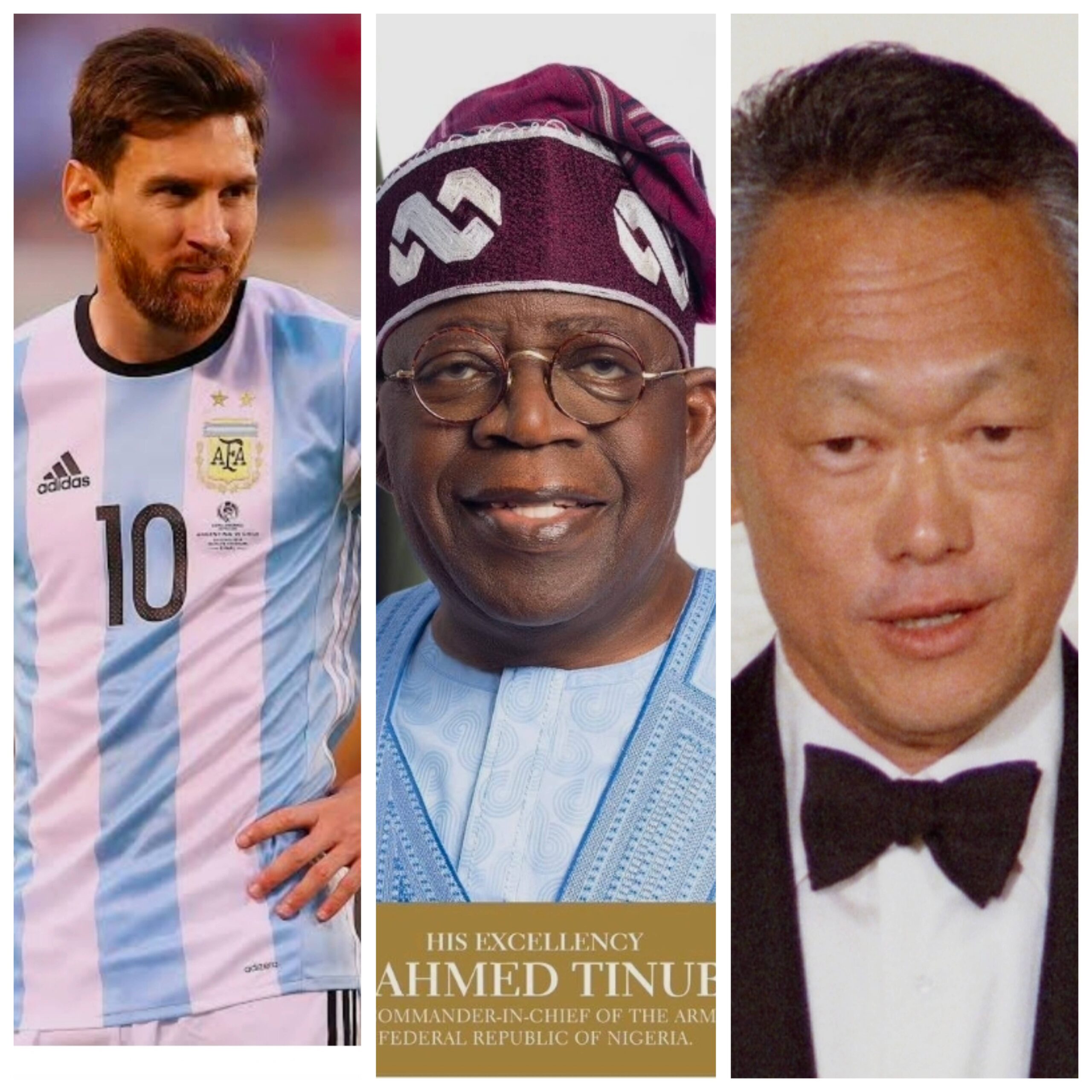
The latter appears to be the objective behind two recent interventions in defense of his excellency, President Bola Ahmed Tinubu. Respectfully, it was observed that veteran journalist Martin Oloja likened Tinubu’s political journey to that of football icon Lionel Messi. He portrayed him as a resilient strategist whose patience and tactical brilliance eventually produced victory. As this now appears to be a trend, Imo State Governor Hope Uzodimma further elevated the narrative, comparing Tinubu to Singapore’s founding Prime Minister, Lee Kuan Yew. He didn’t stop at that; rather further argued that today’s painful reforms would eventually transform Nigeria just as Lee transformed Singapore. They are compelling analogies.
Unfortunately, it was observed that both began to unravel once governance, not politics, was used as the standard of measurement.
It is a known fact to the world that Lionel Messi is celebrated not because he endured criticism or finally lifted the World Cup after years of disappointment. He is celebrated because his greatness is measurable. His goals are counted. His assists are recorded. His trophies are displayed and not just that, his records speak louder than the opinions of his admirers, which may have taken a different turn now after the outcome of the 2026 FIFA World Cup.
The same is also true of Lee Kuan Yew. History has shown that he is not revered because he introduced difficult reforms or enjoyed the support of loyal political allies. Governor Hope should be reminded that Lee is remembered because he fundamentally transformed Singapore. Amongst his achievements were transforming a poor trading port into one of the world’s richest, cleanest, safest and most efficiently governed nations.
Lee’s records speak for him because under his leadership, Singapore built world-class infrastructure, an incorruptible public service, globally competitive education, affordable housing, investor confidence and one of the highest standards of living anywhere in the world.
Neither Messi nor Lee Kuan Yew became legends through carefully crafted narratives. Yes, they became legends because the evidence became impossible to dispute. That is precisely where comparisons with President Tinubu become difficult.
It is an error to assume that winning elections is the same as winning governance and at the same time, political brilliance may secure power, but only effective leadership secures history’s approval.
For millions of Nigerians, governance is not measured by campaign strategy or political resilience. It is measured by the realities they confront every morning.
Can they afford food? Can they pay transport fares? Can they pay rent with the current landlords’ economy? Can they keep their businesses open? Can they sleep or travel freely without fear of kidnapping? Can they find jobs after graduation? Can they access reliable electricity and healthcare? These are the scoreboards by which governments are judged.
Supporters of the Tinubu administration frequently point to encouraging macroeconomic indicators. Foreign reserves have improved. Government revenues have risen. States now receive significantly larger allocations through the Federation Account Allocation Committee (FAAC). Well, these ‘achievements’ will be reviewed soon through the lens of news narratives. International financial institutions have welcomed several policy reforms. The removal of fuel subsidy and exchange-rate liberalisation are presented as courageous decisions that previous administrations avoided.
These developments deserve acknowledgement. Yet macroeconomic improvements are not the same as improvements in citizens’ welfare.
In reality, an economy cannot be declared successful merely because government revenues have increased while household purchasing power continues to deteriorate, as this would be a complete aberration.
Again, it is considered an anomaly that Nigeria reports stronger fiscal numbers, but millions of families continue to struggle with soaring food prices, rising transport costs, expensive housing, high electricity tariffs and shrinking disposable incomes.
Statistics may comfort policymakers. They rarely comfort hungry citizens. Messi never celebrated possession statistics after losing a match; rather, he cried and cried over losing the opportunity of winning the trophy at the concluded 2026 FIFA World Cup. To him, results mattered.
The reality is that governments should be judged by the same principle. This is open to dispute, but of a truth, Governor Uzodimma’s comparison to Lee Kuan Yew deserves even closer scrutiny because it raises an important question, though it may appear hard to answer.
If Tinubu is Nigeria’s Lee Kuan Yew, where is Nigeria’s Singapore? What exactly made Lee Kuan Yew exceptional? Was it simply his willingness to implement painful reforms? Certainly not.
Many leaders across the developing world have introduced painful reforms. Very few transformed their countries.
One thing stands out here: Lee’s legacy rests on outcomes, not intentions. Judging from all indications, it is obvious that his reforms dramatically reduced corruption, attracted investment, strengthened institutions, expanded industrialisation, improved education, guaranteed affordable public housing and steadily raised incomes across generations. Unlike Nigeria’s ongoing experience, Singapore’s rise was not a promise repeatedly postponed to the future. Citizens experienced tangible improvements in their daily lives. That is why history celebrates Lee Kuan Yew. Nigeria’s present reality tells a different story.
It is glaring and ironic that despite improved fiscal revenues, many Nigerians continue to grapple with rising inflation, worsening poverty, declining purchasing power, youth unemployment, struggling businesses and persistent insecurity. If they must know, these are not merely economic statistics; they are the lived realities by which citizens judge any government.
The Lee Kuan Yew comparison also overlooks perhaps the most important ingredient behind Singapore’s success, which is primarily the institutions.
It is obvious and practically doubtful if Governor Uzodinma’s kind of Singapore is the same as the one on which its transformation was built upon an efficient bureaucracy, disciplined public institutions, predictable regulation, meritocracy, uncompromising anti-corruption enforcement and consistent long-term planning as championed by Lee Kuan Yew. An honest question here is, can the same be said of Nigeria today?
The truth is not far-fetched; Nigeria is nothing close to it because the realities and lived experiences of Nigerians are that the country continues to grapple with weak institutions, policy inconsistency, bureaucratic inefficiency, corruption concerns and widespread insecurity.
His impeccable achievements are built on the institutions; hence, without institutional transformation, every effort to invoke Lee Kuan Yew risks confusing aspiration with achievement.
One common trend witnessed lately is that the supporters of the administration often argue that Nigerians must be patient because meaningful reforms require time. That argument deserves consideration.
Let it also be made known that patience should never become an endless substitute for accountability. Citizens are also entitled to ask whether the sacrifices demanded today are producing measurable improvements tomorrow.
History remembers leaders not because they prescribed hardship, but because that hardship ultimately produced prosperity for those alive and not for the dead.
Another weakness in both comparisons is the tendency to confuse political mastery with administrative excellence. These are totally two different things, because when it comes to winning elections, it requires coalition building, negotiation and political calculation. Whilst, running a nation demands competent institutions, sound economic management, transparency, public trust and measurable improvements in living standards.
Again, the two are not the same, and for this reason, many exceptional politicians have governed poorly. Many successful administrators never became political giants. Democracy ultimately rewards governance, not political mythology.
This is not to suggest that President Tinubu’s administration has achieved nothing. Tax reforms, infrastructure investments, fiscal restructuring and efforts to stabilise public finances represent important policy initiatives whose long-term impact remains to be seen. Well, acknowledging those initiatives is consistent with honest public discourse.
Equally important, however, is recognising that millions of Nigerians continue to judge the administration through the realities and their lived experiences rather than the promises they hear.
Football supporters judged Lionel Messi by the trophies in the cabinet. In like manner, history judges Lee Kuan Yew by the Singapore he built. The same measure should be applied in this nation, as Nigerians will judge President Tinubu by the Nigeria he leaves behind.
The key metric here is that if inflation falls sustainably, poverty declines significantly, insecurity is substantially reduced, electricity becomes more reliable, industries expand, jobs multiply and citizens regain confidence in the future, history will acknowledge those achievements without requiring comparisons to Messi or Lee Kuan Yew.
Neither Messi nor Lee Kuan Yew needed political allies to persuade the world of their greatness and that distinguishes both as the greatest of all time (GOAT).
Their records spoke for themselves. Political endorsements may dominate today’s headlines. History, however, listens only to evidence. Even Messi needed trophies. Lee Kuan Yew needed results. Nigerian leaders should be judged by no lesser standard.
Blaise, a journalist and PR professional, writes from Lagos and can be reached via: [email protected]

Nwokolo, Nollywood Actor Claims Internet Fraud is “Keeping Economy Afloat’

SEC Begins Full e-Registration for Capital Market Operators

Elon Musk Launches Invite-only X Money with Visa Debit Card

CBN Fines Banks N430m for Ignoring Customers’ Complaints

Kaspersky Uncovers New Mirage Kitten Malware Used in Cyber-espionage Campaign Across Africa, Others

NRC, Ponzi Scheme Collapses Resulting Loss of Billions of Naira

EFCC Busts NIS Visa Overstay Racket, Uncovers N700m in an Account

From Scarcity to Scale: What Africa Can Learn from India’s Agricultural Transformation

Tokenization, Blockchain Technology will Transform Financial Institutions – IMF

BON Establishes Six Ad Hoc Committees to Modernize Broadcasting




 Telecom2 days ago
Fact-Check: Elon Musk’s “Tesla Pi Phone” is Internet Rumor

 News3 days ago
History as Lagos Becomes First Nigerian State to Launch Greenhouse Gas Registry

 E-Business3 days ago
UNN to Partner Firm on AI, Smart Mobility Innovation Centre

 Telecom3 days ago
AI Investment Gap Threatens Africa’s Future Growth

 Telecom3 days ago
AMCON Puts ntel Up for Sale, Seeks Investors

 E-Financial3 days ago
Remita Raises Alarm Over Nigeria’s Digital Divide, Calls for More Investment

 E-Financial2 days ago
Malpass, Ex World Bank Chief Raises Alarm over Nigeria’s Secretive Debt Structures

 Telecom2 days ago
How and Why Apps Deplete Data – ALTON