

Broadcasting
Terrorism Report: NBC Recants, Denies Gagging Media

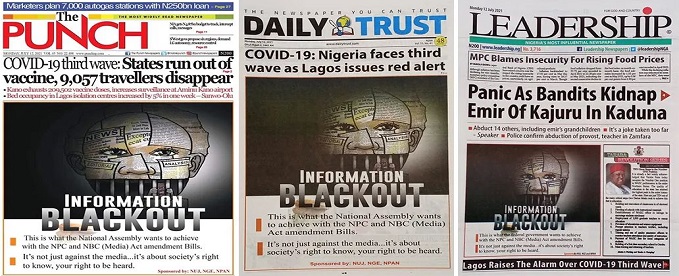
National Broadcasting Commission (NBC), has made a major turnaround as it denied reports it directed media houses to stop reporting details of terrorist attacks.

Balarabe Ilelah, director-general of the Commission, said that NBC “letter are not intended and by no means capable of being construed or interpreted as a sweeping gag on broadcast stations and journalists in the country”.
Recall that the NBC had on July 16, cautioned media stations to desist from “giving details of either the security issues or victims of these security challenges so as not to jeopardise the efforts of the Nigerian soldiers and other security agents.”
The letter titled, ‘Newspaper Reviews And Current Affairs Programmes: A Need For Caution’, was signed by Francisca Aiyetan, director, Broadcast Monitoring, on behalf of Balarabe Ilelah, director-general of the Commission.
Part of the letter reads: “Headlines of most Newspapers on a daily basis are replete with security topics. While bringing information on security to the doorsteps of Nigerians is a necessity, there is a need for caution as too many details may have an adverse implication on the efforts of our security officials who are duty-bound to deal with the insurgency.
“The Commission, therefore, enjoins broadcasters to collaborate with the government in dealing with the security challenges by;
“Not glamourising the nefarious activities of insurgents, terrorists, kidnappers, bandits etc
“Advising guests and/or analysts on programmes not to polarise the citizenry with divisive rhetoric, in driving home their point.
“Not giving details of either the security issues or victims of these security challenges so as not to jeopardise the efforts of the Nigerian soldiers and other security agents.
The Commission also reminded the broadcast stations to be guided by provisions of Sections 5.4.1(f) and 5.4.3 of the NBC Code which states thus:
“The broadcaster shall not transmit divisive materials that may threaten or compromise the divisibility and indissolubility of Nigeria as a sovereign state.
“In reporting conflict situations, the broadcaster shall perform the role of a peace agent by adhering to the principle of responsibility, accuracy and neutrality.”
The letter general public outcries with many Nigerians asking the federal government withdraw the obnoxious directive.
Reacting to the outcries, Balarabe Ilelah, said: “Your letter date July 17, 2021 in respect of the above captioned matter refers.
He was referring to Socio-Economic Rights and Accountability Project (SERAP) which has been in the fore front of the fight against the directive and had gone to court to challenge it.
Ilelah replied SERAP saying that “I write to inform you that the letter from the National Broadcasting Commission dated July 7, 2021 reminding broadcast stations in the Country to be cautious of divisive materials that may threaten or compromise the indivisibility and indissolubility of the country as a sovereign state in line with the provisions of sections 5.4.1(I) and 5.4.3 of the Nigeria Broadcasting Code when reviewing Newspaper Headlines did not in any way direct stations to stop reporting details of terrorist attacks and other violations across the country.
“Furthermore, the contents of the letter are not intended and by no means capable of being construed or interpreted as a sweeping gag on broadcast stations and journalists in the country.
“The Commission as a statutory body established by law is conscious of the Rights and Freedoms contained in the 1999 Constitution and other International instruments, treaties and covenants guaranteeing rights to certain rights and obligations and would not take any action that deliberately infringes on any of these rights.
“The Commission is also conscious of the present security challenges in the Country and advising broadcast stations to also be conscious and exercise caution by not glamorizing the nefarious activities of insurgents, terrorists, kidnappers, bandits etc. by ensuring that their transmissions conform with extant provisions of the Nigeria Broadcasting Code as well as professional ethics of the profession, these are consistent and not incompatible with the constitution 1999. The African Charter on Human and Peoples Rights and article 19 of the International Covenant on Civil and Political Rights.
“Please note that nowhere in the body of the letter complained of are there any words or phrases stopping broadcasters from reporting any case or threatening fines and other punishment other than reminding them of the existing provisions of the code and urging them to perform the role of peace Agents; In the interest of National Security. These can definitely not be seen as suppressing freedom of expression by any means or endanger the job of journalists in the country.
“The Commission even as a parastatal of the Federal Government cherishes a free press and expansion of Civic space; the Commission was not a party or in any way involved in the events that led to the suspension of twitter bY the Federal Government as its regulatory powers do not extend to Social Media Platforms. Also, the Bill for an Act to amend the National Broadcasting Commission Act, Cap N11, Laws of the Federation, 2004 has no single provision that if passed into law, may further suppress media freedom, freedom of expression and access to information and we challenge SERAP to bring out any clause inserted by NBC in the Bill for such purpose as the bill is already in the public domain.”


Canal+ is to cut jobs at MultiChoice as part of a sweeping restructuring plan aimed at stabilising the African pay-TV operator, following years of operational and financial pressure.

The move comes alongside a planned $115 million capital injection, underscoring the urgency of efforts to revive the business after the French media group took control.
The planned layoffs are expected to form a core element of a broader cost-cutting and efficiency drive, as Canal+ seeks to streamline MultiChoice’s operations and improve profitability.
The restructuring signals a shift toward leaner operations, with a focus on eliminating redundancies and optimising the company’s cost base.
MultiChoice has struggled in recent years with declining subscriber numbers across key African markets, weighed down by macroeconomic pressures, currency volatility, and changing consumer behaviour.
The rise of global streaming platforms has intensified competition, chipping away at the company’s traditional pay-TV dominance.
Canal+’s intervention marks a pivotal moment for MultiChoice, reflecting a more aggressive approach to repositioning the business.
By combining fresh capital with structural reforms, the new owners are aiming to both stabilise short-term performance and lay the groundwork for longer-term growth.
The $115 million injection is expected to provide immediate financial relief, supporting operations and potential strategic initiatives.
However, the accompanying job cuts highlight the depth of the challenges facing the company and the scale of transformation required to restore competitiveness.


Nigeria has ranked first globally in the ownership of the two largest stablecoins, Tether (USDT) and USD Coin (USDC), reflecting the country’s growing reliance on dollar-linked digital assets.

USDT, USDC
Stablecoins such as USDT and USDC are designed to maintain a fixed value against the U.S. dollar, allowing users to store money digitally while avoiding the price volatility associated with cryptocurrencies like Bitcoin.
According to the 2026 Stablecoin Utility Report released by BVNK, about 59 percent of Nigerian crypto users hold USDT, while 48 percent own USDC, giving the country the highest combined ownership rate among all nations surveyed.
The report placed Nigeria ahead of several major economies, including Australia and India, highlighting the country’s strong adoption of dollar-denominated digital assets. Australia ranked second with 34 percent USDT ownership and 29 percent USDC, while India placed third with 30 percent USDT and 27 percent USDC holdings.
The study also examined adoption levels across other regions. Countries such as Colombia and Singapore showed strong usage of both stablecoins, while adoption levels were also notable in South Africa and the United States.
Other markets included in the analysis were Philippines, Thailand and Argentina, where stablecoin ownership has also increased significantly. Among European economies, the report said France and Germany showed moderate levels of adoption, while Latin American markets such as Mexico and Brazil recorded smaller but growing usage rates.
The United Kingdom also appeared in the ranking with modest levels of stablecoin ownership. The report noted that USDT ownership exceeds USDC in many countries, including Nigeria, Australia, India, Singapore, the Philippines, Thailand, Argentina and France.
However, USDC is often viewed as a more compliance-focused stablecoin because of its stronger transparency and regulatory alignment. In some markets, including South Africa, Colombia, Germany and Brazil, the report found that USDC adoption slightly exceeds USDT.
More broadly, the data suggests that stablecoin adoption is being driven largely by emerging economies rather than advanced financial markets. According to the report, countries such as Nigeria, Argentina and the Philippines are among the biggest users of stablecoins, where people increasingly rely on dollar-pegged digital assets to protect savings from currency volatility and facilitate cross-border payments.
Spotify has unveiled Nigeria-specific data from its annual Loud & Clear report, highlighting how Nigerian artists generated more than ₦60 billion in revenue from the platform alone last year, amid explosive growth in streams, local consumption, and global discovery.

The report, which analyzes millions of data points to illuminate music streaming economics, shows Nigerian artists’ revenue surged over 140% in the past two years.
This boom stems from rising global appeal and stronger domestic engagement, with 30.3 billion streams and 1.6 billion listening hours on Spotify in 2025. First-time discoveries of Nigerian music hit 1.3 billion, up 26% from 2024.
Locally, Nigerian tracks dominated Spotify Nigeria’s Daily Top 50, accounting for over 80% of features, while consumption of homegrown artists jumped 170% year-on-year.
“Nigeria’s music scene thrives on creativity, innovation, and global influence,” said Jocelyne Muhutu-Remy, Spotify’s Managing Director for Africa. “Loud & Clear spotlights how artists are forging sustainable careers and deepening local ties.”
Key highlights include:
55% year-on-year growth in local streams for Nigerian female artists.
75% surge in streams for independent Nigerian artists.
Independents and indie labels earning 58% of all royalties from Nigerian artists on Spotify.
Spotify’s editorial playlists featured nearly 2,000 Nigerian artists in 2025, boosting visibility. Nigerian music appeared in 320 million global user playlists and over 12 million in Nigeria, totaling more than 60 million playlists worldwide.
The report also notes evolving tastes, with top-growing genres in Nigeria over five years including pop urbaine, alternative pop, anime, emo, and drill.
For full details, visit spotify.com/loudandclear.

Mobile Money Transactions Accounted for $2 trillion in 2025

MoneyMaster Enhances App, Rewards Users with Data and Airtime Bonuses

Nigeria, Finland Sign Cybersecurity Pact

Firm Shares Tips for Updating Your Digital Habits for an AI-driven World

EU Pumps €290m into Nigeria’s Digital, Health, Agri Sectors

Kaspersky Discovers New Phishing Campaign Exploiting Google Tasks Notifications to Steal Corporate Credentials

esentry 2025 Report Shows Healthcare, Financial Services and Telecoms as Staging Grounds for Increased Cyberattacks in Africa

AfDB, UNDP Launch $10Bn AI Initiative for Africa

MultiChoice Suspends Yearly DStv Price Hike as Canal+ Pushes Growth

MTN Nigeria Posts Record N1.70 Trillion Pre‑Tax Profit, Declares N20 Dividend for 2025




 E-Financial2 days ago
DLM SPV PLC Lists ₦9.00bn AAA-Rated Medium-Term Notes on FMDQ Exchange, Sets Benchmark in Corporate Bond Market

 News2 days ago
Metaverse Collapses, Horizon Worlds Shuts Down on Quest

 Telecom2 days ago
Legend Internet, Spectranet in Merger Talks

 News2 days ago
NITDA Reaffirms Commitment to Advancing Creative Economy with Digital Initiatives

 E-Financial2 days ago
SEC Issues Six-Week Ultimatum to Market Operators to Submit Recapitalisation Plan

 News2 days ago
Nigeria Spends $470m on AI-powered Surveillance Devices- Report
 E-Business2 days ago
Qualified Cybersecurity Staff Shortage Among Key Obstacles in Curbing Supply Chain Risks

 News2 days ago
FG Plans New HIV Prevention Injection in 8 States, FCT