

Broadcasting
The Pandemic Undid The Global Strides Made Towards Gender Equality


By Joanna Baidu, Youth Lead, PMI
Over the past decades, the movement to dismantle organised bias against women in workplaces, politics, academia, fast-tracking of economic opportunities and access to healthcare has been gaining ground. While society remains unequal, these gains were unequivocally meritorious and resulted from the tenacity of women driving it. However, in just over two years, Covid-19 undid the gains and exposed existing social inequalities.

Joanna Baidu
If not addressed, discrimination against women and girls will stay on as a side effect of the pandemic. The gender-skewed labour shortages in the workplace need to be ironed out on priority to create an even playing field for women who are in and will be entering the job market. This year’s theme for International Women’s Day “Gender equality today for a sustainable tomorrow” is timely and rooted in human and not just women’s rights.
Project Management Institute (PMI) identified several megatrends such as civil, civic and equality movements, demographics shifts etc in their 2022 Global Megatrends report. The report paints as an ongoing concern the rising inequality intensified by the pandemic as a contributor to social unrest.
According to the Wits University School of Economics and Finance, while women accounted for less than half (47%) of those employed in February 2021, they accounted for two million, or two-thirds (67%), of the three million net job losses recorded between February and April of the same year.
Although women suffered 67% of job losses, men received two-thirds of Covid-19 grants (65%). As the economy started opening again in September 2021 women’s employment levels were still down 20%, while men were down 13%. The fact that, Covid-19 forced more women than men out of work speaks to both the real and perceived value of women in the workplace.
The reality remains that women have had to find a balance under extreme conditions that the pandemic has presented or needed to drop out of the workforce to focus on their caregiver duties which further diluted their contributions in the workplace or presents challenges they’ll face in re-entering the job market.
Despite studies showing the importance of Diversity, Equity and Inclusion for business growth, women and ethnic minorities remain underrepresented and underpaid at all corporate levels.
As such from a project management perspective, it has never been more important to get women back to work as well as more women into work. As the Covid-19 pandemic subsides and companies once again actively seek employees, many women are, however, having trouble resuming or starting new careers.
With 25 million new project professionals needed by 2030, according to PMI’s 2021 Talent Gap report, current labour shortages will only intensify the challenges of delivering projects that are on time, on a budget that meets customer expectations.
Available statistics from PMI show that women only constitute an estimated 20% – 30% of the project management staff worldwide. For women to directly benefit, diversity must be at the heart of sustainability and a preamble to driving solutions and opportunities for women in the project management space.
Overall, the trends we have been witnessing and monitoring combine to present the sector opportunities to build a better, more inclusive, and efficient working environment.
Despite current setbacks, in the longer term, we expect the trend of female participation in the workforce to increase. Equality of access from a gender perspective can hopefully be understood on a more level playing field, one that acknowledges and correctly values and rewards the full contribution of women to economies, beyond the workplace. We also need to recognise the imperative to include more women in leadership so that we can guide more gender-diverse and accommodating cultures.
We believe a lot of the changes that have taken place recently, and observed in the 2022 Global Megatrends report, can be used to achieve greater gender equality.
Remote work, for example, provides flexibility and should over time see more women enter the workforce and stay. Remote work has also been a great leveler for people subject to bias in the workplace.
Many women of colour are reluctant to return to the office, according to a recent New York Times article. In the United States, remote work has also eased the stress of working in predominantly white workspaces and reduced exposure to microaggressions and discrimination.
As far as gender equality goes for a sustainable tomorrow, it will require buy-in from everyone including men.


Nigerian singer, songwriter and producer Pheelz (Phillips Kayode Moses) is set to feature this weekend on African Voices Changemakers, the flagship magazine programme on CNN International.

The 30-minute episode, sponsored by digital solutions company Globacom, premieres on Saturday, February 21, 2026. In a candid sit-down with host Larry Madowo, Pheelz opens up about his journey from church musician to global hitmaker, reflecting on the intersections of faith, fame and the expanding influence of Afrobeats on the world stage.
Now 31, Pheelz began his musical path as a multi-instrumentalist in church before earning widespread acclaim in 2012 as the producer behind the hit tracks “First of All” and “Fucking with the Devil” on Olamide’s YBNL album. His rapid rise saw him named among NotJustOk’s Top 10 Hottest Producers in Nigeria in 2013.
He further solidified his reputation by producing nearly every track on Olamide’s Baddest Guy Ever Liveth, earning nominations at The Headies 2013 and in the Producer of the Year category at both The Headies 2014 and the Nigeria Entertainment Awards. In 2020, he clinched The Headies Producer of the Year award, and in 2021 secured the Soundcity MVP Award for Best Collaboration for “Finesse,” his smash hit with Bnxn (formerly Buju).
On the programme, Pheelz reflects on the experiences that shaped his sound and creative philosophy, discusses landmark collaborations, shares his perspective on artificial intelligence and artistry, and explains why sound, storytelling and culture remain central to African music’s global resonance.
The show airs on DSTV Channel 401 at 8:30 a.m. (WAT) on Saturday, with repeat broadcasts at 12:00 noon the same day; Sunday at 4:30 a.m. and 7:00 p.m.; Monday at 4:00 a.m. and 6:45 p.m.; and Tuesday at 6:45 p.m. The broadcast schedule continues through Monday of the following week.
Broadcasting
Dr. Cairo Ojougboh Foundation Bolsters Nigeria’s Education Drive with ₦2.7m Student Support
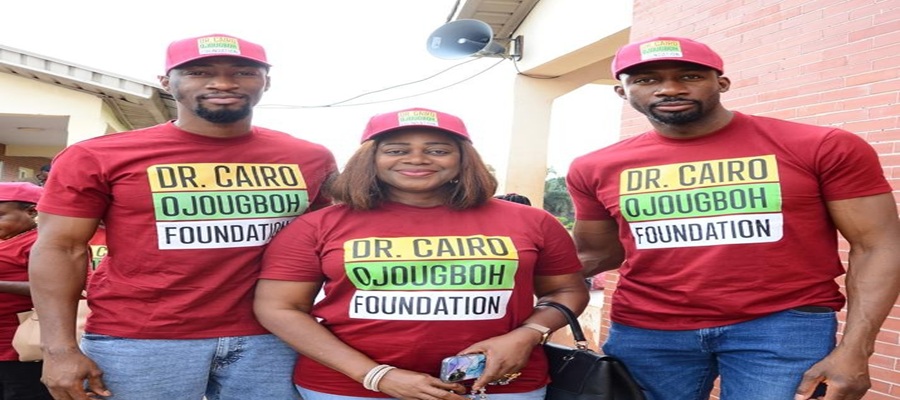
Dr. Cairo Ojougboh Foundation has reinforced government’s educational development efforts in Nigeria through a targeted initiative honouring the late medical doctor and House of Representatives member, Dr. Cairo Ojougboh.

L-R: Son of the late Dr, Cairo Ojougboh, Mr. Nkem Ojougboh; Chairperson, Dr. Cairo Ojougboh Foundation, Mrs. Bose Ojougboh and another son, Mr. Orieka Ojougboh, during the event in Agbor, Delta State recently.
The foundation recently hosted a programme themed “Your Future, Your Choice” at St. Columba’s Grammar School in Agbor, headquarters of Ika South Local Government Area, Delta State.
It presented a cheque of ₦2,700,000 to cover examination fees for students preparing for West African Examinations Council (WAEC), National Examinations Council (NECO), and Junior Secondary School (JSS) 3 exams.
Academic excellence received further boosts with cash rewards for top students across the school’s nine academic arms, alongside distributions of notebooks and writing materials to enhance learning.
Chairperson Mrs. Bose Ojougboh, joined by her sons Mr. Nkem and Mr. Orieka Ojougboh, urged students to view challenges as stepping stones, embrace discipline, consistency, and focus, and make intentional choices shaping their futures.
“The school that moulded Dr. Cairo’s values deserves our support,” she said, highlighting the foundation’s commitment to inspiring hard work and personal growth.
Old Boys of St. Columba’s Grammar School, led by Elder Ndudi Agholor, attended in force, sharing nostalgic reflections and praising the school’s sustained high standards under current leadership.
School Principal Rev. Fr. Joseph Ugboh and Ika South LGA Chairman Engr. Jerry Ehiwarior lauded the initiative as “commendable and impactful,” calling for its continuation to preserve Dr. Ojougboh’s legacy of discipline, excellence, and service.
They noted the support had motivated students to pursue their goals with renewed determination, ending the event on a hopeful note.

In a landmark educational innovation, New Horizons Nigeria has become the first institution to integrate the Chinese (Mandarin) language into its ICT curricular as an elective, thereby positioning Nigerian students for relevance in the rapidly changing world order.

Mr. Tim Akano, Managing Director and CEO of New Horizons Systems Solutions Limited
New Horizons Nigeria is a leading ICT training and solutions provider committed to provide individuals and institutions with future-ready skills. Through innovative program, global partnerships, and strategic foresight, the organization continues to redefine education, workforce development, and global competitiveness.
With over 80% of global consumer products manufactured in China and China’s growing dominance in global supply chains and labour markets, New Horizons Nigeria recognizes the urgent need for the current generation to understand, speak, and engage with the Chinese language and culture. As global economic power dynamics evolve, the labour market is increasingly tilting towards China, making Mandarin proficiency a critical competitive advantage.
According to Mr. Tim Akano, Managing Director and CEO of New Horizons Systems Solutions Limited, Nigeria, the program represents far more than a language course.
He asserted that very soon, the global labour market is likely to increasingly reflect China’s influence rather than the predominantly western orientation it currently exhibits. Language will be a major differentiator and the first Chinese-speaking technology experts in Nigeria will have a significant advantage, especially in integration into Chinese companies operating locally and globally.
Therefore, New Horizons Nigeria has officially launched a Mandarin Scholarship Program with China Advancement Opportunity, selecting 100 outstanding students from five prominent Nigerian secondary schools. This initiative marks a major milestone in Nigeria–China educational cooperation and reflects a forward-thinking response to shifting global economic realities.
Furthermore, the scholarship program has commenced with an intensive three-month online Mandarin training and at the end of the program, the top-performing students will be selected strictly on merit. 20 outstanding students will receive an additional scholarship valued at $2,500 per students to participate in a one-year pre-degree Mandarin and cultural immersion program in China. From this group, the best candidates will progress to fully funded admission scholarships into top universities in China. This initiative is designed not only to build language proficiency but also to enhance global competence, international exposure, and cultural intelligence among Nigerian students.
Also, to maintain international academic standards, participating schools are required to comply with strict guidelines. They will be obligated to join the online classes ten minutes earlier, they must have a minimum of 85% attendance throughout the program, and must ensure they have a stable internet connectivity, reliable power supply and a conducive learning environment.
Therefore, School owners and administrators have been formally congratulated and strongly encouraged to nominate their most disciplined, and committed students, as advancement to the China program will be strictly merit-based.
However, apart from students, internation business men are equally encouraged to attend New Horizon’s Mandarin executive lessons which will equip them with basic Chinese language to enhance their business communications.
Additionally, while the pilot phase begins with selected secondary schools which includes Startrite School, Lightway School, British Nigerian Academy School, Honeyland Schools and Great Heights School, the Mandarin program will be available as an elective ICT course at all New Horizons retail centers.
This is done to extend access to students and learners beyond its partner schools and within one year, committed learners will be able to communicate effectively in Mandarin, which will open doors to global employment, trade, and cultural exchange.
In conclusion, a Mandarin Cultural Fiesta will be hosted, bringing together educators, students, institutional partners, and distinguished guests from China and Nigeria. The event will celebrate outstanding performance, cross-cultural exchange, and the strengthening of bilateral educational ties.
For enquiries and participation details, interested individuals are encouraged to contact New Horizons Nigeria via 08125541750

IXPN Positions as the Regional Internet Exchange Hub for West Africa

Pheelz Shares His Journey on Glo-Sponsored African Voices

AI-Driven Memory Chip Fuels Global Phone Price Surge

NITDA DG Reaffirms FG Commitment to Responsible and Inclusive AI

Menxtt NG Emerges as Nigeria’s Virtual IT Hub for Premium Devices, Solutions
Nigeria’s 9 Top FinTech Firms Valued at $10.6Bn in January 2026

Firm Detected a Fivefold Surge in QR Code Phishing Attacks in the Second Half of 2025

Kaspersky Launches OT Calculator to Align Cybersecurity Investments with Business Goals

CBN Upgrades Licences of Opay, Moniepoint, Kuda, Palmpay, Paga to National Status

NITDA, NBC Explore Strategic Collaboration on Digital Transformation, Media Regulation




 E-Financial3 days ago
Ecobank Nigeria Fully Repays $300m Eurobond Notes

 General News2 days ago
PalmPay Unveils First Batch of Winners in #LoveWithPalmPay Campaign

 E-Financial3 days ago
Zenith Bank Warns Public Over Fake Jim Ovia Investment Videos

 E-Business3 days ago
Chams Carves Out Subsidiary to Support Africa’s Digital Transformation

 E-Financial1 day ago
ACAMB Educates Content Creator to Curb Misinformation on Bank Recapitalisation

 E-Financial3 days ago
BoI Secures CBN’s Approval for Non-interest Banking Operation

 E-Financial2 days ago
FirstCap MD says Payment Security Remains Biggest Barrier to Bankable Gas and Power Projects

 E-Business3 days ago
Nigeria, South Africa Drive Stablecoin Spending in Africa