

E-Financial
TJI Says Nigeria Squanders $2.6Bn on Corporate Tax Incentives


Tax Justice Network (TJN), a nongovernmental organization has said that Nigeria squandered some $2.6 billion on corporate tax incentives in one year, making the country to suffer a downgrade to 34th position on the 2020 Financial Secrecy Index.

In the TJN latest Financial Secrecy Index report, Nigeria’s tax-to-GDP ratio sunk to 5.7 per cent, one of the lowest in the world, due largely “to poor regulatory compliance, weak institutions and a lack of transparency.”
Some studies, the report read, “indicate that corporate incentives are costly and inefficient. In a 2015 report, ActionAid found that Nigeria was losing up to 0.5 per cent of its GDP in corporate income tax incentives given to companies with pioneer status.
“Using the 2015 budget figure, the estimated losses were put at $2.6 billion per year.”
The Financial Secrecy Index, the report read, worsened when international oil companies engaged in oil exploration became the major drivers of foreign direct investment.
Quoting copiously from a report by ActionAid, the secrecy index report noted that Nigeria was “in 2014, advised that its proposed double taxation treaty with Mauritius would promote treaty shopping and tax evasion, yet the country has gone ahead and signed and ratified the treaty.
“Mauritius has also been signaled as one of the most aggressive tax treaty partners towards Africa.”
For treaties and agreements, the Tax Justice Network reported that in 2017, Nigeria signed the Common Reporting Standard Multilateral Competent Authority Agreement, which aims to facilitate the exchange of financial information among jurisdictions.
“With a view to implementing the OECD Guidance for Common Reporting Standard, the country’s Federal Inland Revenue Service released the Income Tax (Common Reporting Standard) Regulation in 2019.
“Under the regulation, reportable financial institutions are to carry out comprehensive due diligence on old and new accounts to identify ‘reportable accounts’ and to file information returnson an annual basis.
“Nigeria currently has double taxation agreements with 22 countries, including the UK, Netherlands, Canada, South Africa, China, Philippines, Pakistan, Romania, France, Belgium, Mauritius, South Korea, Sweden, Slovakia and Italy. Treaties with the United Arab Emirates, Kenya, Poland, South Korea, Singapore, Qatar, Spain, Cameroon and Ghana are not in force as they are yet to be ratified,” the report read.
Furthermore, the country currently has ratified double taxation agreements with 15 countries including Mauritius, which is popularly known as a corporate tax haven and a conduit for illicit financial flows from Africa,” the report added.
Rolling out the Nigeria’s secrecy profile, TJN said: “At independence in 1960, agriculture was the mainstay of Nigeria’s economy, accounting for up to 69 per cent of GDP. The oil boom in the 1970s ushered in a period where petroleum contributed up to 87 per cent of total exports.
“International oil companies engaged in oil exploration became the major drivers of foreign direct investment.
“The macro-economic policies put in place to attract such investment included import duty relief, accelerated depreciation and easy repatriation of profits.
“These incentives, coupled with additional tax avoidance practices, made illicit flows of funds to other secrecy jurisdictions easier.
In 2017, Nigeria scored 17 out of 100 on the Revenue Governance Index (RGI) and ranked 77th out of 89 countries in licensing transparency.
“However, in November 2019, the Nigerian government announced that it will unveil a Beneficial Ownership Register Portal for the oil and mining industry in January 2020 through the Nigerian Extractive Industry Transparency Initiative.
“In practice, littoral states demand personal income tax from the employers of offshore workers on some geographical basis. A possible problem with this is that an FPSO may spread across two or more states, with each state laying claim to taxing rights.”
This, it continued, uncertainty created an avenue for double taxation or under-assessment of tax.
Nigeria’s Financial System Strategy 2020 was launched by the Central Bank of Nigeria in 2006 to transform the financial sector. Part of its objective was to establish an international financial centre in Lekki, Lagos, to create a legal and financial framework linked to international jurisdictions.
“This remains to be implemented, however, and the government has focused on strengthening the integrity of the internal market and automation of payments in the banking sector,” the report read.
On investment incentives, the report states: “In 1992, the Nigerian Export Processing Zones
Authority was established by an enabling act. It gave the authority the power to manage export processing zones that can be established by an order of the president. Currently, there are 13 active free trade zones in Nigeria, with the Lekki Free Trade Zone being the most vibrant.
“The Nigerian Investment Promotion Council promotes investment activities and maintains a one-stop investment centre for registration and licensing of foreign direct investment. Incentives available to enterprises in the export processing zones include an exemption from federal, state or local taxes, levies and duties.


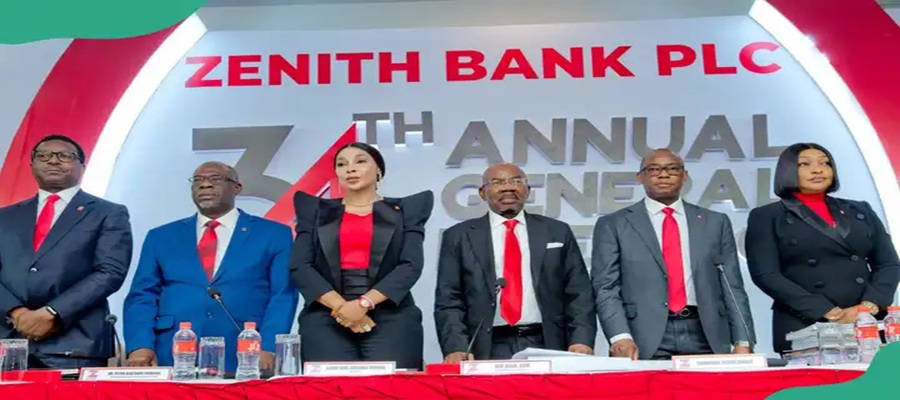
Renaissance Capital Africa (Rencap) has named Zenith Bank Plc its top conviction pick among Nigerian banks, ahead of GTCO and AccessCorp, in a fresh research report highlighting the lender’s robust balance sheet and dividend potential despite sector headwinds.

Zenith Bank
The comprehensive review of the Nigerian banking industry notes that Zenith’s current market valuation lags its improving fundamentals, even as the NGX Banking Index posts strong gains recently.
Rencap upgraded Zenith from HOLD to BUY, lifting its target price by 96 per cent based on a lower risk-free rate from falling government bond yields, refined beta estimates, and expectations of cleaner assets post-forybearance resolutions.
Balance Sheet Strength Drives Outlook
Analysts project challenges to earnings growth from anticipated Central Bank of Nigeria (CBN) rate cuts but foresee higher dividend payouts from resolved forbearance and single obligor loan (SOL) exposures alongside rising cash profits.
“Although we expect banks to face challenges in growing earnings… the balance sheet clean-up… will support higher dividend payouts relative to prior years,” the report states, ranking Zenith first, followed by GTCO and AccessCorp.
Key positives include loan write-offs that bolstered asset quality, enabling sustainable growth amid financial system reforms.
Dividend Recovery in Focus
Sector profitability from 2023-2024 was inflated by unrealised foreign exchange gains, which regulations barred from cash dividends, capping payouts despite headline profits.
Zenith historically led payout ratios in 2021-2022 via strong cash generation and capital discipline; Rencap expects a rebound as pressures ease, attracting income-focused investors.
Tier-1 Leadership Reinforced
Zenith Bank recently topped Nigeria’s tier-1 capital rankings for the 16th straight year, per The Banker magazine (Financial Times), affirming its resilience and positioning for long-term value creation.


CBN
- Access Bank Plc
- Fidelity Bank Plc
- First Bank of Nigeria Ltd
- Guaranty Trust Bank (GTBank)
- United Bank for Africa (UBA)
- Zenith Bank Plc
- FCMB (First City Monument Bank) – currently pushing to raise additional capital to secure its international licence.
- Wema Bank
- Standard Chartered Bank (Nigeria)
- Citibank Nigeria
- Stanbic IBTC Bank
- Sterling Bank
- Globus Bank
- Premium Trust Bank


The Securities and Exchange Commission (SEC) has revised the minimum capital applicable to all categories of regulated capital market entities after 10 years.

The minimum capital review, according to the SEC, is informed by the need to strengthen market resilience, enhance investor protection, align capital adequacy with the evolving risk profile of market activities, and ensure that regulated entities possess sufficient financial capacity to discharge their obligations in a sustainable manner.
“The revised Minimum Capital framework seeks to: enhance the financial soundness and operational resilience of market operators; align capital requirements with the scope, complexity, and risk exposure of regulated activities; promote market stability and systemic risk mitigation; and support innovation and orderly development of new market segments, including digital assets and commodities markets,” SEC said in a January 16 circular to market operators.
The SEC circular was sent to all entities regulated by the Commission, including but not limited to core and non-core capital market operators; market infrastructure institutions; capital market consultants; financial technology (FinTech) operators; Virtual Asset Service Providers (VASPs); and Commodity market intermediaries.
All affected entities are required to comply with the revised Minimum Capital Requirements on or before June 30, 2027, the circular said.
“Entities that fail to meet the prescribed requirements within the stipulated timeline shall be subject to appropriate regulatory sanctions, including suspension or withdrawal of registration, as may be determined by the Commission,” SEC said.
Tier-1 Portfolio Managers (Full Scope) involved in the management of Collective Investment Schemes (CIS) and Alternative Investment Funds (Private Equity, Venture Capital, Infrastructure Funds etc) above N20 billion Net Asset Value (NAV), or discretionary and Non-Discretionary Private Portfolio Management Services above N20 billion Assets under Management (AuM), or exposure to foreign instruments up to 40 percent of the NAV are now required to have a minimum capital of N5 billion as against N150 million.
“Any Fund and Portfolio Manager with NAV/AuM of more than N100billion should have a minimum of 10 percent of the NAV/AuM as capital,” SEC added.
For the Tier-2 fund/portfolio managers (Limited Scope) who are in the business of management of Collective Investment Schemes with limited pooled fund creation of not more than 10 times the required capital (N20 billion) on Net Asset Value (NAV), or discretionary and non-discretionary private portfolio management services of not more than N20 billion, or those exposure to foreign instruments of not more than 20 percent of the NAV, now require N2 billion as minimum capital as against low of N150 million.
Likewise, broker-dealers whose services include: client execution, proprietary trading, margin/securities lending and advisory services no longer require N300 million minimum capital to operate but N2 billion.
The SEC said the minimum capital review from 2015 low is in line with its mandate under the Investments and Securities Act 2025 to regulate and develop the Nigerian capital market.
Also, Tier 1 issuing houses who do non-interest finance services, advisory & arrangement services but no underwriting now require N2 billion as against N200 million; while Tier 2 –issuing houses with underwriting and offers a ‘one-stop-shop’ for issuers, provides underwriting services, and renders advisory and product development services require N7 billion minimum capital for this business as against N200 million.
Also, the minimum capital requirement for brokers (client execution only) has been jacked up from N200 million to N600 million, while that of dealers (proprietary trading only) has been moved from N100 million to N1 billion.
Broker-Dealers’ (client execution, proprietary trading, margin/securities lending and advisory services) has been raised from N300 million to N2 billion, while Sub-Brokers’ (Digital) from N10million to N100million; Sub-Broker (Corporate) has been increased from N10million to N50 million. Also, sub-brokers’ (Individual) now need N10 million minimum capital for the business as against N2 million while inter-dealer brokers require N2 billion as against N50 million.

Zenith Bank Top Nigerian Bank Pick Ahead of GTCO, AccessCorp

Here Are Nigerian Banks That Have Secured Their Licences

ICPC Charges Ozekhome with Forgery, Corruption Over London Property

MTN CEO Toriola Hails Nigeria’s Telecom Transformation at MIPAD

SEC Hikes Minimum Capital Requirements for Market Operators After a Decade

Banks quietly move to enforce new ₦50 transfer levy from Jan. 1

FIRS says NIN, CAC Numbers to Serve as Tax IDs from 2026

FIRS Declares NIN, CAC Numbers as Tax IDs from 2026

US Begins Partial Visa Ban on Nigerians January 1

Galaxy Backbone Tops FG’s Website Performance Ranking



 E-Financial2 days ago
SEC Hikes Minimum Capital Requirements for Market Operators After a Decade

 Telecom2 days ago
Study Shows Blocks in Telegram are Pushing the Underground Out

 News2 days ago
Nigeria Off EU High-Risk Money Laundering List in Major Financial Win

 News2 days ago
NGX Unveils Net-Zero Plan for Greener Capital Market

 Telecom2 days ago
Vodacom Crowned Africa’s Top Employer 3rd Year Running on Innovation, Ethical AI

 Telecom2 days ago
Galaxy Backbone Marks Two Decades of Powering Nigeria’s Digital Evolution

 Telecom2 days ago
Galaxy Backbone Marks 20 Years, Tops FG Website Scorecard
 News5 hours ago
ICPC Charges Ozekhome with Forgery, Corruption Over London Property