

News
TLcom Capital Appoints Eloho Omame as Partner


TLcom, the Africa-focused venture capital firm, has appointed Eloho Omame as a Partner, bolstering its capabilities as it ramps up deployment of TIDE Africa Fund II, its new $150mn pan-African tech fund.

As well as focusing on the firm’s traditional remit of seed to Series B investments in high-growth, tech-enabled startups, Eloho will bring more senior capacity to TLcom’s high-touch approach with entrepreneurs and support deal flow generation at the pre-seed stage, as TLcom doubles down on its commitment to Africa’s thriving tech opportunity. There will be even greater emphasis on attracting more female-led companies into TLcom’s portfolio.
Eloho is a Co-Founder & General Partner at FirstCheck Africa, a female-focused early-stage venture capital firm that has to-date invested in ten high-growth tech start-ups with a female founder or co-founder.
Eloho will combine her new role at TLcom with her existing responsibilities at FirstCheck Africa, which was founded in January 2021 to address the severe funding gap for Africa’s female tech entrepreneurs. TLcom will also support the launch of FirstCheck Africa’s $10mn debut fund with a $2mn co-investment commitment from its TIDE Africa Fund II.
With a professional career spanning more than 20 years, including time at General Atlantic, FirstBank Nigeria and Credit Suisse, Eloho brings a wealth of expertise to the team.
An important contributor to the startup and venture capital ecosystem in Africa, she has worked with several of Africa’s leading entrepreneurs, companies and teams, supporting their ambition to transform the continent’s heavily underserved markets and economies.
As the founding Managing Director of Endeavor Nigeria, she led the company’s mission to drive high-impact entrepreneurship, creating a leading membership community that includes tech founders from pioneering startups such as Paga, Migo and Flutterwave.
Eloho’s track record in early-stage investing will prove vital as TLcom expands its current portfolio from 13 companies to 30. With TLcom widening the range of its core ticket sizes to $500k – $15mn, the firm will continue to primarily target seed to Series B founders that are tackling some of the continent’s most complex challenges in sectors including fintech, mobility, agriculture, healthcare, education and ecommerce. Geographically, TLcom will expand its traditional focus on East and West Africa to include North Africa, starting with Egypt.
Speaking on TLcom’s expansion and the appointment of Eloho, Maurizio Caio, Founder and Managing Partner at TLcom, says “With the launch of our new fund, we are more committed than ever to Africa. As we partner with more entrepreneurs, it is vital that we are able to maintain our existing level of high-quality, on-the-ground strategic support to unlock the full value-generation potential of these companies. With our portfolio companies, and our investors, we are building for the long term and fully focused on the upside of the tech sector.”
“We are especially proud to strengthen our team with a Partner of Eloho’s calibre — a seasoned investor who mirrors our founder-first ethos, and will play a critical role in enabling us to deepen our commitment to the founder journey in Africa through her early-stage experience.
“Equally, her expertise will prove invaluable in strengthening our existing support for female entrepreneurs. We look forward to working with Eloho to drive the next phase of our mission to transform Africa’s key verticals through tech-enabled solutions.”
Following the first close of its new $150mn fund announced in January 2022, TLcom has gained even greater momentum, with a number of additional commitments to its fund and significant new deal flow for its growing portfolio. The firm recently led a $10mn Series A round in Seamless HR, a Nigerian platform providing payroll and HR software-as-a-service (SaaS) solutions to companies in Africa and a seed round in Pastel, a Nigerian fintech company.
Eloho Omame, Partner at TLcom, adds “It’s an honour to join one of the most prestigious investors in African tech. TLcom has seen the benefits of an early-stage approach through the success of both new and repeat founders in TIDE Africa Fund I. As we deploy capital from TIDE Africa Fund II, it’s crucial that we continue to win the race to find the continent’s best entrepreneurs and support their companies to scale.”
“The firm has always demonstrated its commitment to Africa and to the development of its startup ecosystem. It’s exciting to be in a position of mission-alignment with respect to female founders and I’m thrilled to step up the important work we’ve started at FirstCheck Africa with this incredible show of support from an established, high-calibre fund like TLcom.”
Eloho’s appointment increases TLcom’s experienced and growing team from four to five Partners, comprising Founder and Managing Partner Maurizio Caio based in Kenya, Senior Partner Omobola Johnson based in Nigeria, and Partners Andreata Muforo in Kenya, and Ido Sum in the UK. With the new addition, TLcom’s senior leadership is now 60% female.



National Agency for Food and Drug Administration and Control (NAFDAC) has alerted Nigerians on counterfeit and unregistered Cerelac Mixed Fruits and Wheat products being sold in Lagos.

NAFDAC said Nestle Nigeria, the genuine Marketing Authorisation Holder of the product, received a complaint of suspected counterfeit purportedly manufactured by Nestlé Spain, bearing Batch Code 308002910.
It said that Nestle Nigeria reported that the complainant described that the counterfeit product emitted an odour suggestive of possible contact with fuel.
NAFDAC said that preliminary review of the product by Nestle Nigeria indicated that it had expired, in spite of the container displaying an expiry date of 10-2026, which suggested that the date coding had been tampered with (revalidated).
Nestle Cerelac Mixed Fruits and Wheat is a nutritious infant cereal, designed to be a delicious first food for infants.
NAFDAC said that its post-marketing surveillance’s directorate officers in Lagos conducted a surveillance visit to Maxland Shopping Centre, 193 Ago Palace, Okota, where the product was purchased by the complainant.
It added that the suspected counterfeit and unregistered Cerelac were found on sale at the premises and subsequently mopped up, while Nestle assisted in identifying the distinguishing features between registered and unregistered product.
According to the regulatory agency, Nestle revealed that the unregistered product used a hyphen (-) to separate the day from the year, while the registered product used a slash (/) to separate the day from the year.
“It is important to note that Nestle Nigeria is not aware of the channels through which the products are supplied into the country.
“Healthcare professionals and consumers are advised to report any suspicion of the sale of substandard and falsified regulated products to the nearest NAFDAC office, call 0800-162-3322, or send an email to [email protected],” NAFDAC said.
The agency warned that counterfeit formula often lacked essential nutrients, vitamins and minerals, leading to stunted growth or developmental issues.
It said that such formula might also contain contaminants that might lead to severe health consequences to infants or even death.
NAFDAC reiterated its commitment to safeguarding public health adding that it would continue surveillance activities to ensure the quality, safety, and efficacy of all NAFDAC-regulated products circulating in Nigeria.
It said that all zonal directors of the agency and state coordinators had been directed to carry out surveillance and mop up the revalidated product, if found within the zones and states.
The agency urged distributors, retailers, healthcare professionals, and caregivers to exercise caution and vigilance within the supply chain, to avoid the distribution, sale, and use of fake products.
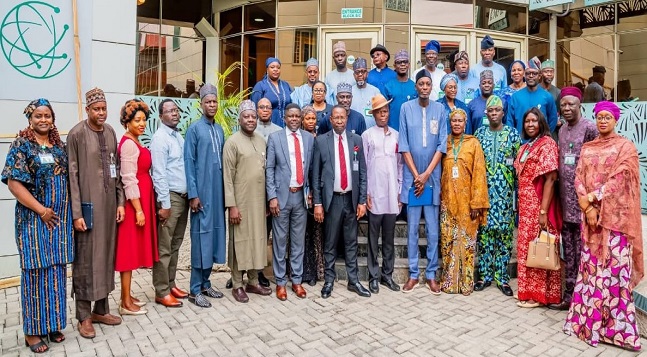
The National Information Technology Development Agency (NITDA) has reinforced its commitment to advancing Nigeria’s digital transformation agenda through strengthened collaboration with key strategic institutions, as it hosted the Director General of the National Institute for Policy and Strategic Studies (NIPSS), Professor Ayo Omotayo, alongside participants of the Senior Executive Course (SEC) 48, 2026.

The visit, which builds on an earlier strategic study tour, provided a platform for in-depth engagement on the role of digital innovation in driving sustainable economic growth, with particular focus on the Orange Economy.
Representing the Director General of NITDA, Kashifu Inuwa CCIE, the Director of Stakeholder Management and Partnerships, Dr Aristotle Onumo, highlighted the Agency’s commitment to fostering a vibrant digital ecosystem through inclusive policies, strategic partnerships, and capacity development initiatives.
“NITDA is committed to creating an enabling environment where innovation can thrive by bringing together government, private sector, academia, and creatives to drive Nigeria’s digital economy,” he stated.
Inuwa underscored the growing importance of the Orange Economy, describing it as a critical driver of innovation and economic value through intellectual property. He identified sectors such as digital content creation, film, animation, and digital art as key contributors to national development.
“The Orange Economy represents a powerful opportunity to transform our rich cultural heritage and creativity into sustainable economic growth,” he noted.
He further highlighted Nigeria’s unique advantage, particularly its youthful and creative population, while calling for stronger collaboration among stakeholders to fully harness the sector’s potential.
“With our youthful population and rich cultural assets, Nigeria is well-positioned to become a global leader in the Orange Economy if we deepen collaboration and investment across the ecosystem,” he added.
During the engagement, NITDA also presented its strategic initiatives aimed at supporting the digital and creative sectors, including digital infrastructure development, promotion of digital literacy, and implementation of policies that enable startups and innovators to scale.
Addressing challenges facing the sector, Inuwa pointed to issues such as limited access to funding, infrastructure gaps, weak intellectual property protection, and ecosystem fragmentation, while emphasising the need for coordinated action.
“Addressing challenges such as funding gaps, infrastructure deficits, and intellectual property protection is critical to unlocking the full potential of Nigeria’s creative economy,” he said.
The Agency reiterated its target of achieving 70 per cent digital literacy by 2027, noting that ongoing programmes are equipping millions of Nigerians with essential digital skills, including those in underserved and informal sectors.
In his remark, Professor Omotayo described the visit as an important opportunity to deepen understanding of how digital technologies are reshaping economic sectors, particularly the creative industry. He noted that the insights gathered would contribute significantly to policy recommendations aimed at strengthening Nigeria’s economic framework.
Participants of the SEC 48 programme engaged actively during the session, raising questions on capacity development, access to tools, and frameworks for protecting digital content. NITDA highlighted its ongoing collaborations with industry stakeholders to provide training, innovation hubs, and access to digital tools for young Nigerians.
The engagement concluded with a renewed commitment from both NITDA and NIPSS to strengthen collaboration in research, policy development, and capacity building, aimed at positioning Nigeria as a globally competitive force in the digital and creative economy.


Nigeria Revenue Service (NRS) has assumed responsibility for collecting mineral royalties from mining operators nationwide, following new tax laws effective January 1, 2026.

NRS
The shift emerged from a Thursday meeting between Solid Minerals Development Minister Dele Alake and NRS Chairman Dr. Zacch Adedeji. Their joint statement, endorsed by both, confirms NRS now administers all federally collectible revenues, including royalties.
Enacted by President Bola Tinubu on June 26, 2025, the Nigeria Tax Laws 2025 empower this transition. The Ministry of Solid Minerals Development remains a key partner, supplying pricing data, geological insights, and sector coordination.
NRS Special Adviser Dare Adekanmbi’s statement outlines collaborative steps: a nationwide sensitization program for operators on filing and payments; development of a digital royalty system; and regular joint technical sessions to address issues.
Both agencies pledge orderly, transparent implementation to boost the mining sector. Operators must comply with obligations and join upcoming programs.
The move aims to streamline revenue collection while fostering mining growth.

Offset Communications Slams N50m Suit against Qore Technologies for Alleged Copyright Infringement

Compensation for Poor Service Quality is Automatic- NCC

SERAP Sues CCB over Electoral Act, New Tax law

Tinubu Approves N3.3 Trillion Payment Plan to Boost Power Supply

NDPC Investigates Remita, Others over Alleged Data Breaches

Spotify’s Loud & Clear Report Reveals Over ₦60Bn Revenue for Nigerian Artists in 2025

Madonna University Taps Tech Guru Adote for Strategic Board Role

China Threatens to Shut Nigeria’s Satellite Over $11.44m Unpaid Debt

Healthcare Under Attack: Why Cybersecurity is Now Critical Care

Why JustMarkets Is a Strong Choice for Gold Trading




 News2 days ago
NITDA Strengthens Collaboration with NIPSS to Drive Digital Innovation, Orange Economy Growth

 E-Financial2 days ago
CBN, Banks, Fintechs Launch PSPC to Boost Nigeria’s Payment System

 General News2 days ago
FG, Others Say Nigeria Wastes 38m Tonnes of Food Annually

 E-Financial2 days ago
CycleFlow, IFC Launch Supply Chain Finance Platform in Nigeria

 E-Financial2 days ago
Anchor Gets Nigerian, Canadian Licences as Transactions Crosses $2.5Bn

 E-Financial2 days ago
Ecobank Assures of Seamless Easter Banking Services

 News2 days ago
NRS Takes Over Mineral Royalties Collection Under New Tax Laws

 E-Financial2 days ago
N4.65 Trillion in the Vault, but is the Real Economy Locked Out?