

News
Tony Elumelu Entrepreneurs to Receive Tech Support from Microsoft

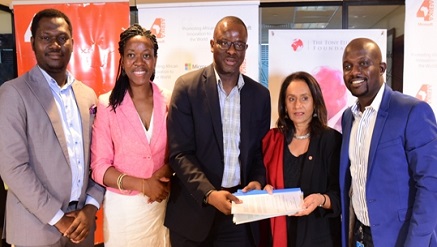
Microsoft, through its 4Afrika Initiative, has collaborated with the Tony Elumelu Foundation (TEF) to provide entrepreneurs in the TEF Entrepreneurship Programme with technology-based tools, resources and mentorship.
Through this support – which will benefit TEF entrepreneurs across the continent – the two organisations will help entrepreneurs effectively use ICT to modernise their businesses, enrich their offerings and reach new customers.
“Microsoft 4Afrika and the Tony Elumelu Foundation share a common goal to accelerate economic and social development by promoting entrepreneurship,” said Akin Banuso, General Manager, Microsoft Nigeria.
“As we enter into an era of digital transformation, it’s vital that we help all entrepreneurs develop relevant technology skills and integrate ICT into their businesses. Technology can help SMEs reach customers outside their local markets, generate powerful business insights and improve their customer retention. We have found that SMEs who adopt this kind of modern IT have seen 15% faster revenue growth than those not using it.”
Microsoft 4Afrika will provide TEF entrepreneurs with:
· Access to cloud-based software, online support and technology through BizSpark
· Access to information and markets through the Biz4Afrika platform, where SMEs can trade with similar-sized organisations
· Technical training on Microsoft technologies and platforms during the 2017 TEF Forum
· Online business and technology training through the Microsoft Virtual Academy, to support entrepreneurs through their start-up, growth and acceleration phases
· Access to Microsoft experts for virtual and in-person mentorship through the MySkills4Afrika programme
· Access to the Interns4Afrika programme

“Every year, the TEF Entrepreneurship Programme provides 1,000 entrepreneurs with business training, mentoring, access to seed capital funding and membership into the TEF Africa-wide Network,” said Parminder Vir OBE, CEO, Tony Elumelu Foundation.
Through this partnership, we are supporting each other’s mission to enable Africa’s entrepreneurs to drive their businesses forward.”
In addition, Microsoft will also identify high potential entrepreneurs from the TEF Entrepreneurship Programme and integrate them into its Innovation Grant Programme.
During the MOU singing at Microsoft headquarters, one TEF Entrepreneur already benefitting from the partnership, Adeniyi Olayemi said: the training I received through the Foundation helped me to refine my business idea and then produce a successful proposal, then once we received access to Microsoft’s Azure software, I was able to close on a deal.”
Since 2013, the Innovation Grant Programme has provided financial support to over 55 local start-ups, who have since generated $5.1 million in reciprocal investments.



Management of Nigeria CommunicationsWeek Media has withdrawn its publication titled “Adefolarin Ogunsanya and the Allegations of Shareholder Interference and Self-Dealing at Pan African Towers,” which was published on its platform.

The decision to retract the story follows an editorial review to ensure that the platform maintains the highest standards of accuracy, fairness and responsible journalism in reporting matters that are the subject of ongoing judicial proceedings.
Nigeria CommunicationsWeek acknowledges that the issues raised in the publication remain before the courts and have not been finally determined.
Accordingly, the organisation has decided to remove the article from its platforms pending the conclusion of the legal processes or the availability of additional verified information.
The publication regrets any inconvenience or misunderstanding the report may have caused to readers or any individuals or organisations mentioned in the story.
Nigeria CommunicationsWeek remains committed to the principles of balanced, factual and ethical journalism and will continue to uphold professional standards in its coverage of judicial and corporate governance matters.


INTERPOL’s African Cyberthreat Assessment Report 2026 revealed that Artificial intelligence accounts for 55 per cent of reported cybercrimes across Africa and making attacks faster, more sophisticated and increasingly difficult to detect.

The report warns that the continent’s rapid digital transformation, marked by more than 1.1 billion mobile subscribers in 2025, is being matched by an equally rapid evolution in cybercrime, while fragmented legislation and limited AI readiness among law enforcement agencies continue to weaken responses.
The 40-page assessment, based on survey data from 36 African member countries, said cybercrime has shifted from isolated criminal activity to an industrialised, borderless ecosystem powered by AI.
According to the report, East Africa has become a hotspot for mobile money fraud and ransomware attacks targeting critical infrastructure, while business email compromise (BEC) and romance scams are widespread across Central and West Africa.
Southern Africa, it noted, has become an attractive target for international cybercriminals due to its high level of internet connectivity.
The report also highlighted the growing financial impact of cybercrime across the continent, revealing that losses have more than doubled since 2024, rising from 192 million dollars to 484 million dollars.
It attributed the increase largely to AI-enabled scams, credential harvesting and automated social engineering attacks.
INTERPOL said online scams remained the most commonly reported form of cybercrime in 2025, with criminals exploiting mobile money platforms, social media and AI-generated content to deceive victims.
It added that 72 per cent of surveyed countries reported the existence of scam centres, with the highest concentration recorded in Southern and West Africa.
The report further identified digital sextortion and online harassment as persistent threats, driven increasingly by AI-generated deepfakes and synthetic media.
According to data from TrendAI, one of INTERPOL’s partners, about 600,000 sextortion incidents were detected during the reporting period.
Business email compromise schemes have also become more sophisticated, with AI being used to generate highly convincing email communications.
The report said Africa-based threat actors are increasingly targeting victims in Europe and North America using cyber infrastructure spread across multiple jurisdictions.
INTERPOL warned that the absence of real-time information sharing between banks, telecommunications companies and law enforcement agencies has created significant vulnerabilities in tackling financial cybercrime.
It said cybercriminals are no longer relying solely on stolen credentials but are now creating AI-generated synthetic identities by combining genuine personal information with fabricated details.
These synthetic identities, the report noted, have been used to bypass biometric verification systems, open bank accounts, obtain mobile loans and register SIM cards under false identities.
Neal Jetton, Director of INTERPOL’s Cybercrime Directorate, described cybercrime as one of the most significant criminal threats facing Africa.
“Cybercrime has emerged as one of the most significant criminal threats to the region. AI is automating every stage of a cyberattack from reconnaissance and phishing to extortion and evasion.
“However, we see that when countries work together, cybercriminal infrastructure can be identified, disrupted and dismantled,” he said.
Despite the growing threat, the report highlighted progress in strengthening cybersecurity across the continent.
It disclosed that 17 African countries enacted or amended cybercrime legislation in 2025, while Senegal launched an online reporting platform to improve responses to online offences affecting children.
The report also noted that regional capacity-building initiatives are helping to improve long-term cyber resilience.
INTERPOL said four major cybercrime operations conducted in 2025, Operation Serengeti 2.0, Operation Contender 3.0, Operation Sentinel and Operation Red Card 2.0, resulted in more than 1,500 arrests, the seizure of hundreds of electronic devices and the recovery of over 100 million dollars.
To address the growing threat, the report recommended the adoption of standardised digital forensic capabilities, stronger cross-border collaboration, greater investment in AI literacy for law enforcement personnel and formal public-private partnerships to improve cybercrime prevention, detection and response.
The African Cyberthreat Assessment 2026 forms part of INTERPOL’s African Joint Operation against Cybercrime initiative, funded by the United Kingdom’s Foreign, Commonwealth and Development Office, with data contributions from Fortinet, Mastercard, the Shadowserver Foundation, S2W and TrendAI.

Nigerian students will soon design, assemble, test and fly drones as part of their university education, following a partnership between Miva Open University and Abuja-based defence technology company Terra Industries.

The collaboration comes as Nigeria intensifies efforts to develop indigenous capabilities in advanced manufacturing and defence technology, with both organisations seeking to strengthen Africa’s pipeline of deep-tech talent.
The partnership will see students gain hands-on experience in drone engineering and related technologies through dedicated labs and industry collaboration.
The partners will establish robotics, drone and virtual reality laboratories across Miva’s study centres, beginning with a pilot facility in Abuja.
Students will also gain access to industry-led workshops, research opportunities, internships and mentorship in artificial intelligence, robotics, cybersecurity and autonomous systems.
According to the partners, Terra’s engineering teams will work alongside Miva faculty to integrate hands-on hardware training into academic programmes, exposing students to real-world engineering challenges and building industry experience before graduation.
Nathan Nwachuku, co-founder and CEO of Terra Industries, said Africa’s technological future depends on developing engineers capable of building solutions for local challenges.
“The engineers who will build Africa’s future must learn by building. This partnership creates opportunities for students to work with the technologies shaping modern security, infrastructure and autonomous systems,” said Nwachuku.
Miva Open University said the initiative forms part of its commitment to experiential learning, adding that students will have the opportunity to “design, test and fly drones as part of their academic experience”.
The partnership builds on Terra’s expanding role in Nigeria’s defence technology sector. Earlier this year, the company signed a joint venture with the Defence Industries Corporation of Nigeria to localise the production of drones, robotics systems and cybersecurity infrastructure, supporting efforts to strengthen domestic manufacturing and reduce reliance on imports.

Dimension Data to Channel Funds to Support Nigerian Fibre Expansion

FG Commences 90,000km Fibre Optic Rollout within Weeks

Kaspersky Reveals a New Malicious Framework Targeting Cryptocurrency Users with the Use of OkoSpyware

Nigeria CommunicationsWeek Retracts Story on Pan African Towers Litigation

Firm to recruit over 100 professionals to boost NRS e-Invoicing compliance

NRC, Ponzi Scheme Collapses Resulting Loss of Billions of Naira

From Scarcity to Scale: What Africa Can Learn from India’s Agricultural Transformation

EFCC Busts NIS Visa Overstay Racket, Uncovers N700m in an Account

BON Establishes Six Ad Hoc Committees to Modernize Broadcasting

NELFUND Investigates 34 Universities Over Students’ Missing Tuition Refunds




 News3 days ago
Atte, Nigerian Develops AI Algorithm for Hair Transplants

 News3 days ago
FG to Abolish Subsidies in Power Sector in 2027 – Minister

 E-Financial3 days ago
FCT Court Awards Ex-Customers N15m against Stanbic IBTC over Data Privacy Breach

 E-Financial3 days ago
CBN Exposes over 13,000 BVNs Tied to Fraud as Banks Tighten Security

 Telecom3 days ago
Starbase Technologies Introduces Yolly, a Reward-Based Social Entertainment Platform

 General News3 days ago
Dare Tackles Onaiyekan over Criticism of Tinubu, Says Economic is Working

 E-Business2 days ago
Kaspersky Identifies Cyberespionage as a Growing Threat Across Africa, Others

 General News3 days ago
SERAP Asks Tinubu to Probe Alleged N6.79Bn Missing Police Funds, Firearms