

General News
Tony Elumelu Lists 3 Things Africa must do to Bridge Infrastructure Gap

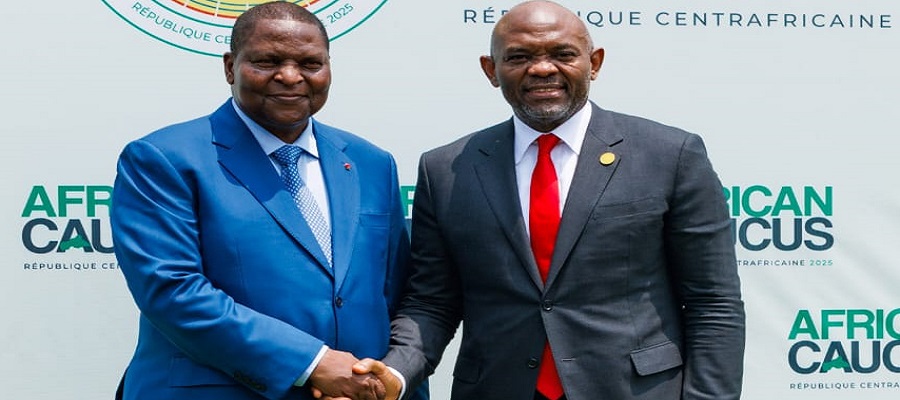
Tony Elumelu, group chairman of Heirs Holdings and UBA, has listed strengthening fiscal capacity, driving operational efficiency, and unlocking innovative financing as three key things Africa must do to truly rise and bridge its infrastructure gap.

L-r: Faustin-Archange Touadéra, president, Central African Republic; and Mr. Tony Elumelu, group chair, UBA and Heirs Holdings and Founder, Tony Elumelu Foundation.
Elumelu, also founder of The Tony Elumelu Foundation, urged Africa to enable the private sector to co-lead infrastructure development.
He stated all these in his keynote address at the African Caucus meeting held in Bangui, Central African Republic.
The meeting was themed, ‘Resilient Infrastructure, Human Capital, and Green Assets’.
Elumelu highlighted that across Africa, there is a deep and persistent infrastructure divide.
“From roads to ports, power to internet connectivity, we lag behind. We cannot achieve prosperity without the foundations of modern development. Without addressing these gaps, we cannot unlock the growth and prosperity our people deserve,” he said.

He emphasised that energy access is the most critical enabler or barrier to Africa’s progress, pointing out that up to 70% of Africans still lack access to electricity.
“My home country, Nigeria, generates less than 7,000 megawatts for over 200 million people.
“If we are to industrialise, create jobs, and participate meaningfully in the global AI revolution, we must invest aggressively in energy from renewables to cleaner gas-based solutions. Imagine what Nigeria’s economy could become with 100,000 megawatts of reliable, affordable energy. That is the scale of transformation we need”, he said.
Elumelu called for a stronger role for the private sector in infrastructure delivery, citing the work of Transcorp and Heirs Energies as an example of how private capital can address public challenges.
“We are generating power, exporting it through the West African Power Pool, and using gas from our oil operations to power our plants. This is Africapitalism in action,” he said.
Africapitalism, he explained, is the belief that Africa’s private sector must lead in driving economic transformation through long-term investments that generate both economic and social returns.
But for Africapitalism to succeed, he said, strong public-private partnerships are essential.
“Governments must create the right environment. The private sector must bring capital and innovation. And our development partners must support Africa’s realities – including recognising gas as a viable transition fuel on our path to clean energy”, he added.
On Africa’s human capital, Elumelu underscored that no resource is more valuable than the continent’s people especially its youth.
“Africa is the youngest continent on earth, with over 60% of our population under 35. This presents both our greatest asset or our greatest risk,” he said. “If empowered, our youth can transform Africa. If neglected, they can become a source of instability.”
Through the Tony Elumelu Foundation, he said, over 24,000 young entrepreneurs across all 54 African countries have been empowered with non-refundable seed capital of USD5,000 each.
The foundation has also trained 1.5 million youths and catalysed 1.2 million jobs. “These entrepreneurs are creating jobs, building businesses, and changing lives,” he noted.
To conclude his address, Elumelu delivered three powerful messages.
“Africa’s development is our responsibility. No one else will do it for us. Africa’s future is in our hands. No one will build this continent for us. We must lead,” he said. “Power is everything. No industrial revolution can happen without electricity. We must prioritise energy. Without power, there can be no progress.”
And finally, “We must invest in our youth. They are not just our future, they are our present.”
He commended the growing focus of global institutions on Africa, referencing his role on the IMF Advisory Council on Entrepreneurship and Growth and expressing optimism about the renewed emphasis on job creation as a path to sustainable development.
He also praised the World Bank’s ‘Mission 300’ initiative led by President Ajay Banga, which aims to connect 300 million Africans to electricity
“Africa is ready,” Elumelu declared. “Let’s seize this moment and build the prosperous, empowered continent our people deserve”.



Federal High Court in Abuja has adjourned the Federal Government’s alleged tax evasion case against Binance Holdings Ltd. cryptocurrency exchange, until September 24, 2026, to allow both parties more time to pursue an out-of-court settlement.

Justice Emeka Nwite fixed the new date on Thursday after Moses Ideho, counsel to the Federal Government, informed the court that discussions aimed at resolving the dispute amicably were still ongoing.
Ideho, a deputy director of Legal and Prosecution at the Nigeria Revenue Service (formerly the Federal Inland Revenue Service), told the court that the matter, which had been scheduled for a report on settlement or continuation of trial, could not proceed.
According to him, one reason for the delay was the reported elevation of Justice Nwite to the Court of Appeal, while the second was the continued reconciliation efforts between the parties.
“The parties are still exploring settlement in the charge that led to this case,” Ideho told the court.
Sunday Agaji, counsel to Binance, did not oppose the application for adjournment, following which Justice Nwite postponed proceedings until September 24 for either a report on the settlement discussions or continuation of trial.
The case was previously adjourned on May 12 after both the Federal Government and Binance informed the court that negotiations were underway to settle the matter outside the courtroom.
Binance had first indicated its willingness to pursue an amicable resolution on March 24.
The cryptocurrency company was re-arraigned on July 12, 2024, on a four-count charge bordering on alleged tax evasion.
Ayodele Omotilewa, Nigerian representative, pleaded not guilty on behalf of the company.
The re-arraignment followed the removal of Binance executive Tigran Gambaryan and his colleague, Nadeem Anjarwalla, from the charge after the Federal Government amended the case to make Binance Holdings Ltd the sole defendant.
Justice Nwite had, on June 14, 2024, discharged and struck out the names of Gambaryan and Anjarwalla after the prosecution filed the amended charge.
Binance is also facing a separate criminal prosecution by the Economic and Financial Crimes Commission (EFCC), which accuses the company of laundering about $35.4m.
In addition, the Nigeria Revenue Service is pursuing a separate civil suit against Binance before another judge of the Federal High Court, seeking approximately $79.5bn in alleged economic losses linked to the company’s operations in Nigeria.
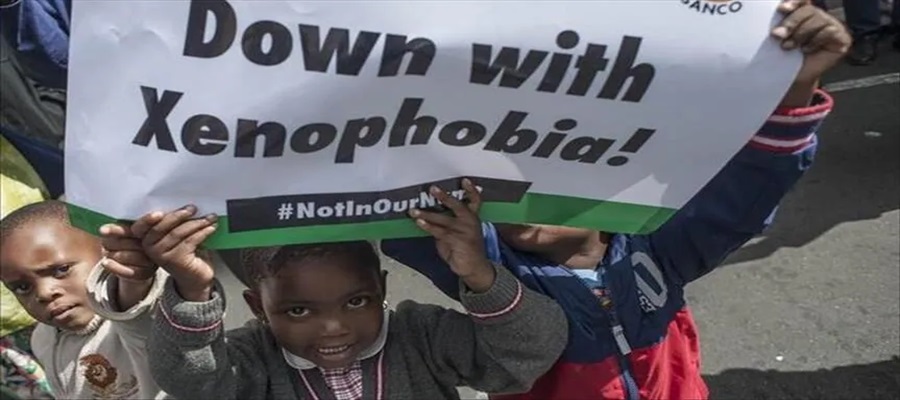
Oodua Youth Coalition (OYC), a Yoruba socio-cultural group, has issued a notice to stage peaceful picketing at MTN Nigeria offices nationwide.

This action stems from the company’s alleged failure to publicly condemn recent xenophobic attacks against Nigerians in South Africa.
This is coming despite statement by Karl Toriola, chief executive officer, MTN Nigeria, who recently said that MTN may have originated from South Africa, he explained, but MTN Nigeria is a Nigerian publicly quoted company, managed by Nigerians and with a Nigerian board.
However, in a statement jointly signed Olatunji Adejuwon and Olaoye Abolaji,vice president and national secretary respectively of OYC, described MTN Nigeria’s silence as unacceptable, given the company’s South African roots and the patronage it enjoys from Nigerians
The coalition said it would proceed with a peaceful protest if the telecommunications company continued to ignore its demands, stressing that the action was intended to draw attention to the need for corporate responsibility and moral leadership in condemning xenophobic attacks against fellow Africans.
“Consequently, the Oodua Youth Coalition hereby gives notice that we shall, without hesitation, commence a peaceful picketing of MTN Nigeria’s offices if the company continues to ignore our legitimate demands.
“Our action is intended to draw attention to the need for corporate responsibility and moral leadership in condemning acts of xenophobia against fellow Africans,” the statement said.
The group renewed its call on MTN Nigeria to immediately convene a press conference, with representatives of the coalition in attendance, to unequivocally condemn the xenophobic attacks and reaffirm its commitment to the safety, dignity and unity of all Africans.
It maintained that the proposed protest would be peaceful, orderly and in accordance with the laws of the Federal Republic of Nigeria.
According to the coalition, relevant security agencies have been notified of the planned action, while appropriate communications have also been sent to the South African diplomatic mission in Nigeria.
“We once again call on MTN Nigeria to immediately convene a press conference, with representatives of the Oodua Youth Coalition in attendance, to unequivocally condemn the xenophobic attacks and reaffirm its commitment to the safety, dignity and unity of all Africans.
“We emphasise that our proposed action shall remain peaceful, orderly and in accordance with the laws of the Federal Republic of Nigeria. Relevant security agencies have been duly notified, and appropriate communications have also been sent to the South African diplomatic mission in Nigeria.”
Reaffirming its commitment to defending the rights and dignity of Nigerians, the coalition vowed not to relent until its concerns received the desired attention.
“The Oodua Youth Coalition remains committed to defending the dignity of Nigerians and promoting African solidarity. We will not relent until our concerns receive the attention they deserve,” the statement added.
Responding to the controversy, Toriola further condemned all forms of xenophobia and violence against Africans living in South Africa, insisting that MTN Nigeria is a Nigerian company with substantial local ownership.
“We unequivocally condemn any form of xenophobia, violence or attacks against any community in the world. We’re a Nigerian company, through and through. We’re listed on the stock exchange with over 201,000 retail investors, and 11 million people hold shares through their pension funds in MTN Nigeria.
“We provide the digital backbone of the economy, and we have a completely Nigerian entity.
“Yes, MTN was founded in South Africa, and the parent company that is the majority shareholder is South African. But let’s also look at it objectively. The shareholding of MTN Holding South Africa is only 50 per cent African.
“The remaining 50 per cent is from across the world — 27 per cent from the United States, with the rest from the United Kingdom, Europe, the Middle East and the Asia-Pacific region,” Toriola said.


By Bidemi Oke
Every civilisation has been built on one invisible infrastructure. The Romans built roads. The Industrial Revolution built electricity. The Internet built information. The next economy may be built on something far less tangible.

Trust
That sounds counterintuitive because we have spent centuries believing that money is the foundation of every economy. It isn’t. Money has never been the foundation; it has simply been the mechanism through which trust is exchanged. Every major financial innovation, from coins and paper notes to credit cards, online banking and blockchain, has been humanity’s attempt to solve the same problem: “how do we help strangers trust one another without ever meeting?”
Seen through that lens, today’s financial revolution looks very different.
Most discussions about digital finance revolve around whether cash will disappear. We debate mobile wallets, central bank digital currencies, cryptocurrency, real-time payments and digital banking. Yet these conversations often mistake the visible change for the actual transformation.
The real shift is not that money is becoming digital. The real shift is that trust is becoming programmable. That single idea explains why the financial landscape is changing faster than many people realize.
For decades, finance has depended on institutions to create confidence. Banks verified identities, governments authenticated currencies, contracts relied on lawyers, payment networks validated transactions and every exchange involved an intermediary whose primary role was to reassure two parties that the system could be trusted.
Technology is quietly rewriting that arrangement
Today, identities can be verified digitally. Transactions can be authenticated within seconds, smart contracts can execute agreements automatically once predefined conditions are met, and artificial intelligence can detect suspicious activity before humans notice it. Increasingly, confidence is being built into the infrastructure itself rather than added afterwards.
This is why I believe we need a new way to think about the evolution of finance, not as a journey from cash to digital payments, but as “three generations of financial trust”.
The first generation was Physical Trust. Trust was tied to tangible assets like gold, paper currency, handwritten signatures and face-to-face interactions. Confidence came from what people could physically see and hold.
The second generation was Institutional Trust. As economies expanded, institutions became the guarantors of financial confidence. Banks, regulators, payment networks and financial intermediaries enabled transactions at a scale impossible through personal relationships alone. Trust shifted from physical objects to established organisations.
We are now entering the third generation: Programmable Trust.
Here, trust is embedded directly into technology. Verification happens automatically. Payments settle in real time, financial services become integrated into everyday experiences instead of existing as separate destinations. Increasingly, people interact with trusted systems rather than trusted institutions alone. That distinction is more profound than it first appears.
Many organisations still measure digital transformation by counting how many services have moved online, but digitising an existing process is not the same as redesigning how trust flows through an economy. Converting paperwork into an application does not automatically create a digital financial ecosystem.
This explains why some economies process millions of digital transactions every day yet continue to face friction, inefficiency and limited financial inclusion. The missing ingredient is rarely another payment platform. More often, it is interoperable infrastructure, trusted digital identity, consistent regulation and systems capable of working together seamlessly.
In other words, the future of finance will not be determined by who builds the fastest application. It will be determined by who builds the most trusted ecosystem.
This has significant implications for Africa. The continent has rightly earned global recognition for accelerating digital financial adoption. Yet the next opportunity extends beyond increasing transaction volumes. The greater challenge is designing financial infrastructure where payments, identity, data, compliance and commerce interact intelligently rather than operating in isolation.
That is where long-term competitive advantage will emerge. Perhaps the greatest irony of all is that the more advanced finance becomes, the less visible it will appear.
People rarely think about the internet protocols that power a video call or the cloud infrastructure supporting an online purchase. Likewise, future generations may hardly think about payment rails, settlement networks or blockchain architecture. Financial experiences will simply happen securely, instantly and almost invisibly.
History suggests that successful technologies eventually disappear from our attention not because they become less important, but because they become so reliable that we stop noticing them altogether.
So, are we entering a fully digital financial economy? Perhaps that is no longer the right question.
A more useful question is whether we are entering an economy where trust itself becomes digital infrastructure because if that is true, then the organisations shaping the future of finance are not merely moving money more efficiently.
They are redesigning how entire economies create confidence at scale and that may prove to be the most valuable innovation of all.
Bidemi Oke is the Chief Executive Officer of FlashChange, a fintech platform focused on secure digital asset exchange. He is an entrepreneur and vibrant leader, recognized for driving innovation and redefining access in the financial technology industry.

Court Adjourns Alleged Binance Tax Evasion Case over Settlement Talks

Fixed Wired Internet Market Lags as Mobile Gains Ground

Xenophobic Attacks: OYC Threatens to Picket MTN Nigeria Offices

New NIMC Act Strengthens Data Protection, Privacy – Director

BON Establishes Six Ad Hoc Committees to Modernize Broadcasting

NASENI Moves to Digitize CCB’s 5m Assets Declaration and Operations

Mobile Internet Gender Gap Widest in Africa – GSMA

Nigeria Launches FreeTV Nationwide

CANAL+ Partners Samsung to Pre-Load DStv Stream on New Samsung TVs In Nigeria, Other African Countries

Lebara Nigeria Launches Lebara Play, Africa’s First Telecom-Owned Micro-Drama Platform




 News3 days ago
NRC, Ponzi Scheme Collapses Resulting Loss of Billions of Naira

 News3 days ago
NSITF Partners South African Insurer on Digital Transformation

 E-Financial3 days ago
FCT-IRS Unveils New Digital Platform, Taxporta

 General News3 days ago
KPMG Urges Africa’s Most Innovative Tech Entrepreneurs to Enter the Global Tech Innovator 2026 Competition

 E-Business3 days ago
FG Suspends New Internet Regulations to Prevent Overlapping Rules
 E-Business3 days ago
NIN Enrollment Hits over 136m as New ID Law Takes Effect

 E-Business3 days ago
Plateau PCC Collects Nigerians’ Data without Privacy Policy – FIJ

 Telecom2 days ago
NCC Seeks Cost-Based Pricing Framework for Ducts