

General News
Turkish Airlines, PIA Expand Codeshare Agreement

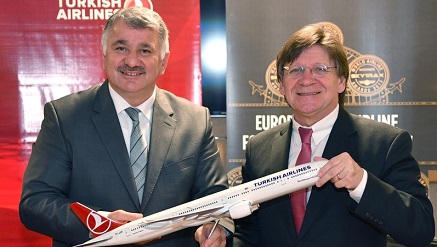
Turkish Airlines and Pakistan International Airlines have expanded their codeshare cooperation starting on February 1st, 2017.
Inclusion of the new routes will enable both airlines step into new market while offering passengers various possibilities to travel.
With the expansion of the existing codeshare agreement, Pakistan International Airlines will be able to sell Turkish Airlines’ beyond Istanbul points of Atlanta, Johannesburg, Atina, Amsterdam, Tashkent, Moskova, Miami, Boston, Houston, Washington, Los Angeles, San Francisco, Chicago with its own airline code and flight number in addition to the already existing cooperation on Istanbul – Karachi/ Islamabad/ Lahorevv.routes; while Turkish Airlines will market Pakistan International Airlines operating flights from Karachi and Islamabad to Dubai, Abu Dhabi and Muscat and from Lahore to Dubai and Abu Dhabiwithits own airline code and flight number.
Turkish Airlines currently operates 7 frequencies each on the Istanbul – Karachi/Islamabad/Lahorevv.routes. The expanded codeshare cooperation provides passengers with more feasible connections as well as seamless travel opportunities between and beyond destinations of Turkey and Pakistan. Pakistan International Airlines’ Jeddah and Madinah flights and as well as 8 domestic routes from Karachi, Islamabad and Lahore are appended to the renewed SPA in force since January 1st, 2017, which abled Turkish Airlines to reach Pakistan domestic destinations.
The new SPA also involves Turkish Airlines’ all American destinations besides most of the European points.
As a matter of course, Turkish Airlines and Pakistan International Airlines will continue to collaborate to enhance the tourism potential and cultural interactions between Turkey and Pakistan while promoting business travel between two brother countries.
Mr. Bilal Ekşi, CEO and Deputy Chairman of Turkish Airlines, stated that the passengers will be able to travel with easier connections and more flexible alternatives. He also indicated that; “The more the frequencies between two countries are increased in the future, the further the cooperation between two carriers will be expanded so as to enable passengers to travel with even shorter connection times and more comfortable travel opportunities.”
Regarding the expansion of the cooperation, CEO of Pakistan International Airlines, Mr. Bernd Hilden brand said; “Pakistan and Turkey are brotherly countries and have close cultural and business cooperation in various areas including aviation. PIA values its commercial relations with Turkish Airlines and expansion of this codeshare will add more value to our commercial ties and be equally beneficial for our customers. We will continue to explore more commercial avenues in future, as well.”
Using Istanbul, the only city settled on two continents at the same time and bridging between Asia and Europe, as its main hub, Turkish Airlines operates to 246 international destinations worldwide, more than 100 of them being on Europe.
Thanks to the advantageous geographical location of Istanbul, the cooperation between two carriers will enable passengers departing from Pakistan to travel all over the world by connecting in Istanbul.



Senate on Tuesday approved the fresh $6 billion loan request forwarded to the lawmakers by President Bola Tinubu.

Lawmakers approved the fresh loan on the same date the request letter was read by Godswill Akpabio, senate president.
The Senate approved the loans following the presentation and consideration of the report by Senator Aliyu Wamakko, chairman, Senate Committee on Local and Foreign Debts.
President Tinubu had written to the Senate seeking approval to borrow a total of $6 billion to finance key government projects and address budgetary gaps.
The requests were contained in two separate letters addressed to Godswill Akpabio, president of the Senate, and read during Tuesday’s plenary.
In the first letter, the President requested approval to obtain a $5 billion loan from Abu Dhabi Bank.
According to the President, the facility will be used to cover the nation’s budget deficit and support debt financing, among other fiscal obligations.
The request forms part of the Federal Government’s efforts to stabilise public finances and sustain ongoing government programmes.
In a separate communication, Tinubu also sought approval to secure a $1 billion UK Export Finance loan facility from London Citi Bank.
The loan is intended for the rehabilitation of key port infrastructure, including the Lagos Port Complex and Tin Can Island Port.
The President said the project aims to address critical infrastructure deficiencies in the country’s maritime sector
According to him, the rehabilitation will help improve efficiency, enhance safety standards, and support Nigeria’s efforts to diversify its economy beyond oil.
He added that the initiative would also strengthen Nigeria’s position as a regional trade hub.
Both requests have now been considered and approved by the Upper Legislative Chamber.
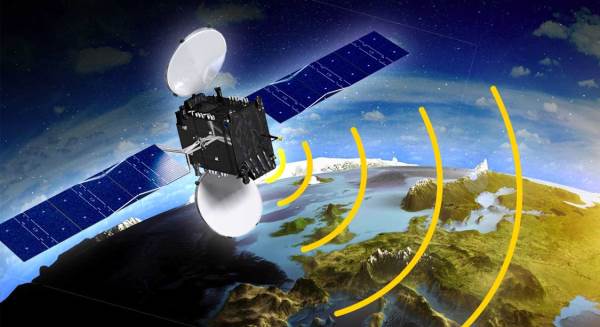
Federal government has fixed 2028 and 2029 for the launch of two communication satellites, NIGCOMSAT-2A and NIGCOMSAT-2B, as part of efforts to strengthen security and expand digital connectivity.

The government will be committing over $22 billion on the ambitious space-led growth agenda focused on new satellite launches, increased industry revenue and expanded broadband access in underserved communities.
At the opening of the 2026 Nigerian Satellite Week in Abuja, Dr Bosun Tijani, minister of Communications, Innovation and Digital Economy, confirmed the government’s approval for the acquisition of two new satellites—NigComSat 2A and 2B, describing the move as a “defining commitment” to national development, digital sovereignty and economic competitiveness.
Also, Mrs Jane Nkechi Egerton-Idehen, managing director of Nigerian Communications Satellite Limited (NigComSat), noted that the projects have moved beyond procurement to the execution stage.
She said the satellites are designed to enhance intelligence gathering, surveillance, and connectivity across Nigeria and neighbouring countries, particularly in support of security operations.
“For 2A and 2B, we have started the process. We have closed the tender and are now back into the financing and implementation stage. 2A is built to come up in 2028, and 2B for 2029.
“When they are up and running, they are expected to provide security within the borders and neighbouring countries. They will support the security agencies because data collection and intelligence in real time is important. Satellites like communication satellites allow that, irrespective of where they are,” she said.
On his part, Tijani, said the satellite programme forms part of a broader government strategy to deepen digital infrastructure nationwide.
According to him, the initiative complements ongoing investments in fibre-optic expansion and telecommunications infrastructure, while extending connectivity beyond Nigeria’s borders.
“The President’s approval of NIGCOMSAT-2A and 2B demonstrates a clear commitment to building the future. These satellites will enhance security, connect remote communities, and extend our fibre-optic network into neighbouring countries.
“Some of these neighbouring countries pay up to ten times more for internet capacity than Lagos. Extending our fibre network will not only improve connectivity but also enhance border security and regional collaboration.
“Satellite technology affects everything, from how a child in a rural community accesses the internet to how farmers make critical decisions and how businesses operate across distance,” he said.
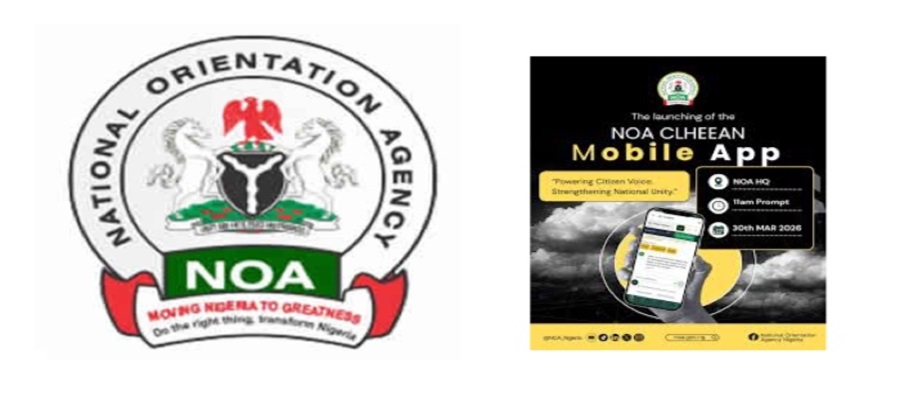
Federal government has announced the launch of CLHEEAN, an artificial intelligence-powered mobile application designed to improve interactions between citizens and public institutions.

It is also a civic education and community engagement app.
Developed under the National Orientation Agency (NOA), the platform functions as a virtual assistant accessible via mobile devices.
It allows users to access information on public policies, ask questions, and interact directly with government services.
The app includes features such as instant messaging, voice recognition, and multilingual support, including several local languages, to reach a wider audience.
With CLHEEAN, users can also submit feedback, report concerns, and take part in discussions on public policies. The approach is intended to strengthen citizen participation and improve communication between the government and the public.
Lanre Issa-Onilu, director general of the NOA, said the initiative addresses a long-standing gap between citizens seeking to be heard and systems that do not always respond effectively, adding that the platform marks a step toward closing that gap.
The launch comes as Nigeria continues to face challenges in citizen engagement and the dissemination of public information.
By leveraging artificial intelligence, authorities aim to make public services more accessible while improving transparency and responsiveness.
The initiative also reflects a broader trend across Africa, where governments are increasingly exploring the use of AI to modernize public services and strengthen ties with citizens.

How Recycled SIM Card Linked to N50m Kidnapping Nearly Landed me in Jail – Businesswoman

Senate Gives Tinubu Nod to Borrow Fresh $6Bn

FG Earmarks $2Bn to Launch 2 Satellites in 2028, 2029

CBN Directs Banks, Fintechs to Complete Cybersecurity Audit Tool

FG Launches CLHEEAN to Streamline Access to Government Services

Spotify’s Loud & Clear Report Reveals Over ₦60Bn Revenue for Nigerian Artists in 2025

Madonna University Taps Tech Guru Adote for Strategic Board Role

China Threatens to Shut Nigeria’s Satellite Over $11.44m Unpaid Debt

Jumia Tech Week 2026 Begins with Tech Deals on Smartphones, Electronics, and Everyday Technology

FCCPC Bans Lagos ‘No Refund’ Policy, Vows Fines and Shutdowns for Traders




 E-Financial2 days ago
CBN bars large‑ticket loan defaulters from banking services in tough new crackdown

 General News2 days ago
ARN Rejects Medical Bill over Attempt to ‘Scrap’ Profession

 Telecom2 days ago
NIGCOMSAT Supports Startups Growth with the Launch of Accelerator 3.0

 News2 days ago
Meningitis Kills a Quarter Million People a Year -Study

 Telecom2 days ago
FG Unveils Digital Economy Research Fund Scheme

 News2 days ago
Stakeholder says AI is Crucial to Nigerian Data Centres Amid Persistent Grid Collapse
- General News2 days ago
Nigeria Advances Digital Governance as NITDA takes over NGEA Portal

 General News2 days ago
Zarttech Reflects on Its Role in Changing Global Perceptions of Africa