

E-Business
Twinpine Partners Afmobi, Offer Brands Premium Mobile Audiences

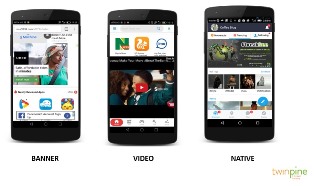
Twinpine, a Terragon Group Company, Africa’s pioneer and premium mobile marketing company, has recently partnered with Afmobi, a mobile internet business with one of the largest portfolio of products in Africa, to offer brands and agencies access to premium local inventory on the Tecno Mobile phones browser, Palm Play content store and the PalmChat Social.
The browser is pre-installed on 27 million devices that have over 700,000 unique users daily and 50,000,000 impressions monthly.
Palmchat is a social channel that reaches core marketing demographics {80% of its users aged 16-30} anywhere in Nigeria. Ad campaigns that run on the PalmPlay store are able to reach a wide audience of over 400,000 daily active users. These channels are accessible on both smart and feature phones.
“Afmobi is pleased to partner with one of Africa’s leading Mobile advertising company in delivering value to brands and agencies through its multiple-channel touch points. With access to over 50 million unique users in Africa with over 30% of those users in Nigeria, we know that our channels would offer tremendous engagement opportunities for brands” said Philicia Lai, AGM, Afmobi Africa.
Also commenting on the partnership, Oduntan Odubanjo, chief operation officer, Twinpine said the collaboration is another step to create more value for our customers by ensuring access to premium yet local inventory that helps brands target the right audience.

“For brands and advertisers, buying media across these platforms which are local yet premium ensures that issues like fluctuations in foreign exchange rates will not affect their campaign. At Twinpine, we will continue to present premium opportunities for brands to get value for money spent when running marketing campaigns on our platform. It’s important to note that the consumers’ experience with our ad formats will be as engaging as possible” he said.
Twinpine recently unveiled its new ad formats (Native Ads, 3D Ads, Brand Cast, Call-to-Action Ads) as well as its Mobile Intelligence Portal, Programmatic Platform and Adrenaline product at an event tagged: “An Evening of Innovation with Twinpine” which brought together a number of digital marketing agencies, brand owners, IT experts and media practitioners.
Twinpine, a Terragon Group Company, is Africa’s premium mobile advertising network reaching millions of Africans on mobile devices via the mobile web. Twinpine helps brands and publishers run and manage tailored mobile advertising campaigns, enabling them to connect with the right audience, increase conversion rates and ultimately, make the most of Mobile.
Twinpine works with several leading advertising agencies, brands and publishers locally and internationally connecting them with their African audience delivering exceptional results for them.
Twinpine has delivered campaigns in several African countries including Nigeria, Kenya, South Africa, Ghana, Uganda, Zimbabwe, Zambia, among others.


E-Business
Organizations Face New Attacks via Unpatched TrueConf Videoconferencing Servers, Kaspersky Warns


Kaspersky has discovered a new multi-stage attack by the Head Mare APT group against organisations with PhantomCore and PhantomGraph backdoors. To deliver these backdoors, the attackers exploit vulnerabilities in unpatched TrueConf videoconferencing servers and can also replace TrueConf client installers with infected ones.

Kaspersky reported the attacks to the vendor; the vulnerabilities were fixed in the latest TrueConf Server update on June 18, 2026 (versions 5.3.9, 5.4.9, and 5.5.5).
To compromise the TrueConf server, attackers exploited a combination of two vulnerabilities (assigned internal Kaspersky identifiers are KLCERT-26-057 and KLCERT-26-058), which allowed the attackers to execute any code with maximum privileges. By exploiting these vulnerabilities, they replaced one of the server’s files with their own web shell.
The attackers then used this shell to collect information about the victim organisation’s IT infrastructure, gain privileged access to the TrueConf server database, and replace the client installer with an infected one. The attack applies to TrueConf servers in versions 5.3.X prior to 5.3.9, 5.4.X prior to 5.4.9, 5.5.X prior to 5.5.5, and earlier.
For users of TrueConf software, the attack looks like this: video conference participants connecting to the compromised server are prompted to download and install an “updated version” of the client application. In reality, as a result of this, malware gets onto the device.
“Exploiting vulnerabilities in popular services is one of the most common methods used by attackers. This campaign is particularly dangerous because it puts at risk not only organisations using unpatched TrueConf servers.
“Even if a company doesn’t use this solution, its employees can connect to compromised servers at the invitation of their counterparties to participate in online meetings. As a result, they may unknowingly download infected installation packages, creating the potential for compromising a large number of enterprises across different countries,” comments Evgeny Goncharov, Head of Kaspersky ICS CERT.

Kaspersky’s latest survey highlights a protection gap between macOS and Windows based devices. While macOS has long been regarded as the more secure operating system, 12% of its users reported malware infections compared with 9% of Windows users. Moreover, only 35% of macOS owners install dedicated security software, versus 42% of Windows users.

According to Kaspersky’s latest global survey*, Windows users report a higher adoption rate for most security measures, while macOS users show a modest advantage in a few privacy‑focused actions. At the same time, during the past year macOS users reported higher percentages than Windows users for a number of cybersecurity incidents.
The largest gap in cybersecurity approaches appears in the habit of not opening suspicious emails or links, with 62% of Windows users following this practice compared to 51% of macOS users.
What’s more, when it comes to cybersecurity software installation, macOS users are also lagging behind. While among Windows users 42% reported using digital‑life‑protection software, for macOS this rate is only 35%, what Kaspersky security experts call a worryingly low figure.
It is noteworthy that 12% of macOS respondents said they fell victim to phishing (fake emails, websites or messages) over the past year compared with 9% of Windows users. Moreover, during this period macOS users faced more scams and investment frauds (16% vs 13%), privacy violations (11% vs 8%) and thefts of personal data (12% vs 7%).
To counter these specific threats, robust anti-malware and anti-phishing protection is essential. Malware authors put a lot of effort into developing new, more powerful and stealthier versions of stealers, spies and other classes of malicious payloads, while relying on phishing techniques that allows them to get access to user’s data.
Dedicated security solutions add a crucial layer of real-time detection and defence that complements macOS’s built-in protection – and independent tests have repeatedly shown that effective options, such as Kaspersky Premium for macOS, deliver strong protection. In 2025, AV-TEST recognised it as the top-performing macOS security solution based on consistent, reliable results across a full year of evaluations.
When it comes to credentials and passwords safety, Windows users also show better security practices’ adoption rates. They lead in using a unique password for each account (38% vs 35%) and complex passwords (52% vs 45%), two‑factor or multi‑factor authentication (51% vs 46%).
Adopting a dedicated password manager becomes a logical next step. Such tools store all credentials in a secure vault protected by a single master password, eliminating the need to remember hundreds of passwords while keeping them safe from breaches.
They also support modern authentication methods like passkeys, enabling seamless, single-tap sign-in across all devices through secure synchronisation – capabilities offered by solutions such as Kaspersky Password Manager.
“There are entrenched stereotypes that macOS is inherently more secure because its user base is smaller, leading cyber‑criminals to deem it a lower‑value target, or because the platform itself includes many robust security features. While these observations are not entirely unfounded, the threat landscape has evolved dramatically.
Attackers actively employ phishing and commit supply chain attacks, which often allow them to affect users of any operating system in a single malware campaign. Moreover, mac specific malware is not rare and there are many malware families that target macs exclusively. Consequently, any device with an Internet connection, regardless of its operating system or form factor, requires cybersecurity software to defend against a wide range of cyber threats,” comments Sergey Puzan, cybersecurity expert at Kaspersky.
E-Business
Cyber Resilience a Critical Priority for Manufacturing Amid Rapid Digitalization – Report Shows

As 60% of manufacturers race toward full digitalisation, cyber risk is increasingly manifesting as a business risk, according to a new global report by Kaspersky and VDC Strategy.

This means cybersecurity is not merely a compliance function, it is a cornerstone of production assurance, safeguarding uptime, quality, and operational continuity.
Manufacturers are modernising to deliver safer, more consistent and more cost-effective production and digitalization is moving fast: just 9% of organisations describe themselves as fully digital today, but 60% expect to get there within two years, according to the joint report by Kaspersky and VDC, titled ‘Cyber Resilience, Built for Manufacturing’.
That shift links shop-floor equipment, production lines and site operations to platforms such as Manufacturing execution systems (MES), Supervisory control and data acquisition (SCADA) and historians, turning many plants into cyber-physical systems (CPS), where a digital disruption doesn’t stay digital. It can slow production lines, quarantine work in progress, invalidate traceability records, or halt production outright.
What’s driving manufacturing digitalization?
Manufacturers are digitising for measurable operational gains, not novelty. Survey respondents identified the primary drivers of their digital transformation strategy as:
- Improving production output or efficiency (24%)
- Reducing operational or production expenses (15%)
- Enabling new strategic opportunities (14%)
- Improving cyber resilience (13%)
The same connected systems that unlock these gains, including MES, IIoT sensors, automated material handling, remote engineering access, also become the systems that determine whether production can be trusted to keep running.
Cyber risk is now a business risk
Cyber risk has evolved from a mere IT concern to a direct threat to revenue generation, as environments transform into cyber-physical systems. In these integrated settings, digital disruptions like malware no longer just affect data, they can cause unsafe operations, scrapped batches, and halted production on the plant floor. This shift highlights the urgent need to treat cybersecurity as a key part of operational resilience.
According to the report, nearly 60% of manufacturing organisations estimate that cyber incidents cause damages exceeding $1 million per event, with an average disruption of 15.3 hours. The most significant losses often result from production halts, missed delivery commitments, and penalties, rather than just forensic costs.
In this context, downtime links cybersecurity risks to overall business performance. Cyber incidents can reduce Overall Equipment Effectiveness (OEE), strain staffing, and disrupt supply chains. Recovery involves more than system restore, it requires re-establishing confidence in process parameters, quality records, and traceability before resuming operations.
Mature cybersecurity programs now incorporate OT security into governance, focusing on metrics valued by production leaders such as time to restore, backup confidence, legacy asset coverage, and safe degraded operation. This alignment ensures cybersecurity supports continuous production and resilience, not just IT compliance.
However, challenges remain due to split ownership. While 59% of organisations’ IT departments manage security policies, these often overlook plant realities. Managing many security tools (44%) and OT patching issues (38%) show that cybersecurity must be embedded into daily routines of production, engineering, and quality teams. Only through such integration can cybersecurity effectively enhance operational reliability and defend against evolving threats.
“As manufacturing environments become increasingly interconnected, cybersecurity shifts focus from merely adding protective layers to ensuring the availability, resilience, and integrity of production processes. The goal is to minimise operational impact and speed up recovery, rather than solely preventing intrusions.
“Kaspersky offers a unified ecosystem that integrates IT, OT, and IIoT security, empowering manufacturers to pursue digital transformation securely. This strategy helps maintain operational continuity and reduces long-term cybersecurity costs,” comments Andrey Strelkov, Head of Industrial Cybersecurity Product Line at Kaspersky.
To implement this strategy, manufacturing companies can leverage solutions from the Kaspersky OT Cybersecurity Ecosystem, centered around Kaspersky Industrial CyberSecurity (KICS), a native Extended Detection and Response platform designed for critical infrastructure protection. KICS enables centralised detection and response to complex attacks across the entire industrial network, ensuring comprehensive visibility and security.

SEC Clears Blockchain for Accelerated Regulatory Incubation Programme

Union Bank Secures Global Payment Data Security Certification

NLNG, NCDMB Boost Engineering Research with Innovation Centre

Organizations Face New Attacks via Unpatched TrueConf Videoconferencing Servers, Kaspersky Warns

Leadway Unveils Multi-generational Insurance Plan for Nigerian Families

EFCC Busts NIS Visa Overstay Racket, Uncovers N700m in an Account

Fact-Check: Elon Musk’s “Tesla Pi Phone” is Internet Rumor

NBC Tasks Broadcasting Stations over 2028 DSO Global Deadline

NBC Scraps Annual Digital Access Fee on DSO

Glo Sponsored African Voices to Feature Netflix’s “The Polygamist” Stars




 News2 days ago
NCAA to Introduce RFID Technology to Tackle Missing Luggages

 General News2 days ago
Nigeria Not Making Progress in Fiscal Transparency –US

 Telecom2 days ago
GSMA Industry Services Unveils Circularity Services to Help Operators Reduce E-Waste and Unlock Value

 Telecom2 days ago
MTN Nigeria Unveils Y’ello Street Museum to Mark 25 Years of Connectivity

 News2 days ago
Firm Urges MSMEs to Increase Digital Payments Adoption for Growth

 E-Financial2 days ago
SEC Directs Operators to Subscribe to NigSac Alerts, Freeze Terrorists-Linked Funds

 E-Financial2 days ago
AFC Raises $430m in Digital Bond to Deepens Digital Financial Infrastructure

 E-Business2 days ago
Cyber Resilience a Critical Priority for Manufacturing Amid Rapid Digitalization – Report Shows