

General News
#VPTourOfTech: NITDA Is Paying Close Attention

By Isa Ali Ibrahim Pantami, PhD
When the Vice President of the Federal Republic of Nigeria, Professor Yemi Osinbajo SAN, gave his steering speech at the 2016 e-Nigeria International Conference and Exhibition, emphasising the point that the President Buhari administration is set to reset Nigeria’s economic architecture by diversifying from oil dependency and leveraging on ICT as a critical contributor to the economy, some people felt it was the usual talk by political leaders, without any intention to bring the vision to fruition.
But events have come to prove that real change is happening in the way government is engaging with Tech.
In 2017, Mr President himself attended the e-Nigeria International Conference and Exhibition to give his scorecard on support for the Information Technology sector and his plans for its further development.
It was therefore not a surprise when I received the mail that I was to join His Excellency the Vice President (VP) for a tour of the Innovation Hubs in Lagos.
Although NITDA through its Office for ICT Innovation and Entrepreneurship (OIIE) embarked on a similar trip in November 2017, having to accompany the VP is something special.
The purpose of the visit was to gain first-hand knowledge of the innovation ecosystem.
The Honourable Minister of Science and Technology, Dr Ogbonaya Onu, was also on the VP’s entourage.
This was not a regular official function, it was not a time of talking and lecturing the citizens about what government has done or not done; it was a time to LISTEN.
Indeed we listened to our young, vibrant, passionate and highly motivated youths. They demonstrated to us that the best of Nigeria is yet to be unveiled.
It was a tour that gave hope to all. The young people saw in the government team, a breath of fresh thinking.
They did not see the grand-standing and disruptiveness that such a visit would have caused in the past.
They remained at their work, coding, some were eating some were taking selfies with the VP. It was such a joy to see the glee on everyone that day.
We listened to the Paystack story, how Shola and Ezra began a quiet revolution in payments processing back in 2014.
Paystack has now become one of the most efficient payment processors in the country.
Many did not pay attention to Andela until Mark Zuckerberg announced an investment in the Startup.
Andela set out to solve the problem of top-class IT skills gap in Africa and the world.
Andela recruits interns after a rigorous process in which less than 1% of over 70,000 scale through.
The interns then go through a six-month intensive bootcamp that sharpens them to become world-class.
The energy, intelligence and zeal of the over 500 strong office of young people in T-shirts and Jeans is enthralling.
Sulyman, the VP Global Operations, gave the visitors an expose on the business model, opportunities and challenges of Andela.
Flutterwave is sited in a bunker-like structure. This company was founded by a team of ex-bankers, entrepreneurs and engineers.
In less than two years of its founding this payment gateway has processed transactions valued over $2 billion and has over 45,000 merchants.
Time would fail me to talk about Autogenius, Carido, Asoko Insight, Branch.
These are startups that provide solutions ranging from auto-mechanics, micro insurance, micro loans, corporate intelligence etc.
Indeed the Nigerian genius is unleashed and we at NITDA are paying close attention.
We visited 6 places and listened to 14 Startups tell us what they do.
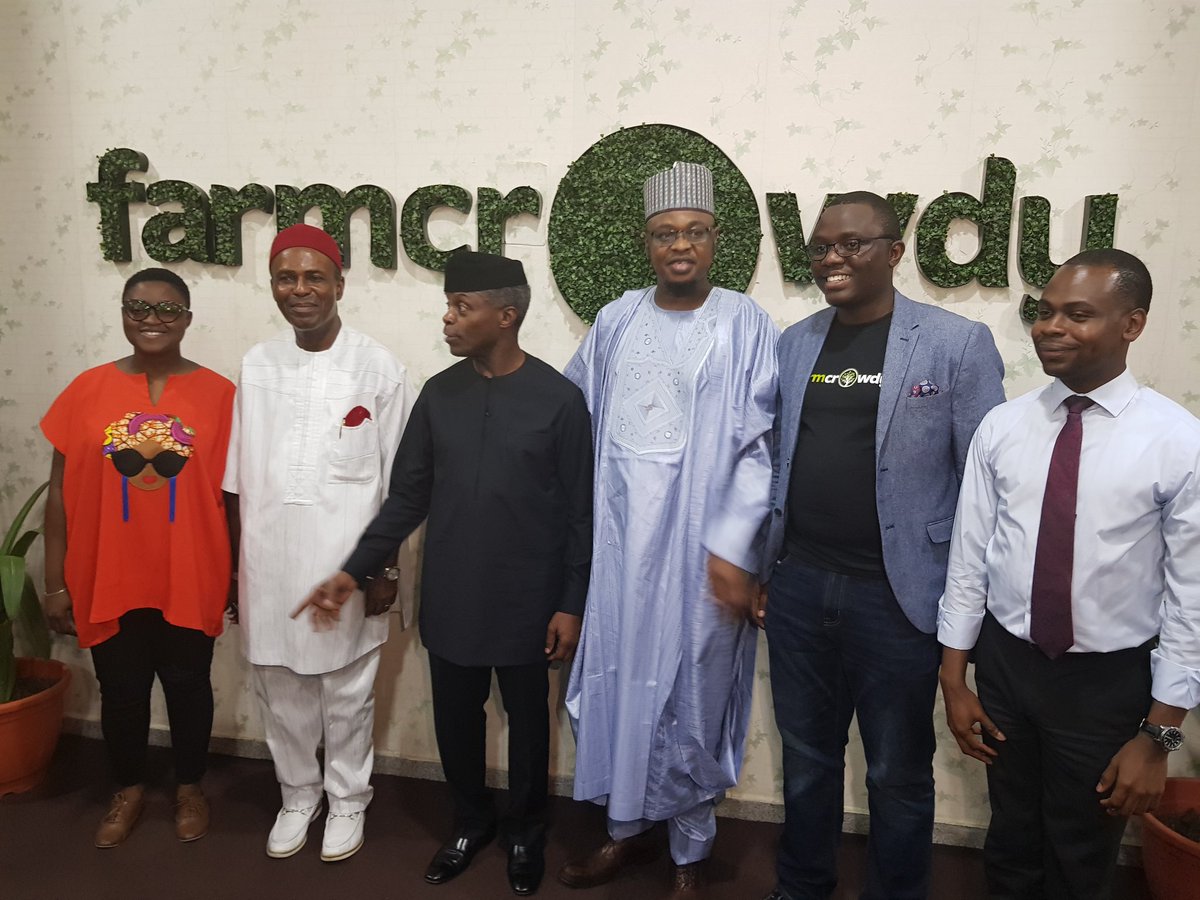
FarmCrowdy solves the problem of under-utilized arable farm lands, help farmers access capital, help people invest in agriculture without owning a farm and everybody gets a share of the profit.
That is amazing indeed. At Africa Fintech Foundry (AFF) operated by Access Bank Plc.
we saw an organisation getting itself ready for the new face of banking and finance.
The final stop was at Co-Creation Hub, Yaba.
This pioneering beehive of innovation is not resting on its oars.
Cc-Hub is giving Nigeria its first home-grown cyber-security platform called Safe-Online.
In the same place we met Re-Learn, a Startup that is working to transform difficult educational concepts into funny cartoons.
We spoke with the Managing Partner of Growth Capital, Tunji Eleso who told us how they are helping fund innovations of Nigerians by Nigerian investors.
Throughout the tour, I as the Director General/CEO of the National Information Technology Development Agency(NITDA)paid very close attention and took notes copiously.
I noted the opportunities and challenges of the sector as well as the impact or gap of our interventions as an Agency of Federal Government.
Since we came on-board, I had often reiterated my resolve to impact the ‘Forgotten Ones’ in the tech ecosystem.
By this I mean the enterprising Startups, the Women, Children and small enterprises.
One of the things we did was to reposition OIIE not as a competitor with the Hubs, rather to be a facilitator and policy compass to ensure the sector got all what it needed to grow.
In this regard, we prepared a draft of the Nigerian ICT Innovation And Entrepreneurship Framework(NIIEF).
The objective of the Framework is to cast a vision for the ICT innovation ecosystem, identify the stakeholders, define critical roles of NITDA in their development and responsibilities of all stakeholders.
A stakeholders’ engagement was held in the 4th quarter of 2017, where representatives of the Hubs, Academia, States and Federal Government all made inputs to the Draft.
The Draft was further scrutinized at the recently organised I4Policy Hackathon held in Lagos and Abuja.
Inputs of stakeholders have been taken and would continue to be until we have a document fit-for-purpose.
The IT Projects Clearance function of NITDA has also become a veritable instrument to empower Startups in Nigeria.
The Committee has been gathering data to identify IT projects that can be reserved for the small-scale tech companies.
Our goal is to engage the relevant Agencies to find a way to reduce the entry barrier for young people to bid and win government contracts in areas they have shown relative competence.
Also, we have insisted on local content where such capacities exist. Another initiative we are experimenting at NITDA is to match Startups and Hubs with successful winners of our project bids.
This has proven successful in some of our programmes and projects as the young innovators bring agility and fresh-thinking to the process while getting experience and finance.
We would ensure this programme continues and grows to become a model for implementing IT and other projects in Nigeria.
Indeed, the creative zeal and passion of the Nigerian youth has caught the attention of the world and President Muhammadu Buhari’s administration is paying close attention and giving the necessary support without disrupting the disruptors.



A “colonel and a major” in a “worldwide highly sophisticated money-laundering syndicate on a breathtaking scale” have been jailed for nine years and 7 and half years respectively.

Ejike Francis Ogbuefi (42) of Clonard Road, Crumlin, Dublin 12, and Steven Silvester (32) of the Paddocks, Morristown, Newbridge, Co Kildare, were both convicted of directing the activities of a criminal organisation following a trial at Dublin Circuit Criminal Court in February.
Ogbuefi was also convicted of 32 counts of money laundering and seven of conspiracy to launder money.
The jury also convicted Silvester of five counts of money laundering, two of attempted money laundering, four of conspiracy to launder money and one of using a false instrument.
Both defendants had no previous convictions here or in another jurisdiction.
The court heard that both men were assessed to be above mule herders and money mules in the operation, with Ogbuefi having a more active role.
During the sentence hearing, Judge Martin Nolan suggested to the investigating garda that the men were a “colonel and a major”, which Det Garda Steven Kelly agreed with.
Imposing sentence on Friday, the judge said both men were involved in the offending and played certain roles.
He noted that the scheme’s ambition was to “get accounts to launder illicit monies” which were “undoubtedly the product of criminal behaviour” and that third parties unknown to the court suffered as a result.
“Both men were reasonably experienced in how the banking system works” and aware of its weaknesses which they tested, sometimes successfully, the judge said.
The judge said he had considered the mitigation and there was a “good chance” the men would not reoffend in future, but that the court could not be certain.
The judge noted that money laundering is a “serious problem” and the court often dealt with cases of people who provided their bank details to be used in these schemes.
“These bank accounts are absolutely necessary for all fraud, because monies have to come to earth somewhere,“ the judge said, noting that the defendants’ main role was to procure bank accounts so that money could be sent to others who profited.
He imposed on Ogbuefi a sentence of nine years and imposed a 7½ year sentence on Silvester, whom he considered to be at a lower level.
Kelly told Seoirse Ó Dúnlaing, prosecuting, that the Garda investigation looked at various bank accounts, transactions and online communications.
Evidence suggested both men were receiving requests, often from phone numbers in Nigeria, to launder money from different types of frauds.
Kelly agreed with Conor Devally, defending Ogbuefi, that his client is from Nigeria and his family is law-abiding.
Garda Kelly agreed with Maurice Coffey, defending Silvester, that his client became involved in this criminality some time after his arrival in Ireland in 2015 and had no record of shopping in high-end stores or trappings of wealth.
It was also accepted that Ogbuefi appeared to have a more active role than Silvester.
Defence counsel told the court their clients accepted the verdicts of the jury and were remorseful.
Testimonials were handed to the court on behalf of both men.
Mr Devally asked the court to view Ogbuefi as being “appointed to a position of local authority in a wider organisation”.
Mr Coffey said Silvester was under pressure and desperate at the time.
He asked the court to consider that his client did not come to Ireland to get involved in this offending, but fell into temptation at a time of vulnerability.

Nnimmo Bassey, environmental activist and food sovereignty advocate has raised concerns over the growing influence of junk food culture and global food politics on Nigeria’s food systems.

Nnimmo Bassey, environmental activist
Bassey warned that the increasing consumption of highly processed foods poses serious risks to public health, cultural identity, and national food security.
He made these remarks on Thursday while speaking at the Sustain-Ability Academy lecture on Food, Power and the Politics of Hunger, organised by the Health of Mother Earth Foundation in collaboration with the University of Port Harcourt.
“Food is not just for sustenance; it is central to our identity, our relationships, and our traditions,” he said.
He explained that traditional diets reflect the diversity of Nigeria’s ethnic groups and have historically fostered unity within communities.
Bassey traced the evolution of food systems in Nigeria, highlighting how colonialism, commerce, and conflict have reshaped local diets.
He referenced the Nigerian Civil War as a turning point when food was weaponized, leading to widespread malnutrition and long-term dietary changes, particularly in the Eastern region.
The activist criticized the rapid rise of fast food consumption, describing it as a product of modern society’s demand for instant gratification.
According to him, fast food outlets use sensory stimulation, bright lighting, loud music, and constant visual entertainment to distract consumers from questioning the nutritional value of what they eat.
“People leave with more than just a full stomach, they carry heavy metals, artificial colourings, and harmful substances in their bodies,” he said.
Bassey also expressed alarm over the increasing presence of genetically modified organisms (GMOs) in Nigeria’s food system.
He argued that such products, often introduced without sufficient scrutiny, could have long-term health and environmental consequences.
He further cautioned against the role of political leaders in normalizing unhealthy consumption patterns.
“When top politicians publicly consume junk food and sugary drinks, they send a dangerous message that such habits are acceptable or even desirable,” he said.
At the heart of his argument is what he described as “food colonialism” a system driven by global power dynamics, where economic pressures, debt, and cultural influence shape local food choices to benefit multinational corporations at the expense of local farmers.
Bassey called for a “decolonization” of food systems across Africa, urging governments and citizens to prioritize indigenous foods, protect seed-sharing traditions, and resist policies that undermine local agricultural practices.
He also challenged prevailing narratives around hunger, questioning whether food insecurity is truly a result of low productivity.
“In countries like Nigeria, nearly half of all food produced goes to waste. The issue is not just production, but distribution, policy, and power,” he explained.
The session concluded with a call for urgent reforms to ensure fairness, resilience, and sustainability in food systems, with a focus on supporting smallholder farmers and addressing the structural causes of hunger.


At least 80% of governments will deploy artificial intelligence (AI) agents to automate routine decision-making, enhancing efficiency and service delivery by 2028.

This is according to market research firm Gartner, which highlights a growing shift toward digital governance, where AI-powered systems will increasingly handle repetitive administrative tasks, such as processing applications, managing public records and responding to citizen queries.
“Government chief information officers are under growing pressure to embed AI into decision-making capabilities rapidly and responsibly,” says Daniel Nieto, senior director analyst at Gartner. “The rise of multimodal AI, alongside conversational and agentic systems, has expanded what public organisations can automate, understand and anticipate.”
The Gartner report comes as South Africa is moving to embed AI into public administration, with early use cases emerging across service delivery, disaster response and internal operations, even as full-scale deployment of autonomous “AI agents” remains some years away.
The country’s National AI Policy Framework, released in 2024, has set the direction for adoption, with a comprehensive national policy expected by 2027.
Implementation is likely to follow from 2027 onwards, positioning the country for a more structured and regulated rollout of advanced AI systems across departments.
While South Africa has yet to deploy AI agents at scale, government and research initiatives indicate that agent-like systems are already taking shape.
Global use cases
Globally, governments are rapidly deploying AI agents to automate public services and internal operations, shifting from simple chatbots to systems that can execute tasks and coordinate workflows.
In the US, federal and city agencies are using AI agents to handle citizen queries, draft documents and manage call centres, while in China, autonomous systems are being integrated into administrative processes and urban management.
European governments are piloting AI-driven tools in policing and public service delivery, and in emerging markets, agentic platforms are being used to improve disaster response, financial inclusion and digital identity systems.
However, Gartner notes that fragmentation is one of the most persistent barriers to AI value in government.
According to a Gartner survey of 138 respondents from government organisations worldwide between July and September 2025, 41% of respondents cited siloed strategies and 31% cited legacy systems as key challenges to adopting and implementing digital solutions.
“Technology modernisation alone has not resolved these issues,” says Nieto.
The market analyst firm says as AI transitions from experimentation to being deeply embedded in decision-making, governance approaches must also evolve. It points out that traditionally, AI governance has centred on managing models, data and algorithms.
However, it states that decision intelligence (DI) shifts this focus towards the governance of decisions themselves; for example, on how they are designed, executed, monitored and audited. This shift in governance is especially critical in government, where public legitimacy relies on transparency and fairness, the firm explains.
Measurable impact
The Gartner survey found that 39% of respondents cited improved service and citizen satisfaction as primary reasons to invest in building citizen trust.
The firm notes that DI offers a structural foundation for operationalising this trust by making decision pathways explicit and auditable.
“By governing decisions, rather than just isolated AI components, governments can better balance automation with human judgement, particularly in high-stakes or rights-impacting contexts,” says Nieto. “Regulated industries and governments cannot rely on opaque ‘black box’ systems for consequential decisions. DI elevates explainability from a technical requirement to a governance imperative.”
Because of the need for transparency in decision-making, Gartner predicts that by 2029, 70% of government agencies will require explainable AI (XAI) and human-in-the-loop (HITL) mechanisms for all automated decisions that impact citizen service delivery.
Gartner explains that XAI and HITL designs are foundational to public-sector DI. These mechanisms ensure decision logic can be inspected, explained and challenged. Because of XAI and HITL, humans also retain authority over exceptions, appeals and high-risk cases, and accountability is preserved even as automation increases, it adds.
While efficiency remains important, Gartner says citizen trust in government’s ability to provide effective services is becoming a key driver of digital transformation. Fifty percent of government respondents cited improved citizen experience as one of their top three priorities.
“As AI and decision intelligence increasingly automate and streamline service delivery, the traditional notion of ‘citizen experience’ evolves,” says Nieto.
“When citizens receive what they need from the government automatically, direct interactions may decrease, making trust in the system’s reliability, fairness and transparency even more critical. Because trust is so imperative in these situations, the predictive capacity to anticipate potential needs could reshape how government digital services are delivered.”

Court Jails ‘Colonel’, ‘Major’ of Global Money-Laundering Ring

Court Bans Kenyan Telcos from Recycling SIM Cards

Providus Bank Fully Meets CBN Capital Requirement, Sets Record Straight

African Tech Start-ups to Receive $46m of Speedinvest Africa Fund

U.S. Charges Three in $2.5 Billion Plot to Smuggle Nvidia AI Chips to China

Kaspersky Discovers New Phishing Campaign Exploiting Google Tasks Notifications to Steal Corporate Credentials

esentry 2025 Report Shows Healthcare, Financial Services and Telecoms as Staging Grounds for Increased Cyberattacks in Africa

AfDB, UNDP Launch $10Bn AI Initiative for Africa

Mutual Benefits Assurance Settles ₦5.9bn Claims in January 2026

MultiChoice Suspends Yearly DStv Price Hike as Canal+ Pushes Growth




 E-Financial3 days ago
Kuda MFB Increases Kuda for Her Business Grants to ₦10 Million

 Telecom3 days ago
Vitel Wireless Lures Subscribers with “Data that Never Expires” Campaign

 News3 days ago
NSIA Sign MoU with UK’s Asset Green Ltd to Develop $496M Integrated Dairy Livestock Production Platform in Nigeria

 News3 days ago
BoI, MTN Foundation Launch N1Bn Fund for Women Entrepreneurs

 General News3 days ago
One SA Bank Equals Nigeria’s Entire Banking Sector – Why Recapitalisation Is Critical for Global Competitiveness

 E-Financial2 days ago
CBN Introduces Stricter BVN Rules to Curb Fraudulent Transactions

 Broadcasting3 days ago
Nigeria tops global rankings for USDT, USDC ownership

 E-Financial2 days ago
Binance is Missing from Ghana’s Crypto Sandbox