

News
“White Widow”, Kenyan Mall Bomber Was in Nigeria-UK Paper


Samantha Lewthwaite, the British widow known as “White Widow” accused of masterminding the despicable terrorist attack on Kenyan shopping mall which killed more than 60 people was in Nigeria and evaded detection, according to a report in the Daily Mirror, UK based newspaper.
Nigeria CommunicationsWeek could not independently confirm the Daily Mirror’s claim as at the time of filing this report.
The Mirror’s report was however typical of reporting Africa in Western media style, complete with maligning words and aspersions on Nigeria’s security system.
According to the Mirror, “In Nigeria, where police forces are notoriously corrupt, there were reports she (Lewthwaite) was almost caught a while ago, but she bribed her way out of trouble”
The full report by Chris Hughes, Defence correspondent of the Daily Mirror read “If White Widow Samantha Lewthwaite is on the run she will be hard to catch”
It went to say that “If Samantha Lewthwaite were to be on the run in Kenya, Nigeria or Somalia, it would be a easier to evade detection than in Europe.
She would be wearing a veil, and sensitivities about searching Muslim women would be observed so she could easily slip through difficult checkpoints.
In Nigeria, where police forces are notoriously corrupt, there were reports she was almost caught a while ago, but she bribed her way out of trouble.
Extremist communities such as al-Shabaab are tight-knit in these countries, making it difficult to recruit agents to penetrate them and trace her.
And Lewthwaite may hold a great deal of power as a special kind of jihadist, having proved her worth in previous attacks.
As a white convert mum and widow of a 7/7 bomber, she would be invaluable propaganda and would command huge loyalty.
Also, the austere nature of her adopted culture means she would rarely go out, so there would be few opportunities to follow her.
Bounties have failed to nail jihadists as money has no value to individuals loyal to the cause”



African technology start-ups will receive a $46 million (€40 million) commitment from EIB Global, the development arm of the European Investment Bank (EIB).

The funds will be deployed through the first Africa-focused investment vehicle from European venture capital (VC) firm Speedinvest.
The Speedinvest Africa Fund, which has a total target size of €200 million, targets companies across innovation hubs in Egypt, Morocco, Nigeria, Kenya, and South Africa.
It also invests in high-potential markets, including Ghana, Côte d’Ivoire, Cameroon, the Democratic Republic of Congo, Tunisia, Tanzania, and Uganda.
The investment strengthens EU–Africa ties, supports digital transformation, and promotes inclusive economic growth, says the EIB.
The strategy is designed to improve digital and financial inclusion while enabling start-ups to scale across borders by strengthening linkages between African and European ecosystems. Technology has the power to turn good ideas into real impact, says Karl Nehammer, vice-president of the EIB.
By backing this vehicle, it is enabling African innovators to scale, access new markets, and build sustainable businesses, says Nehammer.
The fund focuses on technology-enabled and mobile-based services across payments, healthcare, mobility, and education.
This aligns with the EU’s Global Gateway priorities and is expected to deliver social benefits, including job creation for youth and expanded access to digital banking for underserved communities.
At least 30% of the vehicle’s capital will support companies advancing gender equality, including those with women as founders, employees, or consumers.
With EIB Global support, the firm is deepening its long-term commitment to backing founders across Africa while strengthening enduring bridges between Africa and Europe, says Oliver Holle, CEO and managing partner of Speedinvest.
Speedinvest has previously backed African growth-stage companies, including mobility fintech Moove and digital bank FairMoney.
By combining a local presence with a European network of operators, sector expertise, and follow-on capital, the firm aims to help founders scale regionally and internationally, says Holle.
The fund will be managed by partners Deepali Nangia and Rana Abdel Latif, with a new African office planned to support its local operations.

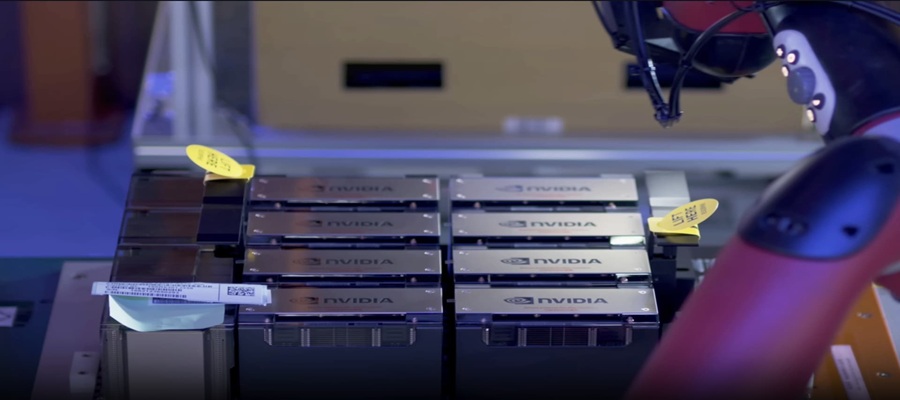
Three individuals connected to a US tech firm have been indicted by the United States Department of Justice (DOJ) for their alleged role in a massive scheme to smuggle billions of dollars worth of restricted Nvidia AI chips to China, bypassing strict export controls.

Nvidia Chip
Prosecutors accuse the suspects of using fake documents, dummy equipment, and even hair dryers to tamper with labels in a bid to dodge compliance checks.
The plot centred on high-performance semiconductors from Nvidia, which are tightly regulated by the US due to fears they could boost China’s military and AI capabilities.
Yih-Shyan “Wally” Liaw, a US citizen and co-founder of California-based Super Micro Computer (a server maker), has been charged alongside two Taiwanese nationals: Ting-Wei “Willy” Sun and Ruei-Tsang “Steven” Chang (who remains at large).
The group reportedly partnered with a Southeast Asian firm to order servers packed with banned chips. They falsified records claiming the gear would stay in Asia, but repackaged and shipped it covertly to China.
Tactics included deploying thousands of fake “dummy” servers for audits, while real restricted tech was diverted. Sun allegedly used household hair dryers to swap serial numbers and labels.
Super Micro Computer confirmed the suspects’ links but stressed it faces no charges and is aiding the probe.
The DOJ estimates the intermediary bought $2.5 billion in equipment, illegally funneling vast amounts of controlled AI tech to China without licences.
This case underscores escalating US-China tech rivalry, where advanced chips are viewed as vital for national security and economic edge.
In a parallel probe, two Chinese nationals were earlier charged for rerouting chips via Malaysia, Singapore, Hong Kong, and mainland China. US authorities warn of tough penalties for evasion.
This development signals intensified global scrutiny on tech supply chains amid superpower tensions.
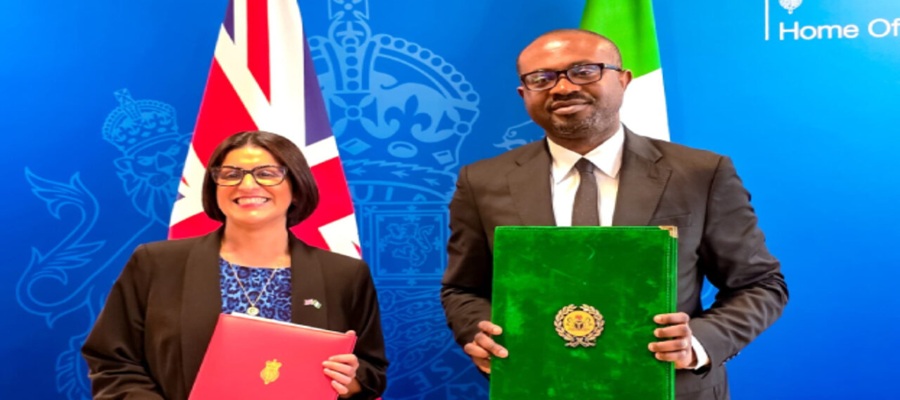
United Kingdom and Nigeria have agreed on a three-year strategic plan to tackle organised immigration crime and strengthen border security cooperation.

The initiative was announced in a joint statement by the UK Home Office following the state visit of Bola Ahmed Tinubu to the UK.
The agreement was signed by UK Home Secretary Shabana Mahmood and Nigeria’s Minister of Interior, Olubunmi Tunji-Ojo.
According to the statement, the framework focuses on combating visa fraud, improving border management systems, and enhancing legal cooperation between both countries.
Under the plan, Nigeria is expected to review its legal framework to impose stricter penalties on immigration-related offences, particularly those involving forged or fraudulent travel documents.
Both countries also pledged to strengthen laws and enforcement mechanisms governing visa processing and travel documentation.
A key component of the agreement is the expansion of the UK–Nigeria Organised Immigration Crime Unit, with new memoranda of understanding centred on intelligence sharing and joint operations.
The UK government will further support Nigerian border agencies through training programmes and capacity-building initiatives.
The partnership also places emphasis on the protection of vulnerable migrants, particularly women and children, while enhancing research, document verification systems, and migration monitoring processes through the UK–Nigeria Migration, Justice and Home Affairs Dialogue.
Both governments described the agreement as a reflection of their shared commitment to tackling transnational crime and improving migration management through closer collaboration.
The deal forms part of broader engagements during Tinubu’s visit, which focused on strengthening bilateral relations across security, migration, and economic development.

Court Jails ‘Colonel’, ‘Major’ of Global Money-Laundering Ring

Court Bans Kenyan Telcos from Recycling SIM Cards

Providus Bank Fully Meets CBN Capital Requirement, Sets Record Straight

African Tech Start-ups to Receive $46m of Speedinvest Africa Fund

U.S. Charges Three in $2.5 Billion Plot to Smuggle Nvidia AI Chips to China

Kaspersky Discovers New Phishing Campaign Exploiting Google Tasks Notifications to Steal Corporate Credentials

esentry 2025 Report Shows Healthcare, Financial Services and Telecoms as Staging Grounds for Increased Cyberattacks in Africa

AfDB, UNDP Launch $10Bn AI Initiative for Africa

Mutual Benefits Assurance Settles ₦5.9bn Claims in January 2026

MultiChoice Suspends Yearly DStv Price Hike as Canal+ Pushes Growth




 E-Financial2 days ago
Kuda MFB Increases Kuda for Her Business Grants to ₦10 Million

 Telecom2 days ago
Vitel Wireless Lures Subscribers with “Data that Never Expires” Campaign

 News2 days ago
NSIA Sign MoU with UK’s Asset Green Ltd to Develop $496M Integrated Dairy Livestock Production Platform in Nigeria

 News2 days ago
BoI, MTN Foundation Launch N1Bn Fund for Women Entrepreneurs

 General News2 days ago
One SA Bank Equals Nigeria’s Entire Banking Sector – Why Recapitalisation Is Critical for Global Competitiveness

 Broadcasting2 days ago
Nigeria tops global rankings for USDT, USDC ownership

 General News2 days ago
Luno Launches First Crypto Prediction Market in Nigeria

 E-Financial1 day ago
CBN Introduces Stricter BVN Rules to Curb Fraudulent Transactions