

Broadcasting
Why Nigerians, Others Pay More for Pay-TV

By Justus E. Fashedemi
Who do you think pays the eye-watering salaries earned by players in England’s Premier League, the Spanish LaLiga or Italian Serie A? It is not the clubs, but fans in those countries and around the world.
Wondering how? Here is it. The Premier League, the world’s favourite football league, for example, is broadcast in 212 countries to an estimated 4.7 billion people.

The 2016/17 season was the first in the current three-year broadcasting deal, which gives the Premier League £8.3 billion in television rights, with £5.41 billion of that coming from two UK broadcasters, Sky and BT.
It means clubs have larger sums to spend on players, who are earning bigger wages, and are less dependent match day income.

To cover the cost of the sum paid for the deal with the Premier League, Sky and BT jacked up prices by about 10% in 2016, meaning that the cost to the subscriber went up.
The two broadcasters were simply responding to the 71% jump over what was paid for the previous television deal. So, whatever commercial progress the clubs are making is at a cost, which is eventually passed on to fans around the world by television companies broadcasting matches of the Premier League everywhere in the world.
Being a red-hot property, a jewel in the Pay TV crown, rights to air Premier League matches are unlikely to attract lower sums when next they are up for renewal.

In fact, they will attract higher sums. Live sport, in general, is hot, hot property. The cut-throat competition for the acquisition of rights to broadcast or redistribute live sport content is unsurprisingly accompanied by stratospheric hikes prices demanded by content owners.
It is the same for content in other genres- movies, general entertainment, documentaries, kiddies’ content et al.
Being part of the global Pay TV landscape, operators in Nigeria are similarly victims of tough negotiations and astronomical content prices as operators in Europe, the US and Asia.
A big portion of the monthly subscription the consumer pays is comprises costs that Pay TV companies, which are essentially distributors or vendors, are required to pay to content creators or those that package Pay TV channels.
It means that for every household receiving that package, whether or not anyone in the household watches the channel, Pay TV providers pay a fee.
Content rebroadcast agreements usually contain clear and stringent rules on how content owners want their television shows and channels should be sold to viewers.
Content owners determine, for example, what packages can contain their channels. With content costs almost always denominated in the US dollar, Euro and the British pound, it is not possible for Pay TV subscription in Nigeria to remain the same for long, especially with the volatility of the exchange rate of the Naira to the aforementioned international currencies.

Even then, Pay TV prices in Nigeria are not anywhere near the steepest in the world as many often suggest. A look at the recent price adjustments made by MultiChoice on its DStv platform provides a confirmation. Under the company’s new price regime, the DStv Premium package, which currently costs N14, 700 will from 1 August rise to N15, 800.
Price of the DStv Compact Plus package has also been slightly bumped up from to N10, 650 from N9, 900. The Compact package, which currently costs N6, 500, will rise to N6, 800.
Prices of the Family and Access packages will equally go up to N4, 000 and N2, 000 respectively from the N3, 800 and N1, 900 currently being paid. Compared to the company’s new rates in Ghana, MultiChoice subscribers in Nigeria can have few complaints.
The West African country’s Premium subscribers will henceforth pay GH 365 (N27, 360.75), while those on Compact plus will pay GH 245 (N18, 365.44). Compact and Family subscribers in Ghana will pay GH 149 (N11, 169.18) and GH 85 (N6, 961.60) respectively.
South African subscribers of the company, erroneously viewed as sacred cows, will pay R809 (N21, 728.47) for Premium, R509 (N13, 670) for Compact Plus, R385 (N10, 340.49) for Compact, R249 (N6, 687.75) for Family and R99 (N2, 656.98) for Access respectively.
Similarly in Europe and the Americas, Pay TV subscribers pay more than Nigerians. In the US, Pay TV operator, Direct TV’s two biggest packages cost $110 (N38, 710) and $60 (N21, 660) respectively. For its third biggest package, Xtra, Direct TV charges $55 (N19, 855).
Its other packages cost $40 (N14, 440), $45 (N16, 245) and $35 (N12, 635). United Kingdom’s premier operator, Sky TV, charges £79.95 (N38, 167.33) for its fullest package and £47.50 (N22, 572.97) for that next to it. The third package attracts £40 (N19, 008.82), while the three below it cost £30 (N14, 256.61), £25 (N11, 731.54) and £20 (N9, 504.41) respectively.
In Mexico, where the provider offers four packages, the costs are higher than what is paid by subscribers in Nigeria. In the Central American country, Sky TV’s topmost package costs MXN 1039 (N19, 798.52). The three others cost MXN 829 (N15, 796. 52), MXN 649 (N12, 366.93) and MXN 569 (N10, 842.50).
Contrary to the widespread belief that Pay TV prices around the world are as stable as rock in a windstorm, the fact is they rise yearly.
Analysts reckon that programming costs have risen by eight to 10 percent in each of the past four years-driven by competition for content and other economic conditions, reducing Pay TV operators’ margins and compelling them to keep hike prices to remain afloat.
Competition has been made fiercer by the rise of streaming services, which are also in the game for compelling programming, offering another outlet to content owners. When this is added to global economic conditions, prices are unlikely to stay the same.
A 2013 research by Robert Gessner of America’s Masillon Cable TV Inc., warned subscribers to expect large increases in prices.
“Wholesale costs for the lowest level of TV service will increase by 11.5% in 2014; expected to increase 400% by 2020. Wholesale costs for Basic TV will increase by 11.7% in 2014 and double by 2020. Anticipated 2020 out-of-pocket Basic Cable program cost will exceed $80/month, more than $100 retail with no equipment, premium services, Internet or phone service,” wrote Gessner.
US website, consumerreports.org, also reported that most US Pay TV operators hiked their prices in 2018, with some introducing hidden fees, with operators blaming the development on the rise in costs paid for programming.
Industry watchers also posit that addition of new features and functions to services, leading to improved subscriber experience, also contributes to the rise in Pay TV prices.
Except the astronomical programming costs miraculously slide-appreciably, too-there is no chance of Pay TV prices remaining the same for a long time.
––Fashedemi, a public affairs analyst, writes from Lagos


Mrs. Clementine Wamba, head, Digital Switch Over (DSO) at the National Broadcasting Commission (NBC), has stressed the need for broadcasting stations and practitioners nationwide to work towards meeting the 2028 global deadline for the switch over.

She made the call in her presentation titled, “DSO Big Picture: Free TV Audience Measurement and the Evolving Media Landscape”, at the 2026 NBC South West Summit held in Ibadan.
Wamba harped on the need for practitioners to adopt DSO in the transmission of news and other programmes in order to meet future challenges, stating that any country that fail to align with the DSO by 2028 will be shut out of practice.
This development, according to her, may result in job losses and other consequences that could hinder the growth of the industry in Nigeria, noting that Free TV is tailored towards the DSO, with provision for many channels in contrast to the age-long analogue system.
According to her, “The Digital Switch Over is a technological improvement on the age-long analogue style of broadcasting in the country. With the adoption of the DSO, practitioners will be in tune with global practice of broadcast journalism.
“Also, its benefits include efficient use of spectrum, changing of industry landscape, more access to national development programmes and better viewing experience.”

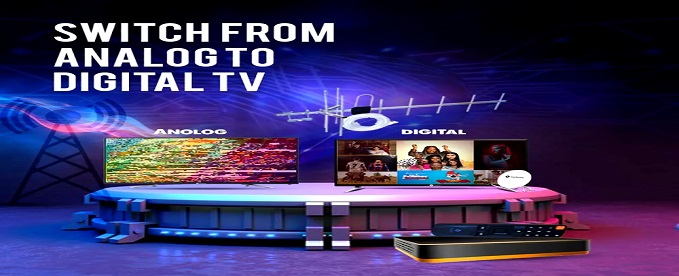
National Broadcasting Commission (NBC) has said that Nigerians will no longer pay annual Digital Access Fees under the renewed Digital Switch Over (DSO) project.

Charles Ebuebu, director-general, NBC, disclosed this in an exclusive interview with the News Agency of Nigeria (NAN) on Wednesday in Abuja,
Ebuebu said viewers only need to purchase an approved decoder and satellite dish which cost below N20,000 to enjoy free television permanently.
“Previously, users paid an annual digital access fee of about N1,500, described as an administrative charge.
“The new system removes that annual fee. It provides free access to free-to-air television channels without any payment.
“Premium channels will be introduced later. Viewers who want those additional channels will be able to access them through paid services.
“Nigerian content on free-to-air channels remains free to watch. Unlike Pay TV, this platform does not require monthly subscriptions for its basic service,” he said
Ebuebu said approved decoders for the FreeTV will cost less than N20,000 and authorised sales outlets will soon be announced.
He urged Nigerians to wait for official information on approved dealers for the DSO decoders, warning that unauthorised sellers are exploiting growing public demand.
He reiterated that people only need a free-to-air decoder, along with a satellite dish instead of the old antenna system to receive the DSO signal.
“Once the equipment is installed, viewers can access all available channels across the country without paying any subscription fees,” he stressed
The DG dismissed claims by some retailers that there are different categories of decoders sold at varying prices, stressing that such sellers are not authorised by the commission.
According to him, the NBC will soon publish the list of approved dealers, official prices, and locations where genuine decoder boxes and accessories can be purchased.
The NBC boss said the DSO project is designed not only to improve television broadcasting but also to stimulate economic growth by creating jobs, attracting investment, and opening up opportunities for businesses that support the broadcasting industry.
Ebuebu noted that content producers and broadcasters stand to benefit significantly from the nationwide reach of the DSO platform.
Unlike the previous system, where many stations had limited regional audiences, he said the new platform will make their channels available to viewers across Nigeria.
He added that the introduction of audience measurement technology will provide scientific and reliable data on television viewership.
Ebuebu added that audience measurement technology will give advertisers greater confidence in placing adverts and enable broadcasters to demonstrate the true size and reach of their audiences nationwide.
Uchenna Mbunabo, Nigerian filmmaker, has raised concerns over the alleged unauthorised broadcast of Nollywood films by some Ghanaian television stations, calling on Ghana’s National Film Authority (NFA) to strengthen the enforcement of copyright laws.

Uchenna Mbunabo, Nigerian filmmaker
Mbunabo made the remarks during a conversation with James Gardiner, deputy CEO of the National Film Authority (NFA) of Ghana.
He questioned whether it was permissible for television stations in Ghana to download Nigerian movies from YouTube and air them without obtaining permission from the producers.
“I noticed that Ghanaian TV stations, the way they are stealing our films and showing them for free with impunity. Is it legalised in your country for TV stations to go on YouTube, download people’s sweat and show it for free?”
According to Mbunabo, some Ghanaian television stations have been downloading newly released Nollywood films from YouTube and broadcasting them without authorisation, depriving producers of revenue generated through the platform.
He also stated that he had not witnessed Nigerian television stations engaging in similar practices and questioned what measures Ghana was taking to protect filmmakers’ intellectual property.
Responding to the concerns, Gardiner acknowledged that the issue exists and said the National Film Authority had begun engaging relevant stakeholders to address it.
He disclosed that the NFA has held discussions with the Ministry of Communications, the National Communications Authority (NCA) and the National Media Commission (NMC) on improving copyright enforcement.
Gardiner explained that while Ghana has copyright laws, enforcement remains challenging because many television stations now operate digitally and may not have physical offices within the country.
“There are copyright laws, but they are not effective because a lot of the TV stations don’t have offices. Most of them are now digital, so they operate from anywhere. They can even have a Ghanaian TV station but be operating from Austria simply because it is digital.”
He added that authorities are considering a new licensing framework that would require broadcasters to undergo a fresh licensing process to improve monitoring and enforcement.
According to Gardiner, television stations found guilty of illegally broadcasting copyrighted content would be required to compensate affected producers through fines.
He added that repeat offenders could face suspension of their broadcasting licences, while a third violation could result in the revocation of their licences.
Although he did not provide a specific timeline, Gardiner said the reforms were already underway and expressed hope that significant progress would be seen next year.
Mbunabo welcomed the proposed measures but urged the National Film Authority to expedite the process, stating that unauthorised broadcasts continue to affect filmmakers’ ability to recover production costs through legitimate distribution channels such as YouTube.
He also stressed that his comments were not directed at Ghana’s film industry, noting that he has worked with several Ghanaian actors over the years and supports collaborations between Nollywood and Ghallywood.

Adebutu, PDP Chieftain Accuses Nigerian Governors of Embezzling LG Allocations

ICPC Secures Final Forfeiture of N941m Linked to IPPIS Fraud

NDIC Urges Youths to Shun Ponzi Schemes, Embrace Savings

NRS Issues July 31 Deadline for e-Invoicing Compliance

SERAP to Sue NASS over Bill Empowering NDPC to Regulate Social Media

NRC, Ponzi Scheme Collapses Resulting Loss of Billions of Naira

NASENI Moves to Digitize CCB’s 5m Assets Declaration and Operations

Lebara Nigeria Launches Lebara Play, Africa’s First Telecom-Owned Micro-Drama Platform

CANAL+ Partners Samsung to Pre-Load DStv Stream on New Samsung TVs In Nigeria, Other African Countries

Tokenization, Blockchain Technology will Transform Financial Institutions – IMF




 News2 days ago
EFCC Busts NIS Visa Overstay Racket, Uncovers N700m in an Account

 News2 days ago
NCC, NDLEA Partner to Fight Piracy and Drug Trafficking

 General News2 days ago
Dangote Refinery’s Private Placement Reportedly Hits $2.5Bn

 Telecom2 days ago
NCC Leads Tecno, Hyperspace, Digital Realty To NITRA Forum On Scientific Innovation

 E-Financial2 days ago
CBN to Monitor Every Dollar with FXBT, Forex Tracker

 E-Financial2 days ago
FG Moves to Crack Down on Crypto Fraud with Virtual Assets Executive Order

 Telecom2 days ago
PayPal Rejects $53bn Stripe-Advent Takeover Bid, Says Offer Undervalues Company

 Broadcasting2 days ago
NBC Tasks Broadcasting Stations over 2028 DSO Global Deadline