

News
Without Alams, Oil will not Flow- FG

The Presidency, desperate, to justify the pardon it granted, Mr. Diepriye Alamieseigha, the convicted former Governor of Bayelsa State, said, yesterday that Alamieseigha is crucial to Nigeria’s economy and credited him for the increase in the barrels of oil Nigeria now sells on the international market.
Doyin Okupe, senior special assistant to President Goodluck Jonathan on Public Affairs at a press briefing in Abuja praised Alamieseigha whom he described as “repentant”
A visibly angry reporter at the briefing said “I thought he (Okupe) was going to say the man has refunded millions of dollars he stole when he was in office.”
Not deterred, Okupe, said that “In truth, Alamieseigha since he left prison has been working strenuously and silently to assist the President stabilize the amnesty in the Niger Delta region.
“Alamieseigha is a foremost leader of the Ijaw Nation, and his political and stabilizing influence in that region has impacted positively on the overall economy of the nation, bringing crude oil exports from the abysmally low level of 700,000bpd to over 2.4million bpd.”
According to him, Alamieseigha, who is still wanted by British authorities, can be credited with ensuring that the blood running through Nigeria’s economic artery is not cut off.
The full text of the briefing read below
TEXT OF A PRESS CONFERENCE ADDRESSED BY THE SENIOR SPECIAL ASSISTANT TO
THE PRESIDENT ON PUBLIC AFFAIRS, DR DOYIN OKUPE ON THURSDAY 14TH MARCH, 2013.
GRANTING OF STATE PARDON: NEED FOR AN OBJECTIVE, HUMANE CONSIDERATION.
Gentlemen of the Press.
I have called this Press Conference to shed more light on the Pardon granted to some Nigerians recently by the National Council of State, especially as it concerns the former Governor of Bayelsa State, Chief Diepriye Alamiesegha.
I speak to you today, not just as the Senior Special Assistant to the President on Public Affairs, but also as a Patriot, a Statesman and a Stakeholder in the Nigerian Polity.
I wish to appeal through this Medium to fellow Nigerians and distinguished members of the Civil Societies for open mindedness on this issue.
This is our country and our dearly beloved Nation which we all owe a duty to nurture, protect, preserve and ensure that after a hundred years of its existence, we hand it over to the next generation as one prosperous indivisible entity where justice, equity and peace reign.
Many will not question the legality or lawfulness of the pardon granted by the National Council of Sate. Section 175 of the 1999 Constitution clearly empowers the President in consultation with the Council of State so to do.
The major concern of many patriotic and reasonable Nigerians is whether the decision is morally right or if it will not send wrong signals on Governments anti-corruption crusade.
These two considerations are my major objectives in addressing this conference and I once again wish to plead earnestly that our people should hear me out and allow us to reason together.
On the issue of morality, I want to state categorically here, that State or Presidential Pardon are not intended for nobility or saints. In general, a state pardon is for those who have committed crimes and breached the laws of the land and may or may not have been tried or convicted regardless of their social status.
A pardon is the forgiveness of a crime and the cancellation of the relevant penalty; it is usually granted by the head of state (such as a monarch or president) or by acts of parliament or a religious authority.
Today, pardons are granted in many countries when individuals have demonstrated that they have fulfilled their debt to society, or are otherwise considered to be deserving.
Also, a Prerogative of Mercy by definition is not a justifiable affair. It has to do with discretion and the necessity to redress bitterness and thereby offer healing and forgiveness especially in the presence of evidence of remorse and potential to add value to the country.
This is what made President George H.W Bush in 1992 to say “when earlier wars have ended, Presidents have always used their powers to pardon to put bitterness behind us, and look to the future.
This healing tradition reaches at least from President James Madison’s pardon of La Titte’s pirates after the war of 1812, to Andrew Johnson’s pardon of soldiers who fought for the confederacy, to Harry Truman’s and Jimmy Carter’s pardons of those who violated the selective service laws in World War II and Vietnam”.
The above tradition must have informed President Bill Clinton when he pardoned Fife Syminghton III, former Republican Governor of Arizona who was convicted of bank fraud.
President Bill Clinton similarly ignited a firestorm of controversy when he pardoned Marc Rich, who was charged, in 1983, with cheating the United States Government of nearly $ 50 Million US Dollars and doing business with Iran during the hostage crisis. Rich was never tried as he fled to Switzerland to avoid prosecution
President George H. W. Bush perplexed a majority of American Citizens when he pardoned six people from the administration of his immediate Republican predecessor Ronald Reagan in whose administration he was also the Vice – President.
The six Americans were under investigation for their involvement in the Iran – Contra Affair, which was a National Scandal, involving selling of arms to Iran and using the proceeds to fund Nicaragua counter – revolutionaries.
These are the bastions of leadership of the International Community which our enlightened citizenry are always too eager to use as bench-mark of good governance and democratic propriety. In all these, we must always remember that all Nations of the world have their own characteristics and will always do things that are socio-politically expedient at every point in time.
American history is replete with similar instances of pardons for reasons that may not appear altogether altruistic but which suited the socio-political situations of the country.
Bill Clinton issued a total of 456 pardons, of which one was his younger brother serving a one year jail term in connection with possession of cocaine. George Bush Snr,176, Jimmy Carter 566, Lydon Johnson 1,157 and F D Roosevelt 3,687!
Gentlemen of the Press will recall that former Governor DSP Alamieyeseigha was removed from office in a manner that was suggested by many as not being entirely above board. Nevertheless, the former Bayelsa Governor whose pardon appears to be drawing all the flaks has been tried, found guilty and adequately punished.
He lost his position, forfeited the property illegally acquired and has demonstrated enough soberness after he served his sentence.
It is out of place to suggest that the pardon is tantamount to abandoning the fight against corruption in Nigeria.
This is too far from the truth. It was Lord Denning that perhaps put it more succinctly when he said “the purpose of punishment is not to destroy the offender but rather to reform him and deter others”. These two features, I must emphasise, have been met in this instance.
People have stated that President Jonathan said publicly that Alamieyeisegha was his political benefactor. This is a display of extreme humility and honesty on the part of Mr. President; in this day that virtually all political benefactors, usually turn into enemy number one and are therefore hounded to the ground by the incumbents.
It was God and Providence that lifted President Jonathan over and above his former political boss. But in truth Alamieyeisegha since he left prison has been working strenuously and silently to assist the President stabilize the amnesty in the Niger Delta Region. Alamieyeiseghais a foremost leader of the Ijaw Nation, and his political and stabilizing influence in that region have impacted positively on the overall economy of the nation, bringing crude oil exports from the abysmally low level of 700,00 bpd, to over 2.4 million bpd!
Therefore, it is obvious that, Alamieyeisegha has been a major player since his release from prison in ensuring that the blood that runs through the Nigerian economic artery is not cut off.
In Nigerian history, great and eminent men who have been crucified for one crime or the other have been pardoned by past Presidents and such men have lived thereafter to further enhance our political and socio-economic development.
Amongst those are our respected departed sage, Chief Obafemi Awolowo and the revered Ikemba Nnewi, Chief Odumegwu Ojukwu who continued after their pardon to contribute immensely to Nigeria’s social, political and economic growth till death.
It has often been said that there is always a season for everything under the sun, a season to punish and a season to forgive. Distinguished gentlemen of the press, fellow Nigerians, this is the season to forgive and to heal. May God forgive us all and bless our country Nigeria.
Before I end this address, let me use this opportunity to announce that in view of the obvious gaps in communication as shown in apparent misunderstanding of issues in the court of public opinion, this department will henceforth hold a bi monthly interactive forum with registered members of the Civil Society Organisations and other critical
stakeholders in the society.This programme will be coordinated by the Special Asistant to the President on Public Relations ,DrOlusanya Awosan, and Alhaji Nasir Zaharadeen ,the Special Assistant to the President on Public Affairs who are both professionally and academically sound practitioners with many decades of experience in the Media and Public Relations industry.
It is my pleasure to invite your partnership in the success of this initiative which I am sure will facilitate an efficient two way information traffic between the Public and the Presidency.
I thank you.
Dr Doyin Okupe
Senior Special Assistant to the President on Public Affairs


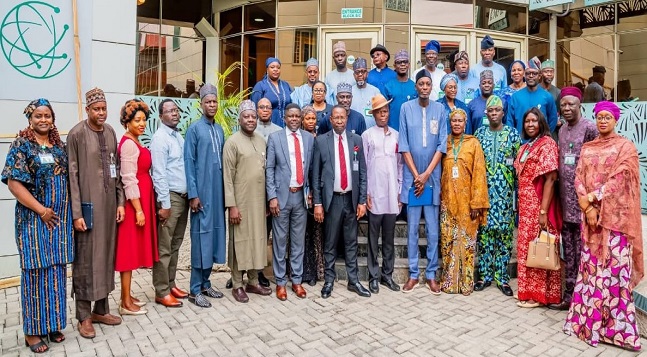
The National Information Technology Development Agency (NITDA) has reinforced its commitment to advancing Nigeria’s digital transformation agenda through strengthened collaboration with key strategic institutions, as it hosted the Director General of the National Institute for Policy and Strategic Studies (NIPSS), Professor Ayo Omotayo, alongside participants of the Senior Executive Course (SEC) 48, 2026.

The visit, which builds on an earlier strategic study tour, provided a platform for in-depth engagement on the role of digital innovation in driving sustainable economic growth, with particular focus on the Orange Economy.
Representing the Director General of NITDA, Kashifu Inuwa CCIE, the Director of Stakeholder Management and Partnerships, Dr Aristotle Onumo, highlighted the Agency’s commitment to fostering a vibrant digital ecosystem through inclusive policies, strategic partnerships, and capacity development initiatives.
“NITDA is committed to creating an enabling environment where innovation can thrive by bringing together government, private sector, academia, and creatives to drive Nigeria’s digital economy,” he stated.
Inuwa underscored the growing importance of the Orange Economy, describing it as a critical driver of innovation and economic value through intellectual property. He identified sectors such as digital content creation, film, animation, and digital art as key contributors to national development.
“The Orange Economy represents a powerful opportunity to transform our rich cultural heritage and creativity into sustainable economic growth,” he noted.
He further highlighted Nigeria’s unique advantage, particularly its youthful and creative population, while calling for stronger collaboration among stakeholders to fully harness the sector’s potential.
“With our youthful population and rich cultural assets, Nigeria is well-positioned to become a global leader in the Orange Economy if we deepen collaboration and investment across the ecosystem,” he added.
During the engagement, NITDA also presented its strategic initiatives aimed at supporting the digital and creative sectors, including digital infrastructure development, promotion of digital literacy, and implementation of policies that enable startups and innovators to scale.
Addressing challenges facing the sector, Inuwa pointed to issues such as limited access to funding, infrastructure gaps, weak intellectual property protection, and ecosystem fragmentation, while emphasising the need for coordinated action.
“Addressing challenges such as funding gaps, infrastructure deficits, and intellectual property protection is critical to unlocking the full potential of Nigeria’s creative economy,” he said.
The Agency reiterated its target of achieving 70 per cent digital literacy by 2027, noting that ongoing programmes are equipping millions of Nigerians with essential digital skills, including those in underserved and informal sectors.
In his remark, Professor Omotayo described the visit as an important opportunity to deepen understanding of how digital technologies are reshaping economic sectors, particularly the creative industry. He noted that the insights gathered would contribute significantly to policy recommendations aimed at strengthening Nigeria’s economic framework.
Participants of the SEC 48 programme engaged actively during the session, raising questions on capacity development, access to tools, and frameworks for protecting digital content. NITDA highlighted its ongoing collaborations with industry stakeholders to provide training, innovation hubs, and access to digital tools for young Nigerians.
The engagement concluded with a renewed commitment from both NITDA and NIPSS to strengthen collaboration in research, policy development, and capacity building, aimed at positioning Nigeria as a globally competitive force in the digital and creative economy.

Nigeria Revenue Service (NRS) has assumed responsibility for collecting mineral royalties from mining operators nationwide, following new tax laws effective January 1, 2026.

NRS
The shift emerged from a Thursday meeting between Solid Minerals Development Minister Dele Alake and NRS Chairman Dr. Zacch Adedeji. Their joint statement, endorsed by both, confirms NRS now administers all federally collectible revenues, including royalties.
Enacted by President Bola Tinubu on June 26, 2025, the Nigeria Tax Laws 2025 empower this transition. The Ministry of Solid Minerals Development remains a key partner, supplying pricing data, geological insights, and sector coordination.
NRS Special Adviser Dare Adekanmbi’s statement outlines collaborative steps: a nationwide sensitization program for operators on filing and payments; development of a digital royalty system; and regular joint technical sessions to address issues.
Both agencies pledge orderly, transparent implementation to boost the mining sector. Operators must comply with obligations and join upcoming programs.
The move aims to streamline revenue collection while fostering mining growth.
Microsoft has rolled out a new set of features for its Microsoft 365 Copilot platform, including tools for complex, multi-step work and deeper research tasks, as competition in workplace artificial intelligence (AI) intensifies.

The update introduces Copilot Cowork, a capability aimed at handling long-running tasks across Microsoft 365 applications.
The feature is being made available through the company’s Frontier programme, which typically gives early access to experimental tools.
Microsoft is also integrating technology linked to Claude – an AI model developed by Anthropic –into Copilot, signalling a broader shift toward using multiple AI systems within a single product rather than relying on a single model.
Jared Spataro, chief marketing officer for AI at Work at Microsoft, says the company is positioning Copilot as a system embedded directly into workplace software, rather than a standalone tool.
“Microsoft 365 Copilot is your AI for work,” he says, adding that it draws on multiple AI models and is integrated into existing workflows.
Alongside this, Microsoft has upgraded its Researcher feature, which is designed to analyse information from multiple sources and generate structured reports.
A new “Critique” function separates the drafting and review process between different AI models – one generates an initial response, while another evaluates and refines it.
The company says this approach improves output quality, with Researcher showing gains on its internal benchmark for accuracy, completeness and objectivity.
Another addition, called Model Council, allows users to compare outputs from different AI models side-by-side, highlighting differences in responses and reasoning.
The updates form part of what Microsoft calls “Wave 3” of Copilot, as it pushes to embed generative AI deeper into enterprise software. The move reflects a wider industry trend towards combining models from multiple providers, including OpenAI and Anthropic, to improve performance and reliability.

FG, Others Say Nigeria Wastes 38m Tonnes of Food Annually

Ecobank Assures of Seamless Easter Banking Services

Anchor Gets Nigerian, Canadian Licences as Transactions Crosses $2.5Bn

CycleFlow, IFC Launch Supply Chain Finance Platform in Nigeria

NITDA Strengthens Collaboration with NIPSS to Drive Digital Innovation, Orange Economy Growth

Spotify’s Loud & Clear Report Reveals Over ₦60Bn Revenue for Nigerian Artists in 2025

Madonna University Taps Tech Guru Adote for Strategic Board Role

China Threatens to Shut Nigeria’s Satellite Over $11.44m Unpaid Debt

FCCPC Bans Lagos ‘No Refund’ Policy, Vows Fines and Shutdowns for Traders

Healthcare Under Attack: Why Cybersecurity is Now Critical Care




 E-Financial2 days ago
CBN Says 33 Banks Raise Fresh N4.65 Trillion in Recapitalisation Exercise

 Telecom2 days ago
NITDA Urges Joint Action to Drive Nigeria’s Digital Innovation

 Telecom2 days ago
NCC Insists Telcos Must Compensate Subscribers for Poor Quality of Service

 E-Business2 days ago
Cybersecurity Firm Uncovers CrystalX RAT which Steals Data, Mocks its Victims

 E-Business2 days ago
Oracle Sacks 12,000 in India, Begins Shift to AI

 Telecom2 days ago
Oracle Corporation Axes 30,000 Workers in Brutal AI Shake-Up

 E-Financial2 days ago
Nigeria, Others Lose $88bn Yearly to Illicit Flows —Edun

 General News2 days ago
DBI Unveils Nigeria Digital Economy Outlook 2026: Q1 Report Highlights Strategic Trends, Risks