

General News
World Logistics Passport Welcomes Nigeria as a Strategic Hub in West Africa


Nigeria has joined the World Logistics Passport (WLP) as a Hub, with the Council for the Regulation of Freight Forwarding in Nigeria (CRFFN) as the coordinating partner.

Nigeria is the largest economy in Africa, with a vibrant and diverse industrial base and rapidly expanding regional and global trade interests. In 2019, product exports totaled $63.8bn1 with trade accounting for 25% of GDP2.
With access to the WLP network, Nigerian traders will have the opportunity to enhance the connectivity and efficiency of their cargo operations. This in turn will open up trade routes – allowing for faster, cheaper access to new markets particularly in Asia, Latin America and across Africa.
H.E Sultan Ahmed bin Sulayem, Group Chairman and CEO of DP World, said: “We view West Africa as a long-term growth market, with Nigeria spearheading growth in the region.
“The WLP helps deliver economic growth and create jobs by boosting trade, principally by making a country’s products more competitive through more efficient supply chains. For Nigerian traders, this means discovering new opportunities through our network across the African continent and beyond.”
Nigeria has joined the WLP alongside other African nations including South Africa, Senegal, Morocco, Kenya, Ethiopia, Botswana, Zimbabwe, Mozambique, Burkina Faso and Guinea.
H.E. Rotimi Amaechi, Minister of Transportation in Nigeria said: “Joining the WLP is about bolstering global trade opportunities for Nigerian businesses and accelerating Nigeria’s already fast paced growth.
“The WLP will help deliver this by providing benefits to businesses such as priority handling and faster clearance – helping to reduce supply chain costs and increase trade volumes.”
The continued expansion of the WLP across Africa will help to deliver on the vision of the African Continental Free Trade Agreement by reducing end-to-end costs across the logistics chain in Africa, boosting intra-regional trade, and opening up competitive access to new international markets for African companies.
CRFFN, the coordinating partner, is the national regulator of the freight forwarding industry in Nigeria, promoting the growth and global competitiveness of the freight forwarding sector for the benefit of the Nigerian economy and the commercial success of its member companies.



Federal government has said that it is evaluating potential policy approaches for the protection of children online, including age restrictions.

In a statement by Bosun Tijani, minister of Communications, Innovation, and Digital Economy, said that, while the internet offers significant opportunities for learning, creativity, and communication, it also exposes children to risks such as cyberbullying, harmful content, online exploitation, misuse of personal data, and emerging challenges linked to artificial intelligence tools.
“As Nigeria evaluates potential policy approaches for protection of children online, including age restrictions, improved age verification systems, platform accountability measures, and enhanced regulatory oversight, public input is essential to ensure that any framework adopted reflects national priorities, respects children’s rights, and responds to the realities of Nigeria’s digital landscape”, Tijani said in the statement.
He encouraged parents, educators, young people, digital professionals, and all stakeholders to share their perspectives on the critical issue by completing a survey, which he noted would shape evidence-based policies.
“As Nigeria evaluates possible policy options, it is important that any approach reflects national priorities, respects children’s rights, and responds effectively to the realities of the country’s digital landscape,” the Ministry stated in a policy note accompanying the survey.
Nigeria has witnessed rapid growth in internet and social media usage over the past decade, driven largely by increased smartphone adoption and expanding mobile broadband networks.
According to Dr. Vincent Olatunji, national commissioner, Nigeria Data Protection Commission (NDPC), more than 40 million Nigerians spend an average of six hours daily on social media.

NIVEA’s landmark ₦3 Billion National Consumer Promotion has successfully completed its ninth weekly draw, sustaining nationwide excitement as thousands of Nigerians continue to win instant and life-changing rewards across the country.

At the Week 9 draw, held on Thursday, March 5, another group of lucky consumers joined the growing community of winners created by the campaign.
Among the standout winners were Ruth Stephen from Enugu and Ayomide Oriola from Ibadan, who each received ₦1,000,000, further demonstrating the campaign’s reach and credibility across diverse regions of Nigeria.
Reacting to her win, Ruth Stephen described the experience as overwhelming and unforgettable.
“I was very happy when I got the call and was smiling throughout the day because I’ve never been this lucky. I will just pay my tithe from the prize money and save the rest until I know what to do with it,” she said.
For Ayomide Oriola, the surprise million-naira reward turned an ordinary purchase into a life-changing moment.
“I was surprised to hear from Nivea that I’d won the one million. And it was a very pleasant surprise for me. I will invest in my kiddies’ wear business to expand more than it is already,” she shared.
With nine successful draws now completed, the ₦3 billion promotion has produced well over 550,000 winners nationwide. So far:
- 90 consumers have won and redeemed ₦1 million each
- Over 450,000 winners have received ₦50,000 Jumia shopping vouchers
- Approximately 550,000 participants have enjoyed ₦1,000 instant airtime rewards
Despite these impressive milestones, NIVEA emphasizes that the promotion is still ongoing, with several weeks of rewards, including major grand prizes, yet to be won.
Participation remains simple:
- Purchase any NIVEA 400ml Body Lotion variant – Cocoa, Rich Nourishing, Even Glow, Advanced Care, Perfect & Radiant, or Deep
- Locate the unique code on the pack
- Scratch and dial 7022*code# and follow the prompts
- Receive ₦1,000 instant airtime and automatic entry into weekly draws
The “Double the Care, Double the Glow” campaign continues to combine everyday skincare with tangible consumer rewards, steadily building anticipation toward the grand finale of the twelve-week promotion.
At the end of the campaign, participants stand a chance to win ₦5 million, ₦3 million, ₦2 million, three brand new SUVs, and ten all-expense-paid trips to Spain to watch Real Madrid live at the Santiago Bernabéu Stadium – a benefit tied to NIVEA’s global partnership with Real Madrid CF.
Speaking on the ninth draw milestone, Fiyin Toyo, Marketing Director for Central, East & West Africa (CEWA) at Beiersdorf, highlighted the growing trust consumers are placing in the campaign.
“Reaching the ninth draw is a powerful reminder of what happens when a brand consistently delivers on its promise. Every week, Nigerians across different cities and communities are seeing real people win, and that transparency continues to strengthen confidence in the promotion. As we move closer to the grand finale, our message remains simple – every purchase still holds opportunity, and the biggest rewards are still ahead.”
She reiterated that every eligible purchase guarantees instant value while offering multiple chances to win before the promotion concludes.
The ₦3 Billion Consumer Promotion is fully approved and regulated by the National Lottery Regulatory Commission (NLRC), Lagos State Lotteries and Gaming Authority (LSLGA), and the Federal Competition and Consumer Protection Commission (FCCPC), ensuring a transparent and credible process.
As the campaign advances beyond its ninth draw, NIVEA encourages consumers nationwide to keep participating, reminding Nigerians that the promotion remains live, accessible, and rewarding every week.
Through this initiative, NIVEA continues to reinforce its leadership in skincare while delivering on its enduring promise of Double Care, Double Glow, and Double Value for consumers across Nigeria.
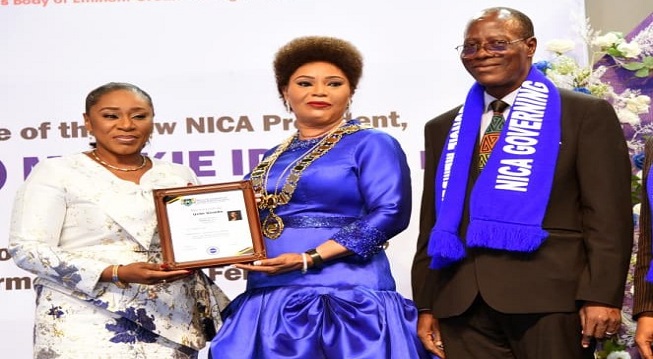
The National Institute of Credit Administration (NICA) has conferred its Professional Fellowship on Mrs. Uche Uzoebo, Managing Director of Shared Agent Network Expansion Facilities (SANEF).

The recognition was announced in Lagos during the investiture of Dr. (Mrs.) Markie Idowu as the Institute’s new President.
In his welcome address, Prof. Chris Onalo, Registrar/CEO of NICA, noted that the National Institute of Credit Administration distinguishes itself from other professional bodies through its unwavering commitment to advancing credit management, promoting professionalism, and empowering Nigerians with credit literacy.
“Unlike many other institutes, NICA recognizes that credit management is a lifeline of commerce, influencing every aspect of business, social, and economic life. Through this commitment, the Institute continues to shape Nigeria’s economic future towards sustainable growth,” he stated.
The Fellowship represents the Institute’s highest professional distinction and is conferred on individuals whose leadership has significantly strengthened Nigeria’s credit environment, institutional governance frameworks, and the integrity of the financial system.
This recognition also comes at a significant moment globally as the world commemorates International Women’s Day, underscoring the growing recognition of women’s leadership and contributions across industries, particularly in finance, governance, and economic development.
The ceremony brought together senior financial sector executives, policymakers, regulators, and distinguished guests to celebrate excellence in credit administration and professional practice.
The Institute described Mrs. Uche Uzoebo as a seasoned business executive and financial services leader with over two decades of professional experience spanning banking, digital payments, and financial services.
A proven change agent, she brings deep expertise across digital payments, financial inclusion, agency banking, product and business development, merchant acquiring, as well as corporate, commercial, and retail banking.
Her leadership has been instrumental in advancing secure and inclusive digital financial services, strengthening payment systems, and expanding last-mile access to financial services across underserved communities in Nigeria.
Through SANEF and related initiatives, she has supported economic empowerment and financial inclusion by expanding agent networks, promoting financial literacy, and championing innovative technology-enabled solutions.
Passionate about gender inclusion and women’s economic empowerment, Uzoebo is also a gender specialist and advocate with a strong focus on supporting women entrepreneurs and breaking structural economic barriers.
As a certified trainer, she designs and delivers high-impact capacity-building programmes for individuals, youth, women, and organizations, enabling sustainable growth and improved performance.

Meta to Charge Location Fees on Ads to Six Countries from July 1, 2026

Tizeti Tests Ad-Funded Internet Access Model in Nigeria and Ghana

Court Orders Final Forfeiture of N81.1m Sterling Bank Fraud Funds

NCC Orders Telcos to Report Cyberattacks Within 4 Hours from 2027

FG Mulls Age Restriction for Kids on Social Media

Dr. Cairo Ojougboh Foundation Bolsters Nigeria’s Education Drive with ₦2.7m Student Support

Kaspersky Brings more Transparency to Threat Detection with New Hunt Hub

Kaspersky Discovers New Phishing Campaign Exploiting Google Tasks Notifications to Steal Corporate Credentials

esentry 2025 Report Shows Healthcare, Financial Services and Telecoms as Staging Grounds for Increased Cyberattacks in Africa

AfDB, UNDP Launch $10Bn AI Initiative for Africa




 Telecom3 days ago
Dimension Data Nigeria Seals N20bn Bond Deal to Bridge Digital Infrastructure Gap

 Telecom3 days ago
First Batch of Nigerian Undergraduates Emerged in Airtel Africa Foundation Scholarships Programme

 General News2 days ago
Zedvance Hits ₦96bn Lending Milestone, Eyes ₦250bn Target in 2026

 E-Business3 days ago
CBN Affirms Alpha Morgan Bank’s Capitalisation

 Broadcasting2 days ago
Madonna University Taps Tech Guru Adote for Strategic Board Role

 E-Financial3 days ago
Polaris Bank Marks IWD2026 with Renewed Pledge to Women’s Empowerment

 General News3 days ago
Mojisola Sayo-Kazeem Reflects on Leadership, Opportunity, Women in Tech @ IWD

 News3 days ago
EFCC Seals Anti-Corruption Alliance with Anambra Security Chiefs, Traditional Rulers