

E-Financial
World Payments Report Shows Strong Consumer Demand for Digital Payments

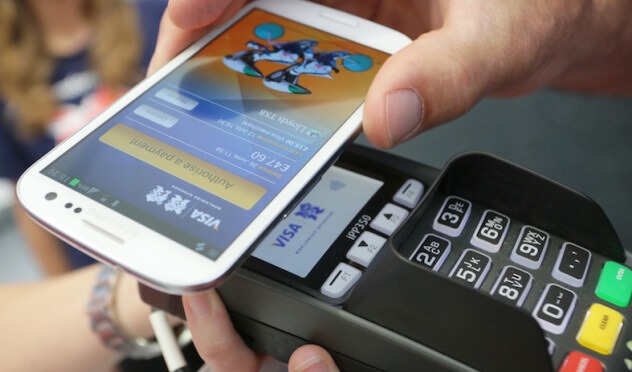
Digital payments are experiencing a boom, according to the World Payments Report 2018 launched by Capgemini and BNP Paribas.
The report forecasts that noncash transactions will post a compound annual growth rate of 13 percent until 2021, following growth of 11 percent in 2015–2016, when the total volume of noncash transactions reached 483 billion.
This boom is being driven by developing markets, with CAGR in Russia (37 percent), India (33 percent) and China (26 percent) most notable during 2015–2016. Mature markets maintained steady growth of more than 7 percent, according to the report.
For the next five years, developing markets are set to show a 22 percent CAGR, led by Asia at 29 percent. By 2021, developing markets are expected to account for approximately half of all noncash transactions, overtaking mature markets, whose current share stands at 66 percent.
Still, regulatory and technical complexity present challenges to new payments ecosystems.
Executives surveyed said that lack of interoperability between schemes (74 percent) and weak standardization of data and authorization (59 percent) were inhibiting adoption of a real-time payments infrastructure.
Regarding distributed ledger technology, or blockchain, 86 percent of executives cited lack of interoperability as a limiting factor; 83 percent pointed to a lack of regulatory clarity; and 77 percent questioned scalability.
Only 38 percent of bank executives surveyed for the report said they were “planning an anchor role” in new payments ecosystems, a stance they might want to rethink, according to Anirban Bose, CEO of Capgemini Financial Services and member of the group executive board.
“With their significant market share in the payments industry and implementation of new technologies, banks are in a unique position to shape the marketplace,” he said. “They can also create new revenue streams through innovative, collaborative relationships with fintechs and active participation by the broader financial services community.”


The naira is projected to remain largely stable in the coming months, while borrowing costs are expected to ease as inflation moderates, according to the Central Bank of Nigeria’s (CBN) latest Business Expectations Survey (BES).

CBN
The survey, which polled about 1,900 businesses nationwide, revealed that confidence in the local currency has strengthened. Respondents expect the naira to rise from an index of 28.8 points to 42.2 points by May 2026, extending the rare period of stability recorded throughout 2025.
Borrowing rates are also forecast to decline, with the index dropping from 15.4 points to 11.7 points, reflecting expectations of softer monetary conditions as inflationary pressures ease.
“Respondents expect the naira–US dollar exchange rate to steadily appreciate across the review periods, as indicated by the positive indices. They also anticipate a continuous positive outlook for borrowing rates during the same periods,” the BES report stated.
The naira has enjoyed an unusually long stretch of stability after losing about 41% of its value in 2024 following the unification of exchange rates. Analysts attribute the current calm to the CBN’s calibrated interventions and steady inflows from foreign portfolio investors.
Inflation, which stood at 14.45% in November 2025, is projected to fall to single-digit levels in 2026. This outlook could give monetary authorities room to begin a gradual easing cycle, potentially improving credit access for businesses.
Despite the improving macroeconomic environment, businesses continue to grapple with structural constraints. The survey highlighted insecurity (70.1 points), high/multiple taxation (69.7 points), and insufficient power supply (69.3 points) as the most pressing challenges. Other concerns include poor infrastructure and an unfavorable political climate, both scoring 57.7 points.
While optimism surrounds the naira and borrowing costs, the BES underscores the need for sustained reforms to tackle deep-rooted operational challenges. Analysts say that without addressing insecurity, taxation burdens, and infrastructure gaps, Nigeria’s businesses may struggle to fully benefit from the improving macroeconomic outlook.
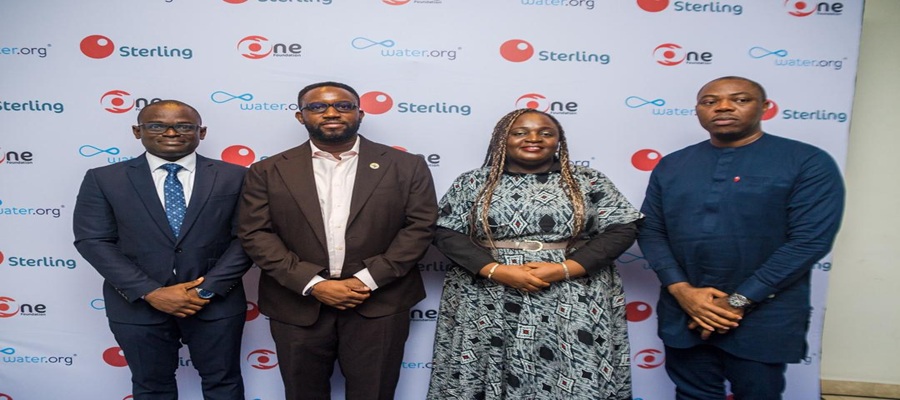
Sterling Bank, in partnership with nonprofit Water.org and Sterling One Foundation, has launched the Sterling WASH Business Loan to empower WASH businesses and scale sustainable access to safe water and sanitation for millions of Nigerians.

L-R: Gilbert Okpono, Snr. Partnership Account Manager, Water.org; Engr. Mukhtaar Temitope Tijani, Managing Director, Lagos State Water Corporation; Mrs. Olapeju Ibekwe, CEO, Sterling One Foundation; Akporee Idenedo, Divisional Head Commercial Banking, Sterling Bank, at the Sterling Bank Water Credit Proposition held in Lagos recently.
The catalytic financing solution addresses daily struggles with clean water and safe sanitation, which impact health, livelihoods, and well-being, while strengthening delivery systems for WASH solutions.
Launched on Monday, November 24, 2025, at The Wheatbaker Hotel, Ikoyi, Lagos, the initiative signals a shared commitment to tackling one of Nigeria’s most pressing development challenges.
Abubakar Suleiman, Managing Director of Sterling Bank, said sustainable development hinges on collaboration and targeted investment in frontline businesses and people.
“By providing accessible financing to entrepreneurs in this critical social sector, we ensure progress reaches communities that need it most. This product aligns with our HEART strategy and commitment to improving quality of life through impact-driven initiatives,” Suleiman stated.
Gilbert Okpono, Nigeria Senior Partnership Account Manager at Water.org, stressed the transformative power of financing WASH businesses.
“Financial inclusion is critical to solving the global water and sanitation crisis. By expanding access to affordable financing, we enable households and WASH entrepreneurs to improve services, reach more communities, and transform lives,” Okpono said.
He added that the partnership reflects a belief in rippling benefits across health, education, and economic opportunity, marking a major step toward sustainable scaling.
The loan supports WASH entrepreneurs, small business owners, and community service providers with flexible financing to expand operations, boost health, livelihoods, and educational outcomes.
Olapeju Ibekwe, CEO of Sterling One Foundation, linked the initiative to the foundation’s mission of catalysing lasting social impact across Africa.
“Our Foundation catalyses initiatives that deliver real, lasting change. Access to safe water and sanitation is one of the most powerful investments in community well-being. We are proud to partner with Water.org and Sterling Bank for inclusive, scalable, and sustainable solutions,” Ibekwe affirmed.
The launch event gathered development partners, WASH entrepreneurs, media, policymakers, and community organisations to discuss coordinated financing, supportive policies, and market-driven solutions to close Nigeria’s WASH access gap.
Interested beneficiaries can visit the initiative’s website for more details.

Access Holdings Plc has received the approval of its shareholders to raise additional capital of up to N40 billion or such other amount or their equivalent in foreign currencies, via private placement.

The shareholders gave the approval as part of the special resolutions at Access Holdings Plc Extraordinary General Meeting (EGM) held on Thursday December 18.
In a notice to the Nigerian Exchange Limited (NGX), Access Holdings said the new ordinary shares created in connection with the private placement, will be allotted at a price of N20.25 to one or more investors in such tranches and on such terms and conditions as shall be determined by the Board.
Access Holdings Plc Board of Directors is authorised to consider, negotiate, approve, and finalise the list of potential private placement investors; determine the structure, valuation, modalities, and timeline for the private placement.
The Board was also authorised to consider, negotiate, approve and finalise the list of potential private placement investors; determine the structure, valuation, modalities and timeline for the private placement.
The shareholders also approved for the issued share capital of Access Holdings Plc to be increased from N26 658 billion to N27.646 billion by the creation and addition of 1,975,308,641 ordinary shares of 50 kobo each ranking pari-passu with the existing ordinary shares of the Company.

Glo Extends Christmas Greetings, Urges Unity and Care for Others

Naira Stability, Lower Borrowing Costs Expected in 2026 — CBN Survey

US Okays $2.1Bn for Christian Healthcare in Nigeria

Leo Stan Ekeh: A “Rare Avis”, an Unconquerable Entrepreneur

SERAP Asks Tinubu to Release CTC of Tax Bill

Nigeria Records Highest Weekly Cyberattacks in Africa — Report

Cyber Tsunami Hits Nigeria as Breaches Surge 1,047%, esentry Q3 Report Reveals

GenAI Adoption Among African workers Outpace Global Peers

Jumia’s Data Shows Nigerians Turning to Digital Retail to Navigate Inflation Pressures

Minister Claims Bandits Exploit Poor Network, Bounce Calls Off Multiple Towers




 General News1 day ago
The Mood Market to Light Up Lagos with a Rooftop Gifting, Food & Lifestyle Fair this Christmas
 News1 day ago
US Okays $2.1Bn for Christian Healthcare in Nigeria

 Broadcasting1 day ago
Tim Akano Recounts 20-Year Growth, Media Support at NITRA End-of-Year Meet
 News1 day ago
SERAP Asks Tinubu to Release CTC of Tax Bill

 E-Financial1 day ago
Sterling Bank, Water.org, Sterling One Foundation Partner on WASH Loan for Millions
 General News1 day ago
Leo Stan Ekeh: A “Rare Avis”, an Unconquerable Entrepreneur

 General News1 day ago
FCCPC Forces Ikeja Electric Into Compliance, Unseals Headquarters After Rights Breach

 General News1 day ago
NITDA Wins Triple SERVICOM Honours for Citizen-Centred Service Delivery