

E-Business
Fighting Corruption: A War for All

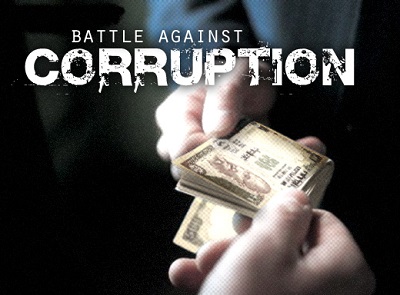
Corruption is a global, stigmatic and dreaded bane of economic development. It is a societal endemic plague that has ravaging effects on the progress of every nation, no matter how wealthy the nation might be.
Corruption cuts across all strata of citizenry of every nation and is coupled with insatiable tendencies. Corruption knows no satisfaction and has no limitation.
This evil is an acknowledged hindrance to the right of individuals to enjoy social provisions such as basic infrastructures. Corruption does not only distort access to social amenities, but also affects the quality of any such provisions, if at all they are provided.
It is tied to egoism, inordinate aspiration and greed. So, in every endeavour of man on this planet earth, corruption rears its ugly head or it is visibly found in some traits of character.
The word corruption has a very wide definition. In theological discussion, corruption is spiritual and is synonymous with sinfulness, unrighteousness, profanity, impiety, impurity, vice, turpitude, and everything that is short of God’s ideal. In philosophical and sociological discussions, corruption is a social vile that is synonymous with dishonesty, unscrupulousness, deceitfulness, duplicity, fraudulence, criminality, bribery, bribing, graft, and all that is related to anti-social norms.
In his essay, ‘Forms of Corruption’, Stephen D. Morris described corruption. as the illegitimate use of public power to benefit a private interest; and in his contribution, I. Senior defines corruption as an action to secretly provide a good or a service to a third party so that he or she can influence certain actions which benefit the corrupt, a third party, or both, in which the corrupt agent has authority.
The origin of this canker-worm transcends earthly existence as its characteristics can be traced to events in heaven as recorded in the Bible.
“Thine heart was lifted up because of thy beauty, thou hast corrupted thy wisdom by reason of thy brightness: I will cast thee to the ground, I will lay thee before kings, that they may behold thee” – Ezekiel 28:17.
This Holy Book mentions corruption in about 80 verses.
Other religious scriptures may have also touched corruption in their verses. The fall of man in the Garden of Eden can be attributed to corruption.
Corruption was with people of the earth as they spread from land to land. Today, all nations of the earth are deluged with different forms of corruption.
The differences in the volume of global corruption are that the developed nations have put in place mechanisms to control this economic virus, while developing and undeveloped nations are yet to successfully implement such mechanisms.
In our dear country Nigeria, corrupt practices date back to colonial era. Writing about the genesis of corruption in Nigeria, Rina Okonkwo exposed that as early as 1947, a colonial government report claimed:
“The African’s background and outlook on public morality is very different from the present day Briton. The African in the public service seeks to further his own financial interest.”
The colonial report concluded that only public opinion could deal with corruption. The problem was that there was no responsible public opinion to check corruption in Nigeria. Rina Okonkwo went on to list the following as early corrupt cases in Nigeria:
* Just seventeen months after the inception of Igbo-Etiti District Council in May 1954, the colonial government held an inquiry into the affairs of the Council. The inquiry judged that the “conduct of the Council’s affairs had become a public scandal.”
The colonial officer who conducted the inquiry, FP Cobb, noted, “public indignation was widespread and strong. The public was outraged at the corrupt behaviours of their representatives. The report on Igbo-Etiti District Council revealed that “there was systematic corruption in the appointment and promotion of staff and in the awarding of contracts.
Bribes of L80 to L100 were demanded for unnecessary appointments. The brother of the Secretary to the District Council was hired above a more qualified applicant.
In one case, a man paid a L400 bribe to secure a post and was never refunded his money when he did not get the job.
Contractors routinely paid ten percent of the value of the contract as bribe. The contracts were not awarded to the lowest bidder or to the most experienced or competent persons.
At the end of its first seventeen months of existence, the Igbo-Etiti District Council was L6000 in debt. There was great wasting of public money due to gross dishonesty in handling council affairs.”
* In 1956, the Foster-Sutton Tribunal investigated the Premier of the Eastern Region, Nnamdi Azikiwe for his involvement in the affairs of African Continental Bank (ACB). Under the code of conduct for ministers, a government officer was required to relinquish his holdings in private business when he assumed public office. The Foster-Sutton Tribunal felt that Zik did not severe his connections to the bank when he became a Minister.
The Tribunal believed that Zik continued to use his influence to further the interests of ACB. Zik, his family, and the Zik Group of Companies were the principal shareholders of the African Continental Bank. ACB loaned over L163, 000 to the Zik Group of Companies at low interest. The Zik group did not have to repay the loans until 1971. ACB was a distressed bank.
The new registrar of banks in 1952 refused to grant ACB a license. Attempts to find partners for the bank in Britain failed because of the insolvency of the bank.
In the words of a colonial government official, “Were a UK minister to be involved in a series of transactions the result of which public funds were used to support an otherwise shaky institution in which he was directly interested, he would be forced to leave public life.”
Why did not the colonial government prosecute Zik for his failure to observe the code of conduct for government officers? The colonial correspondence revealed that the government supported the NCNC as the only party to embrace national unity.
Without Zik, the NCNC would collapse. The national interest of the country demanded that Zik continue as leader of the party.
* Obafemi Awolowo, the first premier of the Western Region was found guilty of corruption by the Coker Commission in 1962. In 1954, the Western Region Marketing Board had L6.2 million. By May 1962, it had to exist on overdrafts amounting to over L2.5 million.
A loan of L6.7 million was made to the National Investment and Properties Co., Ltd. for building projects out of which only L500, 000 was ever re-paid.
The Western Region Finance Corporation and the Western Nigeria Development Corporation also received loans of millions of pounds, which were never re-paid. The Coker Commission found Awolowo responsible for all the ills of the Western Region Marketing Board, and Awolowo “without a doubt has failed to adhere to the standards of conduct which are required for persons holding such a post.”
* The First Republic under the leadership of Sir Abubakar Tafawa Balewa, the Prime Minister, and Nnamdi Azikwe, the President, was marked by wide spread corruption. Government officials looted public funds with impunity.
Federal Representative and Ministers flaunted their wealth with reckless abandon. In fact, it appeared there were no men of good character in the political leadership of the First Republic.
Politically, the thinking of the First Republic Nigerian leadership class was based on politics for material gain; making money and living well. Minister of Aviation, K.O Mbadiwe, flaunted his wealth by building a palace in his hometown.
When asked where he had gotten the money to build such a mansion, K.O replied, “From sources known and unknown.” Minister of Finance Chief F.S Okotie- Eboh responded to charges of accumulation of wealth by government officers by quoting from the Bible, “To those that have, more shall be given.
From those that do not have, shall be taken even the little they have.” The The popular acceptance and even admiration for corruption of that era was highlighted in Chinua Achebe’s novel ‘A Man of the People’ about the politicians of the First Republic.
The author described people’s attitude to corruption thus: “The people had become even more cynical than their leaders and were apathetic into the bargain. “Let them eat,’ was the people’s opinion… It may be your turn to eat tomorrow.”
* In the Northern region, against the backdrop of corruption allegations leveled against some native authority officials in Borno, the Northern Region Government enacted the Customary Presents order to forestall any further breach of regulations. Later on, it was the British administration that was accused of corrupt practices in the results of elections which enthroned a Fulani political leadership in Kano, reports later linking the British authorities to electoral irregularities were discovered.
This writer does not intend to present past and ‘reverend’ leaders as “corrupt” for I, as other Nigerians do not have the moral right to do so.
For we all have in one way or the other aided and abetted corruption. The aim here is to draw our attention to the fact that corruption existed and developed over the years; that corruption has been instituted before the 1st, 2nd, 3rd, and this 4th Republics; that the military incursion into governance worsened and heightened corruption; that this economic virus had long infested both public and private sectors of the Nigeria’s project and that we should know corruption is as old as the amalgamation of the north and south of the nation..
When the military struck in January 1966, Nigerians wholly welcomed the development, hoping that this canker-worm, called corruption would be addressed and hopefully be eradicated at most or at least be brought to diminution. But sadly, Nigerians guessed wrongly as the deluge of corruption flowed in new and different directions under the military.
Briefly reviewed below, are corruptive accounts of the military administrations after the Gen. Aguiyi Ironsi short-lived regime:
Gen. Gowon Administration – Corruption for the most part of Gowon’s administration was kept away from public view until 1975.
Though Gen. Yakubu Gowon was not officially indicted for corrupt practices but his officials and state governors were labeled as “misguided” individuals acting like lords overseeing their personal fiefdom.
The General was viewed as timid, in terms of not being decisive against corrupt elements in his government. For the first time, perhaps, in the nation’s armed forces, its rank and file were enmeshed in corruption.
Those in stores were helping themselves with all types of furnishings and equipments; the medical personnel were looting drugs; the pay boys were taking thousands of the then Nigeria pounds home monthly, just to mention but a few.
In 1975, a corruption scandal surrounding the importation of cement engulfed Gen. Gowon’s administration.
Many officials of the defence ministry and the central bank of Nigeria where involved in the scandal. Some of his commissioners were publicly denounced for grafts.
Gens. Murtala/Obasanjo Administration – Gen. Murtala Mohammed came up with some reformist changes that would reduce corrupt practices, but he was short-lived.
Gen. Olusegun Obasanjo who took over after the Dimka coup, did not quite marshalled the political zest to follow in the footsteps of his assassinated boss.
In no time, corrupt Nigerians sighed great relief after the demise of the anti-corrupt crusader and it became ‘business as usual’. In the corruption bu-ha-ha, $2.8 billion oil money got missing under the watch of petroleum minister, then Colonel Muhammadu Buhari. Also accounts were said not to have been rendered for the funds earmarked for the FESTAC, ‘Operation Feed the Nation’ and other national projects.
The huge fraud relating to ITT venture in Nigeria, which put whopping billions of US dollars in the pockets of very few Nigerians, was said to have taken place under that administration.
Gens. Buhari/Idiagbon Administration – In 1985, a cross section of political gladiators were convicted of different corrupt practices under the government of second republic President Shehu Shagari.
However, the administration itself was involved in a few instances of lapsed ethical judgments. It is on record that the Generals were removed from power when their colleagues smelt hypocrasy in their “War Against Indiscipline” (WAI).
Besides politicians jailed for corruption, no other ‘corrupt operators in the private sectors’ were touched and systematic corrupt practices remained unabated.
Many Nigerians questioned the moral rights of Gen. Muhammadu Buhari, under whose petroleum ministry a whopping sum of $2.8 billion was missing few years back, to send corrupt politicians to jail for up to 10-20 years.
Gen. Babangida Administration – The regime of General Ibrahim Badamosi Babangida is seen as the body that openly “legalized” corruption in Nigeria.
The general did not, throughout his administration, attempt to fight corruption, but instead set or reduced jail terms of corrupt politicians imprisoned by military tribunals of his predecessors.
His administration refused to give account of the Gulf War oil sales windfall, which is estimated to be $12.4 billion. Projects such as Federal Capital Territory Authority, Democratization, Elections, etc, were heavily laddened with corruption practices.
No one can say how much public money, in billions went into private pockets during this administration. It was the era that witnessed gifts of millions of naira in brief case, to traditional rulers.
Gen. Abacha Administration – The death of Gen. Sani Abacha revealed the global nature of graft at it’s worst height.
The French Government investigations of bribes paid to Nigerian Government officials to ease the award of gas plant construction exposed the global level of official graft in Nigeria.
The investigations led to the freezing of Nigerian officials bank accounts in Europe containing over $100 million US dollars.
In two years after the death of the general a Swiss banking commission report indicted Swiss banks for failing to follow compliance process in allowing family and friends of Gen Abacha’s access to accounts and depositing amounts totaling $600 million US dollars into the accounts.
The same year, a total of more than $1 billion US dollars were found in his various bank accounts throughout Europe.
Again, the salient point here is that corruption is not a recent phenomenon that pervades the political, military, police, custom and all national institutions.
Even before the development of modern public administration in the country, there have been cases of official misuse of resources for personal enrichment.
Nigeria is ranked 144th corrupt country in the world and it took many years of corrupt decadence for Nigeria to rank so highly.
Corruption has eaten deep into the fabric of both public and private sectors of the national society; we nurtured it to become a reticulate monster.
It is no gain saying that an average Nigerian is corrupt and selfishly perceived corruption to be a benchmark of financial break-through.
In other words there is hardly a Nigerian who gets to a position of authority that will not take advantage of that position to enrich him/herself.
Most Nigerians who shout on roof top at corrupt practices are those unfortunate ones like yours sincerely, who has not had the opportunity to grab. Even if you are the best-public-spirited type, the persuasion of loved ones, the allure of the opposite sex and the influence across the board can covert you to join them.
What percentage of the Nigerian population would be exonerated if the Almighty God comes down to Nigeria and judge those in public office and those who have retired from public office of corruption.
Corruptive practices do not only entail bribery, it also include bribing and an average Nigerian is guilty of either at a point in time.
And the private sector is not exonerated. As a matter of fact, corruption is instigated, perfected and executed by the private sector.
This is the sector that cushions bribing that the public sector relies on and exploit. The captains of industries are on the front burner of ‘kick-backs, forward and kick-by-the-sides’ systems of corruption in Nigeria.
The system has actually developed from ‘kick-back to kick-upfront’. Now operators in the private sector have to pay upfront percentage of the value of contracts they are vying for before they put pen to paper.
An average Nigerian in the private sector believes that ‘nothing goes for nothing’ and so he/she is ever prepared to offer bribe in order to attain goals.
The private sector has always been comrade-in-crime to public sector.
As corruption has become an evil of the first and vast magnitude in Nigeria enveloping every one, can fighting it be only an individual’s concern?
How easy can it now be for a leader to fight and eradicate an evil that had been persistently institutionalized by past administrations?
And most importantly, are Nigerians sincere in fighting this damaging scourge? These are some of the pertinent questions that need committed answers.
It is very common and easy to expect a leader of the nation to do something about corruption, but it is not common to find answers to some relevant questions as asked above.
And what are most appalling nowadays are the defensive mechanisms employed by some corrupt public officials.
They point at the speck in the eyes of another in order to distract others seeing the plank in their own eyes. Good examples are the Speaker of the House of Representative, who officiated the fixing of his and other “honourable” members’ salaries, allowances and other corrupt benefits at the expense of poor national development, pointing fingers at the President for not fighting corruption.
The suspended Governor of CBN who pointed inadequately, at the financial misappropriation in NNPC and at a time he, himself sat on queries of financial recklessness and infractions of his office.
And the political class which now employ corruption as a weapon to outwit the incumbent in power. Corruption has become a bait to be included in the manifestoes of opposition political parties, in order to hoodwink the unsuspecting electorates, whereas these same politicians have some corruptive smudge in their past public offices.
The whole thing smacks of Nigerians re-inventing corruption and then making it an uphill task to eradicate.
This writer is of the firm opinion that war against corruption cannot be won in this generation because Nigerians of this generation have not accepted that fighting corruption is not a task for an individual nor for a political party in power.
For decades we nurtured, aided and abetted corruption, so we all have to accept our roles individually and forge a united front to fight against its continuous escalation.
Corruption in Nigeria is so enormous that neither leader nor a political party can boast of eradicating it. Any promise by a political party to eradicate corruption when voted into office is nothing but a mere endearment to catch votes.
Such political party should convince Nigerians by outlining its articulated methodology of eradicating the economic virus.
The political party has to show where its war against corruption would commence and how it would handle corruption in both public and private sectors.
A leader of the Nigerian nation can install a dozen or more corruption-fighting agencies but if Nigerians are not united and committed to the fight, the cankerous monster will continue to feed on the nation’s wealth and grow fat while development is hampered. All past and present attempts at eradicating corruption failed because there was no united front by committed Nigerians to fight it. Nigerians did not see corruption as Americans see tax evasion.
A murderer may get away with the crime in America, but a tax evader can never get away with the evasion.
Fighting corruption should start from every Nigerian family. Heads of Nigerian families must shun immoralities, be objective and truthful, avoid rigmarole and short-cuts, show contentment and excitement in occupation, and give the young ones good virtues to imbibe.
The watch word is “Charity begins at home”
Elias Osaghae lives in Toronto, Canada



National Information Technology Development Agency (NITDA) has said it has granted approval to the 2025 Annual Report and 2026 Business Plan of the Nigeria Internet Registration Association (NiRA).

The Agency, through an official statement it released on Sunday, also revealed that the “nation’s active .ng domains have hit a total of 241,000.”
Hajiya Hadiza Umar, director of Corporate Communications, NITDA, who signed the statement disclosed that the approval came during a strategic meeting at NITDA headquarters, Abuja, where Adesola Akinsanya, president, NiRA led members of the association’s board to present its 2026 vision to NITDA.
According to NITDA, the endorsement will ensure the acceleration of the adoption of Nigeria’s country code top-level domain, .ng.
It was also disclosed that through the endorsement, both organisations have pledged to strengthen collaboration towards increasing the adoption of .ng domains across Nigeria and supporting the Federal Government’s digital economy agenda.
The statement also noted that Kashifu Inuwa Abdullahi, director general, NITDA has directed NiRA to work closely with NITDA’s e-Governance and Digital Economy Department to ensure effective implementation, project monitoring and regular progress reporting.
You have my full approval for these initiatives. Let us change our strategy, sync up more closely, and ensure everything we have agreed upon during this presentation is fully implemented by next year,” Inuwa stated.
Speaking on the association’s achievements in 2025, Akinsanya disclosed that NiRA recorded 98,285 new domain registrations, 71,470 renewals and 1,970 restorations, bringing the total number of active .ng domains to 241,000.
He said that beyond the growth in registrations, NiRA strengthened the security of Nigeria’s internet ecosystem through the implementation of Domain Name System Security Extensions (DNSSEC), while also improving registrar support and stakeholder engagement.
According to him, the association’s 2026 strategy is focused on positioning .ng and .gov.ng domains as the preferred digital identity platforms for government institutions, businesses and citizens.
Akinsanya praised NITDA for its continued support and called for joint awareness campaigns and digital capacity-building initiatives to encourage wider adoption among state governments, local councils and public institutions.
He further revealed that NiRA is upgrading its internal systems through increased automation and constitutional reforms aligned with global best practices to ensure long-term sustainability.
NiRA is looking into deeper stakeholder engagement and moving into areas where we see massive possibilities. We are specifically targeting startups and aligning with tech events across the country. With stronger collaboration, we can drive widespread adoption across every tier of government,” he said.


The Federal Government has called for the development of inclusive and human-centred artificial intelligence policies that protect workers’ rights and prevent job losses while harnessing the technology’s potential to drive economic growth and productivity.

The Minister of Labour and Employment, Dr. Muhammad Dingyadi, made the call during the 114th Session of the International Labour Conference in Geneva, Switzerland, while responding to the report of the Chairperson of the Governing Body and the Director-General of the International Labour Organisation, titled “A Moment of Choice: Harnessing Artificial Intelligence for Decent Work,” on Thursday.
Dingyadi said the rapid advancement of AI is transforming labour markets, workplace practices and employment relationships globally, creating both opportunities and challenges for governments, employers and workers.
He noted that while AI can stimulate innovation, improve productivity and expand economic opportunities, it also poses significant risks, including job displacement, widening inequalities and the erosion of the human role in some sectors of the economy.
“The world is moving forward at a rapid pace, underpinned by advances in AI, and we as an organisation must match that pace. While welcoming the positive transformations AI offers, we are also pondering the uncertainties it connotes.
“These shifts, despite their benefits, also cast a dark cloud of uncertainty. Where AI creates new jobs, there may be job losses. Where digital and AI infrastructures are created, there may be a loss of the traditional role and value of the human factor in the work process. We therefore need a balanced approach that ensures that, while harnessing the benefits of AI, the attendant risks do not rob our societies of the gains of decent work,” he said.
The minister commended the ILO leadership for its commitment to advancing the organisation’s mandate despite mounting global economic and social challenges.
Highlighting Nigeria’s efforts to position itself within the rapidly evolving digital economy, Dingyadi said the Federal Government had established the Ministry of Communications, Innovation and Digital Economy to spearhead policies aimed at accelerating technological development and strengthening the country’s competitiveness.
According to him, Nigeria has already begun integrating digital technologies and AI into governance systems through the automation of civil service processes and public service delivery.
“I’m also pleased to inform you that Nigeria is steadily harnessing the gains of this initiative in our Public Service. There is the service-wide automation of civil service processes and communication with AI playing a significant role. Additionally, platform work is gaining ground,” he said.
The minister also welcomed ongoing discussions within the ILO on regulating work in the platform economy, stressing the need for labour standards that protect workers engaged in emerging forms of employment created by digital technologies.
Beyond AI, Dingyadi reiterated Nigeria’s longstanding call for reforms within the ILO, urging member states to accelerate the ratification of the 1986 Amendment to the organisation’s Constitution and review the criteria used to determine countries of Chief Industrial Importance.
He argued that such reforms would promote greater inclusivity, fairness and regional representation within the ILO’s governance structures.
The minister further urged countries to align the ILO Centenary Declaration and the Global Coalition for Social Justice with national development priorities to ensure that technological innovation contributes to social progress and decent work.
Nigeria’s intervention comes amid growing global debate over the impact of artificial intelligence on jobs and the future of work.
According to international labour and development agencies, AI is expected to automate some routine tasks while simultaneously creating new employment opportunities in technology, data science, digital services and other emerging sectors.
However, concerns persist that workers in administrative, clerical and repetitive occupations could face significant disruptions if governments fail to implement policies that support skills development, social protection and workforce transition.
The issue has become a central focus of discussions at the ongoing International Labour Conference, where governments, employers and workers’ representatives are examining how AI can be deployed in ways that promote productivity and economic growth without undermining labour rights, job security and social justice.
For Nigeria, the conversation is particularly significant as the country pursues an ambitious digital transformation agenda aimed at expanding broadband access, growing the digital economy and creating millions of technology-driven jobs for its youthful population.
Experts have repeatedly stressed that achieving these goals will require investments in digital skills, education and worker protections to ensure that the benefits of AI are broadly shared across society.

According to a recent global report by Kaspersky Security Services, password guessing and valid account misuse rank among the most effective tactics used by cyber criminals in 2025.

This trend reflects a strategic shift, as attackers move away from triggering endpoint protection with noisy malware, in preference of leveraging legitimate access to evade detection.
The ‘Anatomy of a Cyber World’ is an in-depth global report based on data gathered from Kaspersky Managed Detection and Response (MDR), Incident Response (IR), Compromise Assessment and SOC Consulting in 2025. It covers the most common adversary techniques, tools and detection scenarios and highlights the peculiarities of detected incidents.
According to the report, a significant portion of the most frequently monitored attack techniques revolves around credentials and identity management. This analysis, which examines the conversion rates* of various Indicators of Attack (IoA), highlights the following prevalent malicious tactics:
Password guessing – 34.8%. This technique entails attackers systematically trying different passwords until successfully gaining access to an account. It tops the conversion list due to its occurrence in both actual attacks and authorised security assessments, making it a persistent threat in today’s cybersecurity landscape. Organisations who rely on weak or reused passwords continues to enable this age-old strategy.
Local account creation – 34.7%. Once inside a system, attackers frequently create new local accounts to maintain access even if their original foothold is discovered and removed. This technique is frequently observed during security exercises and can be detected — but only with the right telemetry in place, which is often lacking.
Valid account abuse – 34.5%. Instead of deploying malware, attackers log in using stolen or compromised credentials and simply blend in with normal user activity. This makes detection significantly harder, as the access itself appears legitimate. The high conversion rate underscores why compromised credentials remain one of the most dangerous attack vectors.
Account manipulation – 32%. Attackers modify existing accounts to consolidate access such as by activating disabled accounts, altering group memberships, or escalating privileges. This reinforces the broader pattern — rather than introducing new tools, adversaries deepen their control using what is already there.
Network service discovery – 31.2%. Before moving deeper into a network, attackers typically scan for open services and systems they can reach. This reconnaissance step is a strong predictor of what follows: lateral movement and further exploitation. Detecting it early provides security teams a critical window to intervene.
The report ranks attacker techniques by how frequently observed activity ultimately resulted in confirmed malicious incidents. According to Kaspersky experts, while MITRE ATT&CK® catalogs a vast number of adversary techniques, effective detection requires prioritising behaviours with the highest probability of malicious intent while avoiding excessive false positives.
“Threat actors do not always need sophisticated malware to achieve their objectives. In many cases, legitimate administrative tools and compromised accounts remain the fastest and most effective way to move inside an organisation while avoiding detection.
The continued popularity of these techniques shows that organisations need deep visibility into attacker behaviour and the ability to correlate suspicious activity across different stages of an attack.
To address these challenges, companies can enhance their security with our solutions: Kaspersky Managed Detection and Response and Incident Response which cover the entire incident management cycle – from threat detection to continuous protection and remediation,” comments Sergey Soldatov, Head of Security Operations Center at Kaspersky.

NITDA Okays NiRA’s Annual, Business Report

Price of Data in Nigerian Mobile among Top Four Cheapest Globally – MTN CEO

CBN Imposes N100m Penalty on Dealing Bank Inadequate Processing of Forex Documents

BOI Wins Dual Honours @ EMEA Finance Awards for Sustainability and Social Impact Leadership

Moniepoint DreamDevs Bootcamp Graduates Second Cohort to Strengthen Homegrown Talent Pipeline

FG to Launch Nationwide Free Digital TV Platform June 17

CBN Extends PoS Geo-Fencing Enforcement Deadline to August 2026

Jumia Nigeria Records Strong Q1 2026 Growth as Technology-Led Strategy Drives Market Expansion

MTN, Airtel, Glo Under Pressure as FG Demands Better Service Delivery

Metro Digital, Nigerian Firm Accuses Multichoice Of Refusal to Obey Court Judgements




 Telecom2 days ago
TikTok Tax Scam Exposed: Two Arrested Over Alleged £153 Million Fraud Scheme

 E-Financial2 days ago
IFC, NGX Group Unveil Nigeria Gender Programme

 Telecom2 days ago
NITDA Backs NiRA’s Ambitious 2026 Plan to Drive Massive .ng Domain Adoption

 General News2 days ago
NITDA, Benin’s Digital Agency Strengthen Ties on Digital Transformation

 Telecom2 days ago
FG Targets Alleged N3tn Capital Flight, Opens Airtime Credit Market to Nigerian Fintechs

 Telecom2 days ago
MTN Dismisses Data Theft Claims, Blames Network Challenges on Fibre Cuts, Vandalism
 E-Business34 minutes ago
NITDA Okays NiRA’s Annual, Business Report

 Telecom36 minutes ago
NAIFF Returns for 2026, Expands Focus on AI-Powered Storytelling in Africa