

Broadcasting
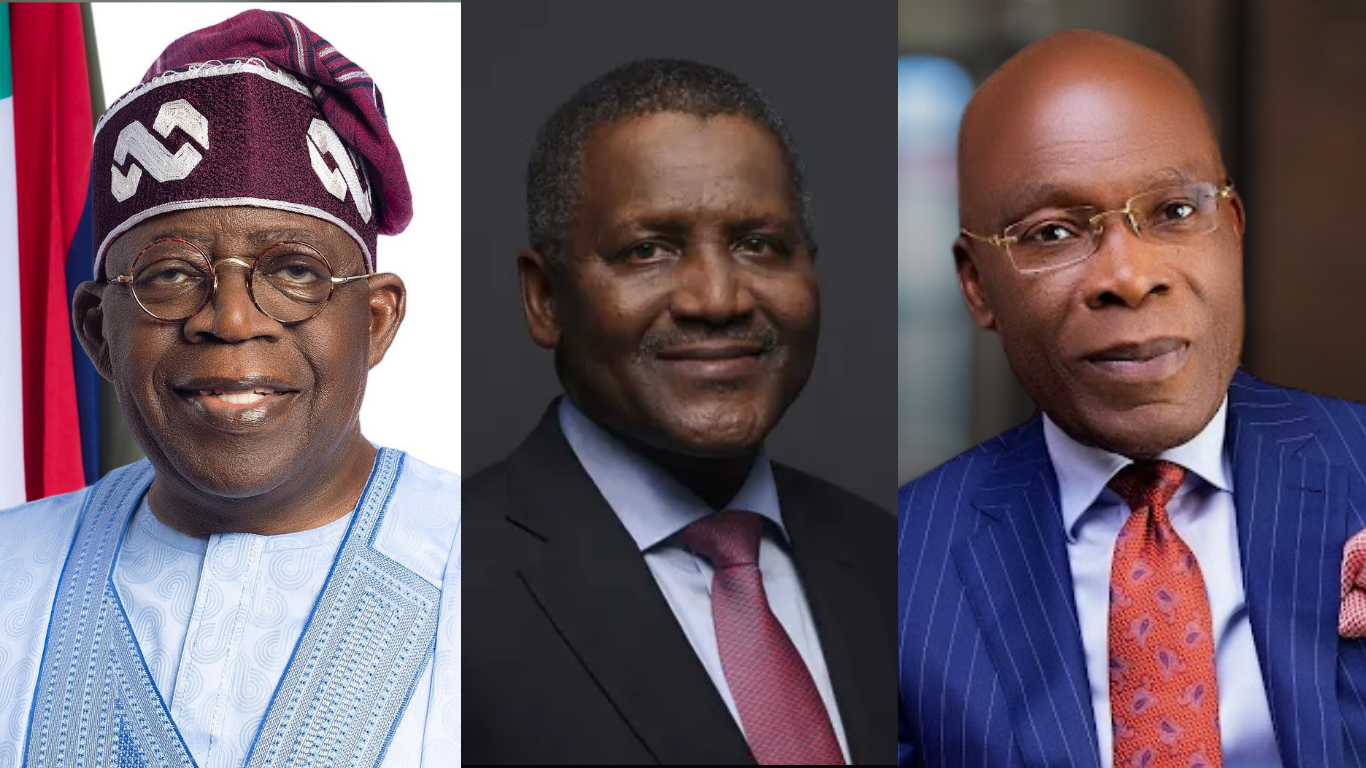
$1 Trillion Economy: Why Tinubu Must Listen to Dangote, Ekeh, Others

By Aliyu Gaya
One exceptionally commendable fact about the Bola Tinubu presidency is that it is not lacking in ambition and audacity. Courage defines the leader and Tinubu has it in good measure. Think about this: Tinubu wants to grow Nigeria’s net worth to a $1 trillion economy by 2030. While this shows ambition, it is much more a demonstration of audacity in leadership.

To achieve this, Tinubu says Nigeria must lean on and encourage local production. He believes that achieving food security is the sine qua non for advancing the nation’s economy through heavy investments in the agriculture value chain. He is pushing a Nigeria First, Buy-Nigeria policy. Some of his ministers and appointees are also singing the same local production hymn.
A quick fact-check shows that this is not new, especially since the commencement of the 4th Republic. President Olusegun Obasanjo, it has to be emphasised, laid a solid foundation to promote indigenous production of goods and services. He did not chime Buy Nigeria, he lived it, implemented it and the results were profound. The results of Obasanjo’s Buy Nigeria policy manifested in diverse ways. Local patronage of indigenous fruit drinks and ban on imported ones; local production of airtime cards for GSM service providers; local patronage of locally assembled computers that gave a huge boost to local production of the same, such that some ministries, departments and agencies (MDAs) standardised their IT operations on indigenous computer hardware and software.
Sadly, despite the traction gained by indigenous products, the succeeding governments did not even sustain the Buy-Nigeria momentum. Tinubu seems determined to do so. However, to achieve the noble ambition of a $1 trillion economy, President Tinubu must listen to key Nigerians who are not only employers of labour but are deeply committed to indigenous production as the key to unlocking the huge potential of the nation’s economy.
One of such Nigerians Tinubu must take heed to his advice is Aliko Dangote, the President of Dangote Group whose refinery is the biggest single infrastructure project in Africa. Dangote, a major indigenous manufacturer, is not happy with the manner local companies are treated in Nigeria.
Dangote recently advocated for policies that protect indigenous industries and nurture them into mega corporations capable of generating jobs and fostering prosperity. Addressing a gathering of manufacturers and investors in Abuja recently while delivering a keynote on ‘Rethinking Manufacturing in Nigeria’ at the Nigeria Manufacturers’ Summit, Dangote advocated a reversal of government policies that expose local players to vulnerabilities including continued importation of goods and services that are also produced in Nigeria. Such a lack of protection of indigenous players, usually in the form of a lack of patronage from the government and Nigerians, stunts the growth of these local players.
He cited countries where governments had to take drastic measures to protect their respective local markets. These include the blocked sale of US steel to Nippon Steel of Japan, the blocked sale of six US port management companies to Dubai Ports World, restrictions on Chinese cranes at US ports, and the US imposition of tariffs such as 100% on Chinese EVs (electric vehicles), 50% on semiconductors, medical products, and solar panels.
There are other instances, including the restriction of Russia gas supply to Europe, which led European countries to increase coal usage despite opposition to fossil fuels; and the US government’s distribution of $39 billion in subsidies to incentivise local microchip production. The above cases clearly show how respective governments deliberately protect their local players, not only to give them a head-start over competition but also to help them scale up on the path to profitability. Nigerian governments have been short on this.
Leo Stan Ekeh, Chairman of Zinox Group, an African ICT unicorn, is yet another voice Tinubu should give ears to. Ekeh, much like Dangote and others, has been a victim of serial blackmail and corporate bullying despite his undeniable sacrifice to create a digital culture in the Nigerian marketplace including education, media, banking, oil and gas, agriculture and other aspects of the economy. His Computerise Nigeria project became the cornerstone for the establishment of digital hubs in the nation’s tertiary institutions.
Ekeh believes that achieving a $1 trillion economy is possible but stressed that the current state of power delivery nationwide (an average of 4 hours per day according to the latest NBS data) cannot support the type of bullish industrialisation and local production that will bolster the nation’s economic trajectory to the trillion-dollar mark. He warned that a situation where genuine players in local production and service delivery are bullied and blackmailed by unscrupulous private sector fringe players and public sector operators does not bode well for economic growth. He urges more protection from government for the progressive and proven indigenous companies. He says the concept of Buy-Nigeria should be enforced, especially among MDAs.
While expressing confidence in President Tinubu’s ability to address the issue of blackmail, he suggested that Tinubu should aggressively pursue a policy that promotes patronage of indigenous manufacturers and service providers as a way of reflating the economy.
He said: “It is evident that the core of the myriad challenges afflicting the nation today is our failure to develop local capacities. We must embrace self-sufficiency by consuming what we produce and supporting indigenous players across various sectors.”
He regretted that in spite of several local content policies established by the Federal Government, such policies are consistently disregarded by government employees and appointees, wondering why “we send our children to the world’s best institutions, where they excel, yet we overlook the products they create.”
He gave the example of the government of India, which effective November 1, 2023, placed restrictions on the importation of laptops, tablets, all-in-one personal computers and ultra-small computers and servers with immediate effect. This, according to him, was to boost local productivity both by multinationals operating in India and indigenous Indian companies to create more jobs, encourage proficiency, and discourage capital flight.
“Mr. President, I humbly appeal to you to be deliberate and decisive in encouraging indigenous producers and service providers across all sectors. This way, we create a market for indigenous products, build confidence in our economy and easily attract international investors. The way we treat our local investors will determine how many foreign investors we can attract,” he stated in an open letter to the President earlier this year. The voices of Dangote and Ekeh echo the voices of other indigenous players who have continued to deliver value amid vicious headwinds.
Speaking at the inaugural Domestic Investors Summit in Abuja recently, the Minister of Industry, Trade and Investment, Dr. Jumoke Oduwole, reaffirmed Tinubu’s determination to achieve the trillion-dollar economy. She outlined targets for 2025, including $6 billion in foreign direct and portfolio investment, $6.5 billion in non-oil exports, a 20 per cent increase in trade value, and the creation of 200,000 export-led jobs. This is grand. But the major pulley that will drive this growth is the recommendation of Dangote, Ekeh, and other indigenous players, which is that the government should, as a priority, protect local investors and entrepreneurs through patronage, a policy shift that encourages growth, and categorising such investors’ assets as national assets deserving of preservation.
Gaya, a public policy analyst, writes from Kano.


Nigerian Civil Aviation Authority (NCAA) has directed Overland Airways to refund Value Added Tax (VAT) wrongly charged to passengers on flight tickets purchased in 2025.

NCAA
The directive follows a social media complaint that highlighted the airline’s application of new tax policies to older bookings, prompting NCAA intervention.
Michael Achimugu, NCAA Director of Public Affairs and Consumer Protection, confirmed Friday that Overland Airways agreed to process refunds after receiving clarification from the Nigeria Revenue Service (NRS).
The issue emerged in late January 2026 when a passenger alleged on X (formerly Twitter) that her grandmother faced an extra N11,286 VAT charge at the airport for a 2025 ticket. On January 28, NCAA summoned the airline to justify the additional payments for pre-2026 tickets.
The regulator sought NRS guidance on retroactive VAT application. NRS ruled that updated VAT rules, effective January 1, 2026, exclude tickets issued before that date.
Achimugu updated on X: “This means passengers who paid VAT at check-in in 2026 for 2025 tickets were not supposed to be charged.”
Overland Airways accepted the clarification and pledged refunds, earning NCAA commendation for cooperation. Achimugu noted the airline initially viewed charges as valid under the new framework, but NRS interpretation prevailed.
“The issue has reached a satisfactory conclusion,” he stated, reaffirming NCAA’s commitment to passenger rights and fair policy enforcement.
Affected passengers who paid extra VAT on 2025-issued Overland tickets qualify for full refunds.


MultiChoice has said that it will not implement its customary yearly price increase on DStv and GOtv subscriptions.

This is the first time the Pay-TV company will not be adjusting its price in April, as it has in previous years, signalling a clear shift in direction under its new owner, Canal+.
The decision, confirmed by David Mignot, group chief executive,MultiChoice in an interview with TechCentral, comes as the pay television operator grapples with steep subscriber losses across its markets.
For many households accustomed to annual April tariff adjustments, the announcement will be a welcome break.
Responding to questions about whether DStv prices would rise in April as they have in previous years, Mignot gave a firm response: there will be no increase.
He explained that the company’s immediate focus is on rebuilding its subscriber base, making this an unsuitable period to adjust prices upward.
He added that while there are no current plans for a price hike, the company has not completely ruled out adjustments later in the year, especially if economic conditions demand it, such as significant currency movements.
MultiChoice has historically reviewed and raised DStv subscription fees in April, often citing inflationary pressures and rising content costs. As recently as April 2025, bouquet prices were adjusted upwards by between 2.1 per cent and 7.9 per cent.
The DStv Premium package rose from R929 to R979 per month, while DStv Access, the entry-level satellite package, recorded one of the steepest increases.
This year’s pause represents a break from that pattern and forms part of a broader reset following Canal+’s acquisition of MultiChoice in September 2025.
Mignot, who brings three decades of experience in the pay television industry, summed up his mission in simple terms: halt subscriber losses and return the business to growth.
The urgency behind the move is evident in MultiChoice’s recent performance.
The group has lost 2.8 million linear broadcasting subscribers in the two years ended 31 March 2025, with roughly half of those losses occurring in South Africa.
In the financial year to end-March 2025 alone, MultiChoice shed 1.2 million subscribers, representing an eight per cent year-on-year decline and leaving the group with 14.5 million active customers.
The previous year saw an even steeper drop of 1.6 million subscribers. By June 2025, Canal+ indicated that the pace of decline had intensified further.
The financial impact has been significant. Revenue for the year ended 31 March 2025 declined by R4 billion to R52 billion, while trading profit fell sharply by 49 per cent to R4 billion.
According to Mignot, the company’s difficulties stem less from its programming slate and more from weaknesses in its commercial execution.
He argued that in subscription businesses, a churn rate of between 12 and 15 per cent annually is inevitable as customers relocate, experience job losses, adjust household budgets, or change priorities. Without attracting a comparable number of new subscribers each year, losses accumulate.
Mignot maintained that the content offering remains strong, particularly in sport and general entertainment. He cited flagship brands such as SuperSport, M-Net and Africa Magic as evidence of sustained investment in programming. However, he stressed that content strength alone cannot offset a weakening subscriber acquisition engine.
He noted that MultiChoice’s commercial machinery had performed robustly across Africa until around 2022, describing the current challenges as relatively recent.
Drawing on Canal+’s experience in French-speaking African markets, Mignot pointed out that pricing there has remained largely unchanged for close to 14 years, supported by a volume-driven approach. He described his strategy as one focused on growing subscriber numbers while maintaining profitability.
While he did not dismiss the possibility of reviewing prices downward in future, he indicated that no such decision has been taken.

Spotify marked five years in Nigeria since its February 2021 launch with dramatic year-on-year listening growth averaging 163.5% through 2025, featuring triple-digit surges early on and sustained momentum, propelled by Afrobeats streams rocketing +5,022% alongside booming genres like Amapiano (+10,330%), Gospel/Praise (+5,499%), Hip-hop/Rap (+3,020%), and R&B (+2,602%).

Spotify
Indigenous language music listening surged +554% in Nigeria in 2024 and +87% in 2025, with global growth at +141% and +41% respectively, underscoring rising demand for local storytelling sounds.
The platform’s Nigerian artist roster expanded +158%, fueling a discovery boom where average listeners (aged 26) streamed 150 different artists recently; users created over 25 million playlists, logged 1.4 million play hours in 2025 alone, and streamed 59 billion podcast hours total.
Top Artists (2021-2025): Asake, Wizkid, Seyi Vibez, Burna Boy, Davido.
Top Songs: “Remember” (Asake), “Dealer” (Ayo Maff & Fireboy DML), “Awolowo” (Fido), “Kese (Dance)” (Wizkid), “Lonely At The Top” (Asake), “Joy is Coming” (Fido), “With You” (Davido feat. Omah Lay), “Terminator” (Asake), “MMS” (Asake feat. Wizkid), “Doha” (Seyi Vibez).
Nigeria’s debut stream was Shiga Lin’s Cantopop epitomizing borderless discovery from day one.

Sunil Bharti Mittal Conferred GSMA Lifetime Achievement Award for Transforming Global Telecommunications

Jumia Tech Week 2026 Begins with Tech Deals on Smartphones, Electronics, and Everyday Technology

AfDB Supports Francophone Africa Start-ups with €6.5M

Krishnan Exits Africa Data Centre to Embark on Professional Chapter

House Probes Fintech Regulation via Public Hearing on New Commission Bill

Accidental Billionaire Opts for Jail Instead of Returning Money Credited Him by Mistake

New Horizons Nigeria Breaks Ground: First to Fuse Mandarin into ICT Curriculum

Kaspersky Brings more Transparency to Threat Detection with New Hunt Hub

Dr. Cairo Ojougboh Foundation Bolsters Nigeria’s Education Drive with ₦2.7m Student Support

NDPC Commits to Balancing Data Privacy, Protection Information




 E-Financial2 days ago
Iran-Israel-US Conflict and CBN’s FX Gains: A Stress Test for Nigeria’s Monetary Stability

 E-Financial2 days ago
Mutual Benefits Assurance Reaffirms Full Regulatory Compliance, Enhanced Governance

 General News2 days ago
JAMB Uncovers AI-Driven Fraud Targeting UTME Candidates, Warns Parents

 General News2 days ago
SERAP Asks FCCPC to Investigate Google, Meta, Others over Alleged Rights Abuses

 News2 days ago
FlashChange CEO, Bidemi Oke, Urges Startups to Build Strong Governance Structures Early

 News2 days ago
TeamApt, Awabah Partner to Boost Pension Drive for Nigerians

 General News1 day ago
Leo Stan Ekeh at 70; thanks Tinubu, Obasanjo, Nigerians, Global Tech Community

 General News2 days ago
Capelli Institute Commits to Advancing Trichology in Nigeria