

Broadcasting
5 Ways to Write an Engaging Value Proposition for Your Website


When it comes to selling newspapers, persuasive and relevant “above-the-fold” content has always been a necessity. The top half of the newspaper—the only part that can be seen from newsstands, is what is commonly referred to as “above the fold.” For newspapers to sell out, this above-the-fold content needs to be compelling and enticing.

The same is true of websites. On a website, this is the part visitors and prospects see immediately, without having to scroll. Also known as the “headline”, this section should carry your business’s value proposition. How well you communicate the core value and qualities of your product/service here will make the visitor want to keep scrolling, learn more about you, and ultimately choose you over other competitors.
Your headline and sub-headline should answer these questions, as briefly as possible:
● What does your company do?
● What pain points does it address and what problems does it solve for your visitors and prospects?
● Why should prospects choose you over your competitors?
In other words, a good value proposition knows its target market and through the above, it immediately lets visitors know if they are in the right place or not.

Here are five ways to ensure you get your value proposition right:
1. Speak to your customer about your entire offering
A good value proposition invites visitors to focus on their needs as well as other aspects of their requirements that they may miss out on considering otherwise. Try to capture the whole essence of your offering instead of talking about one specific aspect. For instance, take a bed and breakfast (B&B) that also includes add-on services like experience packages and guide bookings. The headline and sub-headline together should succinctly inform the visitor that it’s a B&B that not only offers a relaxing stay but also a range of add-ons. A benefits-focused copy always goes a long way.
2. Emphasise your difference
Showcase your product/service’s remarkable qualities that will pique your visitor’s interest. If it’s a CRM software, how is your offering different from the scores of other CRM software in the market? Is it top-rated in the market? Is it recommended by industry experts? Is it priced the best? Is it tailor-made for a certain segment like large enterprises or SMEs?
3. Show them a problem-free and delightful future
Your copy should encourage your visitor to envision a future that will be ‘all the more better’ for them because of your product/service. Say you provide a digital note-taking application. It’s a good idea to portray the pain-points solved as well as the delights offered by the application. The headline and sub-headline could jointly communicate that while the visitor finds it easy to remember things, the note-maker additionally helps them become resourceful and accomplish more by keeping track of their thoughts and ideas in the form of organized lists. Also, while visualizing the relationship, it’s important to use a copy that’s simple and jargon-free to reinforce the benefits in a more impactful way.
4. Get clever (but not too clever)
Wordplay can be a hit or a miss in copywriting – sacrificing clarity for cleverness in your copy more often than not does not create an impression as powerful as the simple but clear copy that you discarded earlier. Whenever you’re using wordplay or less-common words in your copy, use a light hand. Remember, the goal is to show the customer exactly how your product or service will improve their life.
5. Use hero images and CTAs
If you’ve noticed, most headlines and subheadings on websites are placed in the hero image. What’s more, each sub-headline is directly followed by a call to action (CTA). However, both of these items—the hero image and CTA, should only be the second and third elements you consider for your website’s above-the-fold space. First, try to summarise your business value proposition in a copy that’s simple, clear, and brief.
Additionally, go through the websites of some of your favourite businesses, and see how they are using this valuable real estate. Come up with as many headlines and subheadings as possible. Mix and match them, and get input from other people to make the most of this space.


Mrs. Clementine Wamba, head, Digital Switch Over (DSO) at the National Broadcasting Commission (NBC), has stressed the need for broadcasting stations and practitioners nationwide to work towards meeting the 2028 global deadline for the switch over.

She made the call in her presentation titled, “DSO Big Picture: Free TV Audience Measurement and the Evolving Media Landscape”, at the 2026 NBC South West Summit held in Ibadan.
Wamba harped on the need for practitioners to adopt DSO in the transmission of news and other programmes in order to meet future challenges, stating that any country that fail to align with the DSO by 2028 will be shut out of practice.
This development, according to her, may result in job losses and other consequences that could hinder the growth of the industry in Nigeria, noting that Free TV is tailored towards the DSO, with provision for many channels in contrast to the age-long analogue system.
According to her, “The Digital Switch Over is a technological improvement on the age-long analogue style of broadcasting in the country. With the adoption of the DSO, practitioners will be in tune with global practice of broadcast journalism.
“Also, its benefits include efficient use of spectrum, changing of industry landscape, more access to national development programmes and better viewing experience.”

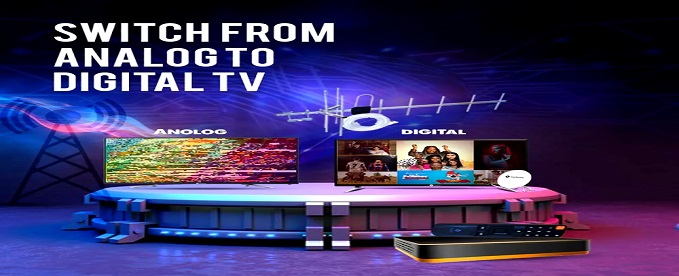
National Broadcasting Commission (NBC) has said that Nigerians will no longer pay annual Digital Access Fees under the renewed Digital Switch Over (DSO) project.

Charles Ebuebu, director-general, NBC, disclosed this in an exclusive interview with the News Agency of Nigeria (NAN) on Wednesday in Abuja,
Ebuebu said viewers only need to purchase an approved decoder and satellite dish which cost below N20,000 to enjoy free television permanently.
“Previously, users paid an annual digital access fee of about N1,500, described as an administrative charge.
“The new system removes that annual fee. It provides free access to free-to-air television channels without any payment.
“Premium channels will be introduced later. Viewers who want those additional channels will be able to access them through paid services.
“Nigerian content on free-to-air channels remains free to watch. Unlike Pay TV, this platform does not require monthly subscriptions for its basic service,” he said
Ebuebu said approved decoders for the FreeTV will cost less than N20,000 and authorised sales outlets will soon be announced.
He urged Nigerians to wait for official information on approved dealers for the DSO decoders, warning that unauthorised sellers are exploiting growing public demand.
He reiterated that people only need a free-to-air decoder, along with a satellite dish instead of the old antenna system to receive the DSO signal.
“Once the equipment is installed, viewers can access all available channels across the country without paying any subscription fees,” he stressed
The DG dismissed claims by some retailers that there are different categories of decoders sold at varying prices, stressing that such sellers are not authorised by the commission.
According to him, the NBC will soon publish the list of approved dealers, official prices, and locations where genuine decoder boxes and accessories can be purchased.
The NBC boss said the DSO project is designed not only to improve television broadcasting but also to stimulate economic growth by creating jobs, attracting investment, and opening up opportunities for businesses that support the broadcasting industry.
Ebuebu noted that content producers and broadcasters stand to benefit significantly from the nationwide reach of the DSO platform.
Unlike the previous system, where many stations had limited regional audiences, he said the new platform will make their channels available to viewers across Nigeria.
He added that the introduction of audience measurement technology will provide scientific and reliable data on television viewership.
Ebuebu added that audience measurement technology will give advertisers greater confidence in placing adverts and enable broadcasters to demonstrate the true size and reach of their audiences nationwide.
Uchenna Mbunabo, Nigerian filmmaker, has raised concerns over the alleged unauthorised broadcast of Nollywood films by some Ghanaian television stations, calling on Ghana’s National Film Authority (NFA) to strengthen the enforcement of copyright laws.

Uchenna Mbunabo, Nigerian filmmaker
Mbunabo made the remarks during a conversation with James Gardiner, deputy CEO of the National Film Authority (NFA) of Ghana.
He questioned whether it was permissible for television stations in Ghana to download Nigerian movies from YouTube and air them without obtaining permission from the producers.
“I noticed that Ghanaian TV stations, the way they are stealing our films and showing them for free with impunity. Is it legalised in your country for TV stations to go on YouTube, download people’s sweat and show it for free?”
According to Mbunabo, some Ghanaian television stations have been downloading newly released Nollywood films from YouTube and broadcasting them without authorisation, depriving producers of revenue generated through the platform.
He also stated that he had not witnessed Nigerian television stations engaging in similar practices and questioned what measures Ghana was taking to protect filmmakers’ intellectual property.
Responding to the concerns, Gardiner acknowledged that the issue exists and said the National Film Authority had begun engaging relevant stakeholders to address it.
He disclosed that the NFA has held discussions with the Ministry of Communications, the National Communications Authority (NCA) and the National Media Commission (NMC) on improving copyright enforcement.
Gardiner explained that while Ghana has copyright laws, enforcement remains challenging because many television stations now operate digitally and may not have physical offices within the country.
“There are copyright laws, but they are not effective because a lot of the TV stations don’t have offices. Most of them are now digital, so they operate from anywhere. They can even have a Ghanaian TV station but be operating from Austria simply because it is digital.”
He added that authorities are considering a new licensing framework that would require broadcasters to undergo a fresh licensing process to improve monitoring and enforcement.
According to Gardiner, television stations found guilty of illegally broadcasting copyrighted content would be required to compensate affected producers through fines.
He added that repeat offenders could face suspension of their broadcasting licences, while a third violation could result in the revocation of their licences.
Although he did not provide a specific timeline, Gardiner said the reforms were already underway and expressed hope that significant progress would be seen next year.
Mbunabo welcomed the proposed measures but urged the National Film Authority to expedite the process, stating that unauthorised broadcasts continue to affect filmmakers’ ability to recover production costs through legitimate distribution channels such as YouTube.
He also stressed that his comments were not directed at Ghana’s film industry, noting that he has worked with several Ghanaian actors over the years and supports collaborations between Nollywood and Ghallywood.

Dangote Refinery’s Private Placement Reportedly Hits $2.5Bn

FG, UNODC Plan National Strategy against Organized Crime

EFCC Busts NIS Visa Overstay Racket, Uncovers N700m in an Account

CBN to Monitor Every Dollar with FXBT, Forex Tracker

NCC, NDLEA Partner to Fight Piracy and Drug Trafficking

NRC, Ponzi Scheme Collapses Resulting Loss of Billions of Naira

NASENI Moves to Digitize CCB’s 5m Assets Declaration and Operations

Lebara Nigeria Launches Lebara Play, Africa’s First Telecom-Owned Micro-Drama Platform

CANAL+ Partners Samsung to Pre-Load DStv Stream on New Samsung TVs In Nigeria, Other African Countries

Tokenization, Blockchain Technology will Transform Financial Institutions – IMF



 News2 days ago
EFCC Busts NIS Visa Overstay Racket, Uncovers N700m in an Account

 News3 days ago
FAAN to Replace Physical ID Check with V-Pass Biometric Verification
 News2 days ago
NCC, NDLEA Partner to Fight Piracy and Drug Trafficking

 News3 days ago
CBN Introduces Digital Tracker to Monitor BDC Forex Transactions

 News3 days ago
CAC Begins Removing 100,000 Companies from Register Over Regulatory Non-Compliance

 Telecom3 days ago
Airtel Delivers Free Employability Training to Young Nigerians @ World Youth Skills Day
 General News2 days ago
Dangote Refinery’s Private Placement Reportedly Hits $2.5Bn

 Telecom3 days ago
ntel Plays Down Calls and Data Services, Moves to BET Agenda