

News
500 Babcock Lecturers Undergo TCCDR Training


The entire Babcock university lecturers have completed a one -week intensive training on Total Classroom and Campus Digital Revolution (TCCDR) thus becoming the first university in Nigeria to achieve a comprehensive training and certification of all its lecturers with a view to strengthening the leadership position of the university in Nigeria and Africa.
The TCCDR project is an end-to-end first-of-its-kind- robust collaborative e-learning designed to enable the students, lecturers and parents and the school Administrators collaborate in a new integrated way that will further enhance academic excellence and boost the university global ranking as a foremost technology-driven university in the same league with the best universities in the world.
With the deployment of TCCDR, Babcock university is now making use of the same quality and quantum of technologies which the topmost one hundred universities in the World are using.
There are eleven components of the TCCDR that seamlessly connect the classrooms , students and their lecturers , hostels and cafeteria on campus.
With this, the hostels and Cafeteria and chapel will be powered by the Israeli latest technology- the In-Motion-Identification Biometrics – which helps guarantee better safety on campus by filtering away all unwanted persons from having access to every important locations on campus where students congregate most, like their hostels and chapels and cafeteria and classrooms.
While the parents also, can now have access to information about their children and wards, via a mobile app, thereby keeping them abreast of the students’ classroom performance ahead of their graduation.
The TCCDR will see the Babcock University deploying a campus-wide WiFi that enables students to access archived lectures from anywhere on campus using their Customised Education-Purpose-Built Tablets (Babcock Learning Tablets – BLTs).
This comes with free Internet bundle available throughout the students’ campus life and a host of educational applications for the enhancement of learning.
With the TCCDR, Babcock University will be the first university in Nigeria to have an automated cafeteria where students are identified using the In-Motion Identification (IMID) biometrics to serve meals to students.
This non-contact biometrics replaces the unhealthy contact biometrics by identifying students at a distance and clearing each student per meal and has a pass rate of 35 – 40 students per minute, thereby eliminating human traffic and reduction in time spent by students at the cafeteria.
The management also can access the records for their necessary reports and planning.
Students are also going to benefit from the SAP global e-learning platform which comes with SOCIAL JAM that allows students to collaborate among one another to do their projects and assignments virtually with in-put from their lecturers that also comes virtually.
Besides, each students will be issued with a Babcock Tablets that comes with free wifi internet and special software like Babcock SKOOLAPP that will help in managing health, cafeteria, and all other issues.
All the classrooms are fitted with inverters and projectors and the new UPOINTER from South Korea that helps in capturing and recording all the lectures and archive them for students revisions purposes in as many times as they desire,giving students access to a border less classrooms.
The TCCDR project will enhance learning in a totally different way from the traditional classroom interaction. It will see the lecturers and students collaborate by using technology to exchange learning materials.
The training was organized by the e learning department of the university led by Professor Akanbi.
In his comment Professor David Akanbi showered praises on the lecturers for accepting to embrace new technologies in training their students.
He expressed his satisfaction with the outcome of the training exercise and the value it will bring to Babcock students in the highly competitive labour market.
On the last day of the training, the Vice Chancellor Professor Ademola Tayo and some members of the Parents Consultative Forum of the university also went round to see how the lecturers are adapting to new technology for teaching Prof Tayo, in his speech, reiterated to the PCF representatives that the students and the lecturers are being furnished with various devices to collaborate in the classroom and use the technology to enhance learning and further boost quality of graduates being produced by the university many of whom have won awards and recognitions from various professional bodies outside the university.
Professor Tayo used the occasion to reiterate his vision for the university that \’\’Babcock will remain a pacesetter and will continue to use the best-in-class technology to improve academic excellence on campus so that the products of Babacock university will remain competitive in the labour market\’\’
The consortium powering the TCCDR package was led by WiniGroup/IVETEC , which put together relevant solutions from six counties including Nigeria where some of the software was developed using even some Babcock graduates.
The In-Motion-Identification Technology comes from Israel, some components come from South Korea, Germany, America and India. The Babcock Tablets come from Canada.
When fully commissioned according to the Chairman of the Consortium working on the TCCDR, Akano: ” The TCCDR is the best way to go in Nigeria to prepare our students for the new globalised market- one world order without any boundary.
The 21st century requires different approach to education, different skills and only those institutions that are adaptable to change will thrive and prosper.
‘We are happy about Babcock playing their usual pacesetter roles when it comes to technology. This is one of the reasons why Babcock graduates are the first choice of most employers in Nigeria today.
‘The issue of power failure during lectures was taken into consideration and all the 120 classrooms were put on power back-up that can last 5-6 hours of uninterrupted power supply.
Also, a technology skill acquisition and Maintenance Center is being put in place at Babcock to maintain all these technologies and it will also help students who desire to acquire practical experience to do so at the Center during Summer.
‘More importantly, best students in each faculty will have opportunity of participating in a students exchange program to Israel during summer to meet with their counterparts in other parts of the world that are more advanced in the usage of Technology”


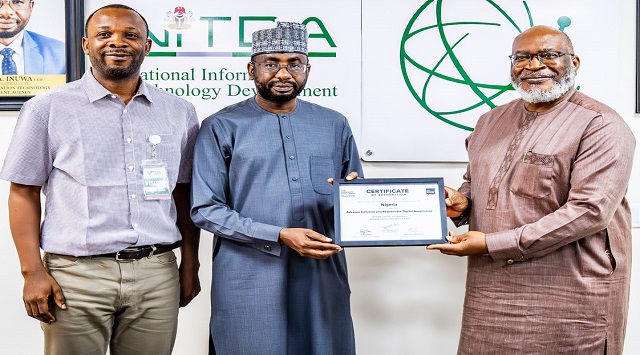
The Director General of the National Information Technology Development Agency (NITDA), Kashifu Inuwa, CCIE, has reaffirmed Nigeria’s commitment to open governance, transparency and inclusive digital development as the Open Government Partnership (OGP) team formally presented the award and certificate received at the OGP Global Summit Spain 2025 to the Agency’s leadership.

Nigeria emerged as the overall global winner in the Digital Governance category in recognition of the country’s excellence in deploying digital tools and policies to strengthen government transparency, accountability, and citizen engagement. In addition, Nigeria received the Regional Award for advancing Open Digital Governance across Africa and the Middle East, reaffirming its leadership role in promoting open government principles and driving digital transformation across the region.
These recognitions were largely attributed to initiatives led by NITDA in collaboration with civil society partners, such as Dataphyte, which showcased innovative and inclusive approaches to digital governance at the summit.
The summit, which was organised in Vitoria-Gasteiz, Spain, brought together more than 1,500 high-level representatives of governments, civil society leaders, and policymakers from around the world to exchange experiences, best practices, and progress on open government initiatives and implementation on key issues.
Receiving the OGP delegation at NITDA, Inuwa described the recognition as a national honour rather than an institutional one, stressing that the award reflects Nigeria’s collective efforts across government, civil society and the private sector in advancing open governance principles through the digital space.
According to him, such global recognition comes with heightened responsibility to deliver on commitments made under the OGP framework.
“This is not just about NITDA. It is a national recognition, and every recognition comes with responsibility,” the DG said.
“If we fail to execute the commitments we have made, it will not only affect our image locally but also at the international stage. This is also not something NITDA can do in isolation,” he added.
Inuwa linked the achievement directly to the Renewed Hope Agenda of President Bola Ahmed Tinubu, noting that digital transformation, transparency, economic diversification, job creation and efficient public service delivery remain central presidential priority areas.
He emphasised that leveraging digital technologies to deepen openness and accountability aligns with national objectives of strengthening institutions, improving governance outcomes and building trust between government and citizens.
Highlighting the importance of collaboration, the NITDA boss underscored the role of the OGP platform as a catalyst for a strong multi-stakeholder approach in Nigeria’s digital ecosystem.
He called on civil society organisations, development partners, the private sector and other government institutions to provide technical expertise, guidance and sustained engagement to ensure effective implementation of agreed commitments.
“We need to leverage the OGP platform. We need your expertise, your guidance, your support and your commitment to hand-hold us in delivering on these commitments,” he said.
He further noted that “a multi-stakeholder approach in the digital space is critical to fostering a resilient ecosystem that delivers real value to citizens.”
Inuwa disclosed that NITDA has already begun internal reviews of its OGP commitments and has tasked its representatives, including Dr Rousseau, to work with colleagues to develop a clear execution strategy.
He proposed the creation of joint work streams with OGP stakeholders to support implementation, ensure accountability and keep all parties on track.
“We are humans. Oversight and collaboration help us stay focused. With commitment, nothing is impossible, and I believe these goals are achievable,” he added, assuring the delegation of NITDA’s readiness and political will to deliver on all agreed commitments.
Inuwa also welcomed the idea of engaging the political leadership of OGP, including the Honourable Minister of Budget and Economic Planning, with a view to briefing President Tinubu on the achievement. He noted that celebrating milestones is important, as it reinforces morale and demonstrates that Nigeria’s efforts in digital governance are gaining global recognition.
“It’s also good when there are wins, we should celebrate, because we too never knew that the little things we are doing are noticed not just within Nigeria, but globally, to the extent of earning us this award,” he asserted.
He concluded by expressing gratitude to the Nigerian National OGP Secretariat and the global OGP leadership, reaffirming NITDA’s commitment to strengthening collaboration and building a more productive working relationship that will translate open governance principles into measurable national impact.
Earlier in his remark, Mr Olusoji Apampa, who led the OGP deelegation, said the honours were earned through a strong partnership between government and civil society, with NITDA playing a critical role, particularly in commitments focused on improving digital governance in Nigeria.
Apampa expressed hope that the awards would serve as added momentum to deepen ongoing commitments under NITDA’s leadership and accelerate the practical implementation of reforms aimed at strengthening digital governance across the country.

PalmPay, Nigeria’s leading digital banking platform, has announced the launch of its ₦400 million festive rewards campaign, designed to reward users with cash prizes and fully sponsored international travel experiences for everyday transactions on the PalmPay app.

The campaign will run from December 17, 2025, to January 8, 2026. The campaign is designed to reward everyday transactions with extraordinary experiences. It runs alongside PalmPay’s Purple December brand campaign, which focuses on wrapping up the company’s key brand and community initiatives for the year.
At the centre of the rewards campaign is the PalmPay World Travel Carnival, an interactive card collection experience that allows users to earn city cards by completing transactions on the app. Users are required to collect five city cards – London, New York, Dubai, Sydney, and Cape Town and combine them into a World Card, which unlocks a share of the prize pool.
The more World Cards a user creates, the larger their share of the cash rewards. Any extra uncombined cards can be swapped with friends and other PalmPay users to help complete additional World Cards.
Beyond cash rewards, the Carnival also offers Free Global Trips. In each round, the top two users with the highest number of eligible transactions (₦100 and above) and at least one World Card will win an all-expense-paid international trip.
The travel grand prize covers:
- Visa fees
- Round-trip international airfare
- 5-day, 4-night hotel accommodation
- Side attraction
- Meal expenses
- Airport pick-up and drop-off
- All transportation for scheduled tour activities during the trip
Winners will be determined through a transparent leaderboard system, with prizes credited automatically at the end of each round on December 25, December 31, and January 8.
Participation is simple:
- Complete tasks on the PalmPay app, such as Airtime, Data, Transfers, and other specific transactions listed in the app, to earn cards.
- Collect all five city cards.
- Swap cards with friends to complete your collection.
- Combine cards to form a World Card and earn cash rewards.
- Perform more transactions to climb the leaderboard for a chance at the global trip prize.
To ensure fairness, PalmPay has instituted strict rules: no cheating, bots, fake accounts, or manipulation. Any violations may lead to disqualification or account bans. Additionally, the Free Travel Prize is limited to one per user throughout the campaign.
Speaking on the launch, Femi Hanson, Head of Marketing & Communication, “This festive rewards campaign is about turning everyday banking into meaningful value for our users. With the World Travel Carnival as the headline activation, we are reinforcing PalmPay’s promise of being the smarter way to bank—where smart financial decisions unlock bigger opportunities.”

The Rural Electrification Agency (REA) and the National Bureau of Statistics (NBS) have signed a Memorandum of Understanding (MoU) to conduct a nationwide energy survey aimed at closing long-standing data gaps in Nigeria’s power sector. The initiative is expected to guide policy, attract investment, and accelerate universal electricity access.

Signed in Abuja, the agreement establishes a National Energy Survey based on the Multi-Tier Tracking Framework (MTF), a globally recognized methodology that measures electricity access not only by grid connection but also by quality, affordability, reliability, and usage of electricity and clean cooking solutions.
The survey will be implemented under the Energy Sector Management Assistance Program (ESMAP) of the World Bank. Dr. Abba Aliyu, REA Managing Director/CEO, said the partnership underscores REA’s commitment to evidence-based rural electrification planning and will generate detailed insights on electricity access and off-grid solutions nationwide.
Prince Adeyemi Adeniran, Statistician-General of the Federation/CEO of NBS, emphasized that reliable statistics are essential for effective policymaking, assuring that NBS will provide technical oversight, sampling expertise, and quality assurance to meet global standards.
The survey will assess energy access, household affordability, expenditure patterns, and the adoption of off-grid technologies such as solar home systems, mini-grids, and clean cooking solutions. REA will provide sector expertise and policy alignment, while NBS manages regulatory approvals, methodology, and technical supervision.
Funded and technically overseen by the World Bank, the exercise will run for 18 months, with the resulting data expected to improve national energy planning, programme targeting, and private sector investment, particularly in underserved and rural communities.
Officials said the collaboration reflects the Federal Government’s commitment to strengthening inter-agency coordination, enhancing energy data availability, and advancing Nigeria’s goal of universal electricity and clean cooking access.

Access Holdings Shareholders Approved to Raise N40bn Capital Through Private Placement

Jumia Kicks Off December Holiday Sale, Bringing Festive Deals to Shoppers Nationwide

Dangote, Monopoly Power, and Political Economy of Failure

OAU, Baptist Day School Oluponna honour Akano with Distinguished Alumnus Awards

NIMC rolls out Pre-Enrolment Portal for seamless NIN registration

Nigeria Records Highest Weekly Cyberattacks in Africa — Report

Cyber Tsunami Hits Nigeria as Breaches Surge 1,047%, esentry Q3 Report Reveals

Jumia’s Data Shows Nigerians Turning to Digital Retail to Navigate Inflation Pressures

GenAI Adoption Among African workers Outpace Global Peers

How Insecurity is Bleeding Nigeria about $15bn Annually and Destroying Its Economic Future




 General News3 days ago
FirstCap Acts as Joint Issuing House on Veritasi Homes & Properties Plc’s ₦30 Billion Bond Programme

 News3 days ago
PalmPay Launches N400 Million World Travel Carnival, Rewarding Users with Free Global Trips

 Telecom3 days ago
Qualcomm Completes Third Edition of Make in Africa Startup Mentorship Program

 E-Business3 days ago
Nigeria Takes the Lead in the Global WSIS+20 Digital Agenda

 Telecom3 days ago
Mastercard Expands Africa Acceptance Network by 45% in 2025, Driving Digital Economy Growth

 Telecom3 days ago
Fynd Expands Global Footprint, Adds Africa With Surtee Group Partnership

 Telecom3 days ago
AI Meets Governance: Anambra Rolls Out SmartGov for Seamless Citizen Interaction

 E-Business2 days ago
Nigeria Police Arrest Okitipi, Nigerian Allegedly Linked to Microsoft 365 Hack