

E-Business
Zinox Bags Coveted SON Certificate

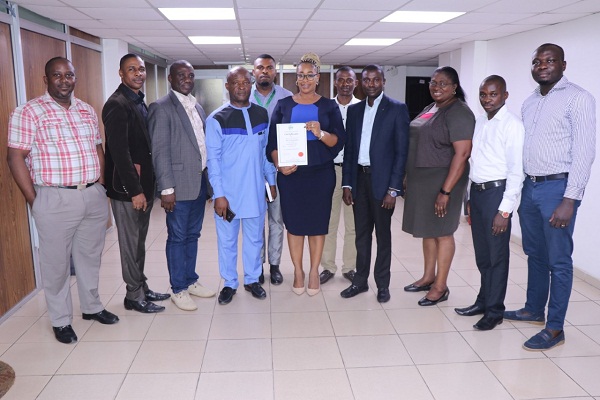
Zinox Technologies Limited, Sub-Saharan Africa’s foremost technology company, has bagged the coveted Quality Management Systems (QMS) certificate of the Standards Organization of Nigeria (SON).

General Manager, HR, Zinox, Mrs. Chioma Nwoke, flanked by SON and Zinox representatives, displays the SON certificate issued to the company
Equally important, Zinox was issued the certificate on Tuesday, March 17.
The certification confers an unerring mark of quality on the various products and solutions under the Zinox stable, for implementing and maintaining a management system that conforms to the globally-recognized requirements of SON’s applicable management system standards.
The certificate was received by Uche Onyechere and Mrs. Chioma Nwoke, general managers, accompanied by other Management staff of Zinox.
Presenting the certificate, Mr. Richard Adewunmi, deputy director, Management System Certification at SON, praised the quality orientation behind the Zinox brand.
Further, he urged the company to continue on the path of quality in its effort to contribute its quota to technological development in Nigeria and beyond.
Explaining why the certification is important, Adewunmi stated that deserving companies are awarded the QMS only after such companies must have met the QMS requirements and undergone the vigorous SON mandatory conformity assessment tests.
He added that such acts go a long way in ensuring that only genuine technology solutions find their ways into the hands of end-users and consumers.
Meanwhile, Mrs. Kelechi Eze-Okonta, managing director, Zinox, has expressed her delight at the development, even as she disclosed that the certificate was a reaffirmation that Zinox was on the right track.
She added that Zinox was the first indigenous computer hardware manufacturing company to receive the ISO 9001 2000 for standardization and quality assurance, a disposition that is corporate culture and mission.
Further, she reiterated that Zinox would not relent in its efforts to ensure that Nigerians and Africans have access to affordable and genuine technology products and solutions.
Mrs. Eze-Okonta said: “The certification gladdens our hearts. It shows that Zinox is consistent on the path of quality. This mark of quality has remained evident in our products and services.
“The SON QMS is one of the several certifications Zinox has received over the years since we started out. We are grateful to our teeming customers and other stakeholders for their continued patronage.
“We pledge to remain the preferred company of choice and assure them of committed services.’’
Nigeria’s first internationally recognized Original Equipment Manufacturer (OEM), Zinox Technologies Limited, has been at the forefront of leading the ICT revolution in Nigeria.
For over 18 years, Zinox has been Nigeria’s IT identity, delivering a suite of cutting-edge but affordable technological solutions, which include high-end personal computers (PCs), laptops, power service, servers, workstations and a host of IT solutions.
Recently, the foremost tech company has diversified into the lifestyle consumer market, with the iTEC brand which has won the hearts of a growing audience with a range of lifestyle and home &kitchen appliances including TV sets, generators, electric kettles, microwaves, toasters, coffee makers and sandwich makers, among others.
Zinox, which has forged close alliances with other global OEMs, has worked assiduously with multinationals and other reputable local organizations, such as Shell, Chevron, Total, the Nigerian Communication Commission (NCC), Independent National Electoral Commission (INEC) and the Ministry of Education over the years in a bid to decentralize technology to the Nigerian market and beyond.


E-Business
Study Reveals 83% of Employees Stay Connected to Work During Time Off, Fuelling Digital Anxiety

A new Kaspersky survey undertaken in the Middle East, Turkiye and Africa (META) region reveals that digital anxiety is becoming a defining feature of modern work culture, as employees don’t disconnect even during their free time and vacations.

According to the findings, 83% of respondents keep an eye on work tasks outside working hours. An overwhelming 85% reply to all work-related messages in instant messaging apps, while the same share (85%) check work emails during their time off – and 81% admit they are responding to work emails while on vacation or in their personal time.
The pressure to remain constantly available is contributing to heightened stress levels in the workplace. Other sources of stress include work issues, for example, 43% experience anxiety after accidentally sending a random message to a work chat.
Interestingly, not all digital mishaps are perceived equally: 40% report that they take it calmly when they send an unfinished email, proving that some mistakes are considered less damaging than others.
Blurred boundaries between professional and personal life, combined with instant communication tools, are intensifying feelings of constant monitoring and fear of making digital errors.
More than a third (36%) of respondents say they feel extremely uncomfortable or even scared if their boss notices them scrolling through social media at work instead of working. The “always-on” culture may undermine employee well-being, increase burnout risks, and reduce overall productivity in the long term.
“Digital anxiety doesn’t just affect employee well-being – it can also increase cybersecurity risks for organisations. When people feel constant pressure to respond immediately to messages and emails, they are more likely to act impulsively, without carefully verifying links, attachments, or sender identities.
This urgency can make employees more vulnerable to phishing, and other scams using social engineering techniques,” comments Brandon Muller, Technical Expert at Kaspersky.
Kaspersky recommends employees to follow the below tips to avoid digital anxiety and associated cyber risks:
- Slow down before clicking or replying. Digital anxiety can trigger automatic reactions. A short pause to check sender details, URLs, or attachments can prevent security breaches.
- Treat urgency as a red flag. Cybercriminals often exploit pressure and fear. Always verify unexpected or urgent requests before responding.
- Avoid handling sensitive information on unsecured networks. Public Wi-Fi, often used when working outside regular hours, increases exposure to cyber threats. Mobile network and VPN should be applied in such cases.
- Use technologies that will help reduce risks. For example, Kaspersky Premium offers AI-powered anti-phishing features designed to help warn of potential threats.
Businesses can reduce cybersecurity risks related to employees’ digital anxiety by providing regular cybersecurity training that helps staff recognise threats and respond correctly even under stress.
At the same time, organisations should use robust cybersecurity solutions to minimise the impact of human error. Kaspersky Next’s adaptable and robust cloud-native protection, underpinned by an unequalled cybersecurity track record, is one of such products.
Protection solutions for mail servers, such as Kaspersky Security for Mail Server, with anti-phishing capabilities, help to additionally decrease the chance of infection through a phishing email.

Federal Government of Nigeria has approved the acquisition of electric buses for civil servants as part of efforts to promote cleaner transportation and boost local vehicle manufacturing.

The development was disclosed in Abuja by Joseph Osanipin, Director-General of the National Automotive Design and Development Council (NADDC). Osanipin said the buses would be sourced from local assemblers to strengthen domestic production and stimulate growth in Nigeria’s automotive sector.
He stated: “The initiative is aimed at encouraging the transition to cleaner mobility while creating opportunities for local manufacturers.” According to him, the government has also procured charging infrastructure that will be deployed across parts of the country to support the adoption of electric vehicles.
As part of broader efforts to develop the sector, the council is establishing the Nnewi Automotive Development Park in Anambra State. Osanipin explained: “We are developing the Nnewi Automotive Development Park where we will provide the necessary infrastructure so that users of the park can share facilities.”
He added that the shared infrastructure model would enable investors and manufacturers to operate without bearing the full cost of setting up independent facilities. The council is also seeking additional investment to accelerate the development of the park and attract more industry participants.
Osanipin urged Nigerians to support locally assembled vehicles, noting that increased patronage would help create jobs and drive economic growth. He said the council is providing training to manufacturers and stakeholders to enhance local production of vehicle components such as batteries and tyres.
“The move will reduce import dependence, create employment opportunities, and contribute to the country’s Gross Domestic Product,” he said. The NADDC is also working with the Bank of Industry Nigeria to facilitate the disbursement of the National Automotive Development Fund to qualified stakeholders.
As the global community commemorates World Consumer Rights Day, Jumia Nigeria joined industry leaders, regulators, and consumer advocates at the Lagos Marriott Hotel, Ikeja, for a high-level panel session hosted by the Lagos State Consumer Protection Agency (LASCOPA) on Tuesday, March 17, 2026.

Speaking during the session, Peters Afebuame, Group Head of Content and Production at Jumia, highlighted Jumia’s comprehensive approach to protecting consumers from counterfeit or adulterated products on its marketplace, noting that the company has implemented structured checks and technology-driven systems across the entire product lifecycle, from seller onboarding to post-listing monitoring, to safeguard product authenticity.
“Ensuring product authenticity on our platform requires a combination of technology, policy enforcement, and continuous seller engagement,” he stated.
“At Jumia Nigeria, we have implemented a multi-layered process that begins with rigorous seller onboarding and policy agreements, followed by catalogue configuration controls, AI-driven product attribute verification, and the use of global product identification standards. These systems are reinforced by ongoing quality moderation, brand protection mechanisms, and strict enforcement actions, including product and seller delisting, ensuring that customers can shop on our platform with confidence.”
Central to Jumia’s consumer protection framework is a rigorous seller verification process designed to ensure marketplace integrity. Vendors are required to provide proof of legal and regulatory compliance before gaining access to the platform. This vetting process is reinforced by a strict quality control system that monitors products listed on the platform, backed by a zero-tolerance policy toward counterfeit or substandard goods. Non-compliant sellers face penalties and permanent delisting from the marketplace.
Transparency also remains a core priority in helping customers make informed purchasing decisions. Product listings across the platform feature clear specifications, verified descriptions, and detailed images, enabling shoppers to understand exactly what they are purchasing before completing a transaction.
Recognising that digital literacy plays a critical role in online safety, Jumia continues to invest in consumer education initiatives through instructional “how-to” videos, platform guides, and social media campaigns that equip Nigerian shoppers with practical knowledge to navigate online shopping securely and confidently.
To further strengthen transaction security, Jumia leverages its proprietary payment solution, JumiaPay, which provides a secure and encrypted payment infrastructure designed to protect customer financial data. The company also adheres to internationally recognised data protection standards such as the General Data Protection Regulation (GDPR) and local regulatory frameworks established by the Nigeria Data Protection Commission (NDPC), ensuring responsible handling and protection of user information.
Beyond the point of purchase, Jumia reinforces consumer protection through a customer-centric return and refund policy designed to ensure seamless resolution when issues arise. A dedicated customer service team also provides support through multiple channels, including phone and social media, enabling swift response to consumer inquiries and complaints.
As e-commerce continues to expand across Nigeria, Jumia reaffirmed its commitment to building a marketplace that prioritises fairness, transparency, and consumer safety. Through continuous investment in technology, strong policy enforcement, and ongoing consumer engagement, the company aims to strengthen trust and confidence in Nigeria’s growing digital commerce ecosystem.

Court Jails ‘Colonel’, ‘Major’ of Global Money-Laundering Ring

Court Bans Kenyan Telcos from Recycling SIM Cards

Providus Bank Fully Meets CBN Capital Requirement, Sets Record Straight

African Tech Start-ups to Receive $46m of Speedinvest Africa Fund

U.S. Charges Three in $2.5 Billion Plot to Smuggle Nvidia AI Chips to China

Kaspersky Discovers New Phishing Campaign Exploiting Google Tasks Notifications to Steal Corporate Credentials

esentry 2025 Report Shows Healthcare, Financial Services and Telecoms as Staging Grounds for Increased Cyberattacks in Africa

AfDB, UNDP Launch $10Bn AI Initiative for Africa

Mutual Benefits Assurance Settles ₦5.9bn Claims in January 2026

MultiChoice Suspends Yearly DStv Price Hike as Canal+ Pushes Growth




 E-Financial3 days ago
Kuda MFB Increases Kuda for Her Business Grants to ₦10 Million

 Telecom3 days ago
Vitel Wireless Lures Subscribers with “Data that Never Expires” Campaign

 News3 days ago
NSIA Sign MoU with UK’s Asset Green Ltd to Develop $496M Integrated Dairy Livestock Production Platform in Nigeria

 News3 days ago
BoI, MTN Foundation Launch N1Bn Fund for Women Entrepreneurs

 E-Financial2 days ago
CBN Introduces Stricter BVN Rules to Curb Fraudulent Transactions

 General News3 days ago
One SA Bank Equals Nigeria’s Entire Banking Sector – Why Recapitalisation Is Critical for Global Competitiveness

 E-Financial2 days ago
Binance is Missing from Ghana’s Crypto Sandbox

 Broadcasting3 days ago
Nigeria tops global rankings for USDT, USDC ownership