

News
Zinox Demands Apology from Falana over Alleged Defamation, Reputational Damage

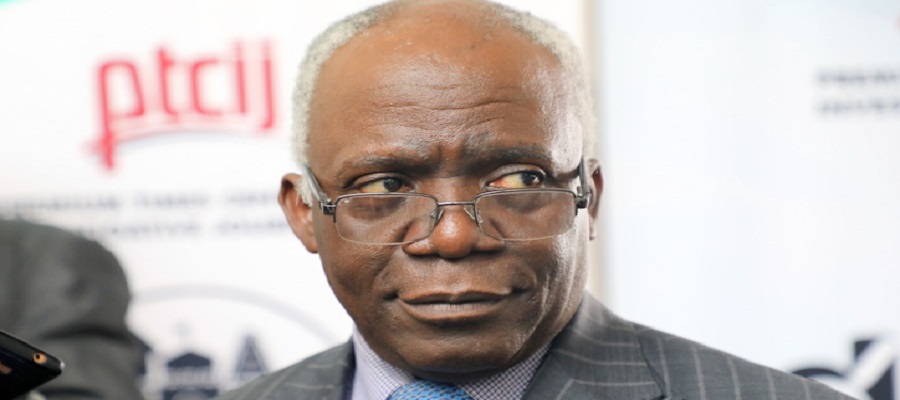
Management of Zinox Technologies Limited, foremost African digital conglomerate, has demanded public apology from Mr. Femi Falana SAN, over alleged defamation and reputational injury inflicted on the company and its representatives by Falana and his client, Benjamin Joseph, the CEO of Citadel Oracle Concept Limited, an Ibadan-based computer firm.

In a statement on Sunday, Zinox referenced recent news items in the media relating to certain charges filed by Falana, purporting to act on a fiat donated to him by Mr. Lateef Fagbemi SAN, attorney general and minister of Justice of the Federal Republic of Nigeria, whom Zinox said may not have been properly briefed.
“We are sure that if the circumstances of this case were made available to the respected Honorable Attorney General, Lateef Fagbemi SAN, he would not have granted the purported fiat to Femi Falana,” Zinox said in the statement.
In the news reports, Falana was said to have filed a suit before Honorable Justice A. O. Ebong of the FCT High Court in charge no. FCT/HC/CR/985/24 in November 2024, a suit Zinox said was based on the same claims which various courts had in the past dismissed as falsehood and baseless.

“Our initial reaction was to ignore these publications as the usual campaigns of calumny that have been orchestrated against Zinox since 2014 by one Mr. Benjamin Joseph, the Managing Director of Citadel Oracle Concept Ltd, the client of Mr. Femi Falana SAN. However, we are persuaded to respond by the consideration that once falsehood is sustained over time, it tends to acquire the garb of truth.”
Zinox said the case arose from a contract between Citadel and Technology Distributions Limited over the supply of computers to the Federal Inland Revenue Service (FIRS), stressing that the matter has no bearing whatsoever with Zinox and its promoter, Mr Leo Stan Ekeh.
“Firstly, we are shocked that Femi Falana would include Zinox in his purported fiat/charges, a company that has nothing to do with the transaction or allegations. For the records, we want to state as follows:
“Zinox has never been invited by any investigative agency, including the police and the EFCC, on these allegations. There is no report either by the police or the EFCC or any investigative agency where the name of Zinox was mentioned as a suspect. There is no judgment or ruling of any court where Zinox was mentioned as having anything to do, whatsoever, with the transaction or the allegations, the basis of the fiat/charges. Mr. Leo Stan Ekeh, the Chairman of Zinox, has never made any statement to the police in the course of any investigations and has never been mentioned in any court proceedings or judgment as part of any investigations relating to these allegations. Indeed, he has never met with Benjamin Joseph before,” the statement said.
Zinox cited instances in which Mr. Joseph lost the case and its adjunct suit. In a petition/case Mr. Joseph reported since 2013 and for which the Inspector General of Police charged him for false information in charge no.CR/216/16, he was unable to prove his allegations for more than 8 years .
In another case filed by the EFCC at his instance against his partner, Princess Kama, in charge no. FCT/HC/CR/244/2018, Honorable Justice Danlami Z. Senchi of the FCT High Court (as he then was), dismissed as false all the allegations made by Benjamin Joseph, and imposed the sum of N20 million as damages against him for false petitioning in relation to these same allegations.
Zinox alleged that the current charges said to have been filed by Falana on the basis of a fiat from the Attorney General is the third in a row as he had earlier filed charge no.CR/469/2022, which was struck out by Honorable Justice C. O. Oba of the FCT High Court, by an order dated 8th November 2022.
In what appears to be forum shopping and abuse of court process, “he filed the same charges before Honorable Justice A. S. Adepoju of the FCT High Court, which charges were, once more, struck out by the Honorable Court on 19th March 2024, with Honorable Justice Adepoju holding that: “This matter was brought in dead, extinct and should be confined into the dustbin of history…I hold that the instant suit is an abuse of the process of court and it is hereby struck out accordingly,” the statement said.
Zinox said it was shocked that a “learned Senior Advocate in the person of Femi Falana, would, yet, proceed to file the same charges before Honorable Justice A. O. Ebong of the FCT High Court in charge no. FCT/HC/CR/985/24 in November 2024.”
The statement said: “It is, therefore, very clear that the deliberate intention for instituting this new charge by Femi Falana SAN, to include the name of Zinox and its Chairman and other persons who were never part of the investigations, is to embarrass them, harm their reputation, and thereby damage their businesses. In the circumstance, we hereby demand a public apology from Mr. Femi Falana SAN, if he is unable to produce the evidence demanded above.
“We, therefore, assure all our business partners, stakeholders, and friends, that we are not ruffled by these spurious allegations. While our lawyers are set to defend the present charges purportedly filed by Femi Falana SAN, we shall not fail to explore all legal remedies against persons associated with the orchestration of these false allegations and publications against us,” Zinox said.



Glovo, a multi-category tech company, has announced its integration into the generative AI ecosystem with the launch of its “Shopping Assistant” for ChatGPT and Claude. Users can now discover retail products, compare prices, and seamlessly order any item using natural conversational language with the AI systems.

The Glovo experience inside such platforms introduces a conversational commerce model that shifts from a search-based web to an intent-based web. Rather than navigating traditional app menus and filters, users can express needs, such as asking for a “last-minute gift for a coffee lover under ₦50,000”, and the assistant handles semantic search, location validation, and product curation.
A Seamless, Concierge-Like Experience
Once both platforms have been connected through either ChatGPT or Claude apps, the user will be able to have a multi-turn dialogue where the assistant remembers context and constraints, such as budget caps. Users receive a visual carousel of up to five highly customised product options available at local stores. Each product displays its image, name, store details and ratings, and price. While the search and discovery experience takes place directly on the Generative AI platforms, selecting a product via the “view on Glovo” button takes the user to the Glovo mobile or web app, where the payment and final purchase are exclusively completed.
Strategic Focus on Retail and Growth
Glovo is prioritising the retail and grocery sectors for this initial launch, capturing the established habit of using AI for product research. Generative AI has driven a significant jump in retail traffic globally, so this first-mover advantage aims to meet customers where they are meeting Gen AI daily, and ensure it captures high-intent organic traffic as search behaviours evolve.
“We’re always looking for ways to meet our customers where they already are. Being available on Claude and ChatGPT means people can discover what Glovo has to offer as part of a natural conversation, with no friction. Glovo has always been about being the everyday app that provides choice and convenience, and this is another step in that direction”, said Shiro Theuri, Chief Technology Officer at Glovo.
How to look for products in the Glovo app through ChatGPT or Claude
- The user must sync ChatGPT or Claude with the Glovo app with the plug-in.
- Once synced, the user must type in @glovo followed by their request.
- The AI platform displays a carousel with 5 available options for the user.
- If the user wants to purchase any of the products or continue searching within the Glovo app, they must click “View on Glovo”, which will redirect the user to the Glovo app or website.
- After the order is confirmed, the store will prepare the item(s) and the courier will head up to the pick-up location. The user will receive the order in minutes.


Southeast Asia cybercrime networks are expanding operations into Africa as crackdowns intensify in the subregion, according to a recent report from the United Nations Office on Drugs and Crime (UNODC).

The massive, unintended geographic shift triggered by intense pressure from international task forces in Myanmar and Cambodia,have seen highly sophisticated criminal networks now establishing footholds in major tech hubs across Kenya and Nigeria, transforming local technical talent into accomplices for industrial-scale digital theft as reported by https://streamlinefeed.co.ke/
This strategic migration represents a critical evolution in the $17 billion crypto scam economy.
Transnational scam syndicates are organized criminal networks that run industrial-scale online fraud using trapped or trafficked labor.
The UNODC has documented this diversification, noting that African nations are increasingly targeted as operational bases due to robust internet infrastructure and a surplus of unemployed tech workers.
In response, local authorities are engaged in a frantic game of catch-up against well-funded foreign cartels.
Recall that in 2025, UNODC, described the shift as part of a broader trend in which crime “spreads like a cancer,” into regions with weaker enforcement and limited digital safeguards.
The report pointed to the rapid proliferation of online fraud operations, including cryptocurrency scams and phishing schemes, moving from countries like Myanmar and Cambodia into new footholds in Africa—particularly Nigeria.
A recent case publicized June 12, 2025 by the WeChat public account West Africa Chinese Voice illustrates the trend: Nigeria’s Economic and Financial Crimes Commission (EFCC) arrested 177 Chinese nationals in Lagos and Abuja between December 2024 and January 2025.
The suspects were allegedly running scam centers under the guise of corporate offices, where local Nigerians were trained to carry out online investment frauds—many following the “pig-butchering” model, which builds trust with victims before luring them into fraudulent crypto investments.
Authorities seized hundreds of SIM cards, high-performance computers, and prewritten scam scripts during the raids

Ugochukwu Eze, a 47 year-old man, was on Thursday arraigned before a Federal High Court in Lagos for allegedly hacking into the server of SunTrust Bank to steal a total of N800m.

Ugochukwu also known as Amazon, was arraigned before the court by the operatives of the Department of State Security (DSS).
DSS accused Ugochukwu of fraudulently hacking into the server of SunTrust Bank to remove and divert the sum of N800 million into several accounts in other financial institutions.
M. Bajela,prosecuting counsel, DSS, in the charges filed before the court alleged that the defendant and others now at large, between 2023 and 2026, conspired among themselves and unlawfully and seriously hindered the function of Suntrust Bank Plc’s computer system server and in the process fraudulently diverted over N800 million belonging to the bank.
Ugochukwu was also accused of concealing and transferring various sums of money traced to the unlawful cyber-attacks to some account in some financial institutions.
The offences alleged to have been committed by the defendant according to the prosecutor contravened sections 5; 6(1) and 8 of Cybercrimes (Prohibition, Prevention etc) Act, 2024. And Sections 10, 20 and 18(2)(D) of the Money Laundering (Prevention and Prohibition) Act, 2022.
The defendant pleaded not guilty to the allegations.
Based on his plea of not guilty, the prosecutor asked the court for a trial date, and prayed the court to remand the defendant in the facility of the correctional services pending the time trial will commence.
However, E. Afrogha, defendant’s lawyer, told the court that she has filed her client’s bail application. adding that her client has been in the DSS custody for over a month.
But the prosecution counsel told the court that he has not been served with the bail application, not withstanding that his witnesses are available.
Based on the counsels’ submissions, Justice Friday Ogazi, presiding judge, adjourned the matter to August 24,2026 for hearing of the bail application.
The judge also ordered that the defendant be remanded in the custody of the Nigerian Correctional Services (NCS) pending the hearing of the bail application.
One of the counts against the defendant reads: “That you UGOCHUKWU EZE (AKA AMAZON) (M) (47 YEARS) sometime between 2023 and 2026 in Lagos, and other places within the jurisdiction of this honourable court, unlawfully seriously hindered the function of SunTrust Bank Plc’s computer system, and in the process fraudulently diverted over N800, 000,000.00 (Eight Hundred Million Naira) belonging to the said SunTrust Bank thereby committed an offence contrary to and punishable under Section 8 of the cybercrime (prohibition, prevention etc.) Act, 2024.”

Glovo Pioneers AI Quick-Commerce

Fleeing Southeast Asia Scam Syndicates Find New Homes in Nigeria, Kenya- Report

DSS Arraigns Eze for Allegedly Hacking, Stealing N800m from SunTrust Bank

SEC Unveils Probate/Unclaimed Monies Clinic to Help Families Recover Inherited Investments

We have Multiple Layers of Protection for 281m Accounts in Nigeria – NDIC

From Scarcity to Scale: What Africa Can Learn from India’s Agricultural Transformation

EFCC Busts NIS Visa Overstay Racket, Uncovers N700m in an Account

BON Establishes Six Ad Hoc Committees to Modernize Broadcasting

How EFCC Turned Recovered Loot Into School Supplies for Thousands of Nigerian Students

BVN Enrollments Hit 69.55m- NIBSS




 E-Business3 days ago
Kaspersky Reveals a New Malicious Framework Targeting Cryptocurrency Users with the Use of OkoSpyware

 E-Business3 days ago
CMS T&M Launches TMO Rides to Enable a Faster & Cashless Transport Experience for CMS – Ajah Passengers

 E-Business3 days ago
Firm to recruit over 100 professionals to boost NRS e-Invoicing compliance

 E-Business3 days ago
Nigeria Tightens Data Privacy Compliance as FG Issues Directive to MDAs

 Telecom3 days ago
FG Commences 90,000km Fibre Optic Rollout within Weeks

 E-Financial2 days ago
Access Holdings Deepens Sustainable Finance Impact, Expanding Green Assets to ₦92.14 Billion

 Telecom3 days ago
Dimension Data to Channel Funds to Support Nigerian Fibre Expansion

 E-Financial3 days ago
Zenith Bank Confirms Cyberattack, Says Hackers Accessed Limited Customer Data