

E-Financial
Forex Time Demo Competition Reveals Market Ingenuity

Foreign exchange-Forex (trade) is the only market that, currency, is truly open 24 hours with decent liquidity throughout the day, with almost $5 trillion traded around the world. It shows the level of enticement, but not without enterprising spirit. In forex, currency obviously follows the sun.
With a laptop and connectivity, there is no limitation to making, except the traders (un)willingness to trade, consistently.
Meanwhile certain factors like the size, volatility and global structure of the foreign exchange market have all enhanced the performances.
For instance, investors are able to place extremely large trades without affecting any given exchange rate due to high liquid state of the market.
Actually, there are gains and pains, if you like risks, associated with the forex market. How can we define the market, distancing it from other markets?

What are the benefits and risks? How can one avoid lessen the risks? What is the place of Nigeria in the global table?
To provide answers these and more, Forex Time (FXTM), an international online forex broker with presence in Nigeria, recently organized a demo competition for journalists where ingenuities of the market prevailed.
First, FXTM is the brainchild of Andrey Dashin, a man whose business insight and entrepreneurial mind were the driving factors behind the success of his first company, Alpari.
The Company is known for offeing the best possible services to its clients. No doubt, Forex is fast becoming an extremely popular trading instrument for Nigerian investors, keen to profit from what now stands as the largest and most liquid market in the world.
“From day one, we have stated that Forex Time is here to provide the ultimate trading experience for clients,” Olga Rybalkina, CEO of Forex Time said, setting the tone of the Company’s operation in Nigeria.
Secondly, the company provides services to a wide range of different customer types including retail, business to business, institutional investors, portfolio management, introducers and in the near future, affiliates. The competency of FXTM is evident in a vast amount of trading instruments, platforms and accounts, is offers and tailored to the individual needs of clients.
Setting the tone of the competition, Mr. Olumide Ladipo, marketing manager, FXTM (Nigeria), disclosed that disclosed that the demo was intended to the overwhelming growing local interest in Forex, even the Company has embarked on one-of-a-kind free training course in professional Forex trading in Lagos, Abuja and Port Harcourt.
“Forex is an exciting and dynamic asset class to trade and it is important that any investors looking to trade take the time to educate themselves and truly understand how the market works before making any financial commitments,” he said.
He added that FXTM has instituted Forex Factor, suited to new traders or those who would like to improve their skills and test their strategies in a risk free environment, while experiencing FXTM’s world class products, top quality services and multi-lingual support.
Explaining on the philosophy behind forex, he defined the market as an international currency market with the language focused on money.
Therefore, companies trade in shares, so do countries trade in currency; unfortunately, the Nigerian Naira is yet to find its entry to the market due to instability. Apparently, ten major currencies rule the market, like the United States dollar (USD), Euro (EUR), Japanese Yen (JPY), etc.
Why Forex? Ladipo enumerated reasons the market has come to stay, such as, the high level of profitability with; safer than stock market shares; high liquidity as your capital remains; low start up entry cost and price stability is maintained with no central location which eliminates manipulations.
That does not imply forex is risk-free, just as the Marketing Manager stated, “Greed is the principal reason people record losses in the market. Thus, when the market opens at Sunday night, traders are advised to buy and sell based on their capabilities to avoid loses by Friday Night”.
Olugbenga Fagbohun, trainer & consultant, FXTM Nigeria, while explaining further on the technicalities, said that the one’s capital doled out for trading is like the collateral to take a loan from a bank. On taking the “loan” the trader is left with his intellectual alertness and assertiveness to reap from the boisterous market.
Thus, “Ask Price” is what the brokers like FXTM sell to the trader, while the “Bid” is what the seller (trader) sells to the broker. For example, it is possible for a trader to control a position of US$100,000 by putting down as little as US$1,000 up front and borrowing the remainder from his or her forex broker.
This amount of leverage acts as a double-edged sword because investors can realize large gains when rates make a small favorable change, but they also run the risk of a massive loss when the rates move against them. Despite the foreign exchange risks, the amount of leverage available in the forex market is what makes it attractive for many speculators. These were explained in details during the demo competition.
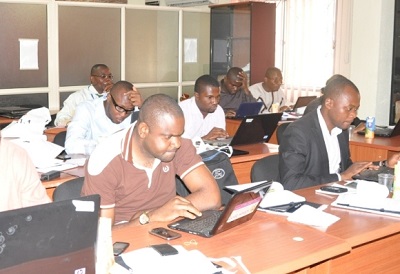
Meanwhile, the participants were presented with a virtual capital of $100,000. After the keenly contest, Obinna Chima of ThisDay Newspaper came first; Odinaka Mbonu (BusinessDay) was second and Kunle Binuyo from (Connect Nigeria) came third, winning different Samsung Galaxy phones.
Madu Nwegbu, IT manager, FXTM Nigeria, who provided the technical support for the “trader” emphasized that as FXTM rapidly grows from strength to strength on a global scale, the competition is a great way for novice traders around the world to get to grips with the forex world while honing in on their talent as they give it their best shot in the fun new demo challenge.
FXTM had in November 4, 2013 commenced a demo for interested trader where a talented trader receive a prize of $3000 credit in a live FXTM trading account, while a further eight runners up were recognised with prizes of trading credit.
The initiative is one which runs in line with the overall company ethos for innovation while always trying to find new ways to engage traders and increase knowledge about what it takes to be successful in forex trading today.
The demo contest is an excellent way for new clients to learn how to use the MT4 platform, come up with a personalized workable trading strategy, and get to know FXTM’s customer centric support and services.
FXTM is fully aware that no one customer is the same, and is dedicated to ensuring that each client’s individual needs and aspirations are catered for.
picture: contestants at the FXTM demo competition held in Lagos in December, 2013.


Nigerians lost N25.85 billion to digital payment fraud in 2025, according to Central Bank of Nigeria (CBN).

Though the figure represents a significant decline from the N52.26 billion recorded in 2024, CBN, said the losses remained substantial for payment service providers (PSPs).
According to the report, although the value of digital payment fraud declined significantly year-on-year, when compared to the N52.26 billion recorded in the previous year, the losses remained substantial for Payment Service Providers (PSPs), underscoring the need for stronger fraud prevention measures across the industry.
In the report, the CBN, also identified systemic risks, cyber threats, the dominance of a few systemically important payment service providers, and the activities of unlicensed payment companies as major concerns confronting the financial sector.
According to the report, although the value of digital payment fraud declined significantly year-on-year, the losses remained substantial for Payment Service Providers (PSPs), underscoring the need for stronger fraud prevention measures across the industry.
“Digital payment fraud in Nigeria stood at N25.85 billion in 2025,” the apex bank said.
It noted that while this represented a considerable improvement from the N52.26 billion lost in 2024, the amount remained significant.
“Though this was lower than N52.26 billion in the preceding year, it represented a substantial loss for PSPs,” the report stated.
The CBN attributed the reduction in fraud losses to enhanced security measures implemented across the financial sector.
It said, “The lower losses in 2025 reflected improvements in monitoring, BVN-NIN integration, and tighter controls.”
Beyond fraud, the report warned that Nigeria’s rapidly expanding digital payments landscape faces increasing systemic vulnerabilities as banks and fintech companies become more interconnected through shared payment infrastructure.
According to the report, a major operational failure involving a single payment service provider could quickly spread across the financial system because of the growing dependence on integrated payment platforms.
The CBN observed that despite ongoing efforts to strengthen payment system integration, interoperability remains a significant challenge.
It disclosed that about half of fintech stakeholders continued to express dissatisfaction with the current level of system-wide interoperability.
The report stated that “about 50.00 per cent of fintech stakeholders continued to rate system-wide interoperability as poor, primarily due to the lack of universal APIs and data-sharing standards.”
The apex bank also expressed concern over the concentration of payment activities among a few Systemically Important Payment Service (SIPS) providers, warning that operational failures involving any of them could have widespread consequences.
It explained that the failure of such providers could trigger a “domino effect”, where insolvency or operational glitches in one payment service provider spread rapidly to others, disrupting the smooth functioning of the financial system.
Cybersecurity also featured prominently among the risks identified in the report.
The CBN warned that payment service providers remain vulnerable to ransomware attacks, data breaches and credential theft, noting that cybercriminals are becoming increasingly sophisticated in targeting financial institutions.
According to the report, “Banking and fintech institutions remained prime targets for ransomware, data leaks, and credential theft.”
It added that, “Cyber threats in Nigeria are no longer random cybercrimes, but increasingly targeted, organised, and identity-driven campaigns.”
The report further cautioned Nigerians against transacting with unlicensed payment companies, stressing that such entities operate outside regulatory oversight and expose users to significant financial risks.
It warned that customers using unlicensed PSPs are not protected by existing regulatory safeguards and that such operators could facilitate illicit financial activities.
“Users of unlicensed PSPs are not covered by regulatory protection that comes with effective oversight and supervision,” the CBN said.
It further warned that, “Unlicenced payment companies are gateways for money laundering which could undermine regulatory efforts and corrode public trust.”
The report underscores the growing importance of strengthening fraud detection systems, improving payment infrastructure interoperability, enhancing cybersecurity resilience, and intensifying regulatory oversight as Nigeria continues to expand its digital payments ecosystem.

Nigeria Revenue Service (NRS) yesterday announced that medium and large companies in Nigeria that earn income from cryptocurrency and other virtual asset transactions will now be subject to a 30 per cent corporate income tax.

NRS stated this in its new guidelines setting out a tax framework for cryptocurrency and other digital asset transactions.
The guidelines cover registration, record-keeping, valuation, and tax treatment for VASPs, P2P operators, and individuals in the virtual asset space.
NRS said the move is aimed at encouraging voluntary compliance and improving transparency as Nigeria’s digital asset sector grows.
The Guidelines on the Taxation of Virtual Assets, provide a comprehensive framework for the taxation of virtual asset transactions and businesses operating within Nigeria’s digital economy.
The guidelines apply to companies, individual taxpayers, Virtual Asset Service Providers (VASPs), peer-to-peer (P2P) marketplace operators and other participants in the virtual asset ecosystem
The latest framework follows the signing of the Presidential Executive Order on Virtual Assets Coordination, 2026 by President Bola Tinubu, which established a coordinated regulatory structure for cryptocurrencies, stablecoins, tokenised assets and other digital assets across government agencies.
According to the NRS, companies that derive profits from virtual asset activities will be taxed under the provisions of the Nigeria Tax Act (NTA), 2025. While small companies will continue to enjoy applicable tax exemptions under the law, medium and large companies will be liable to the standard 30 per cent corporate income tax rate.
The agency stated that taxable income under the guidelines covers a broad range of virtual asset-related activities, including cryptocurrency trading, the operation of virtual asset exchanges, transaction fees, brokerage commissions, custody and wallet services, token issuance, mining, staking, decentralised finance (DeFi) activities, investment gains and other virtual asset business operations.
According to the guidelines, “Applicable rates under the NTA include progressive rates for individuals, and 30 per cent for companies other than small companies.”
The NRS said the guidelines were introduced to provide clarity, certainty and consistency in the administration of Nigeria’s tax laws as they apply to virtual assets, adding that the framework is intended to improve transparency, encourage voluntary tax compliance and support the development of an efficient tax regime for the digital asset sector.
The agency also clarified that merely holding cryptocurrencies or other virtual assets does not constitute a taxable event.
Any appreciation in the value of a digital asset while it remains in a taxpayer’s possession will not attract income tax until the asset is sold, exchanged or otherwise disposed of through a taxable transaction.
Similarly, transfers of cryptocurrencies or other virtual assets between wallets owned and controlled by the same individual are exempt from income tax, provided there is no change in beneficial ownership.
This means that moving digital assets such as Bitcoin or Ether between personal wallets will not trigger a tax liability.
However, the exemption does not extend to transfers involving companies, partnerships, trusts, unincorporated associations or other legal entities, where different tax rules may apply.
The NRS further explained that although these non-taxable transactions do not attract immediate tax, they establish the acquisition cost for future disposals.
Consequently, taxpayers are required to maintain adequate records of acquisitions, transfers and disposals to facilitate accurate tax computations when taxable events occur.
The guidelines also reaffirm that unrealised gains on cryptocurrencies and other virtual assets are not subject to income tax. Instead, tax liability arises only when a taxable disposal takes place, aligning Nigeria’s approach with internationally recognised principles for the taxation of digital assets.
The issuance of the guidelines is expected to provide greater regulatory certainty for investors, businesses and digital asset service providers, while strengthening the government’s efforts to expand the tax base and improve compliance in Nigeria’s growing virtual asset ecosystem.


As more Nigerians adopt digital financial services, fraudsters are also finding new ways to target unsuspecting users. Nigeria has recorded more than 24.1 million compromised online accounts since 2004, with hundreds of thousands of additional cases reported in early 2026. While these figures are not limited to financial accounts, they highlight the growing exposure of personal information and login credentials online.

Fraudsters often use phishing links, impersonation and other social-engineering tactics to trick people into revealing sensitive information such as passwords, OTPs, BVN or NIN details.
To help users strengthen the security of their accounts, PalmPay provides a range of built-in protection tools. One of these is the Transaction Guard.
The feature enables users to set single, daily, or monthly transaction limits. Whenever a transaction exceeds that limit, an additional verification step; facial verification- is required before it can be completed. This helps reduce the risk of unauthorized transfers, even if an account has been compromised.
Here’s how Transaction Guard helps keep your money safe:
- Keeps User in Control
The feature gives you greater control over your account by ensuring that higher-value transactions require your facial verification before they are processed. Transaction Guard requires facial verification before eligible transactions are completed, making it harder for unauthorized users to move your funds.
- Helps Mitigate Account Takeovers
Even if your login credentials or OTP are compromised, Transaction Guard helps limit potential losses by requiring an additional verification step that fraudsters cannot easily complete.
- Reduces the Risk of Fraud
By activating this security checkpoint, Transaction Guard helps protect users against common fraud attempts, giving them greater confidence when faced with scam attacks.
In a recent interview, Femi Hanson, Head of Marketing, PalmPay said: “Nigerians are increasingly embracing digital payments in their everyday lives hence maintaining trust and confidence of users must remain a top priority. Today, security is just as important as speed and convenience. That’s why PalmPa is continuously investing in solutions that give our customers greater control over their finances. Transaction Guard is one of those security features we’ve introduced to help users add an extra layer of protection to their accounts and mitigate fraud.”
How to Activate Transaction Guard
Activating Transaction Guard is quick and easy. Simply open the PalmPay app, go to Profile, tap Security Center, select Transaction Guard, switch it on, and complete the verification process.
As digital payments become embedded in everyday life, taking advantage of built-in security features can make a significant difference. By enabling Transaction Guard, PalmPay users can better protect their accounts and enjoy a safer, more secure digital banking experience.

NBC Files Fresh Appeal against Judgment Barring it from Imposing Fines on Broadcast Stations

Nigerians Lost N25.85Bn to Digital Payment Fraud in 2025 –CBN

NRS Announces 30 Percent Tax on Corporate Crypto Income

Kaspersky Identifies Cyberespionage as a Growing Threat Across Africa, Others

PalmPay’s Transaction Guard Gives Users More Control, As Fraud Tactics Evolve

NRC, Ponzi Scheme Collapses Resulting Loss of Billions of Naira

From Scarcity to Scale: What Africa Can Learn from India’s Agricultural Transformation

EFCC Busts NIS Visa Overstay Racket, Uncovers N700m in an Account

BON Establishes Six Ad Hoc Committees to Modernize Broadcasting

Tokenization, Blockchain Technology will Transform Financial Institutions – IMF




 News2 days ago
Atte, Nigerian Develops AI Algorithm for Hair Transplants

 E-Financial2 days ago
FCT Court Awards Ex-Customers N15m against Stanbic IBTC over Data Privacy Breach

 News2 days ago
FG to Abolish Subsidies in Power Sector in 2027 – Minister

 E-Financial2 days ago
CBN Exposes over 13,000 BVNs Tied to Fraud as Banks Tighten Security

 General News2 days ago
Dare Tackles Onaiyekan over Criticism of Tinubu, Says Economic is Working

 Telecom2 days ago
Starbase Technologies Introduces Yolly, a Reward-Based Social Entertainment Platform

 General News2 days ago
SERAP Asks Tinubu to Probe Alleged N6.79Bn Missing Police Funds, Firearms

 Telecom2 days ago
Adefolarin Ogunsanya and the Allegations of Shareholder Interference and Self-dealing @Pan African Towers