

General News
Why the End-to-End Journey Matters to Customers


Gone are the days when the customer purchasing journey was a simple, neat linear one from point A to B. Indeed, the process between these two points has become a great deal more complex with the wide array of technologies and purchasing channels available to modern customers.

Think about it. If you want to buy a household appliance like a washing machine, for example, or book a service online, how likely is it that you’ll head straight to the nearest appliance store, or book the very first service you come across while online?
Chances are you’ll start with a search and compare reviews and prices across multiple sites. You might even check customer reviews to see what other people have to say about a service or product, before deciding whether or not it’s worth paying for.
In between becoming aware of a service or a product and deciding to pay for it, a customer can go on several searches, make mistakes, abandon the process before picking it up again, and switch channels. It’s still a journey, but more of a complicated path with twists, turns and detours.
The importance of a customer’s end-to-end journey is well-established in a number of industries, particularly those in the services space. These businesses know that, once they’ve landed a customer, they have to work hard to attract and retain them.
In a world where online is taking an increasingly large slice of the retail pie (data shows that e-commerce spending in Nigeria is growing so rapidly that it’s expected to outperform the global average), companies that understand that the customer journey starts long before they decide to buy something and ends a long time after they’ve paid for the product or service, will be rewarded.
“The key is to constantly look at how to offer real customer value, with a special focus on being there if and when a customer needs you,” says Awazi Angbalaga, Country Manager for SweepSouth, an online home services company through which customers are able to book domestic workers to clean their homes.
“Being able to quickly find a reliable and efficient domestic worker has long been a problem for many people. SweepSouth offers a quick and convenient way to book a trustworthy, thoroughly vetted and excellent cleaner for a time and day that best suits you.” says Angbalaga.
“Clients love the fact that not only do we provide good service, we provide them accountability that was otherwise lacking in other working arrangements they have had in the past to solve for their home cleaning needs. Customers can give SweepStars (the workers on the SweepSouth platform) ratings for other clients to see. We also have a support team on standby if a problem occurs.
Angbalaga adds that the company is well aware that customers are also more likely to recommend brands that have given them a good customer experience to friends and family, making it a crucial way of growing the customer base and revenue.”
The rewards for ensuring that customers have the best possible experience at every point in their journey are significant. Research shows that not only are customers willing to pay more for a great customer experience but that they’ll remain loyal too. That’s crucial, given that up to 65% of a company’s business can come from existing customers.
Companies can reap those rewards if they put in the effort to ensure that the customer has the best possible experience throughout their journey and beyond. And in a world where customers have an array of choices available to them, providing those kinds of experiences isn’t just a nice-to-have, it’s an imperative.


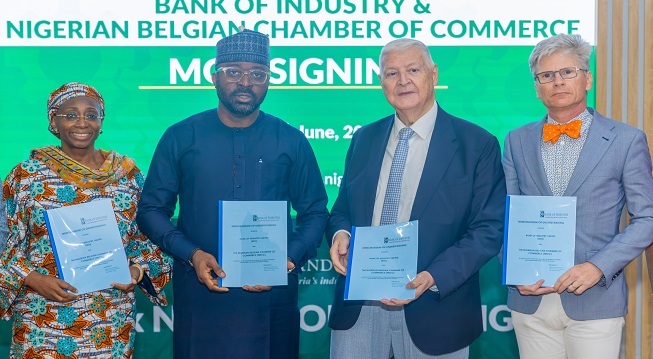
The Bank of Industry (BoI), Nigeria’s foremost Development Finance Institution (DFI), has signed a landmark Memorandum of Understanding (MoU) with the Nigerian Belgian Chamber of Commerce (NBCC), setting the stage for deeper economic cooperation, expanded investment flows, and stronger industrial partnerships between Nigeria and Belgium.

The agreement was signed during a high-level breakfast meeting jointly hosted by BoI and the NBCC under the theme, “Scaling Operations, Expanding Capacity, and Accessing Competitive Finance.” The event convened senior government officials, diplomats, business leaders, development partners, MSMEs, and private sector stakeholders committed to advancing bilateral trade and industrial development.
Speaking on behalf of the Managing Director and Chief Executive Officer of the Bank of Industry, Dr. Olasupo Olusi, the Executive Director, Corporate Finance, Sustainability and Investments, Mr. Rotimi Akinde, described the partnership as a strategic milestone in BoI’s drive to expand global collaborations that accelerate Nigeria’s industrial transformation.
“As Nigeria’s leading Development Finance Institution, the Bank of Industry has consistently recognised that sustainable industrial development is built not only on access to finance but also on enduring strategic partnerships.
“This collaboration with the Nigerian Belgian Chamber of Commerce reflects our commitment to creating stronger international business corridors that unlock investment, facilitate technology transfer, support MSMEs, and strengthen Nigeria’s industrial competitiveness,” he said.
Akinde noted that Belgium remains one of Europe’s most dynamic trading and investment destinations, making the partnership an important platform for promoting co-investment opportunities, export development, enterprise growth, and knowledge exchange between businesses in both countries.
The two-year renewable MoU establishes a framework for joint business forums, investment roadshows, trade missions, business matchmaking, enterprise capacity development, and increased promotion of BoI’s financing solutions to Belgian investors and businesses operating in Nigeria.
The collaboration is also expected to improve access to foreign direct investment, expand export-oriented industrial projects, and create stronger commercial linkages between BoI-supported enterprises and the Belgian business community.
Delivering the welcome address, His Excellency Pieter Leenknegt, Ambassador of the Kingdom of Belgium to Nigeria, commended the growing economic relationship between both countries and expressed optimism that the partnership would create new opportunities for businesses on both sides.
The General Manager of the Nigerian Belgian Chamber of Commerce, Marc Eeckhout, described the agreement as a practical platform for translating business interest into measurable economic outcomes.
“This Memorandum of Understanding represents more than an institutional partnership; it creates a structured bridge between Belgian innovation and Nigerian enterprise. By working closely with the Bank of Industry, we are opening new pathways for investment, technology exchange, and business collaboration that will enable companies from both countries to scale with confidence while contributing to sustainable industrial development,” he said.
The breakfast dialogue featured presentations on business expansion, industrial financing, and competitiveness, with contributions from industry leaders, including Engr. Vincent Adegbotolu, Managing Director/CEO of DWC Engineering, and Mudiaga Okumagba, Managing Director/Chief Executive Officer of Direct Logistics Plus.
The partnership aligns with BoI’s 2025–2027 Corporate Strategy, which prioritises industrialisation, MSME development, youth and skills, women’s economic empowerment, climate finance, digital transformation, infrastructure, and export promotion. With assets valued at over ₦6.8 trillion, the Bank continues to strengthen strategic international partnerships that support the Federal Government’s industrialisation agenda while creating jobs, enhancing productivity, and promoting sustainable economic growth.
Through the collaboration, BoI expects to attract new investment opportunities from the Belgian business ecosystem, increase financing for high-impact industrial projects, strengthen export value chains, and improve the investment readiness of Nigerian enterprises through joint advisory and capacity-building initiatives.
The Bank reaffirmed its commitment to working with global partners to unlock long-term capital, accelerate industrial growth, and position Nigeria as a competitive investment destination within Africa and beyond.


Federal government has announced plans to end the separation between Junior Secondary School (JSS) and Senior Secondary School (SSS) as part of efforts to improve school retention and reduce the high number of pupils dropping out before completing secondary education.

Tunji Alausa, minister of Education
Tunji Alausa, minister of Education, announced the proposal on Tuesday during the inauguration of the Ministerial Implementation and Monitoring Committee of the Universal Basic Education Commission (UBEC) in Abuja.
Alausa said the existing “disarticulation policy,” which requires junior and senior secondary schools to operate independently with separate principals, management structures and facilities, has failed to achieve its intended objectives and has instead worsened access to education.
According to him, the Federal Government will present a proposal to abolish the policy at the next meeting of the National Council on Education (NCE), the country’s highest education policymaking body.
“We have 20 million dropouts from primary school to JSS. Where are those students?” the minister queried.
“We also found we have 80,000 public primary schools and only about 15,000 junior secondary schools. That’s a one-to-eight ratio.”
He explained that the mismatch between the number of primary and junior secondary schools has created severe bottlenecks in the education system, leading to overcrowded classrooms at the junior secondary level while many senior secondary school facilities remain underutilised.
Alausa cited Kaduna and several northern states as examples where the policy has contributed to poor transition rates between basic and secondary education.
“This disarticulation policy has failed. We will phase it out. We can’t be creating positions because we want to create director-level appointments for people while we harm our education system. It’s about doing what is best for every Nigerian child,” he said.
The minister said the proposed reform forms part of broader efforts by the Tinubu administration to improve access to education, increase retention rates and enhance learning outcomes across the country.
He acknowledged previous shortcomings in tackling the out-of-school children crisis but expressed confidence that the current administration would reverse the trend.
“This government will not fail. We are fixing it,” Alausa declared.
At the ceremony, the minister also inaugurated the UBEC Ministerial Implementation and Monitoring Committee, chaired by Prof. Rashid Aderinoye, to supervise the execution of UBEC-funded Smart Schools, Bilingual Schools and Alternative Schools nationwide.
He said the committee had been tasked with ensuring that the projects are completed, handed over to state governments and opened for teaching and learning.
Although UBEC has invested in hundreds of Smart Schools and related educational projects across the country, Alausa lamented that many remain abandoned, unfinished or yet to admit pupils, describing the situation as an unacceptable waste of public resources.
He stressed that improving education requires more than constructing schools, insisting that completed facilities must become fully operational and accessible to learners.

Federal government has said that it plans to establish a National Skills Database as part of efforts to reduce unemployment, address the growing mismatch between available skills and industry needs, and strengthen workforce planning through data-driven policies.

The proposed database, to be developed under a Nigerian Skills Observatory, is expected to provide real-time information on the supply and demand of skills across sectors, enabling better job matching, improved policy formulation and targeted investments.
The plan was unveiled at the second National Skills and Industry Alignment Roundtable Series held in Abuja with the theme, “The Role of Data in Job Creation, Coordination and Linkages.”
Delivering the keynote address, Yemi Kale, group chief economist and managing director of Research and Trade Intelligence, Afreximbank, said Nigeria’s labour market challenge was no longer the absence of data but the inability to convert existing information into actionable intelligence.
“The challenge for us as a nation is not one of data accumulation. It is one of data integration and intelligence,” Kale said.
He explained that although vast amounts of information on education, employment, wages and skills development already exist across government agencies, educational institutions and the private sector, the data remains fragmented, making effective labour market planning difficult.
“Data tells you what exists. Intelligence tells you what is happening, what is likely to happen next and what actions should be taken,” he said.
Kale lamented that while Nigeria produces thousands of graduates annually, employers in critical sectors continue to struggle to recruit qualified workers, even as millions of Nigerians remain unemployed or underemployed.
“The problem is that employers are searching, workers are searching, policymakers are searching and investors are searching independently rather than collectively. Opportunities that should be visible remain hidden because the information needed to connect them is fragmented,” he said.
According to him, the disconnect has created structural inefficiencies that discourage investment, suppress productivity and prevent Nigeria from fully leveraging its youthful population.
He added that countries that successfully transformed their economies deliberately aligned education, skills development and workforce planning with the needs of industry.
Kale urged Nigeria to view its youthful population as an economic asset by ensuring young people acquire skills demanded by modern industries.
Speaking on the proposed National Skills Database, Rimam Nuhu, special assistant to the President on Workforce Development, said the platform would serve as the foundation of the Nigerian Skills Observatory.
“At the most foundational level, the Skills Observatory is to create a database on the demand and supply of skills,” Nuhu said.
He explained that the National Council on Skills, chaired by Vice President Kashim Shettima, would rely on data generated by the observatory to formulate evidence-based policies on workforce development.
“Skills development is an input for job creation. We have a market where there are a lot of skills mismatches. Understanding exactly where those shortages exist will help us plan better and improve workforce planning.
“Ultimately, that contributes to a more productive economy,” he added.
Nuhu acknowledged ongoing debates over whether Nigeria is facing an actual shortage of skilled workers or merely a mismatch between available skills and labour market demand, stressing that the database would provide the evidence needed to guide interventions.
Earlier, Akubo Adegbe, senior special assistant to the President on Coordination and Delivery, said the roundtable was convened to tackle the fragmentation of labour market information across government institutions and the private sector.
He noted that despite huge volumes of workforce data being generated daily, the lack of coordination often leaves policymakers without a comprehensive understanding of labour market realities.
“If our first Roundtable challenged us to better align skills with industry, this second Roundtable challenges us to better align information with action,” Adegbe said.
Also speaking, Massimo De Luca, head of Cooperation at the European Union Delegation to Nigeria and ECOWAS, said the EU would continue supporting Nigeria’s efforts to build a labour market capable of meeting investors’ needs.
“We have a shortage of skilled labour when it comes to big investment projects. On the other hand, we have a lot of untapped talent that is not adequately recognised.
“Those are realities that investors take into account,” De Luca said.
He commended the Office of the Vice President for leading reforms aimed at strengthening Nigeria’s skills development ecosystem.
The Federal Government’s plan comes amid persistent unemployment and skills mismatch in Nigeria, where many graduates remain jobless despite employers reporting shortages of qualified workers in critical sectors.
The National Skills Database will serve as the foundation of the proposed Nigerian Skills Observatory, an initiative designed to provide real-time labour market data to guide workforce planning, skills development and evidence-based job creation policies.

World Bank Okays New $1.25Bn Loan for Nigeria

Xenophobia: MTN Nigeria Belongs to Nigerians, Not Only South Africans — Toriola

SEC Grants Approval to Luno, Other Crypto Firms under Regulatory Sandbox

MTN Nigeria Celebrates Volunteers at Y’ello Care Impact Showcase

Listicle: 10 Essential Meta Safety Tools Every Parent and Teen Should Know

Mobile Internet Gender Gap Widest in Africa – GSMA

London Strengthens Global Investment Ties with Africa @ First Ever London-Africa Business Summit

FG Targets Alleged N3tn Capital Flight, Opens Airtime Credit Market to Nigerian Fintechs

Nigeria Launches FreeTV Nationwide

NASENI Trains 50 Women in Kano on Renewable Energy Technologies Under She-Powers Initiative



 Telecom2 days ago
MTN Foundation, Microsoft Empower Nigerian Educators with AI Integration Skills

 Telecom2 days ago
NCC Raises Alarm as Nigeria Lags in Fibre Internet, Pushes for Urgent Expansion

 E-Financial3 days ago
UBA Surprises Thousands of Customers with Over ₦400 Million Cash Bonus

 Telecom2 days ago
Airtel Nigeria CEO Urges Adoption of Intelligent Technology Platforms to Accelerate National Growth

 Broadcasting2 days ago
Spotify partners Afro Nation Portugal to expand African music experience

 E-Financial2 days ago
CBN Cracks Down, Revokes Licences of 46 Microfinance Banks

 E-Business2 days ago
Report Reveals More than Half of Users Encountered Fraud or Scams Online

 Telecom2 days ago
Google Rolls Out Fresh AI Projects Across Africa, Opens New Innovation Hub