

Telecom
22 Institutions, Others Set to Enjoy N16.7bn Broadband Access Projects

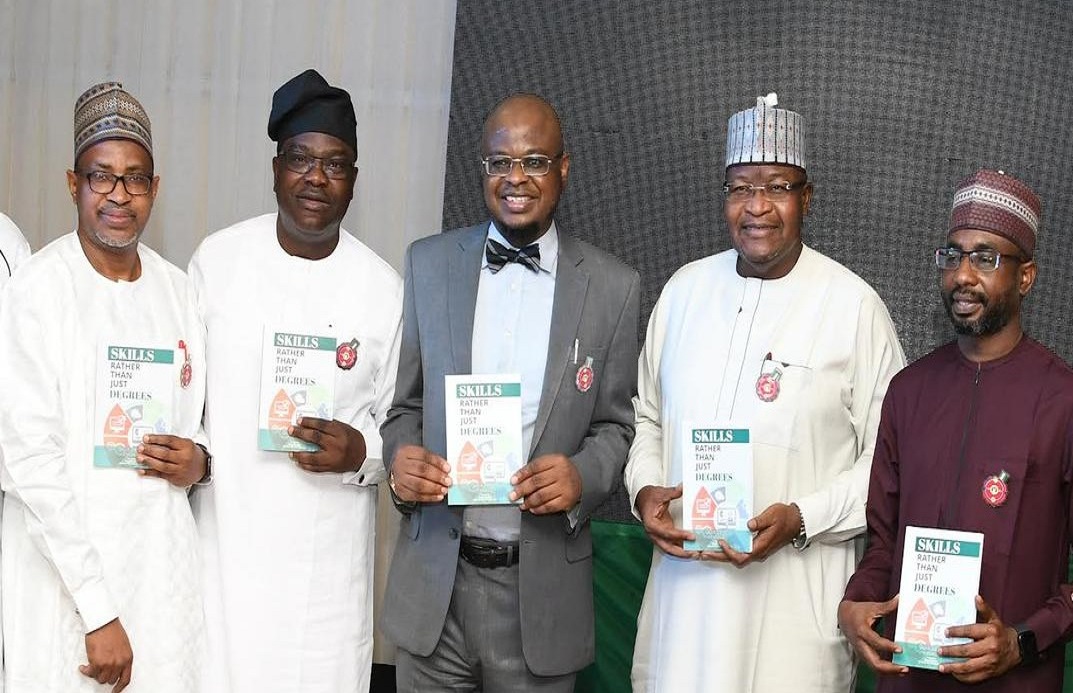
More than 22 institutions in the country, comprising 18 universities, and six polytechnics, Micro, Small and Medium Enterprises (MSME), drawn evenly from the six geopolitical zones in the country, have benefited from a Federal Government’s broadband infrastructure projects designed to accelerate the Nigeria Digital Economy efforts.

L-R: Prof. Muhammed Abubakar, Managing Director, Galaxy Backbone; Prof. Adeolu Akande, Chairman, Board of Commissioners, Nigerian Communications Commission (NCC); Prof. Isa Ali Ibrahim Pantami, Minister of Communications and Digital Economy; Prof. Umar Garba Danbatta, Executive Vice Chairman/CEO, NCC and Mr. Kashifu Abdullahi, Director General, National Information Technology Development Agency, at the launch of Information Technology infrastructure projects for small businesses and public presentation of a book by the Minister in Abuja on Thursday.
At the unveiling of the projects being driven by the Nigerian Communications Commission (NCC), which held at the Transcorp Hilton, Abuja, Minister of Communications and Digital Economy, Prof Isa Ali Ibrahim Pantami, who presided over the event, said the projects underscores the importance of broadband connectivity and access as central to the accomplishment of the targets of the National Digital Economy Policy and Strategy (NDEPS) 2020-2030 for a digital Nigeria, and that the project is in line with the mandates of President Muhammadu Buhari on job creation and economic diversification.
Pantami, who was joined by the Minister of Federal Capital Territory (FCT), Mallam Mohammed Bello at the event, disclosed that the key infrastructure being provided for the project, comprise of broadband infrastructure for tertiary institutions of learning; broadband infrastructure for MSME; distribution of 6,000 e-pad tablets, in addition to provision of broadband connectivity to 20 markets as a pilot.
He said the interest in supporting the MSMEs is justified by their current contribution of more than half of Nigeria’s Gross Domestic Product (GDP) prior to COVID-19 outbreak, and now constitute 96.7 per cent of entire businesses in the country, and therefore, “any effort to develop our economy without bringing such important sector into the equation will amount to efforts in futility.”
At the event, which had in attendance the Chairman of the Board of the NCC, Prof. Adeolu Akande; the Executive Vice Chairman of the Commission, Prof. Umar Danbatta; the Executive Secretary, National Universities Commission (NUC), Prof. Abubakar Rasheed; and the Executive Secretary, National Board for Technical Education (NBTE), Prof Idris Bugaje, a book authored by Pantami, titled “Skills Rather Than Just Degrees” with foreword written by Brad Smith, President of Microsoft Corporation, was unveiled for the industry.
Pantami said the book is his intellectual contribution to bridging skills gap to enable Nigerians to tap into the opportunities that exist in Information and Communications Technology (ICT) and other sectors of the economy.
The book was reviewed by three different Vice Chancellors – Prof. Muhammad Abdulazeez of Abubakar Tafawa Balewa University, Bauchi; Prof Owuanari Georgewill of University of Port Harcourt; and Prof. Sagir Adamu Abbas of Bayero University Kano, who commended the efforts of the Minister in putting his thoughts and experience to paper. They recommended the book, which they commended highly.
In their comments, NCC’s Akande and Danbatta, corroborated that the project will fast-track and enhance the ongoing efforts of the NCC’s to deepen connectivity towards achieving the targeted broadband penetration of 70 per cent by 2025.
NCC’s Chairman, Prof. Akande, assured of the commitment of the Commission in completing the projects, which will add the necessary fillip to achieving the major objectives spelt out in the NDEPS, 2020-2030.
The EVC of NCC, Prof. Danbatta, highlighted the Commission’s drive towards deepening broadband penetration in the country and the promotion of digital skills acquisition to improve service delivery in other sectors of the economy, including education, commerce, healthcare, agriculture, finance, transportation, governance, among others.
The event attracted so many stakeholders especially from the academia, as well as technology enthusiasts, including prospective start-up companies, fintech organisations and other interested sectors whose activities are billed to be energized through diligent implementation of the NDEPS and other extant policies guiding the digital economy agenda of the Nigerian government.


Nigerian Communications Commission (NCC) has linked Quality of Service (QoS) challenges across telecom networks to rising data consumption, stating that operators are ramping up efforts to sustain investments to improve coverage and capacity.

Dr Aminu Maida, executive vice chairman, NCC,
Dr Aminu Maida, executive vice chairman, NCC, stated this during a breakfast meeting with the media in Abuja on Friday, where he noted that while service quality is improving, it is yet to meet regulatory expectations.
He said recent data shows positive signals from independent user-based measurements, indicating that network performance is getting better rather than deteriorating.
However, he explained that increased usage is offsetting gains, creating a cycle where improved services trigger higher demand, which in turn puts fresh pressure on infrastructure.
“We’re still not where we want to be, but are we satisfied as a regulator? I would say within the context for which we operate, I think the area of satisfaction is the fact that we’re beginning to see the right signals. But at the same time, we also see a rise in consumption. So it’s like a cycle. As they’re making investments and making upgrades, people are consuming more,” he said.
Maida disclosed that data consumption has risen by about 170 per cent in the last two years, describing the surge as a major factor behind network strain.
The EVC added that operators are responding with increased investments, with site upgrades expected to rise significantly this year to expand both coverage and capacity.
He also highlighted regulatory efforts to improve industry sustainability, including ongoing policy reviews, cybersecurity framework implementation, and collaboration with security agencies to protect telecom infrastructure.

Nigeria’s drive toward a fully digital economy is gathering pace as the Federal Government intensifies work on e-governance and digital economy bill to strengthen the regulatory framework for emerging technologies and boost public sector innovation.

The Director General of the National Information Technology Development Agency (NITDA), Kashifu Inuwa Abdullahi, CCIE, represented the Minister of Communications, Innovation and Digital Economy, Dr. Bosun Tijani, at the Global Partnership for Human-Centric ICT Standardisation (GIST) Nigeria Introductory Stakeholder Workshop in Abuja.
At the Global Partnership for Human-Centric ICT Standardisation (GIST) Nigeria Introductory Stakeholder Workshop in Abuja, the Director-General of the National Information Technology Development Agency (NITDA), Kashifu Inuwa representing the Minister of Communications, Innovation and Digital Economy, Bosun Tijani said the country has moved beyond strategy design to implementation of its national Artificial Intelligence (AI) roadmap.
He noted that the current phase focuses on developing clear guidelines and regulatory frameworks to ensure AI deployment aligns with ethical standards, accountability, and strong safeguards.
As part of the broader digital transformation agenda, the government is also advancing data classification efforts to ensure the availability of clean, reliable datasets for AI training. In parallel, it is promoting cloud adoption across public institutions to enhance efficiency, scalability, and service delivery.
Inuwa stressed the importance of a “cloud-first” policy, warning that continued dependence on premise systems could slow large scale digital transformation. However, he added that cloud integration would be approached cautiously to safeguard Nigeria’s digital sovereignty and protect critical national data.
Progress is also being recorded in the e-governance space, with the development of an interoperability framework and the Nigerian Government Enterprise Architecture. Additionally, work is ongoing on a data exchange platform to support Government Statistics Digital Public Infrastructure (DPI), aimed at improving data sharing and coordination among Ministries, Departments, and Agencies (MDAs).
The initiative is expected to harmonise public sector digital projects while creating opportunities for private sector participation.
Inuwa stressed the need for stronger collaboration among government, industry, and other stakeholders to build resilient digital infrastructure. He expressed confidence that the proposed legislation and related initiatives would enhance Nigeria’s standing in digital governance while promoting innovation, transparency, and inclusive growth.
Earlier, the European Commission’s Team Leader for Digital Governance, Peter Marien DG INTPA, highlighted the role of international cooperation in shaping global digital standards. He said the European Union’s digital strategy prioritises partnerships and ecosystem alignment across regions, including Nigeria and the United Kingdom.
Marien referenced a recent engagement in Brussels on e-governance, organised with Smart Africa, which included participation from NITDA. He described Nigeria’s involvement in the GIST initiative as a strong signal of its commitment to global digital governance.
He emphasised the EU’s focus on a human-centric digital ecosystem that prioritises inclusivity, privacy, and security, noting that its 27 member states have, over two decades, built a cohesive digital framework centred on citizens.
Marien also identified Nigeria as a strategic player in Africa’s quest for a unified digital market, highlighting its role in advancing cross-border digital integration.
According to him, standards serve as the “invisible backbone” of modern societies, supporting critical systems across sectors. He said the GIST platform enables alignment of technical standards and fosters knowledge exchange between regions.

Google has revealed new insights showing that Nigerians are increasingly leveraging Search and artificial intelligence tools to develop creative skills and explore artistic pursuits in 2026.

Google AI
According to the latest trends for March, there is a growing shift toward using technology as a practical assistant for personal growth, learning and creative expression across the country.
Nigeria’s longstanding reputation as a creative powerhouse continues to shape this trend. From the global dominance of Afrobeats to the rise of Nollywood—now ranked as the fifth-largest film industry globally—the country’s cultural influence remains strong. Industry data shows Nollywood’s value is approaching $8 billion, with over 70 per cent of viewership for Nigerian-produced content coming from international audiences. Similarly, Afrobeats continues its global surge, recording more than 13 billion streams annually on platforms like Spotify.
Google’s data indicates that Nigerians are deliberately using digital tools to sharpen their creative abilities. Interest in learning painting has surged by 90 per cent over the past year, while calligraphy has emerged as a breakout trend, reflecting new forms of artistic exploration.
Music-related learning is also on the rise, with searches for guitar lessons increasing by 80 per cent. At the same time, users are exploring emerging AI-powered tools such as Lyria 3, highlighting a blend of creativity and advanced technology.
Beyond the arts, Nigerians are turning to digital tools to broaden global connections. Interest in learning Italian has jumped by 130 per cent, while searches for Japanese language learning have doubled within the past year.
This growing appetite for digital learning is supported by Nigeria’s expanding tech-driven economy. Research by Public First suggests that every dollar invested in digital technology generates more than eight dollars in economic value. The ICT sector has also emerged as a key contributor, accounting for over 16 per cent of the country’s real GDP.
Students and families are equally tapping into AI-powered tools for education. Searches for AI tutors have become a breakout trend, while interest in combining AI with subjects like chemistry has doubled over the past year. Homework-related searches have also risen by 70 per cent.
These developments are being bolstered by improved digital infrastructure, including projects such as the Equiano subsea cable, which significantly increases internet capacity and connectivity across the region.
Commenting on the trend, Taiwo Kola-Ogunlade said it is encouraging to see Nigerians using AI creatively to unlock new opportunities.
He noted that the rise in creative arts and language learning reflects a population actively shaping its future with technology, using AI tools as “24/7 tutors” to build skills and connect globally.
Google added that tools such as Search and Workspace are already delivering measurable productivity gains, with Nigerian knowledge workers saving over 22 million hours weekly—equivalent to an estimated $4.7 billion boost in productivity.
The surge in AI literacy, which has grown by 840 per cent, further underscores a broader shift as Nigerians increasingly integrate technology into their creative, academic and professional lives.

NCC Blames Growing Data Demand Network Quality Issues

EFCC Detains Ayeni, Ex-Skye Bank Chairman over Alleged N36.5Bn, $30m Fraud

Bank Customers to Pay N1,500 for ATM Card Issuance, Replacement – CBN

Summit Factory Opens in Ogun, Targets Hygiene Market Expansion

Kaspersky Discovers Vulnerability in Qualcomm Snapdragon Chips that can Lead to Data Loss & Device Compromise

NITDA Takes Over National Digital Architecture System

FG to Gift Nigerians over 100 Free TV Channels from May 15

FG Shifting Focus to “Meaningful Connectivity” to Drive Inclusion – Minister

Microsoft Revamps Copilot in Workplace AI Push

Dangote Refinery Debunks Speculations on IPO




 Telecom3 days ago
NCC Orders Telcos to Give Users Free Airtime for Poor Network Service
 Telecom2 days ago
NCC Blames Growing Data Demand Network Quality Issues
 E-Financial2 days ago
Bank Customers to Pay N1,500 for ATM Card Issuance, Replacement – CBN

 Telecom3 days ago
MTN to Pay Subscribers After NCC Cracks Down on Service Failures

 E-Financial3 days ago
EXPLOSIVE: How Titan Trust Bank Allegedly Used Union Bank’s Own Assets to Fund Its Takeover

 E-Financial2 days ago
ATM Card Fees Jump to ₦1,500 as CBN Scraps Maintenance Charges
 E-Business2 days ago
Kaspersky Discovers Vulnerability in Qualcomm Snapdragon Chips that can Lead to Data Loss & Device Compromise

 News2 days ago
CADEF, Stakeholders Push for Zero Added Sugar Standards in Infant Foods