

Broadcasting
Gen Zs shaping musical preferences and growing artists’ fandom across Sub Saharan Africa

This past year has seen many artists drop countless brilliant songs which have been streamed numerous times on Spotify, particularly by Gen Zs, who are the most tech savvy generation currently alive. While a lot can be said about this generation, aged between 11 and 26 years, what we can all agree on is their influence on popular culture, music being no exception.

And while listening behaviours differ from one person to another, an exercise in which artists and tracks unite Gen Z across Sub Saharan Africa is perhaps one step closer to understanding what makes the Africasn Gen Zs move and groove, as seen in this year’s Spotify Wrapped.
Which artists came out on top?
Canadian rapper Drake takes up the number one spot in 2023, in part thanks to his collaborative album with 21 Savage on Her Loss which dropped late 2022, as well as the release of his highly anticipated album For All the Dogs in October.
Afrobeats continues to be a very popular genre amongst Gen Z’s as Nigerian Afrobeats artists such as Burna Boy, Asake, Davido, Rema and Omah Lay find themselves on the top ten list thanks to their consistent contributions throughout the year. Burna Boy, Asake and Davido all dropped new albums this year while Rema and Omah Lay released deluxe versions of their previous albums.

However, it was not only Afrobeats musicians who Gen Z gravitated towards this year, Drake’s Canadian counterpart The Weeknd was also streamed numerous times by Gen Z’s this past year which can be credited to the release of the deluxe version of his 2016 album Starboy. American Hip hop artist Travis Scott dropped his highly anticipated album Utopia which fans had been anticipating for 5 years, so naturally he too is in the top ten most streamed artists by Gen Zs in SSA.
Despite not releasing solo projects throughout the year, 21 Savage and Future are also on the list of most streamed artists by Gen Z’s across Sub-Saharan Africa, showing the generation’s affinity for international rap music.
Which were the grooviest songs of the year?
If the top songs streamed by Gen Z tell us anything, it is that they were in the mood to dance the whole year. Nine out of the top 10 songs are African and are either rooted in Afrobeats or Amapiano, with a couple of songs fusing both genres.
Despite being the only Hip hop song in the top 10, Sprinter by British artists Dave and Central Cee is in second place in a dance-genre-dominated list, which is no surprise as the song received global love from Gen Z, who enjoyed the banger made by two of England’s most popular stars.
Nigeria dominates this list too, with Ruger’s Asiwaju coming at the top, and also making an appearance is Asake’s Lonely At The Top, the artist’s testimonial on the life of fame. Off his highly anticipated album Timeless, Davido has two songs that the Gen Z’s cannot get enough of, FEEL and UNAVAILABLE featuring Musa Keys, both in the top ten.
Mnike, the Amapiano song that took social media by storm is the only South African song in the top ten, showing that there is something to be said on the power of virality. Meanwhile, Ayra Starr’s Rush is the only track by a female artist that’s in the top ten.
What does this tell us about Gen Z’s?
Gen Z’s are known for being hip and full of “vibes”, so it is no surprise that most of the artists and songs that they are streaming are mostly rooted in dance genres such as Afrobeats and Amapiano. Mnike, one of the biggest Amapiano songs to come out of South Africa this year, birthed several dance challenges on social media which had a huge role to play in the success of the song.
What makes these songs unite Gen Z’s is their ability to not only bring out the urge to dance, but also their spiritual and love undertones. Songs like Asiwaju and Sprinter are two completely different songs, but their subtle and less subtle braggadocious nature help represent a whole generation which has often been thought of as being too expressive, while Rush by Ayra Starr taps into Gen Z’s desire to grind and pursue success without the negative energy.
Gen Z’s value authenticity and self-expression, and all these ten songs capture these values either through the use of African music to tell authentic stories of love, success, and pain, or through Sprinter’s employment of UK rap which Gen Z’s have grown to love and appreciate over the past few years.
Spotify 2023 Wrapped data show that Afrobeats is not only the biggest genre across Sub-Saharan Africa, it also unites different generations in a region that thrives off authentic, self-expression music that captures their love for dance and a sense of freedom.


Mrs. Clementine Wamba, head, Digital Switch Over (DSO) at the National Broadcasting Commission (NBC), has stressed the need for broadcasting stations and practitioners nationwide to work towards meeting the 2028 global deadline for the switch over.

She made the call in her presentation titled, “DSO Big Picture: Free TV Audience Measurement and the Evolving Media Landscape”, at the 2026 NBC South West Summit held in Ibadan.
Wamba harped on the need for practitioners to adopt DSO in the transmission of news and other programmes in order to meet future challenges, stating that any country that fail to align with the DSO by 2028 will be shut out of practice.
This development, according to her, may result in job losses and other consequences that could hinder the growth of the industry in Nigeria, noting that Free TV is tailored towards the DSO, with provision for many channels in contrast to the age-long analogue system.
According to her, “The Digital Switch Over is a technological improvement on the age-long analogue style of broadcasting in the country. With the adoption of the DSO, practitioners will be in tune with global practice of broadcast journalism.
“Also, its benefits include efficient use of spectrum, changing of industry landscape, more access to national development programmes and better viewing experience.”

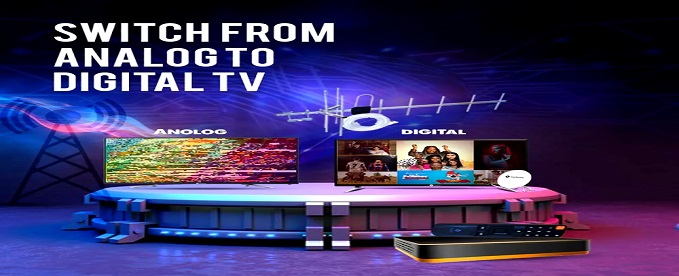
National Broadcasting Commission (NBC) has said that Nigerians will no longer pay annual Digital Access Fees under the renewed Digital Switch Over (DSO) project.

Charles Ebuebu, director-general, NBC, disclosed this in an exclusive interview with the News Agency of Nigeria (NAN) on Wednesday in Abuja,
Ebuebu said viewers only need to purchase an approved decoder and satellite dish which cost below N20,000 to enjoy free television permanently.
“Previously, users paid an annual digital access fee of about N1,500, described as an administrative charge.
“The new system removes that annual fee. It provides free access to free-to-air television channels without any payment.
“Premium channels will be introduced later. Viewers who want those additional channels will be able to access them through paid services.
“Nigerian content on free-to-air channels remains free to watch. Unlike Pay TV, this platform does not require monthly subscriptions for its basic service,” he said
Ebuebu said approved decoders for the FreeTV will cost less than N20,000 and authorised sales outlets will soon be announced.
He urged Nigerians to wait for official information on approved dealers for the DSO decoders, warning that unauthorised sellers are exploiting growing public demand.
He reiterated that people only need a free-to-air decoder, along with a satellite dish instead of the old antenna system to receive the DSO signal.
“Once the equipment is installed, viewers can access all available channels across the country without paying any subscription fees,” he stressed
The DG dismissed claims by some retailers that there are different categories of decoders sold at varying prices, stressing that such sellers are not authorised by the commission.
According to him, the NBC will soon publish the list of approved dealers, official prices, and locations where genuine decoder boxes and accessories can be purchased.
The NBC boss said the DSO project is designed not only to improve television broadcasting but also to stimulate economic growth by creating jobs, attracting investment, and opening up opportunities for businesses that support the broadcasting industry.
Ebuebu noted that content producers and broadcasters stand to benefit significantly from the nationwide reach of the DSO platform.
Unlike the previous system, where many stations had limited regional audiences, he said the new platform will make their channels available to viewers across Nigeria.
He added that the introduction of audience measurement technology will provide scientific and reliable data on television viewership.
Ebuebu added that audience measurement technology will give advertisers greater confidence in placing adverts and enable broadcasters to demonstrate the true size and reach of their audiences nationwide.
Uchenna Mbunabo, Nigerian filmmaker, has raised concerns over the alleged unauthorised broadcast of Nollywood films by some Ghanaian television stations, calling on Ghana’s National Film Authority (NFA) to strengthen the enforcement of copyright laws.

Uchenna Mbunabo, Nigerian filmmaker
Mbunabo made the remarks during a conversation with James Gardiner, deputy CEO of the National Film Authority (NFA) of Ghana.
He questioned whether it was permissible for television stations in Ghana to download Nigerian movies from YouTube and air them without obtaining permission from the producers.
“I noticed that Ghanaian TV stations, the way they are stealing our films and showing them for free with impunity. Is it legalised in your country for TV stations to go on YouTube, download people’s sweat and show it for free?”
According to Mbunabo, some Ghanaian television stations have been downloading newly released Nollywood films from YouTube and broadcasting them without authorisation, depriving producers of revenue generated through the platform.
He also stated that he had not witnessed Nigerian television stations engaging in similar practices and questioned what measures Ghana was taking to protect filmmakers’ intellectual property.
Responding to the concerns, Gardiner acknowledged that the issue exists and said the National Film Authority had begun engaging relevant stakeholders to address it.
He disclosed that the NFA has held discussions with the Ministry of Communications, the National Communications Authority (NCA) and the National Media Commission (NMC) on improving copyright enforcement.
Gardiner explained that while Ghana has copyright laws, enforcement remains challenging because many television stations now operate digitally and may not have physical offices within the country.
“There are copyright laws, but they are not effective because a lot of the TV stations don’t have offices. Most of them are now digital, so they operate from anywhere. They can even have a Ghanaian TV station but be operating from Austria simply because it is digital.”
He added that authorities are considering a new licensing framework that would require broadcasters to undergo a fresh licensing process to improve monitoring and enforcement.
According to Gardiner, television stations found guilty of illegally broadcasting copyrighted content would be required to compensate affected producers through fines.
He added that repeat offenders could face suspension of their broadcasting licences, while a third violation could result in the revocation of their licences.
Although he did not provide a specific timeline, Gardiner said the reforms were already underway and expressed hope that significant progress would be seen next year.
Mbunabo welcomed the proposed measures but urged the National Film Authority to expedite the process, stating that unauthorised broadcasts continue to affect filmmakers’ ability to recover production costs through legitimate distribution channels such as YouTube.
He also stressed that his comments were not directed at Ghana’s film industry, noting that he has worked with several Ghanaian actors over the years and supports collaborations between Nollywood and Ghallywood.

Dangote Refinery’s Private Placement Reportedly Hits $2.5Bn

FG, UNODC Plan National Strategy against Organized Crime

EFCC Busts NIS Visa Overstay Racket, Uncovers N700m in an Account

CBN to Monitor Every Dollar with FXBT, Forex Tracker

NCC, NDLEA Partner to Fight Piracy and Drug Trafficking

NRC, Ponzi Scheme Collapses Resulting Loss of Billions of Naira

NASENI Moves to Digitize CCB’s 5m Assets Declaration and Operations

Lebara Nigeria Launches Lebara Play, Africa’s First Telecom-Owned Micro-Drama Platform

CANAL+ Partners Samsung to Pre-Load DStv Stream on New Samsung TVs In Nigeria, Other African Countries

Tokenization, Blockchain Technology will Transform Financial Institutions – IMF



 News2 days ago
EFCC Busts NIS Visa Overstay Racket, Uncovers N700m in an Account
 News2 days ago
NCC, NDLEA Partner to Fight Piracy and Drug Trafficking

 News3 days ago
FAAN to Replace Physical ID Check with V-Pass Biometric Verification
 General News2 days ago
Dangote Refinery’s Private Placement Reportedly Hits $2.5Bn

 News3 days ago
CBN Introduces Digital Tracker to Monitor BDC Forex Transactions

 News3 days ago
CAC Begins Removing 100,000 Companies from Register Over Regulatory Non-Compliance

 Telecom3 days ago
Airtel Delivers Free Employability Training to Young Nigerians @ World Youth Skills Day

 Telecom3 days ago
ntel Plays Down Calls and Data Services, Moves to BET Agenda