

General News
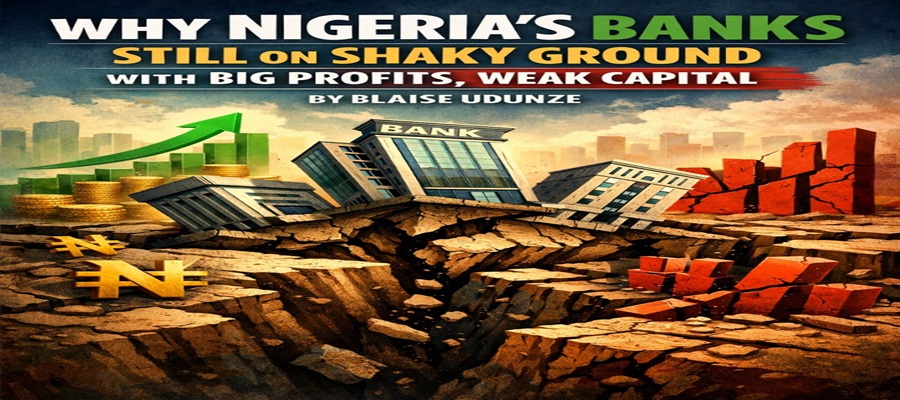
Why Nigeria’s Banks Still on Shaky Ground with Big Profits, Weak Capital

By Blaise Udunze
Despite the fragile 2024 economy grappling with inflation, currency volatility, and weak growth, Nigeria’s banking industry was widely portrayed as successful and strong amid triumphal headlines. The figures appeared to signal strength, resilience, and superior management as the Tier-1 banks such as Access Bank, Zenith Bank, GTBank, UBA, and First Bank of Nigeria, collectively reported profits approaching, and in some cases exceeding, N1 trillion. Surprisingly, a year later, these same banks touted as sound and solid are locked in a frenetic race to the capital markets, issuing rights offers and public placements back-to-back to meet the Central Bank of Nigeria’s N500 billion recapitalisation thresholds.

The contradiction is glaring. If Nigeria’s biggest banks are so profitable, why are they unable to internally fund their new capital requirements? Why have no fewer than 27 banks tapped the capital market in quick succession despite repeated assurances of balance-sheet robustness? And more fundamentally, what do these record profits actually say about the real health of the banking system?
The recapitalisation directive announced by the CBN in 2024 was ambitious by design. Banks with international licences were required to raise minimum capital to N500 billion by March 2026, while national and regional banks faced lower but still substantial thresholds ranging from N200 billion to N50 billion, respectively. Looking at the policy, it was sold as a modern reform meant to make banks stronger, more resilient in tough times, and better able to support major long-term economic development. In theory, strong banks should welcome such reforms. In practice, the scramble that followed has exposed uncomfortable truths about the structure of bank profitability in Nigeria.
At the heart of the inconsistency is a fundamental misunderstanding often encouraged by the banks themselves between profits and capital. Unknown to many, profitability, no matter how impressive, does not automatically translate into regulatory capital. Primarily, the CBN’s recapitalisation framework actually focuses on money paid in by shareholders when buying shares, fresh equity injected by investors over retained earnings or profits that exist mainly on paper.

This distinction matters because much of the profit surge recorded in 2024 and early 2025 was neither cash-generative nor sustainably repeatable. A significant portion of those headline banks’ profits reported actually came from foreign exchange revaluation gains following the sharp fall of the naira after exchange-rate unification. The industry witnessed that banks’ holding dollar-denominated assets their books showed bigger numbers as their balance sheets swell in naira terms, creating enormous paper profits without a corresponding improvement in underlying operational strength. These gains inflated income statements but did little to strengthen core capital, especially after the CBN barred banks from using FX revaluation gains for dividends or routine operations. In effect, banks looked richer without becoming stronger.
Beyond FX effects, Nigerian banks have increasingly relied on non-interest income fees, charges, and transaction levies to drive profitability. While this model is lucrative, it does not necessarily deepen financial intermediation or expand productive lending. High profits built on customer charges rather than loan growth offer limited support for long-term balance-sheet expansion. They also leave banks vulnerable when macroeconomic conditions shift, as is now happening.
Indeed, the recapitalisation exercise coincides with a turning point in the monetary cycle. The extraordinary conditions that supported bank earnings in 2024 and 2025 are beginning to unwind. Analysts now warn that Nigerian banks are approaching earnings reset, as net interest margins the backbone of traditional banking profitability, come under sustained pressure.
Renaissance Capital, in a January note, projects that major banks including Zenith, GTCO, Access Holdings, and UBA will struggle to deliver earnings growth in 2026 comparable to recent performance.
In a real sense, the CBN is expected to lower interest rates by 400 to 500 basis points because inflation is slowing down, and this means that banks will earn less on loans and government bonds, but they may not be able to quickly lower the interest they pay on deposits or other debts. The cash reserve requirements are still elevated, which does not earn interest; banks can’t easily increase or expand lending investments to make up for lower returns. The implications are significant. Net interest margin, the difference between what banks earn on loans and investments and what they pay on deposits, is poised to contract. Deposit competition is intensifying as lenders fight to shore up liquidity ahead of recapitalisation deadlines, pushing up funding costs. At the same time, yields on treasury bills and bonds, long a safe and lucrative haven for banks are expected to soften in a lower-rate environment. The result is a narrowing profit cushion just as banks are being asked to carry far larger equity bases.
Compounding this challenge is the fading of FX revaluation windfalls. With the naira relatively more stable in early 2026, the non-cash gains that once flattered bank earnings have largely evaporated. What remains is the less glamorous reality of core banking operations: credit risk management, cost efficiency, and genuine loan growth in a sluggish economy. In this new environment, maintaining headline profits will be far harder, even before accounting for the dilutive impact of recapitalisation.
That dilution is another underappreciated consequence of the capital rush. Massive share issuances mean that even if banks manage to sustain absolute profit levels, earnings per share and return on equity are likely to decline. Zenith, Access, UBA, and others are dramatically increasing their share counts. The same earnings pie is now being divided among many more shareholders, making individual returns leaner than during the pre-recapitalisation boom. For investors, the optics of strong profits may soon give way to the reality of weaker per-share performance.
Yet banks have pressed ahead, not only out of regulatory necessity but also strategic calculation.
During this period of recapitalization, investors are interested in the stock market with optimism, especially about bank shares, as banks are raising fresh capital, and this makes it easier to attract investments. This has become a season for the management teams to seize the moment to raise funds at relatively attractive valuations, strengthen ownership positions, and position themselves for post-recapitalisation dominance. In several cases, major shareholders and insiders have increased their stakes, as projected in the media, signalling confidence in long-term prospects even as near-term returns face pressure.
There is also a broader structural ambition at play. Well-capitalised banks can take on larger single obligor exposures, finance infrastructure projects, expand regionally, and compete more credibly with pan-African and global peers. From this perspective, recapitalisation is not merely about compliance but about reshaping the competitive hierarchy of Nigerian banking. What will be witnessed in the industry is that those who succeed will emerge larger, fewer, and more powerful. Those that fail will be forced into consolidation, retreat, or irrelevance.
For the wider economy, the outcome is ambiguous. Stronger banks with deeper capital buffers could improve systemic stability and enhance Nigeria’s ability to fund long-term development. The point is that while merging or consolidating banks may make them safer, it can also harm the market and the economy because it will reduce competition, let a few banks dominate, and encourage them to earn easy money from bonds and fees instead of funding real businesses. The truth be told, injecting more capital into the banks without complementary reforms in credit infrastructure, risk-sharing mechanisms, and fiscal discipline, isn’t enough as the aforementioned reforms are also needed.
The rush as exposed in this period, is that the moment Nigerian banks started raising new capital, the glaring reality behind their reported profits became clearer, that profits weren’t purely from good management, while the financial industry is not as sound and strong as its headline figures. The fact that trillion-naira profit banks must return repeatedly to shareholders for fresh capital is not a sign of excess strength, but of structural imbalance.
With the deadline for banks to raise new capital coming soon, by 31 March 2026, the focus has shifted from just raising N500 billion. N200 billion or N50 billion to think about the future shape and quality of Nigeria’s financial industry, or what it will actually look like afterward. Will recapitalisation mark a turning point toward deeper intermediation, lower dependence on speculative gains, and stronger support for economic growth? Or will it simply reset the numbers while leaving underlying incentives unchanged?
The answer will define the next chapter of Nigerian banking long after the capital market roadshows have ended and the profit headlines have faded.
Blaise, a journalist and PR professional, writes from Lagos and can be reached via: [email protected]



Federal government recently received a proposed protocol agreement from India that could pave the way for agricultural cooperation between the two countries.

Abishek Singh, India’s high commissioner to Nigeria, announced the proposal recently n Abuja during the India-Nigeria Business Forum on Agriculture and Allied Sectors.
New Delhi’s proposed cooperation would support Nigeria’s food security efforts, with the goal of reducing post-harvest losses by nearly 50% and expanding agricultural processing.
It would also cover technology transfers, mechanization, financing solutions and capacity building.
Abuja has opened similar discussions with China.
Only recently, Mukhtar Muhammed, permanent secretary at the Ministry of Innovation, Science and Technology, said Nigeria wanted to deepen scientific and technological cooperation with Beijing in agriculture.
The discussions with China have focused on developing low-cost, solar-powered cold storage facilities and transferring food-processing technologies.
Nigeria, also wants to work with Chinese research institutes to develop infrastructure that can improve the preservation of perishable products.
Nigeria’s outreach to its Asian partners addresses a major problem for the agricultural sector.
The Bank of Agriculture (BoA) estimates that Africa’s most populous country loses 30 million to 40 million tons of food each year before it reaches consumers.
Those losses are worth an average of about N3.5 trillion ($2.5 billion) annually, according to data the institution presented at a workshop in Kaduna in July 2026.
Perishable products are particularly vulnerable, according to local media reports, with fruits and vegetables accounting for an estimated 40% to 50% of total losses.
The government has already launched its own response to the problem.

Independent Corrupt Practices and Other Related Offences Commission (ICPC) indicted the National Information Technology Development Agency (NITDA) and other ministries over administrative lapses that allowed the fictitious Presidential Foreign Investment Promotion Council (PFIPC) to operate.

Musa Aliyu, chairman, ICPC, stated that NITDA, alongside the Office of the Secretary to the Government of the Federation (OSGF), the Budget Office, and other bodies, failed to carry out adequate due diligence and standard operating procedures.
ICPC said however, clarified that the findings pointed to severe internal control weaknesses and administrative negligence rather than active official complicity by NITDA and the other affected agencies.
The briefing followed a 30-day investigation ordered by the president on July 7 into allegations surrounding the purported presidential council.
The commission also cleared the presidency and the Central Bank of Nigeria (CBN) of any wrongdoing but blamed institutional lapses in several ministries, departments and agencies (MDAs).
Aliyu said investigators established that Adeniyi Adeyemi, the director-general, was never appointed by the federal government and that the PFIPC had no legal existence.
“As you may recall, on the 7th of July, Mr. President directed the ICPC to conduct an investigation into the fake Presidential Foreign Investment Promotion Council and submit a report within 30 days,” he said.
“Today, exactly within the stipulated period, we have submitted an interim report based on our interactions with all stakeholders involved.”
According to Aliyu, Tinubu directed the commission to make its findings public in the interest of transparency and accountability.
He said the investigation found that Adeyemi’s purported appointment letter was forged.
“It has been established that Adeniyi Adeyemi Matthew was never appointed by the Federal Government or any authority whatsoever,” he said.
“The Presidential Foreign Investment Promotion Council, which sometimes they called the Presidential Foreign Intervention Promotion Council, was never established by any law, executive order or any valid instrument of government.
“The appointment letter presented by Adeniyi Adeyemi Matthew was completely forged alongside similar documents used to perpetuate the illegal activities of the fake agency.”
Aliyu stated that a purported government gazette used to legitimise the organisation was also fabricated.
“If you recall, there was a gazette which he used to support the fake agency. That gazette is an illegal document that never passed through the processes prescribed by law,” he stated.
“Our investigation found that the office used by the fake agency was the office of the Presidential Economic Advisory Council. The office was broken into and access was gained illegally. That was how he was able to operate from there.”
Aliyu also revealed that investigators uncovered two additional fictitious government agencies allegedly created by the suspect — the FCT Investment Promotion Agency (FIPA) and the Foreign Investment Promotion Agency/Public-Private Partnership (FIPA-PPP).
According to him, fake legislative instruments were used to create the agencies and open bank accounts.
Despite the elaborate scheme, the ICPC chairman said the investigation found no evidence that federal government funds were disbursed to the fake council.
“Our investigation found that no funds of the federal government were approved or disbursed to the fake PFIPC,” he said.
“We also discovered no weaknesses in the systems of the State House or the Central Bank of Nigeria during our investigation. The fake appointment letter did not originate from the presidency.
“Our investigation found that some public officers failed to carry out due diligence and failed to comply with standard operating procedures in their ministries and departments. That gave him the opportunity to carry out these illegal acts.”

Nigeria tax system is build on taxing prosperity not poverty, according to Dr. Zacch Adedeji, executive chairman, Nigeria Revenue Service (NRS).

Dr. Zacch Adedeji, executive chairman, Nigeria Revenue Service
Adedeji, also dismissed the insinuation that the government’s tax reform is aimed at extracting money from Nigerians .
He said the essence of reform is creating an economic environment where individuals and businesses can prosper.
Dr. Adedeji made the clarifications on Sunday night while appearing on Channels Television’s Politics Today, where he defended the administration’s tax reforms and addressed concerns over rising government revenue amid the economic hardship facing Nigerians.
According to him, the government’s objective is to tax the fruits of investment rather than the investment itself.
“For us at Nigeria Tax, we are not there to extract. Our focus is not revenue. I don’t want to tax poverty. I’m to tax the fruit, not the seed, and I’m to tax the return, not investment.”
Adedeji explained that the government would generate more revenue as businesses became more profitable, without necessarily increasing the tax burden on individuals and companies.
He said a company that made N100 in profit could generate N30 in tax revenue for the government, but if its profit increased to N200 or N300, government revenue would rise accordingly.
“So, if I want to make more, I must work for you to make more. And that is why it is in the best interest of us in Nigeria Revenue Service that businesses are doing well, individuals are doing well,” he said.
He said the approach was consistent with President Bola Tinubu’s economic agenda, which seeks to remove barriers to investment and create a more conducive environment for businesses to operate and expand.
Adedeji cited reforms in the electricity sector as part of the government’s efforts to stimulate economic activity.
He noted that the Electricity Act had devolved powers to state governments to generate, transmit and distribute electricity, arguing that improved power supply would boost production and productivity across the economy.

Affordable, Flexible Streaming Platforms May Kill PAYtv – Report

FG Suspends NAICOM’s N680m Insurance Recapitalisation Fees

FG Taps Indian, Chinese Technologies to Tackle $2.5Bn in Food Losses

MTN Nigeria Clocks 25, Connects over 90m People

Subscribers to Seek Legal Redress if Poor Quality of Service Continue in September

EFCC Busts NIS Visa Overstay Racket, Uncovers N700m in an Account

Fact-Check: Elon Musk’s “Tesla Pi Phone” is Internet Rumor

NBC Tasks Broadcasting Stations over 2028 DSO Global Deadline

NBC Scraps Annual Digital Access Fee on DSO

Glo Sponsored African Voices to Feature Netflix’s “The Polygamist” Stars




 E-Business2 days ago
X Replaces Revenue Sharing wit New Creator Rewards Programme

 Telecom2 days ago
MTN Alerts Subscribers over Fake 25GB Anniversary MTN Data Giveaway

 E-Financial2 days ago
Interswitch, Temenos Commit to Advancing Nigeria’s Digital Banking Technology

 General News2 days ago
Fake Agency: ICPC Indicts NITDA, Others over Inadequate Due Diligence

 E-Financial2 days ago
FG Spent N3.1 Trillion on Domestic Debt Servicing in Q1- DMO

 General News2 days ago
UNESCO Taps Oguamanam,Nigerian Scholar to Advisory Body on Science, Tech Ethics

 General News2 days ago
Tax Reform Built on Taxing Prosperity, Not Poverty– Adedeji

 Broadcasting2 days ago
Awba-Ofemili Unveils 2026 Health Campaign, Offers Free Medical Screening